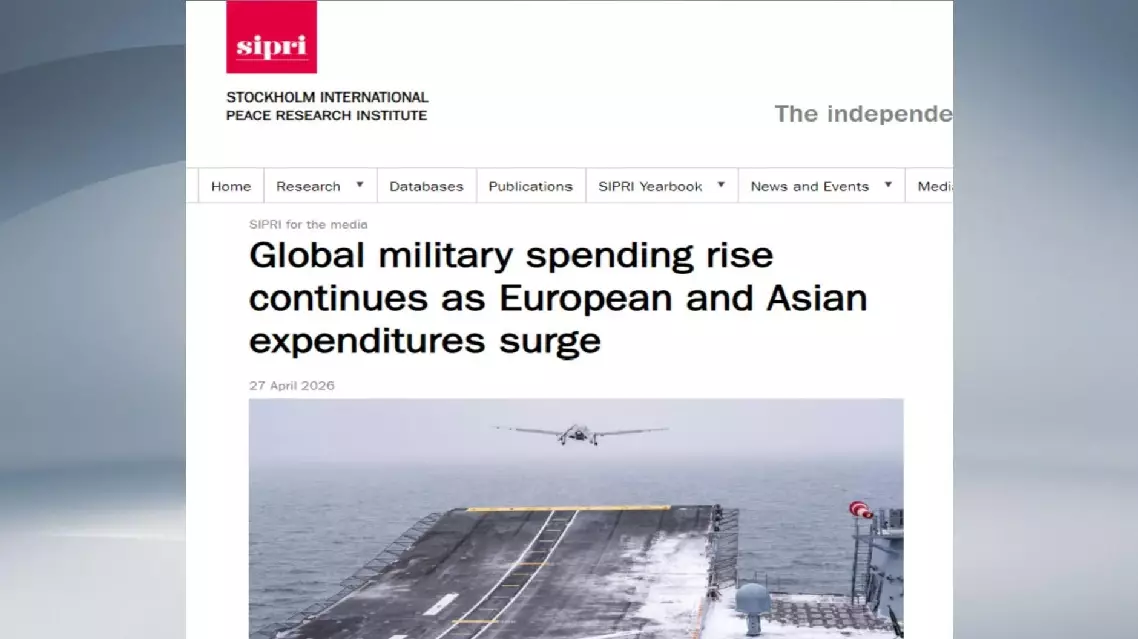
Global military expenditure rose to a record 2.89 trillion U.S. dollars in 2025, marking the 11th consecutive year of growth, according to a report released by the Stockholm International Peace Research Institute (SIPRI) on Monday.
The global military burden, or military expenditure as a share of gross domestic product (GDP), rose to 2.5 percent in 2025, the highest level since 2009, SIPRI said.
Military spending increased by 2.9 percent in real terms from 2024, a sharp slowdown, however, from the 9.7 percent rise recorded the previous year.
Global military spending rose again in 2025 as states responded to another year of wars, uncertainty and geopolitical upheaval with large-scale armament drives, said a researcher with SIPRI's Military Expenditure and Arms Production Programme.
The United States remained the world's largest military spender, though its expenditure fell by 7.5 percent to 954 billion dollars in 2025. SIPRI said the decline was mainly because no new financial military assistance for Ukraine was approved during the year, in contrast to the previous three years.
SIPRI said the decline in U.S. military spending was likely to be short-lived. The director of SIPRI's Military Expenditure and Arms Production Programme said spending approved by the U.S. Congress for 2026 had risen to more than one trillion dollars and could climb further to 1.5 trillion dollars in 2027 if U.S. President Donald Trump's latest budget proposal is accepted.
Europe was the main contributor to the global increase in 2025. Military spending in the region rose by 14 percent to 864 billion dollars.
The 29 European members of the North Atlantic Treaty Organization (NATO) spent a combined 559 billion dollars in 2025. Of them, 22 had military spending of at least two percent of GDP, according to SIPRI's methodology.
Military spending by European NATO members rose faster in 2025 than at any time since 1953, reflecting European efforts to strengthen self-reliance and growing U.S. pressure for greater burden-sharing within the alliance, SIPRI said.
In the Middle East, military expenditure reached an estimated 218 billion dollars in 2025, almost unchanged from 2024. SIPRI said regional spending remained stable despite ongoing conflicts and rivalries.
In Asia and Oceania, Japan's military expenditure rose by 9.7 percent to 62.2 billion dollars, equivalent to 1.4 percent of GDP, its highest share since 1958.
SIPRI said military expenditure covers government spending on current military forces and activities, including personnel, operations, arms and equipment purchases, military construction, research and development, and central administration.
Global military spending hits record high in 2025: report
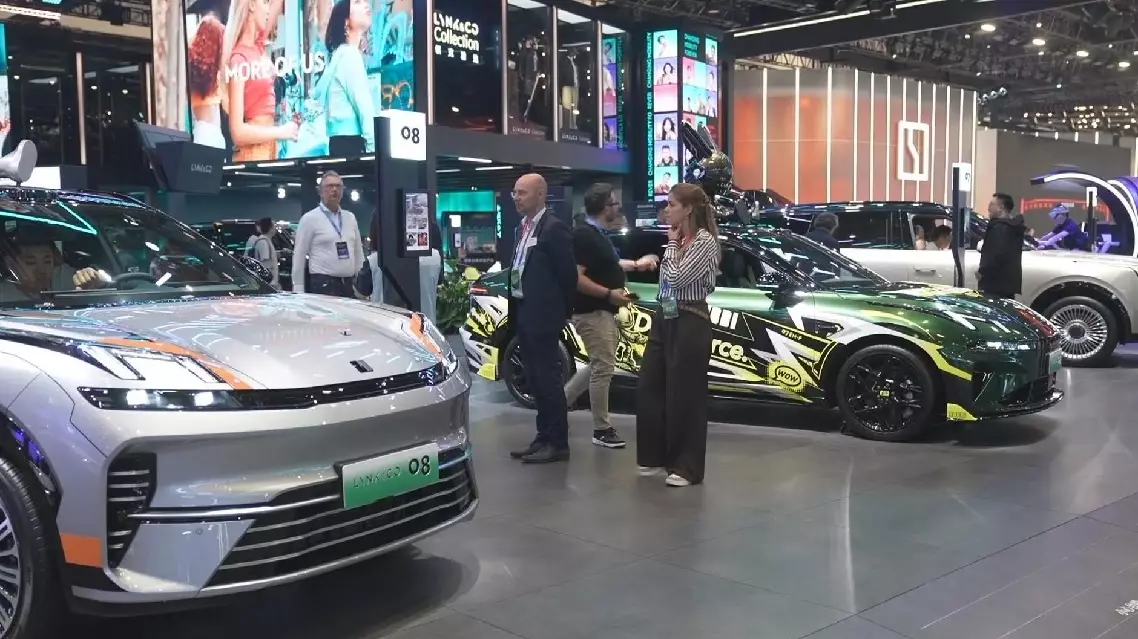
Global automakers are coming together at Auto China 2026, also known as the Beijing International Automotive Exhibition, not only to showcase new products, but also to help shape the industry's future.
With the theme of "Future of Intelligence," Auto China 2026 showcases intelligent vehicles, including electric models granted road approval for "hands-off, eyes-off" Level 3 driving.
This year's show features a record-breaking total exhibition area of 380,000 square meters, making it the world's largest auto show by exhibition area.
A total of 1,451 vehicles, including 181 debut models and 71 concept cars, are being showcased at the ongoing event.
Car enthusiasts from around the world are converging at the show, sharing their impressions of the show and China's auto market.
"I'm a big fan of cars and this is the biggest motor show in the world. So I have to be here," said a visitor named Jan.
"I come from a country, Argentina, where Chinese cars have gone from being two to three percent of the market to being over 10 percent of the market in the span of two years. So it's very important to know what's going on," said Lucas Abriata, who works as a journalist.
"I'm used to combustion cars. I love the smell. I love the sound. I love the feeling. But electric cars are very cool too," said Ludmila Duarte, a Brazilian content creator.
Beyond enthusiastic fans and media, industry professionals are equally invigorated by the show.
Uliana, a localization specialist at Great Wall Motor (GWM), a Chinese automaker, expressed amazement at the technologies and innovations on display.
"I'm overwhelmed with how many technologies there are, and how many new concepts and innovative fields that are presented here," she said.
Francois Marion, Chief Communications and Sustainability Officer of Valeo, a major French automotive parts supplier, highlighted the importance of the Chinese market and the company's strong commitment to it.
"We believe the China market is a very good opportunity for us. We see growth coming back in the second semester for us in China and we have the opportunity to sell so many great technologies in China with our Chinese customers - 63 percent of our orders last year were with Chinese OEMs (original equipment manufacturers). We are here because we are super committed to China as a market," said Marion.
Kevin Clark, Chair and CEO of American automotive technology supplier Aptiv, explained the necessity of continuous localization to stay relevant in the automotive market.
"We've always been here for the China market. Obviously, this is the largest market. It's the fastest growing from a technology standpoint. To be relevant, you need to continue to increasingly localize our engineering capabilities, our supply chains. And that's just something that we keep doing to be resilient and to be relevant in the market," said Clark.
As global players deepen their presence in China, Chinese innovation is simultaneously expanding onto the world stage.
Shifting from technology adopters to solution providers, Chinese smart driving companies are emerging as a new force within the industry.
Chinese self-driving technology company QCraft, shaped by China's complex and demanding road conditions, is now extending its reach into markets such as Europe and the Middle East.
Yu Qian, Co-founder and CEO of QCraft, shared his perspective on connecting China's innovation with the world.
"It's truly encouraging to see that so many new technologies and products are first deployed right here in the Chinese market. We've certainly benefited from this, growing and thriving as a result. At the same time, we're eager to build stronger bridges between China and the rest of the world," said Yu.
The 10-day event is scheduled to run until May 3.
Global automakers drive collaboration at Auto China 2026