
Skip to Content Facebook Feature Image

Intel and FPT Collaborate to Advance AI-Driven Autonomous Factories with Digital Manufacturing Platforms

Business

Intel and FPT Collaborate to Advance AI-Driven Autonomous Factories with Digital Manufacturing Platforms
Business

Business

Intel and FPT Collaborate to Advance AI-Driven Autonomous Factories with Digital Manufacturing Platforms

2026-04-28 10:00 Last Updated At:10:11

RICHARDSON, Texas--(BUSINESS WIRE)--Apr 27, 2026--

FPT and Intel, a global leader in semiconductor and AI technologies, announced a strategic relationship to deliver an end-to-end AI-driven factory optimization solution. Powered by AI, simulation, and digital manufacturing technologies, the collaboration aims to reduce bottlenecks, accelerate decision-making and improve downtime recovery, facilitating the sector’s transition towards AI-driven, autonomous operations.

This press release features multimedia. View the full release here: https://www.businesswire.com/news/home/20260427301486/en/

As manufacturers increasingly face complex, data-intensive operations, many still struggle to predict disruptions, optimize production flows, and fully leverage real-time data. This relationship addresses these challenges by enabling closed-loop factory intelligence—where simulation, real-time data, and AI continuously optimize performance.

The collaboration brings together Intel’s high-speed simulation and digital twin technology with FPT’s data platforms and system integration expertise. Intel® Automated Factory Solutions (AFS)—including Intel® Factory Pathfinder and Intel® Factory Recon—allow manufacturers to gain a dynamic, end-to-end view of factory operations. FPT complements these capabilities with its digital manufacturing platforms, FleziOps (MOM+), FleziQMS (Quality Management Suite), and FleziUDP (Unified Data Platform), which integrate data across MES, ERP, and shop-floor systems to create a unified operational data layer. This foundation enables seamless deployment of Intel’s AI-driven optimization tools within live production environments.

Together, the solution allows manufacturers to:

Paul Schneider, Principal Engineer and Director at Intel Corporation, said: “Manufacturing is one of the most complex environments in the world, and optimizing it requires more than isolated tools; it requires a connected, intelligent system. By collaborating with FPT, we’re able to extend the reach of Intel’s factory optimization technologies and help manufacturers operationalize AI-driven insights at scale.”

“Manufacturing has reached a turning point where AI is not just augmenting operations but actively orchestrating them. At FPT, we see a growing demand for smarter, more adaptive manufacturing systems that can respond to real-time conditions,” added Hoan Nguyen, FPT Software SEVP and FPT Americas CEO, FPT Corporation. “By combining Intel’s expertise with our AI-first solutions and global delivery capability, we are helping manufacturers achieve new levels of operational agility and efficiency.”

FPT has deployed digital transformation projects to more than 150 companies in manufacturing to convert production lines into smart factories with enhanced supply chain resilience. This expertise is backed by end-to-end AI-enabled solutions delivered by an AI-augmented workforce of over 25,000 globally certified engineers. Through its global delivery model across more than 30 countries and territories, FPT enables companies to scale these outcomes across their operations worldwide, thereby enhancing time to value and cost efficiency.

About FPT

FPT Corporation (FPT) is a globally leading Vietnam-headquartered technology and IT services provider, with operations spanning more than 30 countries and territories. Over more than three decades, FPT has consistently delivered impactful solutions to millions of individuals and tens of thousands of organizations worldwide. As an AI-first company, FPT is committed to elevating Vietnam’s position on the global tech map and delivering world-class AI-enabled solutions for global enterprises. FPT focuses on three critical transformations: Digital Transformation, Intelligence Transformation, and Green Transformation. In 2025, FPT reported a total revenue of USD 2.66 billion and a workforce of over 54,000 employees across its core businesses. For more information about FPT's global IT services, please visit https://fptsoftware.com.

Intel and FPT collaborate to advance AI-driven autonomous factories with digital manufacturing platforms

Intel and FPT collaborate to advance AI-driven autonomous factories with digital manufacturing platforms

JAKARTA, Indonesia (AP) — A Sumatran orangutan has been filmed for the first time using a human-made canopy bridge to cross a public road on the Indonesian island of Sumatra, conservationists said Monday.

Rapid development has been shrinking the jungle habitat of the critically endangered species, and fatal conflicts with people have been increasing.

The fleeting scene, captured by a motion‑sensitive camera, showed a young Sumatran orangutan pause at the forest’s edge, grip a rope with deliberate care and step out into open air. Halfway across, it stopped, casting a glance down at the road below. Moments later, it crossed.

Conservationists said that it marks the first documented case of an Sumatra orangutan using an artificial canopy bridge to cross a public road that had divided its habitat.

“This was the moment we had been waiting for,” Erwin Alamsyah Siregar, executive director of Indonesian conservation group Tangguh Hutan Khatulistiwa, or TaHuKah, told The Associated Press. “We are very grateful that the canopy here provides benefits for orangutan conservation efforts.”

He said that the bridge spans the Lagan–Pagindar road in Pakpak Bharat district, a vital corridor connecting remote villages to schools, healthcare and government services. But the road also cuts directly through prime orangutan habitat, splitting an estimated 350 orangutans into two isolated forest areas: the Siranggas Wildlife Reserve and the Sikulaping Protection Forest.

When the road was upgraded in 2024, the gap in the forest canopy widened, eliminating natural crossings for tree‑dwelling wildlife.

“Development was necessary for people,” Siregar said. “But without intervention, it would have left orangutans trapped on either side.”

TaHuKah, working with the Sumatran Orangutan Society, or SOS, and local and national government agencies, proposed a simple solution: rope bridges suspended between trees, allowing arboreal animals to cross above traffic.

Five canopy bridges were installed each with a camera trap, carefully positioned after surveys of orangutan nests, forest cover and animal movement. The structures were designed to support the orangutan’s weight — no small feat for the world’s largest tree‑dwelling mammal.

The program is closely monitored, with camera traps on every bridge and regular patrols to prevent forest encroachment. Conservationists hope more orangutans will follow the first pioneer.

They waited two years for the first orangutan to cross the bridge. Before the accomplishment, only smaller animals used it. Camera traps recorded squirrels, langur monkeys and macaques, followed by gibbons — a promising sign.

The orangutan’s approach was slower, building nests near the bridge, lingering at its edges and testing the ropes over time.

“They observe,” Siregar said. “They don’t rush. They watch, they try, they retreat. Only when they’re certain it’s safe do they move.”

Then, one day, he crossed fully — a first not just for Sumatra, but for the species globally on a public road, conservations say.

Similar bridges have been used by orangutans elsewhere, but usually over rivers or on private industrial forest road. Conservationists say public roads — noisy, busy and unpredictable — pose a far greater challenge.

For orangutans, the stakes are high. Isolation leads to inbreeding, genetic weakening and eventual population collapse. Restoring connectivity gives them a chance to survive.

Once widespread across southern Asia, the animal now only survives on the islands of Sumatra and Borneo. Fewer than 14,000 Sumatran orangutans remain in the wild, alongside just 800 Tapanuli orangutans and about 104,700 Bornean orangutans, according to conservation groups

“These bridges allow orangutans to move, to mix, to maintain healthy populations,” Siregar said. “It reduces the risk of extinction.”

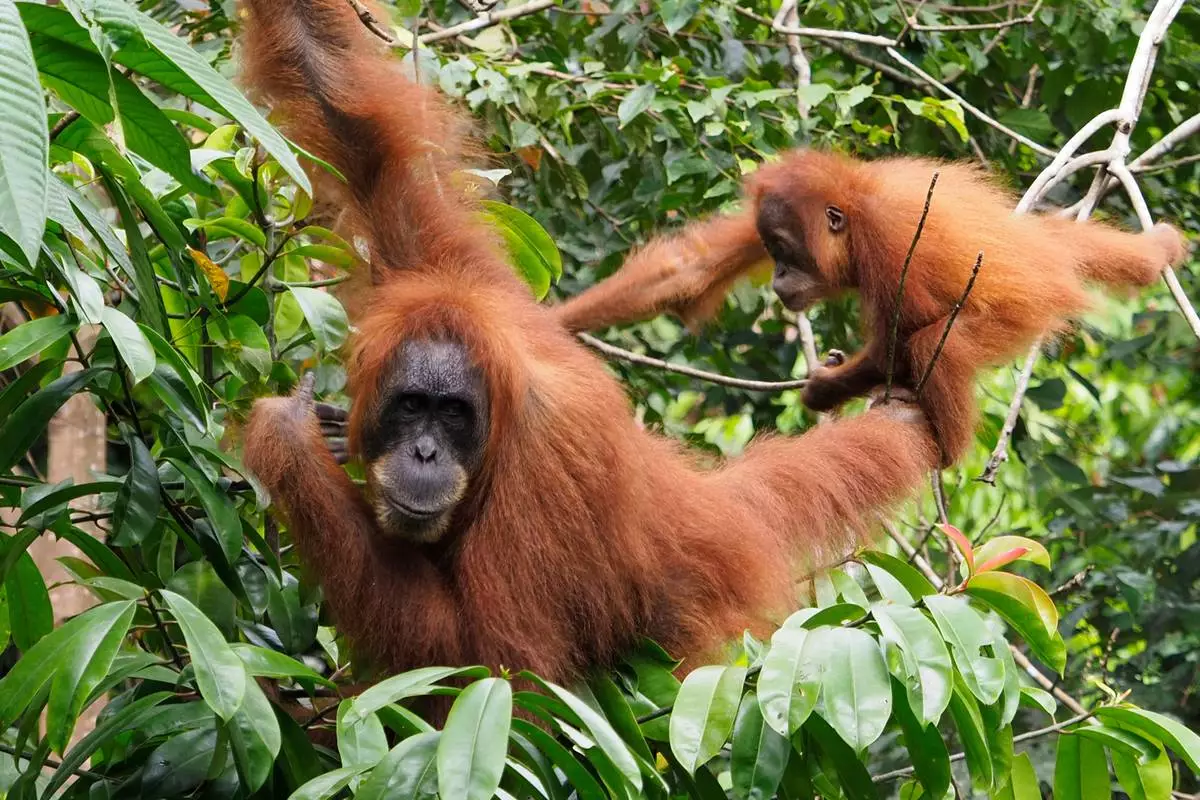
Orangutans in North Sumatra's Gunung Leuser National Park near Bukit Lawang, Indonesia, Feb. 20, 2023. (AP Photo/David Rising)

Orangutans in North Sumatra's Gunung Leuser National Park near Bukit Lawang, Indonesia, Feb. 20, 2023. (AP Photo/David Rising)

Recommended Articles