The United Arab Emirates announced Tuesday that it will leave OPEC effective May 1, stripping the oil cartel of one of its largest producers. While the announcement doesn’t change anything regarding the blockage of the Strait of Hormuz, it could help lower oil prices after the war if the UAE increases its production capacity. On Tuesday, Brent crude oil traded above $111 a barrel, over 50% higher than its prewar price.
Iran offered to end its chokehold on the Strait of Hormuz if the U.S. lifts its blockade on the country and ends the war in a proposal that would postpone discussions on the Islamic Republic’s nuclear program, two regional officials said Monday. U.S. President Donald Trump seems unlikely to accept the offer, and U.S. Secretary of State Marco Rubio appeared to rule out any deal that excludes Iran’s nuclear program.
Dozens of nations repeated calls to open the critical waterway in a joint statement led by Bahrain. German Chancellor Friedrich Merz criticized the U.S. for going into the war with what he said was no strategy.
Here is the latest:
Shifa Hospital said the Israeli airstrike hit a car in Gaza City on Tuesday, killing four men, about 6 kilometers (3.7 miles) from the so-called Yellow Line separating Israeli-controlled areas from the rest of Gaza. The Israeli military said it struck “a terrorist” but provided no further details.
Although a fragile ceasefire between Israel and Hamas in October eased large-scale fighting after two years of war, Israeli forces still carry out near-daily strikes and fire around military-held zones of the tiny Palestinian territory. Since the ceasefire, Israel has killed at least 818 people in Gaza, including 226 children and 179 women, according to health officials there.
U.N. Assistant Secretary-General Khaled Khiari said Gaza is facing “ongoing and deadly Israeli strikes and dire humanitarian conditions,” with 1.8 million people — nearly its entire population — living in camps and dependent on aid.
He told a U.N. Security Council ministerial meeting Tuesday that in the West Bank, “violence, including rampant settler attacks, displacement and accelerating settlement activity, is threatening entire communities and further eroding prospects for a political process” toward a two-state solution.
In Gaza, he said, “the ceasefire is increasingly fragile as Israeli strikes and armed activity by Hamas and other groups continue.”
Khiari, whose portfolio includes the Middle East, warned that while diplomatic efforts are underway to consolidate the ceasefire and implement Phase II of the peace plan, “talks on the disarmament of Hamas and other armed groups have thus far not resulted in an agreement, raising concerns over the potential return to widespread hostilities.”
The president of the International Committee of the Red Cross has arrived in Iran to meet with officials and local affiliates and assess the war’s humanitarian consequences.
Mirjana Spoljaric will also discuss efforts of the Geneva-based humanitarian organization to ship more relief supplies to Iran, notably through the Iranian Red Crescent Society.
The ICRC says it delivered more than 170 tons of essential relief items to help people affected by the conflict this month, with more medical items and forensic supplies on their way.
Her visit is part of a trip through the region that involves bilateral discussions to help ensure respect for the rules of war, the organization said.
The Conference Board said Tuesday that its consumer confidence index inched up to 92.8 from 92.2 in March, despite growing anxiety over soaring energy prices brought on by the war in Iran. It remains mired near its lowest level since the COVID-19 pandemic.
It’s the first read on inflation to capture the effects of the Iran war. The surge in gas prices to an average $4.18 a gallon this week, up more than a dollar since before the war, will stretch budgets and erode incomes, making it harder for lower- and middle-income American households to afford food and rent.
“Consumers are singing the blues,” said Heather Long, chief economist at Navy Federal Credit Union. “They aren’t happy with high prices for gas, housing, electricity and many other items. It’s clear consumers aren’t going to feel much better until there’s an end to the Middle East conflict.”
▶ Read more
The announcement doesn‘t change anything regarding the blockage of the Strait of Hormuz, but could help speed the oil market’s return to lower prices after the war, said Michael Brown, senior research strategist at Pepperstone foreign exchange brokerage.
Once the war ends, the UAE could reach its pre-conflict goal of increasing production to 5 million barrels per day, “in turn helping crude benchmarks to normalize in shorter order once the ongoing Middle East conflict comes to an end,” he said.
The UAE’s move appears to be part of an effort to assert themselves as leaders and independent actors in the region, and sell oil and gas when and how they see fit, said Karen Young, senior research scholar at Columbia University’s Center on Global Energy Policy.
“This exit of OPEC fits into the UAE need for flexibility with key energy consumers as well — including a future relationship with China and a more competitive relationship with Saudi Arabia,” she said.
The exit won’t immediately change export capacity, since the UAE’s lone pipeline around the Strait of Hormuz to the port at Fujairah on the Gulf of Oman is already running at full capacity, she noted.
The move also indicates UAE’s frustration with regional organizations, such as the Gulf Cooperation Council, she said: “It signals regional cooperation and coordination is weak, the GCC as a unit is dead, this war has demonstrated failure of mutual defense.”
U.N. Secretary-General António Guterres spoke with Pakistan’s Foreign Minister Ishaq Dar on Tuesday and conveyed the international community’s “deep appreciation” for Pakistan’s constructive role in promoting regional and global peace and stability, according to Pakistan’s Foreign Ministry.
In a statement, the ministry said Guterres also expressed the United Nations’ full support for Pakistan’s ongoing peace efforts.
Dar briefed the U.N. chief on the latest regional developments and Pakistan’s diplomatic engagement with relevant parties, the statement said.
The ministry added on Tuesday that 7,863 have been wounded since the war broke out on March 2.
The war has displaced more than 1 million people and caused destruction worth billions of dollars.
Leon said the approaching peak in global oil demand has shifted the incentive for producers from collective restraint to earning money from their reserves now.
He said the UAE, with its 4.8 million barrels per day of production capacity and potential to increase output, is “particularly well positioned to pursue such a strategy outside the group.”
The UAE’s withdrawal removes one of OPEC’s few members with ability to quickly increase production — the mechanism through which the cartel manages oil prices, said Jorge Leon, head of geopolitical analysis at Rystad Energy.
“A structurally weaker OPEC, with less spare capacity concentrated within the group, will find it increasingly difficult to calibrate supply and stabilize prices,” Leon said. “The net effect points to a more fragmented supply landscape and a potentially more volatile oil market over time as OPEC’s capacity to smooth imbalances diminishes.”
“They want us to “Open the Hormuz Strait,” as soon as possible, as they try to figure out their leadership situation,” Trump posted on social media.
He added that he believes they will be able to sort out reported divisions within the Islamic Republic government about negotiations with the U.S.
The White House did not immediately respond to questions about who on the Iranian side delivered the message, who in the Republican administration received it and whether the communications were conducted directly with the U.S. or through an intermediary.
Israel’s Foreign Minister Gideon Saar said on Tuesday that Israel’s tax authority has opened an investigation into a ship expected to dock in the Haifa port that Ukraine said carries stolen grain.
Earlier, Ukrainian President Volodymyr Zelenskyy wrote on X that Ukraine is preparing sanctions against companies that profit from grain harvested from areas of Ukraine under Russian control. Saar dismissed Zelenskyy’s comments as “Twitter diplomacy” and said Ukraine had not provided information about the cargo’s contents or a request for legal assistance.
“The vessel has not entered the port and has yet to submit its documents. It is not possible to verify the truth of the Ukrainian claims regarding the forgery of the bill of lading,” Saar said.
▶ Read more
Gideon Saar said the Israeli military-occupied “buffer zone” that stretches 10 kilometers (6 miles) into Lebanon is necessary to protect residents in Israel’s north.
“Hezbollah has transformed the entire front line of southern Lebanon into a network of terrorist infrastructure, and this threat has not been properly addressed by the Lebanese government,” he said during a press conference with Serbian Foreign Minister Marko Đurić in Jerusalem.
Saar refused to comment on the fragile ceasefire with Hezbollah, which both sides have violated multiple times since Trump announced it last week, and whether Israel might expand its military operations beyond southern Lebanon. He did note Israel’s first direct negotiations with Lebanon in decades.
“Our direct negotiations with Lebanon are important, it could be an opening to a different, better future,” he said. “But the Lebanese government must take practical steps to restore its sovereignty against de facto Iranian control in its territory.”
Meanwhile, Ukraine’s domestically developed long-range attack drones struck a Russian oil refinery and terminal on the Black Sea for the third time in less than two weeks. Ukraine has developed cutting-edge and battle-tested drone technology that has proved essential in holding back Russia’s bigger army.
The interceptor drones as part of a comprehensive air defense system are now being sought by Middle East and Gulf countries amid the Iran war, according to Ukrainian officials.
▶ Read more
The United Arab Emirates announced Tuesday that it will leave OPEC and the oil cartel’s wider OPEC+ group effective May 1, a move rumored for some time as the Emirates chafed under production restrictions and had increasingly frosty relations with neighboring Saudi Arabia.
The UAE had been a member of OPEC since before it became a country in 1971, but its foreign policy has become less aligned with Riyadh as Saudi Arabia began to directly challenge the Emirates in trying to draw foreign investments under assertive Crown Prince Mohammed bin Salman.
“This decision reflects the UAE’s long-term strategic and economic vision and evolving energy profile, including accelerated investment in domestic energy production, and reinforces its commitment to a responsible, reliable, and forward-looking role in global energy markets,” the UAE said through its state-run WAM news agency.
▶ Read more
U.S. and Israeli airstrikes crippled thousands of factories in Iran, and the economic damage is reverberating — millions more Iranians could lose their jobs. Most damaging, Israeli strikes knocked out most steel and petrochemical production, causing a surge in prices for metals and plastic. Things could get worse as the U.S. blockades Iranian ports. Economic woes sparked the mass protests that were crushed before the war, and could again push Iranians into the streets. But Iran’s leaders are betting that economic self-reliance built under decades of sanctions can help them endure the pain longer than Trump. ▶ Read more
United Nations General Assembly President Annalena Baerbock said urgent efforts to secure a ceasefire in the Iran war are critical.
During a visit Tuesday to New Delhi, Baerbock warned the conflict is disrupting global supplies and deepening regional crises, with attacks and blockades in the Strait of Hormuz increasing oil and fertilizer prices worldwide.
“Every effort to come to a ceasefire is highly needed,” Baerbock said, adding that the escalation is diverting attention from humanitarian crises in Gaza. “It overshadows the devastating situation for the people in Gaza. The humanitarian situation in Gaza is still heartbreaking.”
International aid group Doctors Without Borders accused Israel of “systemically depriving” people in Gaza of water in what it calls a “campaign of collective punishment” against Palestinians.
Known by its French acronym MSF, the group said in a report Tuesday that Israel has destroyed or damaged about 90% of Gaza’s water and sanitation infrastructure including desalination plants, boreholes, pipelines and sewage systems.
MSF said it also documented the Israeli military shooting at clearly identified water trucks and destroying boreholes that were a lifeline for tens of thousands of people.
The practices have far-reaching consequences for the health, hygiene and dignity of Gaza’s 2.1 million people, MSF said.
“Israeli authorities know that without water life ends, yet they have deliberately and systematically obliterated water infrastructure in Gaza – while consistently blocking water-related supplies from entering,” MSF emergency manager Claire San Filippo said.
COGAT, Israel’s military body that coordinates aid to Gaza, rejected the accusations and said the water supply in the Gaza Strip “consistently exceeds humanitarian thresholds.”
Lebanon’s state-run National News Agency said Israeli airstrikes hit the villages of Chakra, Tebnine and Kafra in southern Lebanon on Tuesday.
A drone strike also hit a motorcycle in the village of Mansouri, the agency reported.
There was no immediate information about possible casualties.
The strike came as Israel’s military asked residents of 16 southern villages to evacuate, saying Hezbollah is using the communities to launch attacks on Israeli troops in southern Lebanon.
Bahrain sentenced five people to life in prison and the remaining 25 defendants to 10-year terms over accusations of spying for Iran and supporting Iranian attacks on the tiny island kingdom.
Human rights activists have long criticized Bahrain’s rights records including convicting people in closed-door trials without allowing defendants to properly defend themselves.
Bahrain’s public prosecution said Tuesday that five people, including two Afghans, received life sentences after being convicted of spying for Iran’s Revolutionary Guard.
The prosecution said 25 others were separately sentenced to 10 years each for supporting Iran’s “terrorist acts” in Bahrain.
A 9-year-old boy was killed Tuesday by Israeli fire in southern Gaza, Nasser Hospital said.
The hospital said Adel al-Najjar was collecting firewood in a roundabout in Khan Younis city when Israeli forces shot him about 400 meters (1,312 feet) west of the Yellow Line separating Israeli-controlled areas from the rest of Gaza.
The Israeli military did not immediately comment.
An Associated Press video shows two of the boy’s siblings crying over him on a stretcher at the hospital’s morgue. One knelt on his body and kissed his cheeks.
“What is the guilt of those children,” a woman said during the boy’s funeral. “God is plaguing you, Israel.”
The boy’s younger brother was killed a month ago, also while collecting firewood in Khan Younis, according to hospital records.
Since a ceasefire agreement went into effect in October, Israeli airstrikes and troops firing on Palestinians near military-held zones have killed at least 818 Palestinians, including at least 226 children and 179 women, according to Gaza health officials.
Pakistan Prime Minister Shehbaz Sharif on Tuesday briefed New Zealand Prime Minister Christopher Luxon by phone on Pakistan’s diplomatic outreach promoting regional peace and de-escalation.
Luxon expressed appreciation for Pakistan’s diplomatic efforts including outreach to the United States and Iran, according to Sharif’s office.
Sharif thanked Luxon for his support and reaffirmed Pakistan’s commitment to peace, dialogue and regional stability, the office said.
The war between Hamas and Israel in Gaza has left 96% of the Palestinian enclave’s cropland damaged or inaccessible, a study has found.
A study released Tuesday by aid group Mercy Corps found only 7% of Gaza’s agricultural infrastructure remains functional.
The group said water systems have been severely degraded, wells have been damaged, salinity has risen and wastewater has infiltrated Gaza’s farmland.
“This destruction is not just environmental,” Mercy Corps said. “It is directly linked to the food crisis.”
The group warned full recovery of Gaza’s cropland could be hindered for years if Israel continued its restriction on goods delivery, and the contamination of land and water was not addressed.
An October ceasefire stopped heavy fighting in the Gaza war, which began when Hamas-led militants attacked southern Israel on Oct. 7, 2023.
A senior U.S. State Department official says Iran’s “illegal behavior” in the Strait of Hormuz should serve as a “wake-up call” for global energy security.
Under Secretary of State for Political Affairs Allison Hooker told a gathering of Baltic, Black, and Adriatic Sea countries Tuesday in Croatia that more needs to be done to diversify supplies and connect to avoid future problems.
“Iran’s illegal behavior in the Strait of Hormuz should be a wake-up call for all of us with regard to the need to secure our supply chains and reduce our dependencies on unreliable countries and geographies,” Hooker said during a panel discussion in the southern Adriatic Sea city of Dubrovnik.
“We all need to do more,” Hooker said. “The world is changing under our feet.”
The secretary of state was asked in a Fox News interview about Iran’s latest proposal, which would postpone discussions on its nuclear program but end its chokehold on the Strait of Hormuz if the U.S. lifts its blockade and ends the war.
“There’s no doubt in my mind that at some point in the future if this radical clerical regime remains in charge in Iran, they will decide they want a nuclear weapon,” Rubio said.
“That fundamental issue still has to be confronted,” he said. “That still remains the core issue here.”
Asked if he thinks the Iranians are serious about a deal, Rubio said they are skilled negotiators looking to buy time.
“We can’t let them get away with it,” Rubio said. “We have to ensure that any deal that is made, any agreement that is made, is one that definitively prevents them from sprinting towards a nuclear weapon at any point.”
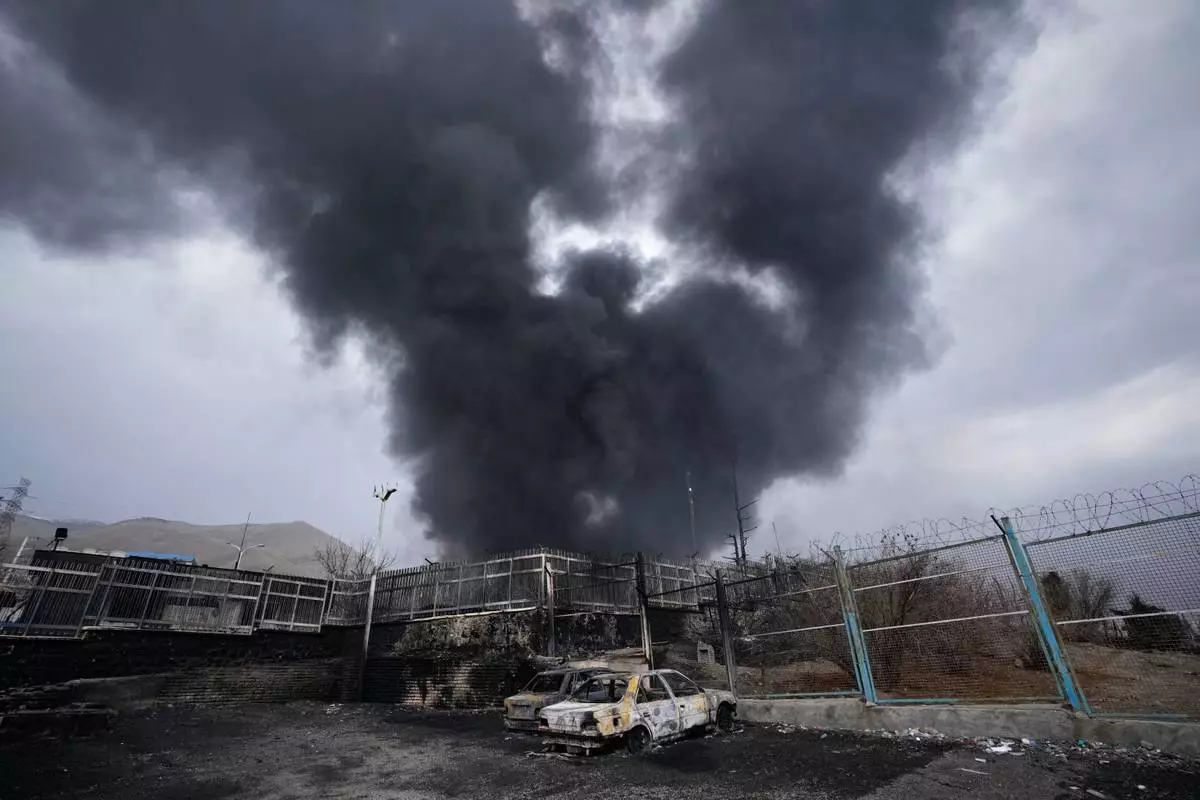
FILE - A thick plume of smoke rises from an oil storage facility hit by a U.S.-Israeli strike in Tehran, Iran, March 8, 2026. (AP Photo/Vahid Salemi, File)
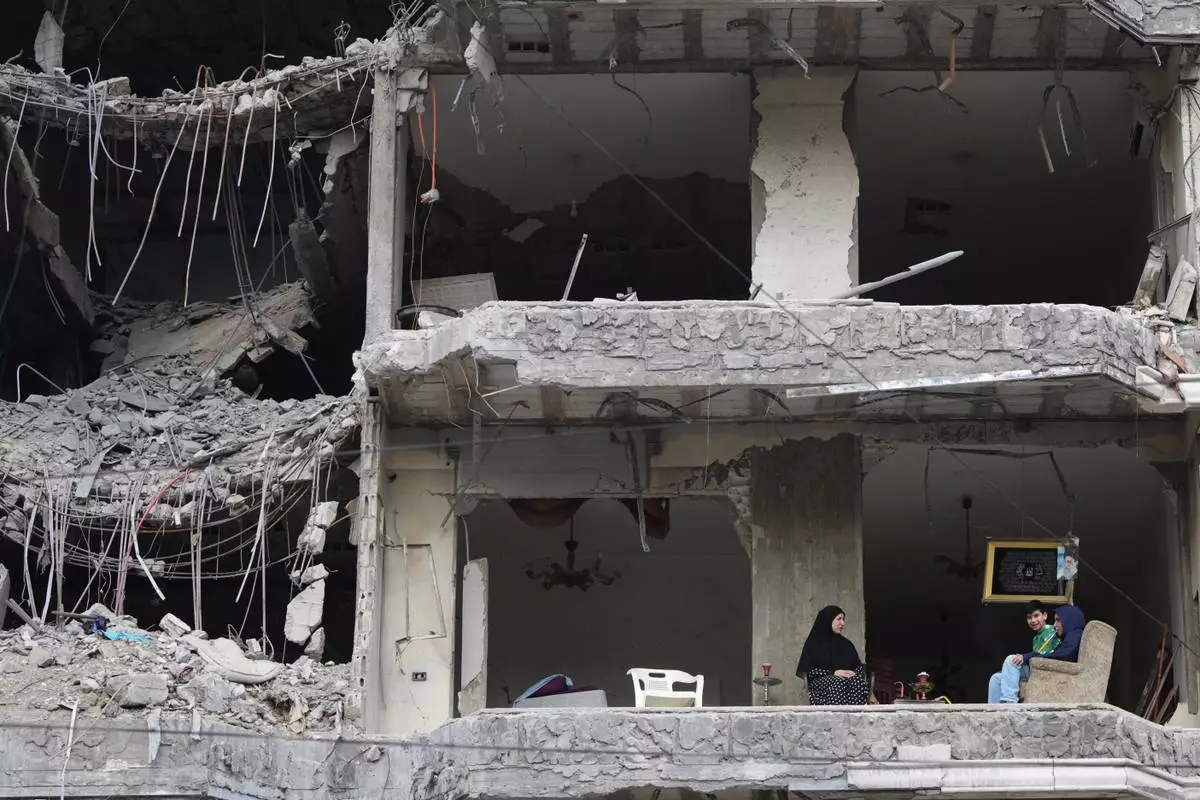
The wife and children of Fadi Al Zein, who lost both his homes in Israeli strikes in his village of Khiam and in Dahiyeh, sit on the balcony of their heavily damaged apartment building in Beirut's southern suburbs, Lebanon, Saturday, April 25, 2026. (AP Photo/Hassan Ammar)
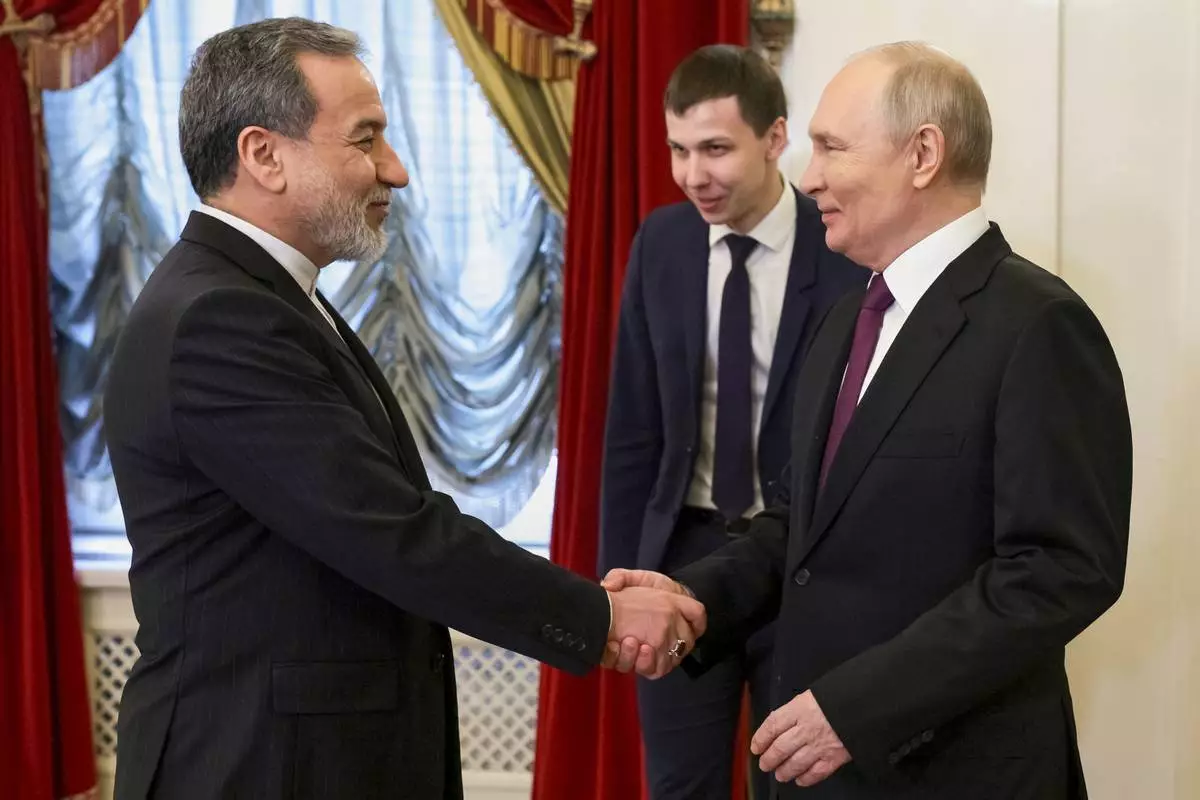
Russian President Vladimir Putin, right, shakes hands with Iranian Foreign Minister Abbas Araghchi during their meeting at the Boris Yeltsin Presidential Library, in St. Petersburg, Russia, Monday, April 27, 2026. (Gavriil Grigorov, Sputnik, Kremlin Pool Photo via AP)
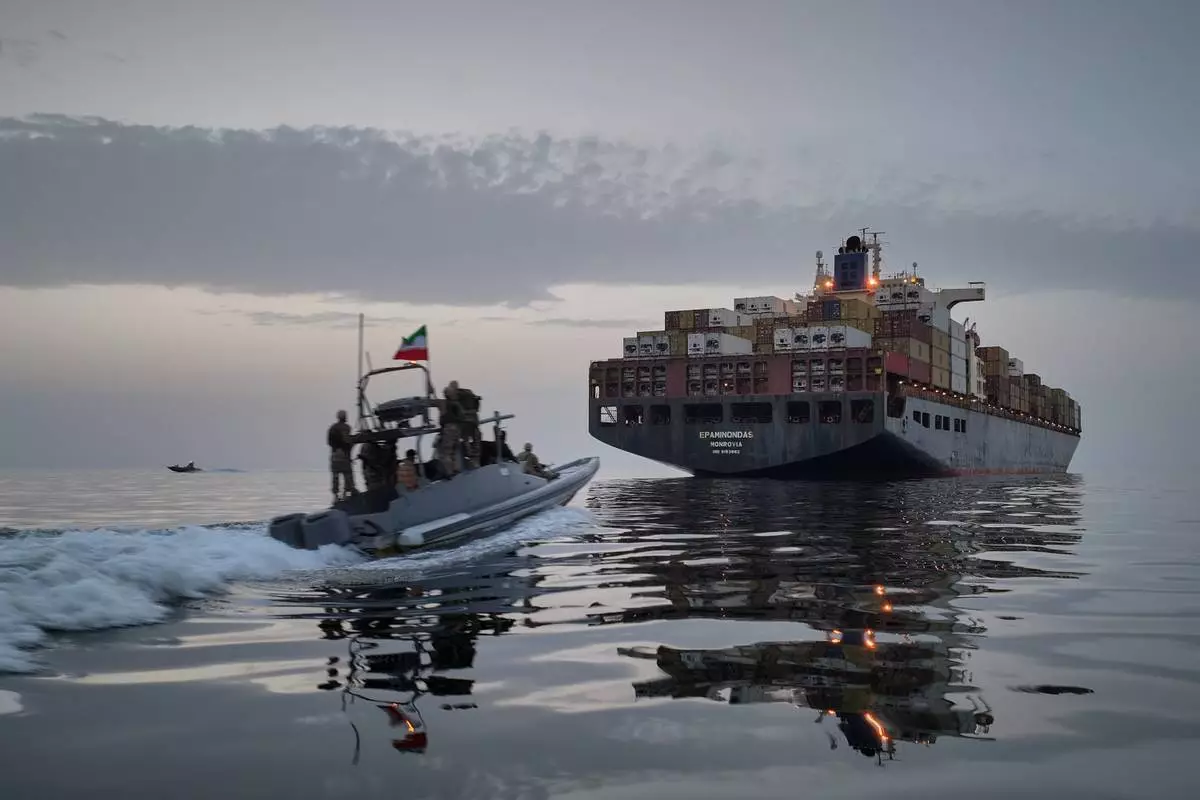
FILE - In this photo released by Tasnim News Agency, a Revolutionary Guard Navy (IRGC) speedboat approaches the cargo ship Epaminondas during what state media described as the seizure of one of two vessels accused of violations in the Strait of Hormuz, April 21, 2026. (Meysam Mirzadeh/Tasnim News Agency via AP, File)
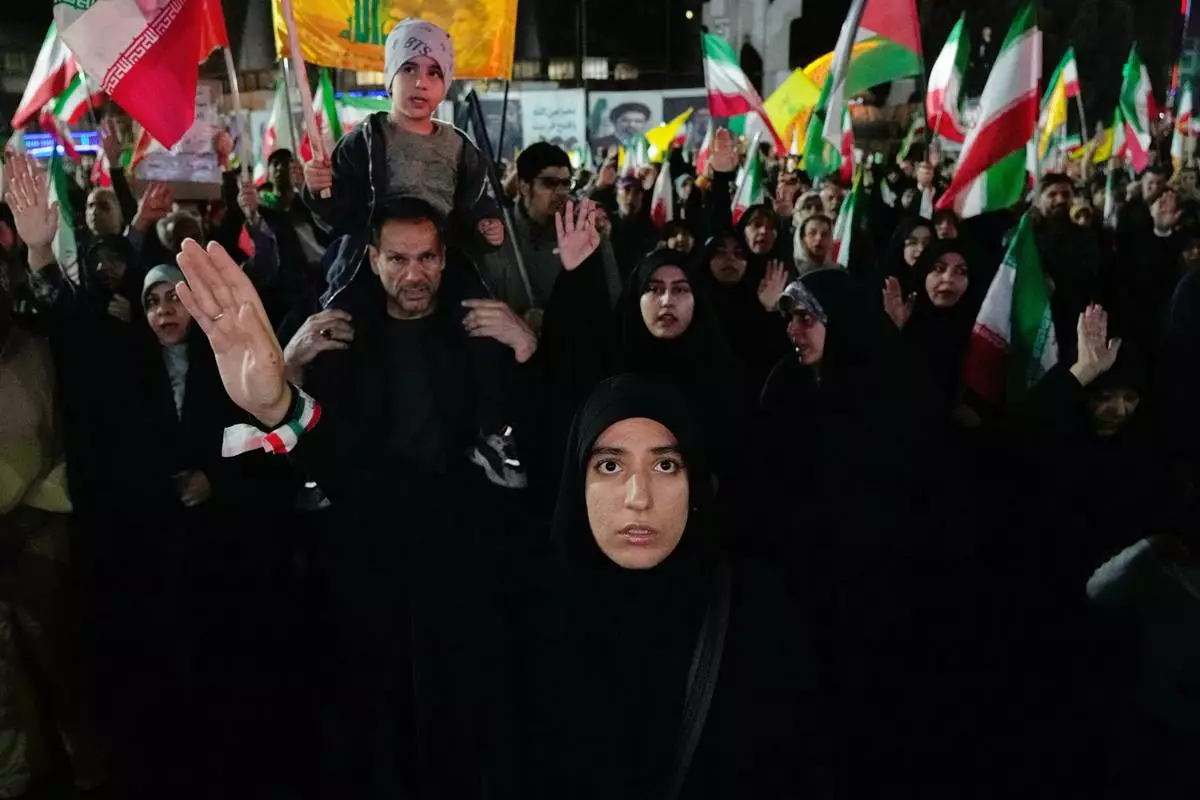
Pro-government demonstrators attend a gathering in Tehran, Iran, Monday, April 27, 2026. (AP Photo/Vahid Salemi)
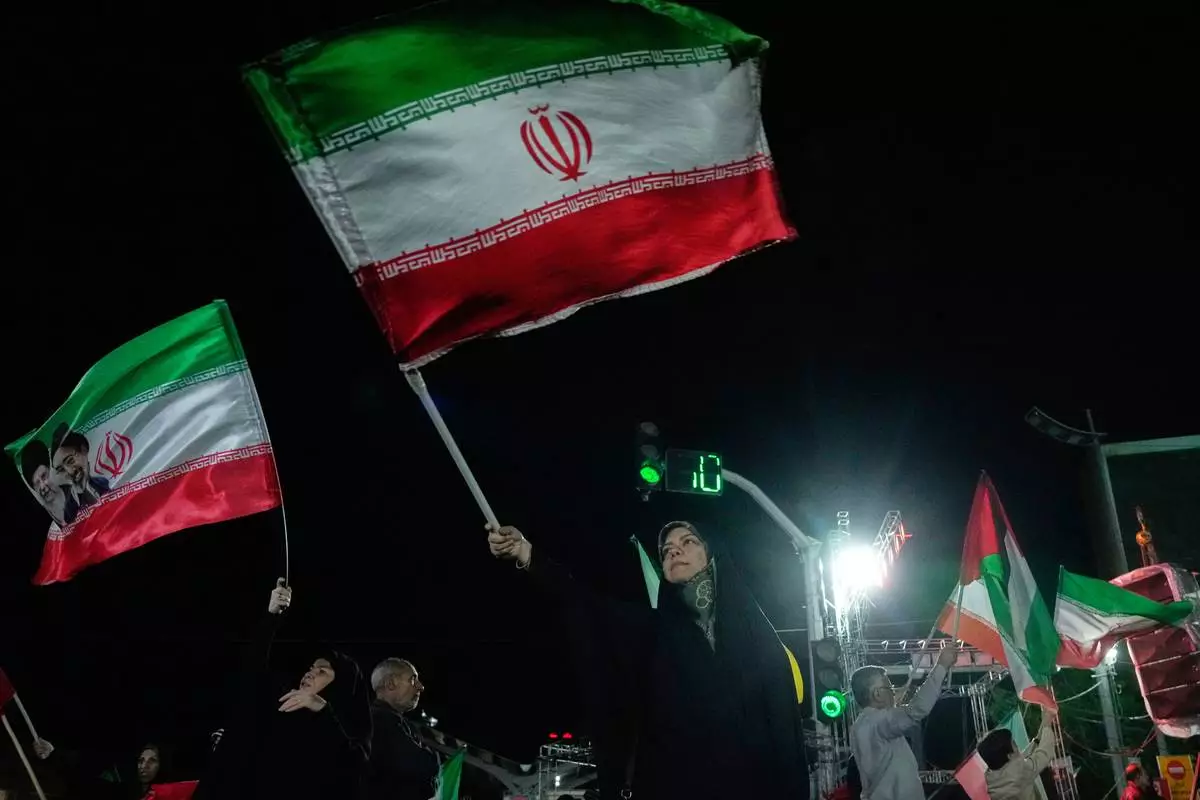
Pro-government demonstrators wave Iranian flags during a gathering in Tehran, Iran, Monday, April 27, 2026. (AP Photo/Vahid Salemi)