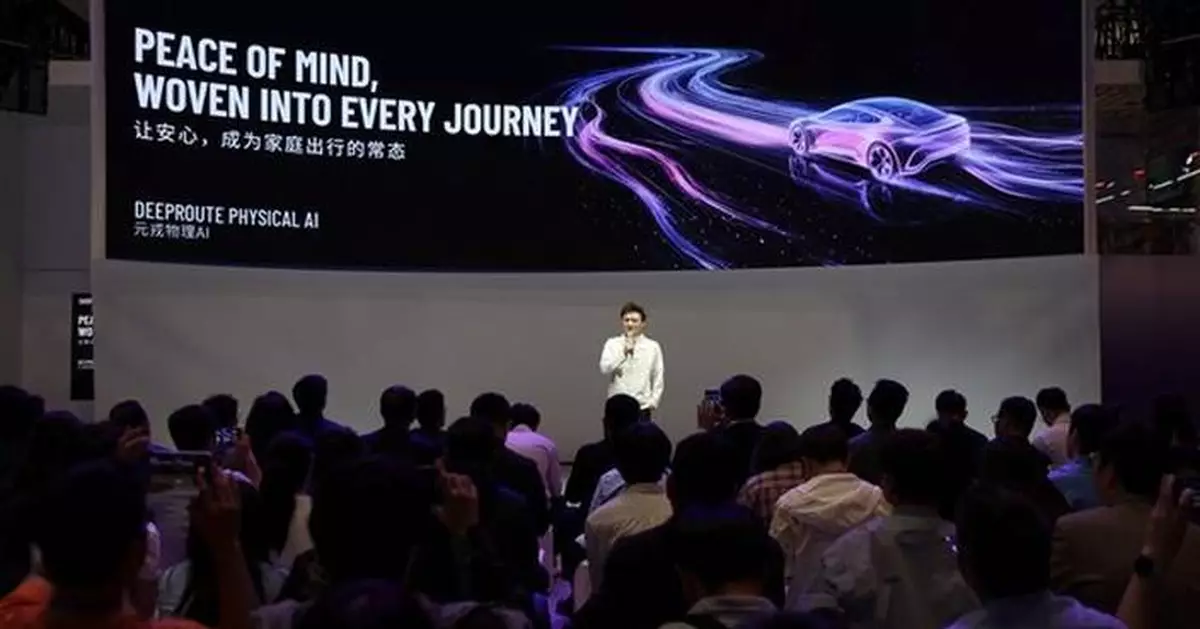
BEIJING, April 29, 2026 /PRNewswire/ -- At the 19th Beijing International Automotive Exhibition (hereinafter referred to as "Auto China"), DeepRoute.ai held a press conference to showcase its latest advances in Physical AI. During the event, CEO Maxwell Zhou reflected on the company's founding mission and outlined its latest advances and vision in Physical AI. Chief Scientist Chong Ruan then delivered his first public keynote, providing a systematic overview of the company's technical architecture around its Foundation Model. The event marks a milestone in DeepRoute.ai's push to establish leadership in Physical AI and shape the direction of next-generation advanced intelligent driving systems.
Maxwell Zhou: Aiming to Become the AI Infrastructure of the Physical World
Opening the press conference, CEO Maxwell Zhou recounted a traffic accident that occurred near him in the early days of his startup journey in 2016. "At that time, I wondered whether we could use AI technology to save more lives," Zhou said. He acknowledged that current advanced intelligent driving systems are not yet perfect, with MPCI (Miles Per Critical Intervention) in urban areas still measured in the tens of kilometers, but noted that available data indicates their safety is already several times higher than that of human drivers. "We believe that within the next two to three years, as large models continue to develop their comprehension capabilities, we will achieve truly safe advanced intelligent driving systems."
Zhou set out a long-term vision for DeepRoute.ai: "I hope that in the future, the company will become the AI infrastructure of the physical world, serving as a foundational capability that sustains real-world operations, much like telecommunications and electricity. When people talk about intelligence in the physical world, DeepRoute.ai should be an essential part of that foundation."
Chief Scientist Chong Ruan's Keynote: Updates on the Foundation Model
Chong Ruan, former Head of R&D at DeepSeek and a core researcher in multimodal AI, made his public debut as DeepRoute.ai's Chief Scientist at this event. He provided a systematic overview of the Foundation Model and the latest progress in building cognitive capabilities for the advanced intelligent driving system.
Ruan noted that as intelligent driving enters the mass production phase, earlier approaches relying on smaller models have shown limited progress in system stability and consistent user adoption. These systems still exhibit performance fluctuations in complex, edge-case scenarios, and a reliable foundation of trust in the driving experience has yet to be established. To address this, DeepRoute.ai has developed a next-generation technical approach centred on the Foundation Model.
The Foundation Model unifies driving decision-making, scene understanding, and behaviour evaluation within a single architecture. By leveraging greater model scale, higher data quality, and a faster data-driven closed-loop, it enables the continuous improvement of the advanced intelligent driving system. Under this framework, the iteration cycle of the data-driven closed-loop has been cut from approximately five days to around 12 hours, significantly improving operational efficiency.
Ruan also noted that the value of the Foundation Model extends beyond product capabilities and is now influencing how the organisation operates. "From internal knowledge base Q&A and automated code generation to cross-departmental collaboration and autonomous experimental analysis, AI is reshaping our R&D and management workflows."
Cross-Industry Dialogue: Focusing on the Core Proposition of "AI for what"
At the press conference, DeepRoute.ai also hosted an "AI Talk" industry dialogue themed "AI for what." The panel was moderated by Li Zhang, Professor at the School of Data Science at Fudan University. Participants included Jian Huo, General Manager of Automotive and Energy Solutions at Alibaba Cloud; Yinghao Xu, Assistant Professor at HKUST CSE and Staff Research Scientist at RobbyAnt; Hao Jingfang, Hugo Award-winning author, Founder of Tong Xing College, and holder of a PhD in Economics and an M.S. in Astrophysics from Tsinghua University; and Chong Ruan.
Unlike traditional product presentations, the dialogue was structured around a series of probing questions: from the capability boundaries of large models in real-world environments and the debate between World Models and VLA models, to the broader societal impact of Physical AI. Each question built on the last, keeping the discussion focused on the fundamental question of what AI is ultimately for.
Propelled by the Data Flywheel for Scaled Evolution, Fully Entering the Era of Physical AI
During the event, DeepRoute.ai also previewed its Cabin-Driving Integration Agent. Rather than functioning as a conventional voice assistant or in-vehicle infotainment system, the feature is designed to evolve the system into an "AI Brain" capable of understanding user needs and responding proactively to complex scenarios.
DeepRoute.ai reports that mass production vehicles equipped with its Urban NOA solution have now exceeded 300,000 units. Over the past year, vehicles running DeepRoute.ai's active safety systems have accumulated over 1.3 billion kilometres of real-world road operation and 44.8 million hours of user driving time. This volume of real-world data, generated through the Data Flywheel, both validates the system's safety performance and provides a critical foundation for the ongoing optimisation of the Foundation Model.
By 2026, DeepRoute.ai plans to grow mass production delivery of its advanced intelligent driving system past one million units. The company also aims to increase its MPCI metric to over 1,000 kilometres and raise its active daily use rate to over 50%. These targets are intended to drive continued improvements in system safety, stability, and user experience, advancing the commercial deployment of Physical AI at scale.
** This press release is distributed by PR Newswire through automated distribution system, for which the client assumes full responsibility. **
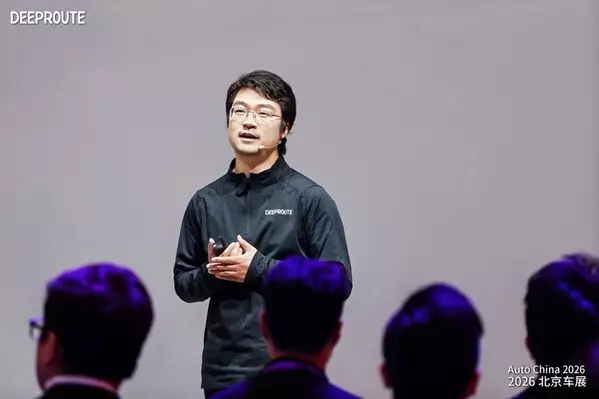
DeepRoute.ai CEO Maxwell Zhou: Aiming to Become the AI Infrastructure of the Physical World
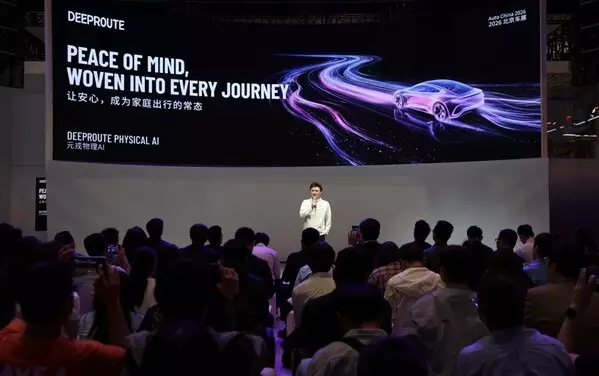
DeepRoute.ai CEO Maxwell Zhou: Aiming to Become the AI Infrastructure of the Physical World
|
CAMBRIDGE, England, April 29, 2026 /PRNewswire/ -- myrtle.ai, a recognized leader in accelerating machine learning inference, today announced that a stack featuring its VOLLO® product has recently been audited by STAC®, a leading benchmark authority for the finance industry.[1] The results, unveiled at the STAC Summit in London today, clearly demonstrate the latency benefits of an FPGA-based solution for ML inference in financial trading and related applications.
STAC-ML (Markets) Inference is the technology benchmark standard for solutions that may be used to run inference on real-time market data. Designed by quants and technologists from some of the world's leading financial firms, STAC-ML Markets (Inference) reports the performance, resource efficiency, and quality of any technology stack capable of performing inference using the provided models.
VOLLO achieved latencies as low as 2 microseconds (99th percentile) while also exhibiting excellent results in throughput and efficiency. Across all three benchmark models, VOLLO inferred in lower latency (99th percentile) than all previously audited systems, halving its previous record. Such low, deterministic latency enables users to make more intelligent decisions using more complex models faster than in the past, giving them a competitive advantage in trading, risk analysis, quotes and many other trading-related activities.
With hundreds of thousands of hours of production trading under its belt, VOLLO is generating alpha for many of the world's leading trading firms today. Those firms have developed and trained a wide range of models in standard ML tool flows before compiling them into VOLLO and then running them on their choice of FPGA-based hardware platform.
In the system under test, VOLLO ran on the standard form factor FBAP4@VP18-2L0S PCIe accelerator card from Silicom, containing an AMD Versal™ Premium series VP1802 Adaptive SoC and installed in a Supermicro AS -2015CS-TNR server. The AMD Versal Premium Series Adaptive SoC provides PCIe Gen5x8 and more than 3.3M programmable LUTs, making it well suited to low latency inference applications.
"Since VOLLO first exploited the full potential of FPGAs in this STAC benchmark in 2023, we have worked with our customers to further reduce latencies, expand the variety and size of models that VOLLO can run, and grow the range of platforms it can run on," said Peter Baldwin, CEO of myrtle.ai. "We're excited to work with AMD, Silicom and Supermicro on this benchmark, to demonstrate how our combined technologies can enable ultra-low latency AI inference in quant trading."
"The future of financial markets will be shaped by AI systems that can interpret data and act on it in near real time," said Girish Malipeddi, director for Data Center FPGA business, AMD. "With AMD Versal™ Premium series adaptive SoCs at the foundation, myrtle.ai's VOLLO demonstrates how advanced, low-latency inference can help unlock a new generation of intelligent trading infrastructure."
"Supermicro continues to address a wide range of markets with our AMD systems, which were used for this STAC-ML benchmark," said Michael McNerney, Senior Vice President Marketing and Network Security, Supermicro. "Our servers address the most challenging workloads in the financial services industry, and together with partners, we are able to deliver top-end performance with very low latencies for machine learning workloads."
Anders Poulsen, VP Solutions at Silicom Denmark, said: "We're pleased that myrtle.ai selected Silicom's Artena accelerator card, based on AMD Versal Premium, for these tests. Built around one of the largest FPGAs in a PCIe form factor, Artena is an ideal platform for VOLLO. Together, VOLLO and our low-latency hardware deliver deterministic, microsecond-level inference for demanding trading workloads."
ML developers can evaluate today how their models could perform on VOLLO, without the need for any FPGA tools or expertise. For more details go to vollo.myrtle.ai or contact myrtle.ai today at fintech@myrtle.ai.
The full benchmark results are available in the STAC Report (SUT ID MRTL260323) at http://www.STACresearch.com/MRTL260323.
About myrtle.ai
Myrtle.ai is an AI/ML software company that delivers world-class inference accelerators on FPGA-based platforms from all the leading FPGA suppliers. With broad neural network expertise, myrtle.ai has delivered accelerators for applications including fintech, wireless telecoms, LLMs, speech processing, and recommendation.
VOLLO, VOLLO Accelerator and the VOLLO logo are registered trademarks of myrtle.ai.
"STAC" and all STAC names are trademarks or registered trademarks of the Strategic Technology Analysis Center, LLC. AMD, the AMD logo, Versal, and combinations thereof are trademarks of Advanced Micro Devices, Inc.
[1] www.STACresearch.com/MRTL260323
CAMBRIDGE, England, April 29, 2026 /PRNewswire/ -- myrtle.ai, a recognized leader in accelerating machine learning inference, today announced that a stack featuring its VOLLO® product has recently been audited by STAC®, a leading benchmark authority for the finance industry.[1] The results, unveiled at the STAC Summit in London today, clearly demonstrate the latency benefits of an FPGA-based solution for ML inference in financial trading and related applications.
STAC-ML (Markets) Inference is the technology benchmark standard for solutions that may be used to run inference on real-time market data. Designed by quants and technologists from some of the world's leading financial firms, STAC-ML Markets (Inference) reports the performance, resource efficiency, and quality of any technology stack capable of performing inference using the provided models.
VOLLO achieved latencies as low as 2 microseconds (99th percentile) while also exhibiting excellent results in throughput and efficiency. Across all three benchmark models, VOLLO inferred in lower latency (99th percentile) than all previously audited systems, halving its previous record. Such low, deterministic latency enables users to make more intelligent decisions using more complex models faster than in the past, giving them a competitive advantage in trading, risk analysis, quotes and many other trading-related activities.
With hundreds of thousands of hours of production trading under its belt, VOLLO is generating alpha for many of the world's leading trading firms today. Those firms have developed and trained a wide range of models in standard ML tool flows before compiling them into VOLLO and then running them on their choice of FPGA-based hardware platform.
In the system under test, VOLLO ran on the standard form factor FBAP4@VP18-2L0S PCIe accelerator card from Silicom, containing an AMD Versal™ Premium series VP1802 Adaptive SoC and installed in a Supermicro AS -2015CS-TNR server. The AMD Versal Premium Series Adaptive SoC provides PCIe Gen5x8 and more than 3.3M programmable LUTs, making it well suited to low latency inference applications.
"Since VOLLO first exploited the full potential of FPGAs in this STAC benchmark in 2023, we have worked with our customers to further reduce latencies, expand the variety and size of models that VOLLO can run, and grow the range of platforms it can run on," said Peter Baldwin, CEO of myrtle.ai. "We're excited to work with AMD, Silicom and Supermicro on this benchmark, to demonstrate how our combined technologies can enable ultra-low latency AI inference in quant trading."
"The future of financial markets will be shaped by AI systems that can interpret data and act on it in near real time," said Girish Malipeddi, director for Data Center FPGA business, AMD. "With AMD Versal™ Premium series adaptive SoCs at the foundation, myrtle.ai's VOLLO demonstrates how advanced, low-latency inference can help unlock a new generation of intelligent trading infrastructure."
"Supermicro continues to address a wide range of markets with our AMD systems, which were used for this STAC-ML benchmark," said Michael McNerney, Senior Vice President Marketing and Network Security, Supermicro. "Our servers address the most challenging workloads in the financial services industry, and together with partners, we are able to deliver top-end performance with very low latencies for machine learning workloads."
Anders Poulsen, VP Solutions at Silicom Denmark, said: "We're pleased that myrtle.ai selected Silicom's Artena accelerator card, based on AMD Versal Premium, for these tests. Built around one of the largest FPGAs in a PCIe form factor, Artena is an ideal platform for VOLLO. Together, VOLLO and our low-latency hardware deliver deterministic, microsecond-level inference for demanding trading workloads."
ML developers can evaluate today how their models could perform on VOLLO, without the need for any FPGA tools or expertise. For more details go to vollo.myrtle.ai or contact myrtle.ai today at fintech@myrtle.ai.
The full benchmark results are available in the STAC Report (SUT ID MRTL260323) at http://www.STACresearch.com/MRTL260323.
About myrtle.ai
Myrtle.ai is an AI/ML software company that delivers world-class inference accelerators on FPGA-based platforms from all the leading FPGA suppliers. With broad neural network expertise, myrtle.ai has delivered accelerators for applications including fintech, wireless telecoms, LLMs, speech processing, and recommendation.
VOLLO, VOLLO Accelerator and the VOLLO logo are registered trademarks of myrtle.ai.
"STAC" and all STAC names are trademarks or registered trademarks of the Strategic Technology Analysis Center, LLC. AMD, the AMD logo, Versal, and combinations thereof are trademarks of Advanced Micro Devices, Inc.
[1] www.STACresearch.com/MRTL260323
** This press release is distributed by PR Newswire through automated distribution system, for which the client assumes full responsibility. **

Myrtle.ai Halves Latency in Financial Machine Learning Inference Benchmark Record with VOLLO