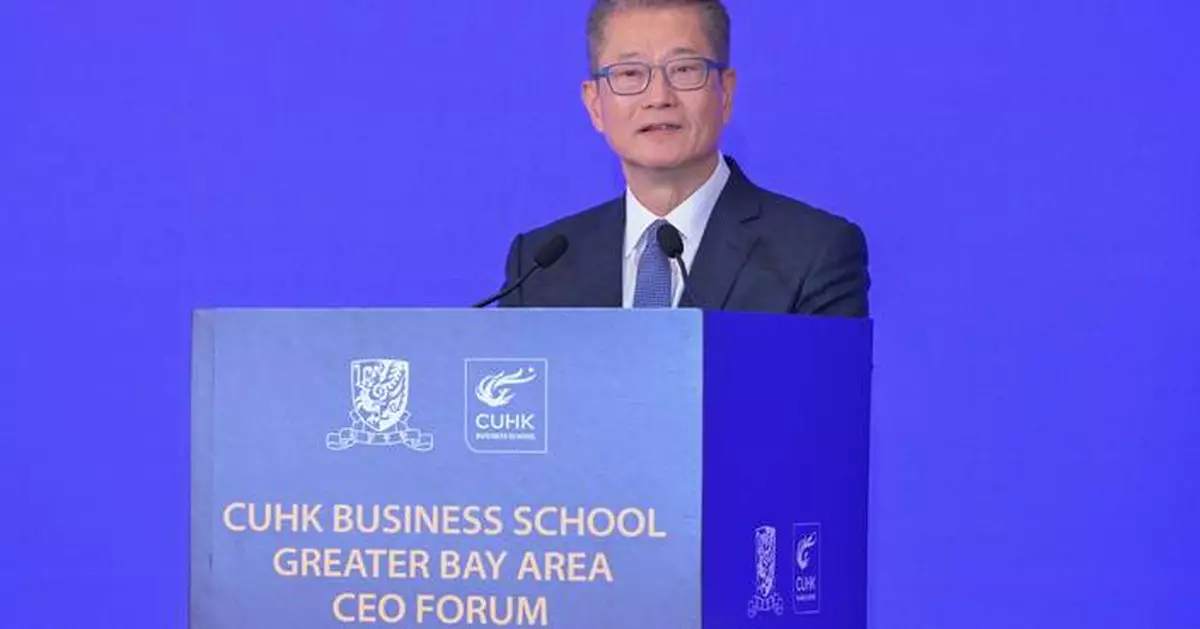
Speech by FS at CUHK Business School Greater Bay Area CEO Forum
Following is the speech by the Financial Secretary, Mr Paul Chan, at the CUHK Business School Greater Bay Area CEO Forum today (April 29):
Professor Dennis Lo (Vice-Chancellor and President, the Chinese University of Hong Kong (CUHK)), Professor Lin Zhou (Dean, CUHK Business School), distinguished alumni, ladies and gentleman,
Good Morning. It is a pleasure to join you today at the CUHK Business School inaugural Greater Bay Area CEO Forum.
This is a valuable opportunity to discuss an important topic: how to drive the Greater Bay Area's next wave of growth.
The world of change
We are living in a world that is changing fundamentally. Geopolitical tensions and technological competition are intensifying. Unilateralism and protectionism are on the rise. Consequently, supply chains, industry base, innovation networks are being reconfigured. Capital flows are shifting and asset allocation is being recalibrated. Instability, volatility and uncertainty have become the defining features of our time.
At such a historic time, the role of our country, China, is becoming more prominent, serving as a stabilising force in the global arena and a powerful engine of growth. It is advancing high-quality development with clear directions and strong strategic resolve.
This year marks the beginning of the National 15th Five-Year Plan period. The Plan explicitly supports Hong Kong in better integrating into and serving the country’s overall development. We have been entrusted with the roles of "ten centres" and "two hubs", plus building a vibrant ecosystem of commodity trading. Under the leadership of the Chief Executive, the HKSAR Government is moving ahead at full speed with Hong Kong's first five-year plan.
The National 15th Five-Year Plan
There are three key directions in the National 15th Five-Year Plan that deserve our particular attention.
The first is building a modernised industrial system and strengthening self-reliance in science and technology.
At a time of rapid technological competition and industrial transformation, our country is placing strong emphasis on closer integration between technological innovation and industrial development. This transformation is being driven by artificial intelligence, digitalisation, green transition and greater cross-industry integration.
After years of steady progress, our country is now at the global forefront in innovation and technology. Two simple facts illustrate this well. China has the world's most complete industrial system. It is also home to the largest number of global innovation clusters.
In the years ahead, we can expect many more major breakthroughs from our country in frontier fields such as AI, quantum computing, semiconductors, biotechnology, communications and new energy. We can also expect breakthroughs in critical bottlenecks that have constrained technological development in the past.
For these efforts to succeed, a strong and complete innovation chain is essential. This chain will need to extend from research and development to commercialisation and application, and be supported by a comprehensive ecosystem of finance, professional services, education and talent development.
This highlights the important role Hong Kong can play as an international financial and innovation centre, and an international talent hub.
The second direction in the 15th Five-Year Plan is to expand the domestic market and pursue high-level two-way opening up.
The key phrase here is "two-way". For many Mainland enterprises, in the face of geoeconomic pressure, their supply chains and manufacturing bases need to be diversified. Going global is no longer optional. It is essential.
At home, domestic demand is equally crucial to sustaining high-quality growth, as the country evolves from a major manufacturing power into a major consumer market as well.
This means that more high-quality goods and services from around the world will gain broader access to the Mainland market. At the same time, they need to adapt to evolving consumer behaviour. The market is shifting away from mass production toward a flexible, demand-driven production model, defined by more personalised, diverse and rapidly changing demand.
Against this backdrop, domestic demand on the Mainland will continue to expand in both scale and quality. In this regard, Hong Kong's role as a gateway for trade and investment between the Mainland and the rest of the world will become even more important.
The third direction, which is closely linked to today's theme, is co-ordinated regional development. Today, competition is no longer between individual cities, but increasingly among regions. To prevail, city clusters must leverage their respective strengths and comparative advantages.
The Greater Bay Area is one of the three major national engines of growth, and it has a set of distinctive competitive strengths.
We all know the basic facts. The GBA (Guangdong-Hong Kong-Macao Greater Bay Area) is already a major economy on its own with a GDP (Gross Domestic Product) roughly equivalent to Italy's. Its per capita GDP, measured in purchasing power terms, has exceeded US$40,000.
But the GBA is much more than a large market. It is a dynamic and diversified economic powerhouse.
The region has strong research and development capabilities, innovative power, advanced manufacturing capacity, complete industrial chains and vast real-world application scenarios. This is one reason why there is so much optimism about the region's development potential in AI and health science.
At the same time, the GBA benefits from Hong Kong's unique connectivity and institutional strengths, especially its highly respected legal system, deep pools of global capital and talent, alignment with international standards and practices, and world-class professional services.
Indeed, the GBA presents a value proposition that is difficult to replicate anywhere else in the world. Some say it combines the strengths of both the San Francisco Bay Area and the New York Bay Area. To that, I would add safety, security and unparalleled quality of life.
One key focus in the GBA's future development is alignment in rules and standards. For us, this is not only about regional integration. It is also about bridging national standards and international standards, so that Mainland products, services and enterprises can gain broader recognition and respect in the global arena. We are advancing this work on a number of fronts, such as construction, transportation, food quality and medical care. Besides, we are contributing to the development of the Greater Bay Area standards.
Our future priorities
Looking ahead, in the interest of time, let me highlight three key areas of our focus over the coming few years.
The first is "Finance+".
Hong Kong is an international financial centre. Many people used to see this mainly as an efficient platform for fundraising and financing.
Of course, that function remains vital. But we can do much more than that. For example, building a modernised industrial system requires more than a vibrant IPO (initial public offering) market. It requires an ecosystem that can provide a full range of financial options, ranging from angel investment to patient capital, together with professional and high value-added services.
For example, in the field of technology and innovation, IP financing enables firms to use their intangible assets as collateral and turn them into working capital. This helps meet the needs of innovative enterprises, especially smaller ones that are rich in IP but lack tangible assets.
In short, "Finance+" is about leveraging the power of finance to fast-track every stage of innovation, technology and industrial development. It is about using finance to power the region's innovation economy.
The second area is "AI+".
AI is becoming a foundational technology across every sector. Hong Kong is well placed to seize the opportunities it presents. We combine world-class research capabilities with international application scenarios. That is why, as announced in this year's Budget, we will establish the Committee on AI+ and Industry Development Strategy. Its purpose is to promote closer collaboration across sectors and accelerate practical applications in AI.
Talent is the cornerstone of this effort. Our goal is not only to train professionals and attract specialists. We aim to strengthen AI capability across society - among students, professionals, entrepreneurs and the wider public. In this way, the community as a whole will be able to better grasp the opportunities of the digital intelligence era.
The third area of focus is to strengthen Hong Kong's role as a supply chain management and high value-added services hub.
Geopolitics presents both challenges and opportunities for Hong Kong as a trading centre. As global industrial and supply chains restructure, and global demand linked to the AI sector rises, Hong Kong's export rose by more than 15 per cent in the past year despite the tariff war.
Global supply chains will likely grow more regionalised, more diversified and more risk-conscious. And therefore Hong Kong's value as an agile super connector and super value-adder becomes even more evident.
To Mainland enterprises going global, we are the showroom, the connector in standards, a platform for funding, and a trusted partner in navigating the international market.
All these developments will create strong demand for our financing, logistics, legal, accounting, consulting and other professional services.
Closing remarks
Ladies and gentlemen, the GBA is no doubt one of the most promising regions in the world for investment, innovation and business growth. And Hong Kong stands at the heart of this opportunity.
To realise our full potential, we need strong public-private collaboration. I therefore invite you to bring your market insight, entrepreneurial energy and valuable experience to help shape Hong Kong's future. Your contributions to the formulation of Hong Kong's first five-year plan would be very much valued.
Together, I am confident that we can begin a new chapter of growth for Hong Kong and the Greater Bay Area, creating broader opportunities for the generations to come.
Thank you very much.
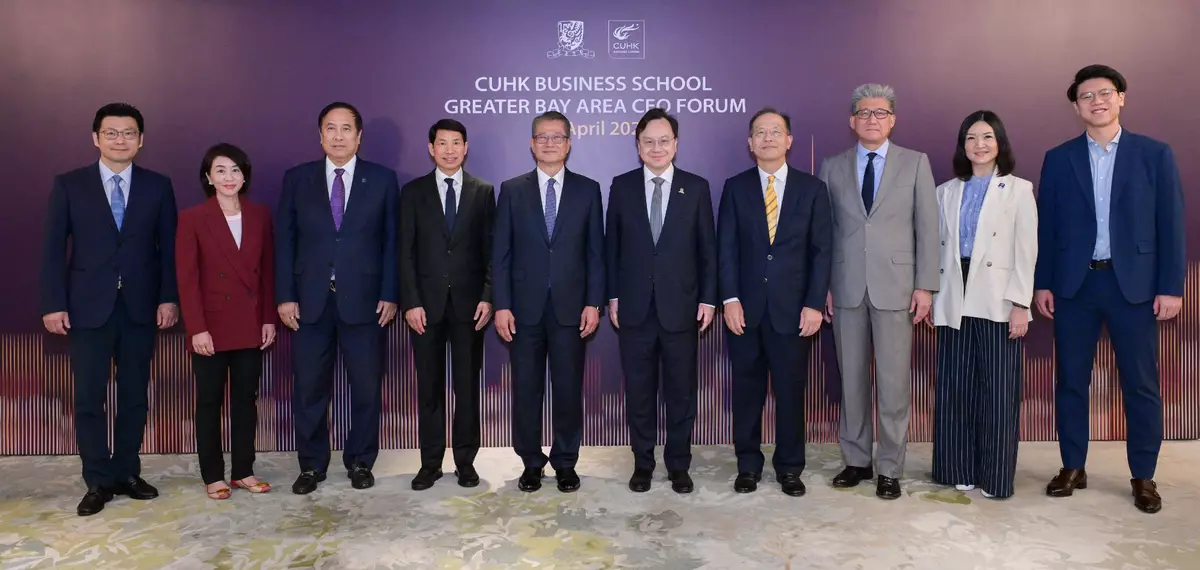
Speech by FS at CUHK Business School Greater Bay Area CEO Forum Source: HKSAR Government Press Releases
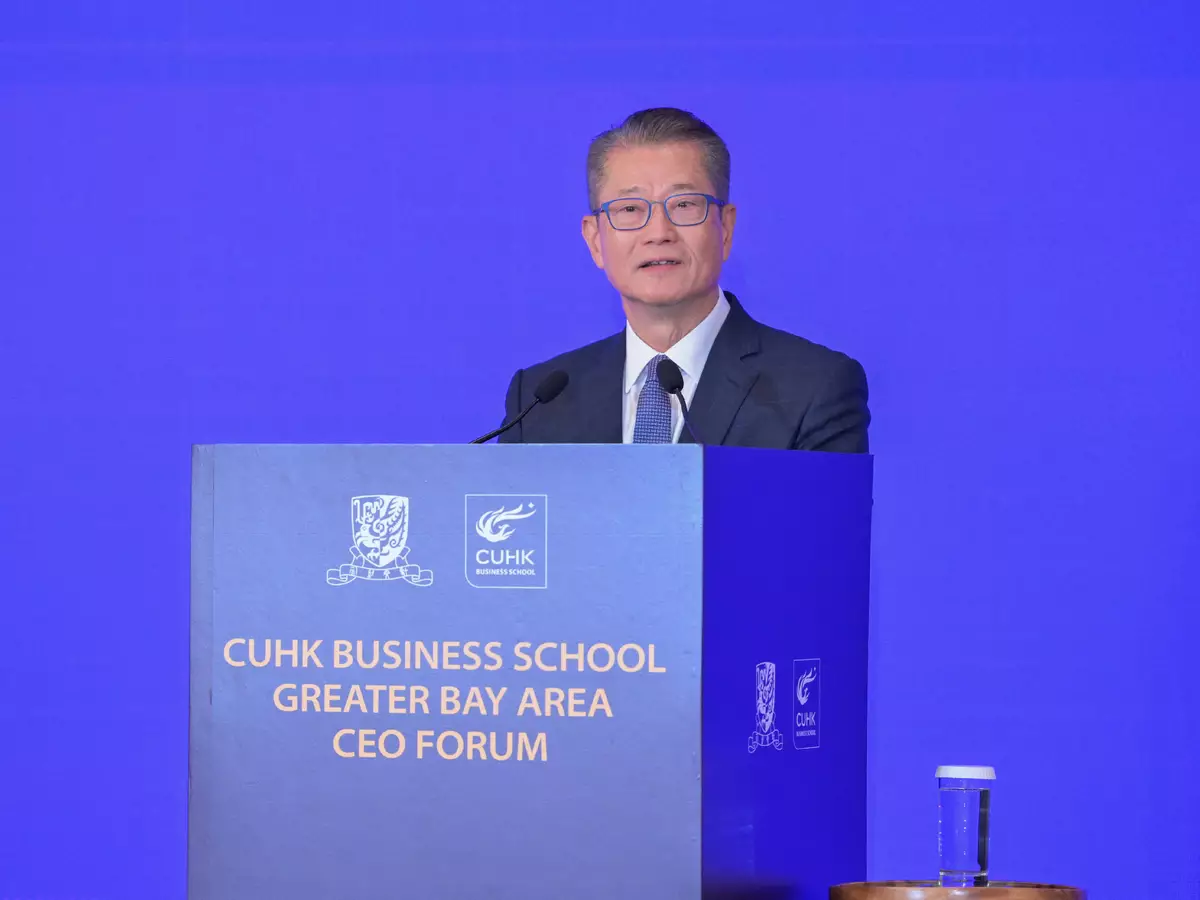
Speech by FS at CUHK Business School Greater Bay Area CEO Forum Source: HKSAR Government Press Releases