NEW YORK--(BUSINESS WIRE)--Apr 29, 2026--
Better Home & Finance Company (NASDAQ: BETR) today announced the Better Home Equity Card, built on Stripe’s financial infrastructure at Stripe Sessions 2026, the global internet economy conference. The new card provides homeowners with prepaid debit access to funds drawn from a secured Better HELOC, connecting financing, spending, and record keeping in a single integrated system. The card is designed to help eliminate the friction that has traditionally pushed homeowners towards high-cost unsecured debt.
This press release features multimedia. View the full release here: https://www.businesswire.com/news/home/20260429486991/en/
US homeowners collectively hold $21.4 trillion in tappable home equity, with more than 85 million consumers sitting on a median of $276,000 in available capital. Yet non-mortgage debt has climbed to $857 billion, with the average homeowner carrying $8,900 in debt and roughly 24 million homeowners carrying more than $10,000 in non-mortgage debt. Rather than treating home equity like generic cash, Better is rebuilding the interface between home equity borrowing and deployment to modernize how homeowners access capital they already own, while enabling greater visibility into spending behavior to inform future underwriting.
“Homeowners are sitting on $21.4 trillion in equity and reaching for a credit card to pay for a kitchen renovation or backyard upgrade because the tools to access their equity haven’t evolved,” said Vishal Garg, CEO and Founder of Better. “Banks have known for years that homeowners were overpaying for credit cards when they had equity sitting right there. We've built the Better Home Equity Card to repair it.”
Unlike a traditional credit card, which draws from an unsecured revolving balance, the Better Home Equity Card is a prepaid debit card that allows homeowners to easily access disbursements from their secured Better HELOCs. Approved funds are placed into a dedicated financial account and accessible immediately; no waiting for disbursements, no managing multiple payment methods. Cardholders can also earn 1% cashback on eligible purchases, introducing a rewards feature to home equity spending that traditional HELOCs typically lack. Stripe’s financial infrastructure powers card issuing, account management, and compliance in one seamless system.
The Better Home Equity Card is the next step in Better's broader strategy to build a fully integrated, AI-native home finance platform, connecting origination, funding, spending, and planning in one system powered by Tinman®. All approved Better HELOC customers will be offered the Better Home Equity card as a disbursement method beginning in Summer 2026.
About Better Home & Finance Holding Company
Better Home & Finance Holding Company (NASDAQ: BETR) is the first AI-native mortgage and home equity finance platform, and first fintech to fund more than $110 billion in loan volume. Better has leveraged its industry-leading AI platform, Tinman®, to achieve its singular mission of making homeownership cheaper, faster, and easier for all Americans. Tinman® allows customers to see their rate options in seconds, get pre-approved in minutes, lock in rates, and close their loan in as little as three weeks. In addition, Betsy™, the first AI loan agent built exclusively for the mortgage industry, revolutionizes the homebuying journey by answering questions, delivering approvals, comparing products, processing rate locks, and moving their loan application along to closing 24/7/365. Better’s mortgage offerings include GSE-conforming mortgage loans, FHA and VA loans, and jumbo mortgage and home equity loans. Better serves customers in all 50 US states and the United Kingdom.
For more information, follow @tinmanAI on X and @betterdotcom on Instagram and TikTok.
Better Home Prepaid Debit Cards are issued by Cross River Bank, Member FDIC and Equal Housing Lender.
Better Mortgage Corporation partners with Stripe Payments Company for money transmission services and account services with funds held at Fifth Third Bank N.A., Member FDIC and Equal Housing Lender.

Better Home Equity Card Powered by Stripe Enables Easy Access to HELOC Funds and Introduces a Modern Access Layer Across the $21.4 Trillion Home Equity Market
UNITED NATIONS (AP) — The majority of Iran’s highly enriched uranium is likely still at its Isfahan nuclear complex, which was bombarded by airstrikes last year and faced less intense attacks in this year's U.S.-Israeli war, the U.N. nuclear agency's leader told The Associated Press.
Rafael Grossi said in an interview Tuesday that the International Atomic Energy Agency has satellite images showing the effects of the latest U.S.-Israeli airstrikes against Iran and that “we continue to get information.”
IAEA inspections ended at Isfahan when Israel last June launched a 12-day war that saw the United States bomb three Iranian nuclear sites.
The U.N. nuclear watchdog believes a large percentage of Iran's highly enriched uranium “was stored there in June 2025 when the 12-day war broke out, and it has been there ever since,” Grossi said.
“We haven't been able to inspect or to reject that the material is there and that the seals — the IAEA seals — remain there,” he said. “I hope we'll be able to do that, so what I tell you is our best estimate.”
Images from an Airbus satellite show a truck loaded with 18 blue containers going into a tunnel at the Isfahan Nuclear Technology Center on June 9, 2025, just before last year's war started. Those containers, believed to contain highly enriched uranium, likely remain there.
The IAEA also wants to inspect Iran's nuclear facilities at Natanz and Fordo, where there is also some nuclear material, the IAEA director general added.
Iran is a party to the Nuclear Nonproliferation Treaty, whose five-year review is underway at U.N. headquarters. Under its provisions, Iran is required to open its nuclear facilities to IAEA inspection, Grossi said.
Iran has 440.9 kilograms (972 pounds) of uranium that is enriched up to 60% purity, a short, technical step from weapons-grade levels of 90%, according to the agency. Grossi has said the IAEA believes roughly 200 kilograms (about 440 pounds) is stored in tunnels at the Isfahan site.
The Iranian stockpile could allow the country to build as many as 10 nuclear bombs, should it decide to weaponize its program, Grossi told the AP last year.
Tehran long has insisted its nuclear program is peaceful. President Donald Trump said one of the major reasons the U.S. went to war was to deny Iran the ability to develop nuclear weapons, even as he has insisted that the strikes last summer “obliterated” the country's atomic program.
Grossi told a U.N. press conference Wednesday that Iran declared a new uranium enrichment facility at Isfahan last June and that IAEA inspectors were scheduled to visit the day strikes began. He said the facility apparently was not hit in attacks on Isfahan this year or last.
Grossi said the IAEA has discussed with Russia and others the possibility of sending Iran's highly enriched uranium out of the country — a complex operation that would require either a political agreement or a major U.S. military operation in hostile territory.
Trump said Wednesday that Russian President Vladimir Putin renewed his offer to help the United States handle Iran's enriched uranium. Trump said he told Putin it was more important the Russian leader “be involved with ending the war with Ukraine.”
Grossi, meanwhile, noted that “what's going to be important is that that material leaves Iran” or is blended to reduce its enrichment.
He said the IAEA participated in U.S.-Iran nuclear talks in February but has not been part of recent ceasefire negotiations mediated by Pakistan. He said the agency has been in discussions separately with the U.S. and informally with Iran.
Trump told Axios on Wednesday that he’s rejecting Iran's latest proposal, which had called for postponing discussions on its nuclear program but ending its chokehold on the Strait of Hormuz, a crucial sea route for oil and natural gas shipments, if the U.S. lifts its blockade and ends the war.
Grossi told reporters Wednesday that Iran had a much smaller nuclear program with one type of centrifuge in 2015 when it agreed to rein in its nuclear program in a deal with six major powers. Trump pulled the U.S. out of the agreement in 2018.
The IAEA chief said negotiations now are a “completely different ballgame” because of Iran's “exponential progress” not only on enriching uranium but using the latest generation of centrifuges, different compounds and new facilities.
It would take “political will” from Tehran to reach a deal, Grossi told AP, stressing that “Iran has to be convinced that it is important to negotiate.”
Iran's leaders say they are willing to negotiate and so does the Republican U.S. president, Grossi said, but “where the frustration kicks in, apparently for both, is that they do not seem to come to agreement, or be at an eye-to-eye level, on what needs to be done first, or on how.”
Calling himself a negotiator who likes to see a “flicker of hope,” Grossi noted that “one important thing is that there is apparently an interest on both sides to come to an agreement.”
Asked if he thinks the Iranians are serious about making a deal, Secretary of State Marco Rubio told Fox News Channel this week that they are skilled negotiators looking to buy time and that any agreement must be "one that definitively prevents them from sprinting towards a nuclear weapon at any point.”
AP writer Aamer Madhani in Washington contributed to this report.

Rafael Grossi, International Atomic Energy Agency (IAEA) Director General and a candidate for United Nations Secretary-General, speaks during an interview at U.N. headquarters, Tuesday, April 28, 2026. (AP Photo/Yuki Iwamura)

Rafael Grossi, International Atomic Energy Agency (IAEA) Director General and a candidate for United Nations Secretary-General, speaks during an interview at U.N. headquarters, Tuesday, April 28, 2026. (AP Photo/Yuki Iwamura)
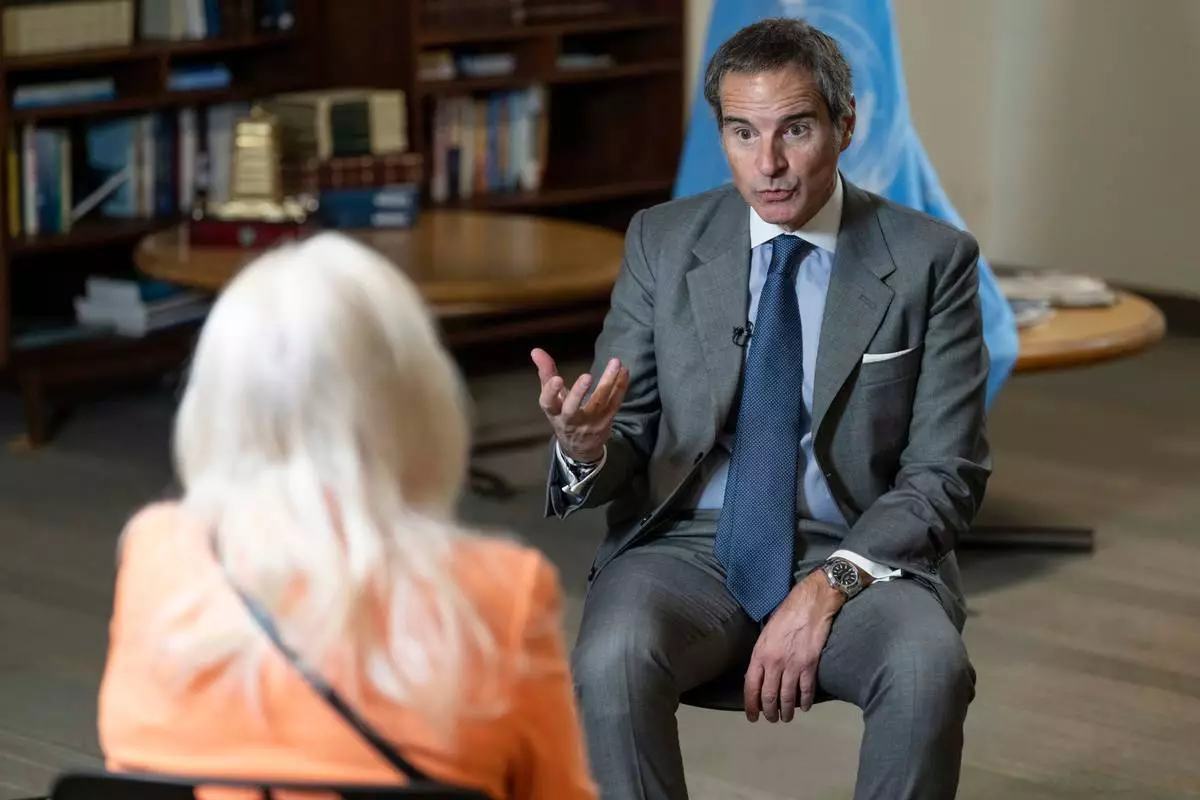
Rafael Grossi, International Atomic Energy Agency (IAEA) Director General and a candidate for United Nations Secretary-General, speaks during an interview at U.N. headquarters, Tuesday, April 28, 2026. (AP Photo/Yuki Iwamura)

Rafael Grossi, International Atomic Energy Agency (IAEA) Director General and a candidate for United Nations Secretary-General, speaks during an interview at U.N. headquarters, Tuesday, April 28, 2026. (AP Photo/Yuki Iwamura)

Rafael Grossi, International Atomic Energy Agency (IAEA) Director General and a candidate for United Nations Secretary-General, speaks during an interview at U.N. headquarters, Tuesday, April 28, 2026. (AP Photo/Yuki Iwamura)
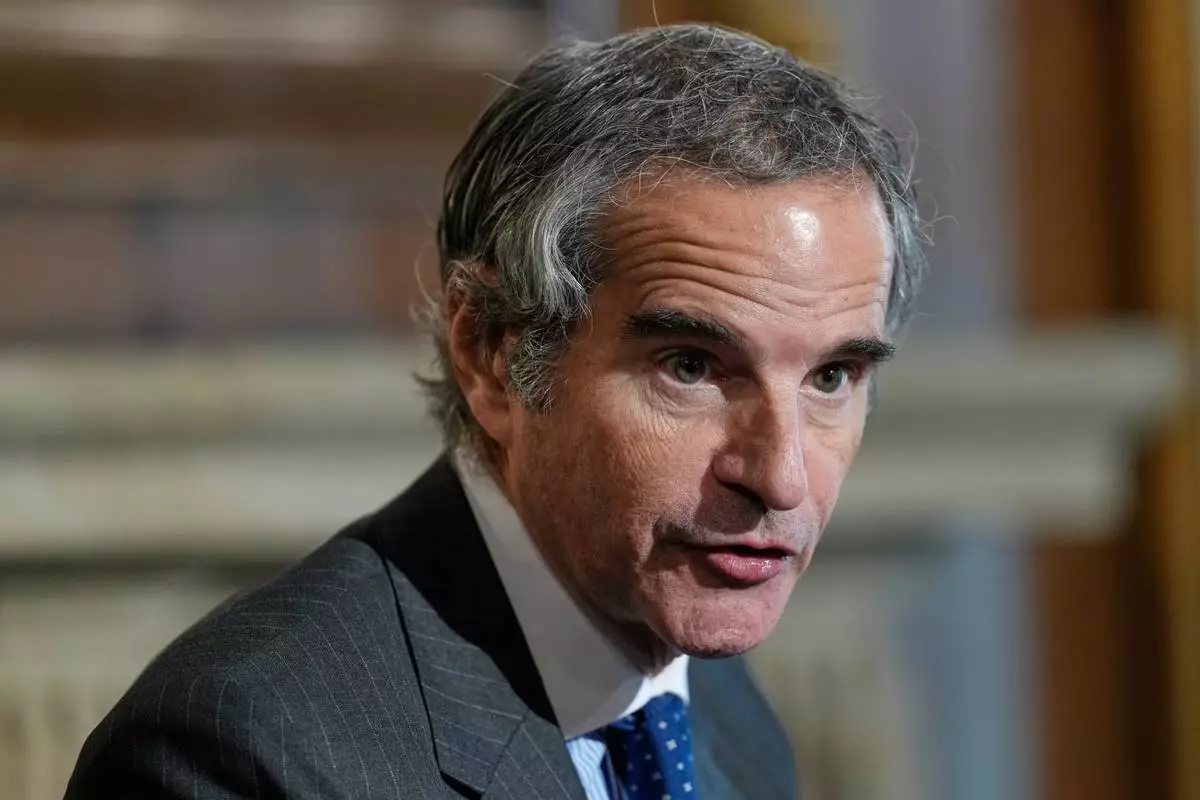
FILE - Rafael Grossi speaks during an event at the Council on Foreign Relations in New York, April 23, 2026. (AP Photo/Seth Wenig, File)