Google’s transition into the era of artificial intelligence continued to pay off for its corporate parent, Alphabet Inc., which on Wednesday announced another quarter of the stellar growth that helped to more than double its already lofty market value during the past year.
Alphabet earned $62.6 billion, or $5.11 per share, during the January-March period, an 81% increase from the same time last year. Revenue climbed 22% from last year to $109.9 billion. Both numbers easily surpassed the analyst projections that steer investors.
Alphabet's stock price rose more than 6% in extended trading after the numbers came out, setting up the shares to hit a new high during Thursday's regular session. The company's market value currently stands at $4.2 trillion, up from $1.9 trillion just a year ago. If the stock trades in a similar trajectory Thursday, Alphabet's market value could approach $4.5 trillion while creating more than $250 billion in additional shareholder wealth in a single day.
The stock market gains that Alphabet is producing are not being matched by other big AI spenders such as Microsoft and Facebook parent Meta Platforms, whose stock price plunged by about 6% in extended trading after disclosing an investment strategy being second guessed by investors. Meanwhile, Microsoft's shares also dipped, despite posting quarterly results that topped analyst forecasts.
Alphabet's performance in the past quarter CEO Sundar Pichai to celebrate the huge bets that the company has been placing on AI technology during the past three years. Those investments, Pichai said, “are lighting up every part of the business.”
As usual, digital ads fueled by Google’s dominant search engine propelled the growth as revenue from those operations shot up 16% from last year’s first quarter. It marked the fourth straight quarter that Google's ad sales increased by more than 10% from the previous year.
Google’s fastest growing division remains its Cloud division, which has been riding the AI boom to sell more products and services to corporate customers and government agencies such as the deal that it just struck with the U.S. military. Google Cloud’s revenue surged 63% from last year to $20 billion.
That growth is a sign that Alphabet’s spending spree on AI is producing dividends so far, although investors continue to worry that the Mountain View, California, company and its Big Tech peers are pouring too much money into a still-nascent and unproven technology.
Alphabet, though, is betting that it’s better to overspend on AI than being too stingy and risk behind left behind.
In a previous quarterly update released in February, Alphabet disclosed that it’s earmarking $175 billion to $185 billion for capital expenditures this year that will largely be devoted to building AI data centers and other tools tied to the technology.
In a reflection of management’s confidence in its strategy, Alphabet’s top finance executive Anat Ashkenazi told analysts on a conference call that this year’s capital expenditures may climb as high as $190 billion. And even if the spending runs that high, Askkenazi said it will “significantly increase” again next year.
All of that would be on top of $91 billion in capital expenditures during 2025.
“The key message is that Alphabet is no longer asking investors to underwrite AI spending on faith,” said Investing.com analyst Thomas Monteiro.
FILE - A woman walks by a giant screen displaying the Google logo at an event at the Paris Google Lab on the sidelines of the AI Action Summit in Paris, Feb. 9, 2025. (AP Photo/Thibault Camus, File)
NEW YORK (AP) — The governor of Sinaloa and nine other current and former Mexican officials were charged with drug trafficking and weapons offenses in a U.S. indictment unsealed Wednesday in New York, accused of aiding in the massive importation of illicit narcotics into the United States.
Some officials were members of Mexico's progressive ruling party, Morena, posing a political conundrum for Mexican President Claudia Sheinbaum as she seeks to offset mounting pressures from the Trump administration. Some of those politicians called the indictment a political attack on their party.
U.S. federal officials announced the charges in a news release. None of the defendants were in custody, but Mexico's government said shortly afterward that it had received multiple extradition requests from the U.S. without identifying those requested. It did not say how it would respond.
The 10 people charged in Manhattan federal court are current and former government or law enforcement officials in Sinaloa, including Rubén Rocha Moya, 76, who has been governor of Mexico's Sinaloa state since November 2021.
Charges against Moya included narcotics importation conspiracy and possession of machine guns and destructive devices, along with another conspiracy count. If convicted, he could face life in prison or a mandatory minimum of 40 years behind bars.
Rocha was a staunch ally of Sheinbaum's mentor, former President Andrés Manuel López Obrador. The governor enthusiastically backed the ex-president's “Hugs, Not Bullets” policy, which involved avoiding direct confrontation with powerful drug cartels. López Obrador built a political platform by railing against endemic corruption plaguing Mexican politics.
Rocha, the highest profile official charged, said he “categorically and completely rejects” the accusations as baseless and called them an “attack” on Mexico’s ruling party and its leaders.
“It is part of a perverse strategy to violate (Mexico’s) constitutional order, specifically on national sovereignty, ” he wrote in a post on X on Wednesday afternoon. “We will show them that this slander doesn’t have any sort of foundation.”
Some of those named, according to the indictment, have themselves participated in the Sinaloa Cartel's campaign of violence and retribution.
The indictment alleged that they were closely aligned with the Sinaloa Cartel faction known as “Los Chapitos,” which is run by the sons of Joaquín “El Chapo” Guzmán, the ex-cartel leader now serving a life sentence in a U.S. prison.
Authorities said the defendants played critical roles in helping the cartel ship fentanyl, heroin, cocaine and methamphetamine from Mexico into the U.S. The Sinaloa Cartel is among eight Latin American crime groups designated as terrorist organizations by the U.S. government.
“As the indictment lays bare, the Sinaloa Cartel, and other drug trafficking organizations like it, would not operate as freely or successfully without corrupt politicians and law enforcement officials on their payroll,” U.S. Attorney Jay Clayton said in a release.
The indictment of Rocha, who was born in the same town as “El Chapo”, was particularly notable because the governor was embroiled in a scandal in 2023 involving the Sinaloa Cartel. His name was published in a letter written by a then-Sinaloa Cartel capo who was kidnapped by leaders of a rival faction of the cartel and handed off to law enforcement in the U.S. In the letter, the capo said that when he was kidnapped he believed he was on his way to meet with Rocha.
In the years since, the cartels two warring factions have ravaged the northern Mexican state in their struggle for territorial control.
Among those indicted, at least three officials –- Rocha the mayor of Sinaloa’s capital, and a senator -– were affiliated with Sheinbaum’s party, Morena. A number of other officials held positions unaffiliated with Mexican parties.
It's not the first time the U.S. has brought drug trafficking charges against ranking Mexican officials. In 2023, Genaro García Luna — a former Mexican public security secretary under former President Felipe Calderón — was convicted by a U.S. court and sentenced to 38 years in prison after he was accused of taking bribes from the Sinaloa Cartel. He denied the allegations and is appealing his conviction.
The indictment unsealed Wednesday come after U.S. Ambassador to Mexico Ron Johnson last week said that the U.S. administration would launch an anti-corruption campaign targeting Mexican officials he said were linked to organized crime.
"Corruption not only hinders progress, it distorts it. It increases costs, weakens competition, and erodes the trust upon which markets depend. It is not a problem without victims,” Johnson said.
Sheinbaum responded Monday by saying her government has not seen “any evidence” of the charges of corruption.
“Any investigation in the United States against any person in Mexico must have evidence reviewed by the (Mexican) Attorney General’s Office,” Sheinbaum said.
Sheinbaum’s government has already detained several local officials across Mexico in its ongoing crackdown against the cartels, fueled by pressure by the Trump administration.
The indictment has once again forced the Mexican leader to walk a political tightrope, said Vanda Felbab-Brown, a senior fellow in foreign policy at the Washington-based Brookings Institution who specializes in organized crime.
If Sheinbaum doesn’t go after Rocha it will put strain on relations with the U.S. ahead of renegotiations of a free-trade agreement with the U.S. crucial to the Mexican economy, the analyst said. If she does arrest him, “it carries tremendous consequences for her politically” ahead of next year’s midterm elections in Mexico.
“Is she going to move to arrest Gov. Rocha and the other eight indicted politicians and attempt to extradite him to the United States? This is certainly what the United States wants,” Felbab-Brown said.
Associated Press writers Megan Janetsky, María Verza and Fabiola Sánchez reported from Mexico City, and AP writer Jennifer Peltz from New York.
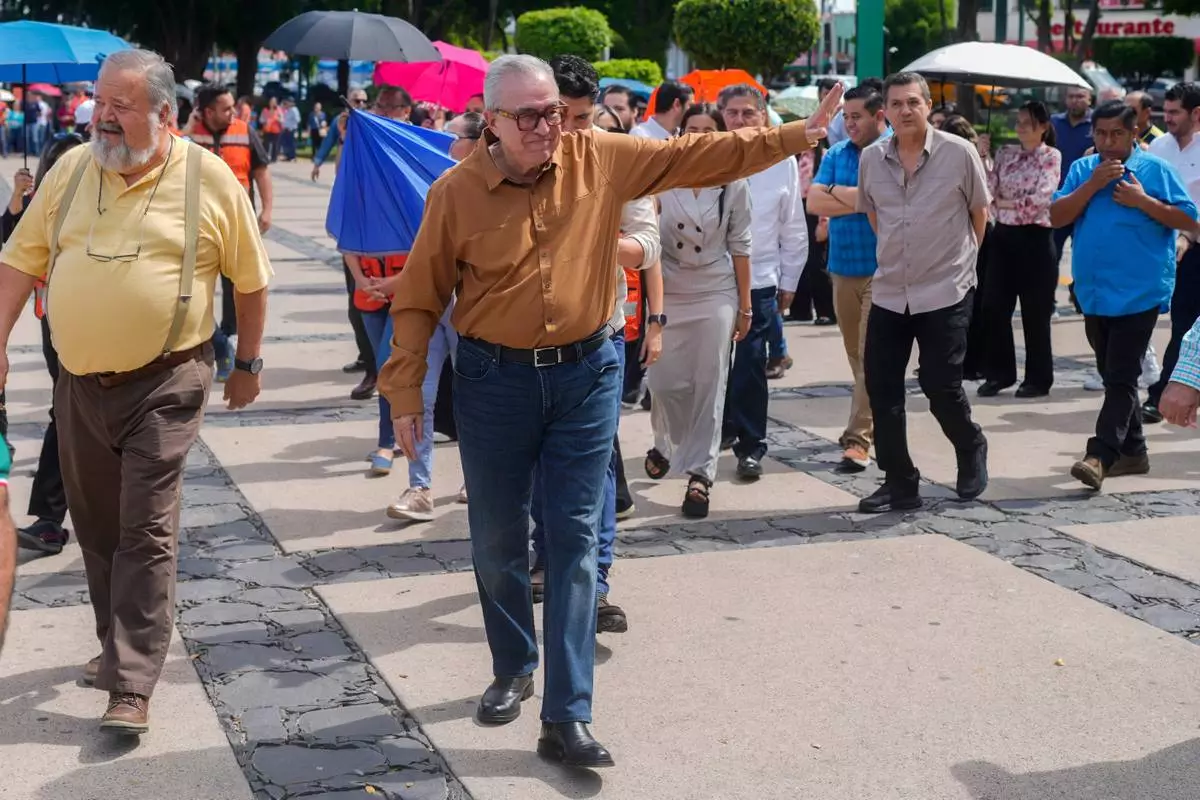
FILE - Sinaloa state Gov. Ruben Rocha waves as he takes part in an annual earthquake drill in Culiacan, Mexico, Sept. 19, 2024. (AP Photo/Eduardo Verdugo, File)