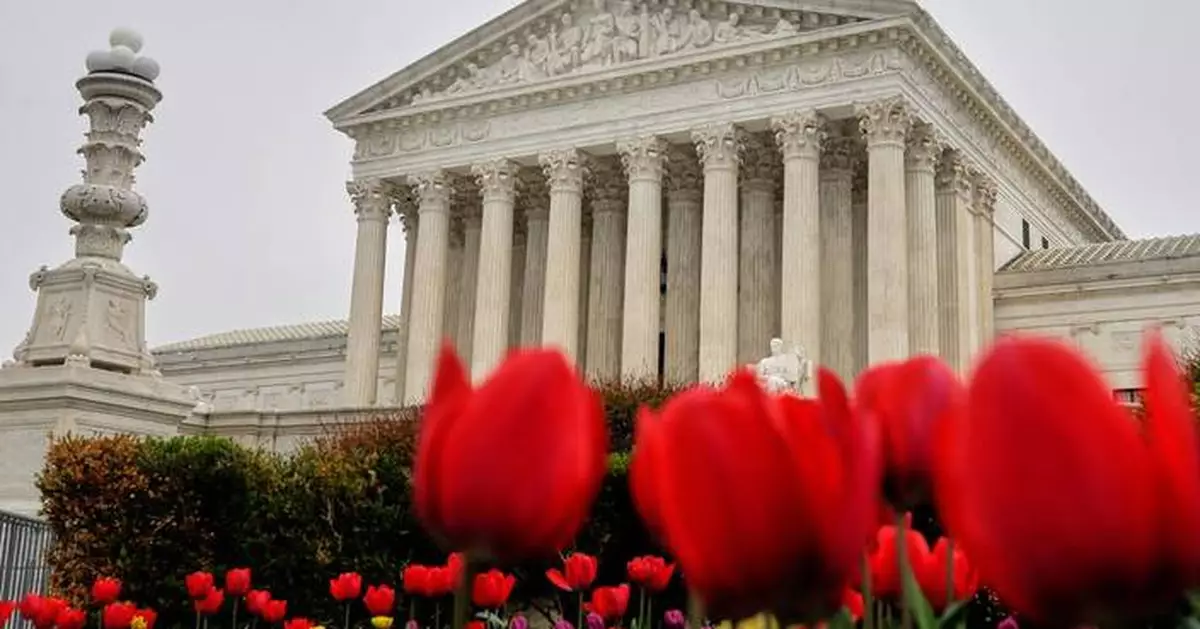
The U.S. Supreme Court's conservative majority on Wednesday handed Republicans their biggest victory yet in the perpetual battle to control the House of Representatives and statehouses across the country — but it may have come too late to have much of an effect on this year's midterm elections.
The 6-3 ruling effectively gutted the Voting Rights Act's requirement that districts be drawn to give minority voters a chance to elect representatives of their choosing. One practical effect of that requirement was the protection of reliably Democratic-voting majority-minority districts, even in solidly red states where lawmakers could otherwise favor the GOP.
With that mandate now largely gone, Republican lawmakers across the country — and especially in the South — have a freer hand to eliminate Democratic-leaning districts and pad the total number of seats they can win to hold the U.S. House. There are more than a dozen such seats in Republican-controlled states.
Shortly after the ruling, Republicans were urging a review of their congressional maps in Louisiana, Tennessee and elsewhere.
Their immediate challenge is that the ruling came down well after filing deadlines for this year's primary elections — and in some cases, after those primary elections have been held. That means ballots are set and in some states early and absentee voting has already begun.
The timing makes it difficult to tear up maps and draw new ones. In Louisiana, where the mandate to draw a second, Democratic-leaning majority-Black House district led to Tuesday's decision, the primary election for federal offices is set for May 16 — and early voting is scheduled to begin Saturday. Nevertheless, the state's governor, attorney general and legislative leaders were meeting to discuss how the state would respond.
Republicans have been scrambling to comply with President Donald Trump's directive to redraw maps to add more winnable House seats to stave off losses in the midterms. In a sign of the pressure for Republicans to take advantage of the opportunity, multiple hopefuls running for governor in GOP primaries called for immediate redraws.
“There is no time to waste," Rick Jackson, a businessman and GOP governor candidate in Georgia, said in urging a redraw there even as voting is underway for the May 19 primary. "Georgia must act now to ensure secure elections in Georgia and counter the Democrats’ national assault on our elections.”
Sen. Marsha Blackburn, running for the GOP nomination for governor in Tennessee, called for redrawing that state's congressional map to replace its lone, majority-Black Democratic congressional seat with one more winnable for Republicans — even though that state's deadline for candidates to get on the ballot was March 10.
In a social media post, Trump praised the opinion by “brilliant Justice Samuel Alito” for returning “the Voting Rights Act to its Original Intent, which was to protect against intentional Racial Discrimination.”
Democrats have managed to largely counter Republicans' push to draw more winnable seats in the round of mid-decade redistricting that started last year, but there is no clear way they could match the GOP's potential gains from the effective loss of the Voting Rights Act.
“It should not be lost on anyone that the Roberts court makes this decision at a time when Republican leaders across the country are foaming at the mouth to draw the American people out of a meaningful say in our elections,” former Attorney General Eric Holder, chairman of the National Democratic Redistricting Committee, said in a statement, referring to the court's Republican-nominated chief justice, John Roberts. "They want to retain illegitimately obtained power through the use of, among other things, now Supreme Court-sanctioned racial and partisan gerrymandering.”
Only one Republican state has a relatively clear path to gaining seats from the decision in time for the midterms — Florida. GOP Gov. Ron DeSantis has called a special session to adopt his map that could give his party four new winnable House seats. DeSantis had been counting on the Supreme Court ruling as it did Wednesday, and his state's primary is not until August.
The Florida Legislature approved the new congressional map Wednesday.
Other states have to confront the unprecedented possibility of revising maps even as voters are casting ballots or the legal process of declaring intent to run for office has concluded.
“I don’t know what the implications are going be for the fall. It's pretty late,” said Rep. Richard Hudson of North Carolina, chairman of the National Republican Congressional Committee.
He said any redistricting decisions in the weeks ahead would be up to governors and legislatures.
In the longer term, the ruling clears the way for a drastic reshaping of the nation's political geography, at least by the time of the next presidential election year in 2028.
“The Voting Rights Act as a means to protect minority voters from vote dilution is essentially dead,” said Jonathan Cervas, a political scientist at Carnegie Mellon University who has worked as the court-appointed special master and mapmaker in multiple Voting Rights Act cases. “It's hard to imagine how this decision does not lead to additional GOP districts into the future.”
Cervas noted the Voting Rights Act isn't necessarily a partisan benefit for Democrats. Its most frequent use comes in local, nonpartisan races for offices such as school board or city council. But Republicans have long complained that Democrats have used the law to get winnable districts for their Black voters in red states that Republican-leaning white voters could never receive in blue states.
“For decades the left has spent hundreds of millions of dollars seeking to divide Americans along racial lines in a cynical pursuit of partisan power masquerading as civil rights,” Adam Kincaid, the National Republican Redistricting Trust’s executive director, said in a statement. “Today’s decision rebukes that divisive and unconstitutional effort.”
While the Voting Rights Act has helped preserve Democratic-leaning districts, those voters don't vanish just because of Wednesday's ruling. Republicans in some states cannot just eliminate all those districts without spreading enough Democratic voters around to jeopardize their own incumbents.
Likewise, the requirement that Democratic-leaning minority voters be concentrated in certain districts has occasionally hurt Democrats in states such as Michigan, lowering the number of swing districts they might win. The party could partly counter Republican gains by spreading minority voters wider in states it controls.
But there will be political pressure against that from some Black and Hispanic Democrats who want to ensure their communities still command the majority in certain districts. Democratic-controlled states also are more likely to have nonpartisan redistricting commissions that make their congressional maps less partisan and increasingly have adopted state-level versions of the Voting Rights Act to protect sometimes marginalized communities.
That will take time, but it all points to a far less regulated environment for mapmaking in the years to come.
That worries Thomas Johnson, a Black voter in New Orleans who was at the state Capitol to lobby on unrelated legislation Wednesday when the Supreme Court ruling came down. The majority-Black congressional district in which he lives can now be diced up by that state's Republican legislature.
“We are going to do all we can and continue fighting so our voices are heard,” Johnson said. “That’s all we want, to be heard.”
Associated Press writers Jeff Amy in Atlanta, Lisa Mascaro in Washington, Jonathan Mattise in Nashville, Tennessee, and Sara Cline in Baton Rouge, Louisiana, contributed to this report.
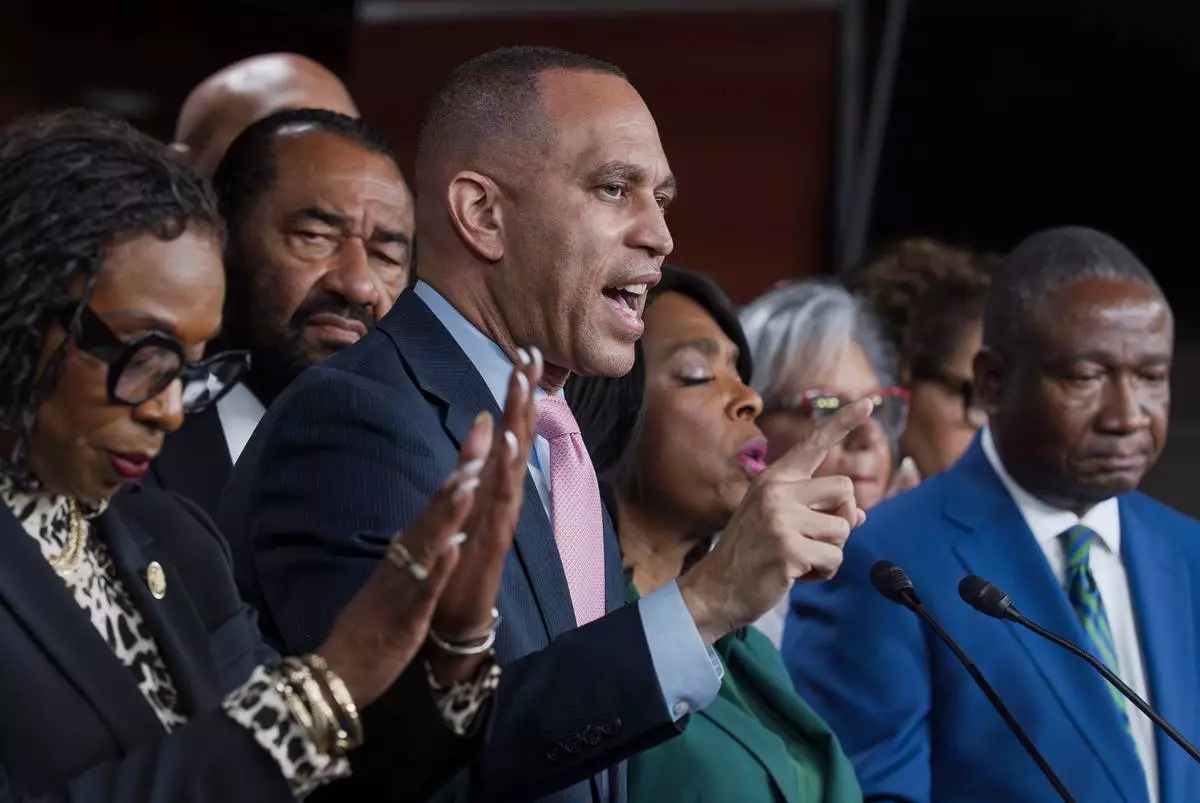
House Minority Leader Hakeem Jeffries, D-N.Y., and members of the Congressional Black Caucus speak to reporters in the wake of the Supreme Court ruling to strike down a majority Black congressional district in Louisiana, at the Capitol in Washington, Wednesday, April 29, 2026. (AP Photo/J. Scott Applewhite)
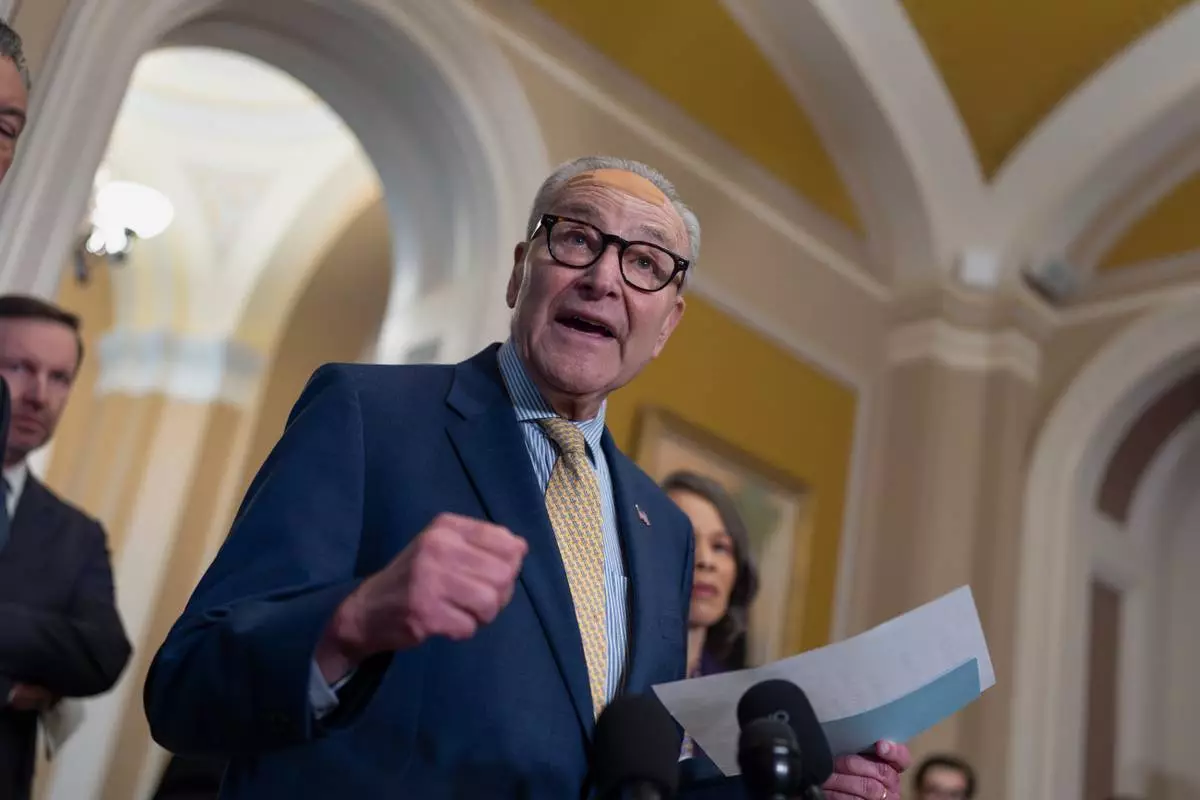
Senate Minority Leader Chuck Schumer, D-N.Y., speaks on fair elections and the Supreme Court's ruling to strike down a majority Black congressional district in Louisiana, at the Capitol in Washington, Wednesday, April 29, 2026. (AP Photo/J. Scott Applewhite)
FILE - The U.S. Supreme Court is seen in Washington, Friday, April 3, 2026. (AP Photo/Rahmat Gul, File)