President Donald Trump has confirmed a deal to end the war with Iran and allow oil traffic to begin again through the Strait of Hormuz.
The announcement on social media came just a couple of hours before the president was slated to celebrate his 80th birthday and the nation’s 250th anniversary with an unusual White House event: a UFC show featuring seven fights within an eight-sided, wire-mesh cage on the White House South Lawn.
UFC Freedom 250 has kicked off with knockouts by Diego Lopes against Steve Garcia, by Bo Nickal against Kyle Daukaus and by Mauricio Ruffy against Michael Chandler.
Next up is Sean O’Malley vs. Aiemann Zahabi.
Here's the latest:
Tony Hinchcliffe was one of the VIPs at the event, smiling and waving for the broadcast.
Near the end of Trump’s 2024 run for a second term, Hinchcliffe caused an uproar at a Madison Square Garden rally when he called Puerto Rico “a floating island of garbage.”
Trump’s campaign took the rare step of distancing itself from the comedian at the time, saying the joke didn’t reflect Trump’s views.
Brazilian Mauricio Ruffy got a knockout and followed it with a wedding proposal.
In the interview after his knockout of Michael Chandler, Ruffy proposed to his girlfriend, Nadine.
She gave a thumbs up.
Brazilian Mauricio Ruffy knocked out American Michael Chandler in the first round of a middleweight fight.
Ruffy stunned Chandler with a kick and then finished him off by TKO 4:29 into the fight.
President Donald Trump pumped his first in approval after the knockout from his ringside seat.
U.S. Park Police said in a statement that UFC middleweight champion Sean Strickland’s presence at the Ellipse drew enough attention from attendees that it resulted in disorder. He wasn’t cited or arrested, they said. Instead, he was taken to his hotel and told not to come back to the venue.
Earlier in the day, Strickland was escorted barefoot out of the White House Ellipse area, where thousands of ticketed fans congregated to watch the fights.
The law enforcement agency said Strickland’s removal from the site was due to concerns for his safety and the UFC fans. U.S. Marshals Service, U.S. Park Police and other agencies were involved in escorting him out.
Republican Sen. Lindsey Graham is a close ally of Trump and an Iran hawk. He expressed skepticism about the emerging deal, saying that Congress would need to review and vote on it, and said he expects Vice President JD Vance — “the architect of the deal” — to present it.
“I am somewhat concerned that Iran’s view of the agreement seems different than what the American negotiating team is claiming,” Graham said on social media.
Bo Nickal knocked out Kyle Daukaus in the first round in a middleweight fight.
Nickal knocked Daukaus down with a right hook, and the referee quickly stopped the second fight of the event 4:34 into the opening round.
Nickal went right over to Trump after the win and talked briefly with the president. Nickal, a three-time NCAA Division I wrestling champion at Penn State, has forged a friendly relationship with Trump after they met in 2019 at the White House during a ceremony for collegiate national champions.
The fighters are getting impressive walkouts before each fight.
They leave the White House, one at a time, accompanied by two people described by the broadcast as “heroes.”
Bo Nickal and Kyle Daukaus were each joined by a Las Vegas police officer and a medal of honor recipient before the second fight.
Diego Lopes and Steve Garcia each walked out with two first responders before the first fight.
Diego Lopes knocked out Steve Garcia in the second round of the first fight of the UFC Freedom 250.
Lopes connected with a left hook that knocked Garcia down and then finished him off before the referee stopped the fight.
The UFC Freedom 250 event started with a featherweight fight between Diego Lopes and Steve Garcia.
Garcia walked out of the White House draped in an American flag and accompanied by two police officers. Lopez walked out the Mexican song “La Chona.”
Fans were chanting “USA! USA!” just before the start of the fight.
The president and UFC chief Dana White walked together from the Oval Office to the Truman balcony, then stood for the National Anthem as fighter jets streaked overhead.
Before the anthem began, the two men shared a moment on the balcony. Trump smiled as White pointed to the Octagon and “The Claw” on the White House’s South Lawn.
After the anthem, the crowd cheered and chanted “USA! USA!”
Trump and White then put on somber expressions as they walked the rest of the way to the cage where the UFC fights will take place.
Trump has a seat very close to the Octagon.
Clouds are getting darker but there’s still no significant rain at the Ellipse, where a live band was still playing for fans when the broadcast’s 8 p.m. start time arrived.
Earlier, a message appeared on the video screens warning about possible bad weather and telling the crowd to be prepared to leave and take shelter.
UFC middleweight champion Sean Strickland was escorted out of the Ellipse event by a group of police officers and taken into a Park Police van Sunday.
Once a vocal supporter of Trump, Strickland has recently said on social media that he was not invited to participate in the event at the White House because he is an outspoken critic of Israel.
Strickland was wearing a black anorak jacket and was barefoot. It wasn’t immediately clear why law enforcement led him away.
UFC CEO Dana White has rejected Strickland’s accusation that he was banned from UFC Freedom 250 events.
“Nobody is banned. Nothing is banned,” White told reporters earlier this month.
Richard Williams doesn’t have tickets to Sunday’s fights. But he drove with a friend from Pittsburgh to attend Saturday’s Fan Festival in Washington, D.C., because he wanted to see what all the hubbub was about.
He’s never been to an MMA event before but described the show the UFC put on for fans as “pretty awesome.”
For the fights to coincide with Trump’s 80th birthday and America’s 250th year, “all of that coming together at once is really amazing,” Williams said.
Even with a deal in place, it will take months for oil and gas supplies to be flowing freely enough for the world’s needs to be met, because shipping and insurance companies will want to be confident the agreement will last, energy experts said. And countries in the Middle East who paused production may have a long road ahead to restart those oil fields.
Vice President JD Vance in an interview with Fox News said the White House was still figuring out the logistics of who will attend Friday’s signing ceremony in Switzerland.
“I certainly plan to be there, but it’s possible the president himself could be there,” Vance said.
He said the deal could have a transformative impact on the Middle East.
“This region of the world has been a basket case for my entire life, and longer than that,” Vance said, explaining the deal could “eliminate the nuclear threat of Iran” as well as build prosperity.
Along with a string of Trump administration officials and lawmakers, including FBI Director Kash Patel, acting U.S. Attorney General Todd Blanche and Speaker of the House Mike Johnson, at least one foreign dignitary was seen entering the White House campus on Sunday.
Poland’s President Karol Nawrocki was spotted heading into the White House before the UFC event on the South Lawn.
Hockey’s Tkachuk brothers were at the Ellipse as part of pre-fight festivities. They were interviewed on the main stage.
Matthew Tkachuk offered the following hot take: “It’s going to be the under in every single fight,” he said. “I think it’s not going to last like halfway through. They’re all going to be knockouts or finishes early.”
Jake Rowe, of Grand Rapids, Michigan, traveled to Washington, D.C., with his brother for the UFC fights.
“I’ve never been to an MMA match before,” he said. He jumped at the chance when he got tickets to Sunday’s events.
He’s hoping American Justin Gaethje emerges the victor in the lightweight title bout against Spanish-Georgian lightweight champion Ilia Topuria.
In a card that has been panned by fans online as underwhelming, Alex Pereira of Brazil will meet Ciryl Gane of France for the interim UFC heavyweight title. Spanish-Georgian lightweight champion Ilia Topuria then takes on interim champ Justin Gaethje, one of just two Americans who currently hold even a share of the UFC’s 11 championship belts.
There are five other fights on the main card that include former title-fight participants Michael Chandler and Derrick Lewis and former 135-pound champion Sean O’Malley.
UFC CEO Dana White said the show will go on rain or shine. Strong thunderstorms and heavy lightning disrupted Friday’s Lincoln Memorial promotional event, and the forecast for Sunday evening also looks threatening.
French President Emmanuel Macron said the deal between the United States and Iran will be discussed at the G7 summit, which begins Monday in the French resort town of Evian-les-Bains and brings together leaders of the world’s major advanced economies, including President Donald Trump.
“The aim will be to assess the implications of this agreement, support for Lebanon, the long-term reopening of the Strait of Hormuz, and, of course, reaching a deal on Iran’s nuclear and ballistic (missile) programs,” Macron said in a video posted on X.
Egypt, Qatar and the United Arab Emirates will join discussions in Evian on Tuesday.
The G7 includes the U.S., France, Canada, Germany, Italy, Japan and the United Kingdom.
Tomasz Oracz, from south Poland, traveled from his home country to watch the seven Sunday fights.
He was spotted watching one of the many mixed martial arts fighter interviews that were taking place on the mainstage Saturday. Oracz said he was equally excited about each bout on Sunday’s fight card and couldn’t pick a favorite.
“These events are very important,” he said, especially since Poland’s president, Karol Nawrocki, is expected to attend the festivities, according to Polish media. Nawrocki has a background as an amateur boxer.
UFC posted on social media that severe weather was expected Sunday night and fans should plan accordingly.
“We anticipate inclement weather in the area, so attendees should plan accordingly,” the UFC wrote. “We will share additional information when available.”
UFC CEO Dana White said the show will go on rain or shine. Strong thunderstorms and heavy lightning disrupted Friday’s Lincoln Memorial promotional event, and the forecast for Sunday evening also looks threatening.
Sunday’s event includes a watch party on the Ellipse, the expansive lawn area located between the White House and Washington Monument.
In addition to the massive video screens, there are various military-themed vehicles on display, as well as concession stands and free water that fans were lining up for under the afternoon sun.
The area is heavily secured from the outside, and there’s law enforcement presence inside as well, but as of 5 p.m. there was little sign of any unruliness.
Trump says “the Deal with the Islamic Republic of Iran is now complete” and says the Strait of Hormuz will open immediately.
“Congratulations to all!” he wrote Sunday on his social media site. “I hereby fully authorize the toll free opening of the Strait of Hormuz, and, simultaneously herewith, authorize the immediate removal of the United States Naval blockade.”
The president added, “Ships of the World, start your engines. Let the oil flow!”
Trump’s post came hours before a UFC event at the White House marking his 80th birthday.
Pakistan says the United States and Iran have reached an agreement to end the war and open the Strait of Hormuz, offering relief to the global economy more than three months since the war began.
Full details of the deal were not immediately available. The signing will be Friday in Switzerland. It is not clear how quickly the strait might reopen to all traffic. The U.S. previously said it would ease its blockade of Iranian ports as the strait reopens, and would agree to relax sanctions to allow Iran to sell more of its oil and strengthen its battered economy.
A muggy and very hot afternoon in Washington was forecast to give way to thunderstorms shortly after the evening fights in honor of Trump’s 80th birthday are set to begin.
UFC chief Dana White has insisted for days that the show will go on rain or shine.
But he’s also conceded, “I’m sick and tired of hearing about the weather” and said his league is sticking to indoor arenas going forward.
The White House is also touchy.
After the Weather Channel warned on X of a “60% chance of thunderstorms, heavy downpours, and wind gusts up to 34 mph,” the Rapid Response 47 account — which posts for the Trump administration — dismissed the post as the work of a “friendless loser” and added an expletive for emphasis.
The Freedom 250 card marks the pinnacle of the relationship between UFC CEO Dana White and Trump, which has yielded personal, political and financial dividends for both parties. White’s first card as UFC president took place in 2001 at an event held at the Trump Taj Mahal casino.
Trump has attended four UFC cards as sitting president, walking to the cage amid rock music and patriotic chants from fans, much like the fighters themselves. White introduced Trump at two Republican National Conventions. White also attended the White House Correspondents’ Association dinner in April that was cut short by a shooting.
The UFC event is an apt metaphor for Trump’s pugilistic political style. He is as big a fan of cage-match-style politics as he is of cage-fighting itself.
But Trump has also long been a master of political misdirection, purposely presenting people with something other than his presidency to focus on when things aren’t going well.
With the war in Iran grinding on despite weeks of assurances from Trump that its end is nigh, gas prices staying high, renewed concerns about inflation and plummeting job approval ratings for Trump — a White House birthday party unlike anything America has ever seen is definitely a diversion.
The apparent breakthrough in negotiations comes after Iran exchanged fire with the U.S. and Israel over three days this week, threatening to push the region into a full-scale war. U.S. Central Command late Friday said in a social media post that it intercepted several Iranian attack drones that were targeting commercial ships in the Strait of Hormuz. (Produced by Luke Garratt)
“This is all distraction,” said Mike Fontaine, a classics professor at Cornell University, who likened it to the gladiatorial games of Imperial Rome, when combatants brutalized each other for public entertainment meant to bolster rulers’ popularity and quell potential unrest.
“This is a classic strategy,” Fontaine said. “In ancient Rome, the phrase would be, ‘bread and circuses.’”
Trump says the UFC is paying for the event, and while its full costs haven’t been divulged, the National Park Service said in a court filing that $60-plus million and tens of thousands of hours of labor have gone into it, while seven government agencies have “allocated significant resources and manpower.”
UFC also announced on Friday that it was adding World Liberty Financial as an official partner for the event to create a special $250,000 athlete bonus pool for Sunday night’s winners. The cryptocurrency company is co-owned by the Trump family, founded with the president’s special diplomatic envoy Steve Witkoff and run by his son, Zach. The arrangement further blurs lines between the Trump family’s financial interests and the events and construction projects the president has prioritized and used government resources to pull off.
One by one, the burly mixed martial arts fighters made their entrance past the solemn, hulking marble statue of America’s 16th president and jogged down the steps of the Lincoln Memorial to roars from thousands of fans drawn to the unusual sporting weekend.
The news conference Friday night featured the fighters who are preparing to face off Sunday in the Octagon built outside the White House. But it was also a chance to see the UFC fans who have thronged to Washington and endured lightning, humidity and bugs for the spectacle.
Tracy Philbeck and his son Levi drove from Charlotte, North Carolina, with a group of friends to support their favorite fighter, American Justin Gaethje, in the upcoming lightweight title bout against Georgian Ilia Topuria.
“You will hear an eagle screaming when Justin Gaethje wins,” the elder Philbeck chuckled.
▶ Read more
President Donald Trump turned 80 on Sunday and is set to celebrate with one of the more surreal spectacles both in sports and even in the nation’s capital: cage fighting on the White House lawn.
Against the backdrop of a 3-month-old war with Iran that’s been broadly unpopular with Americans and has rattled global oil markets and with inflation spiked to the highest level since April 2023, the White House — long known as the people’s house and a symbol of American democracy — opened its backyard Sunday night to stage a bruising UFC card on the South Lawn.
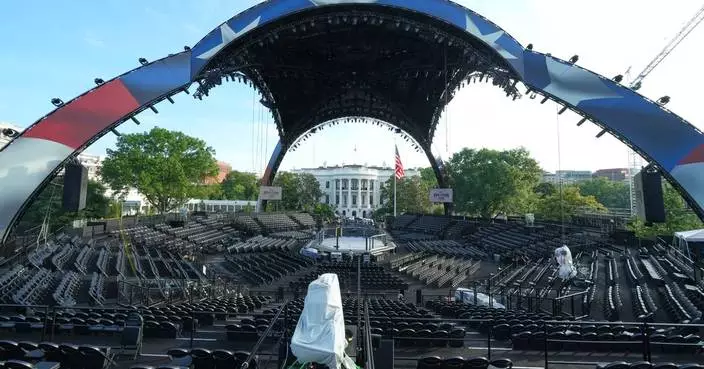
More than $60 million and tens of thousands of hours of labor have been poured into building the arena, according to a court filing from the National Park Service, which oversees the South Lawn.
UFC is staging seven fights with all male fighters under the Freedom 250 banner to celebrate Trump’s 80th birthday and the 250th anniversary of the Declaration of Independence’s signing.
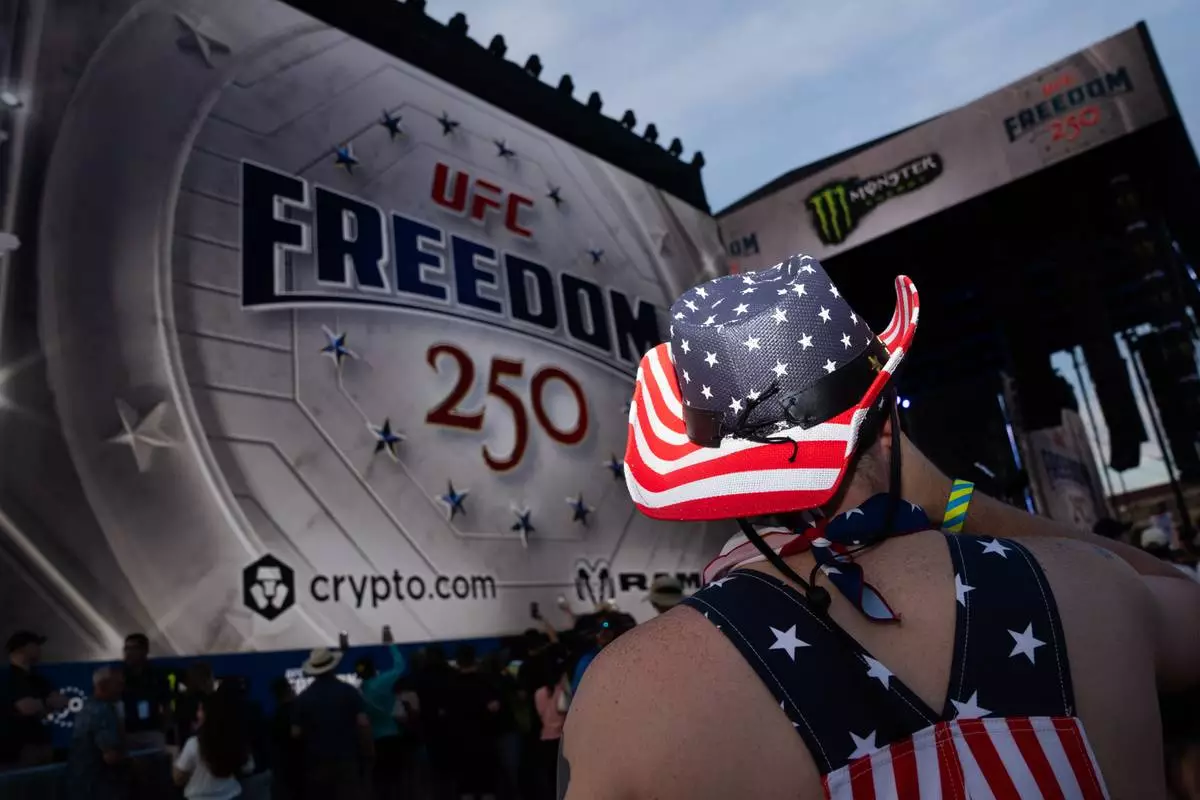
The UFC Fan Fest on the White House Ellipse ahead of Sunday's fight on the South Lawn, Saturday, June 13, 2026, in Washington. (AP Photo/Allison Robbert)
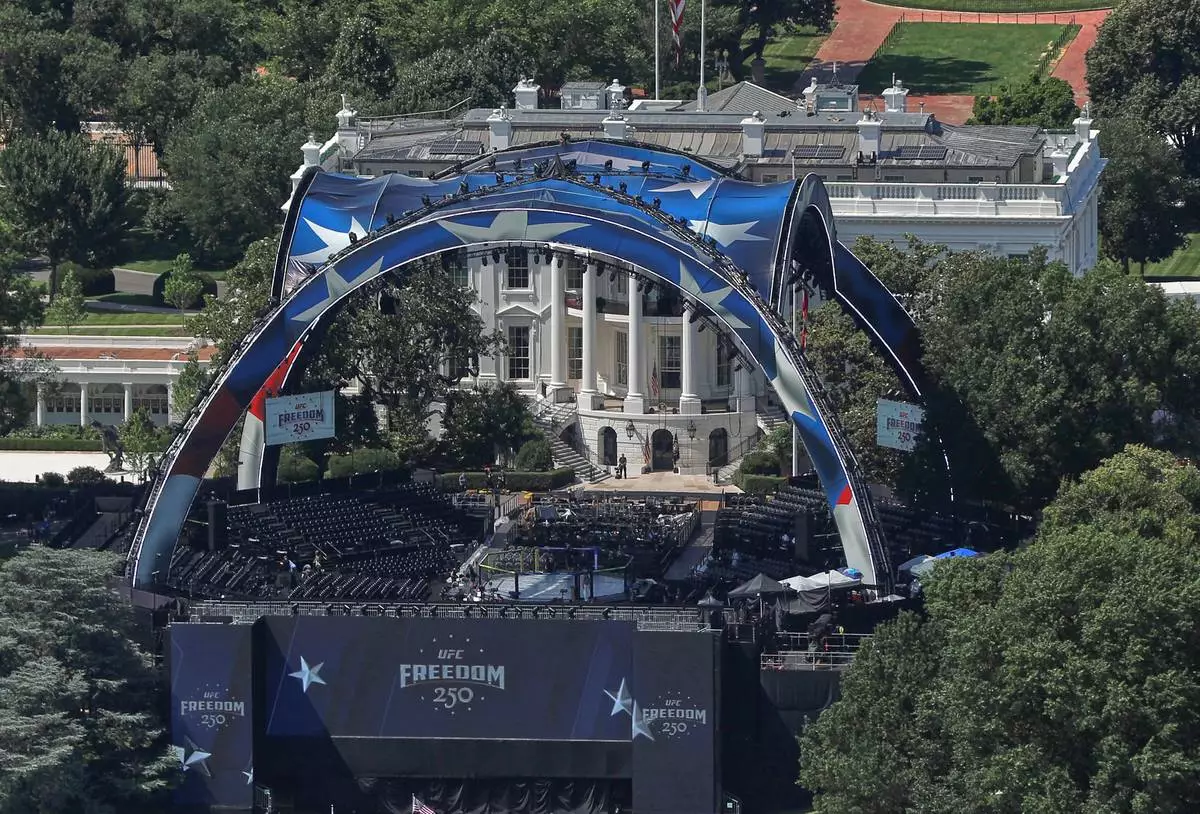
The arena for the UFC Freedom 250 fights is pictured on the South Lawn of the White House, in Washington, Saturday, June 13, 2026. (AP Photo/Rahmat Gul)