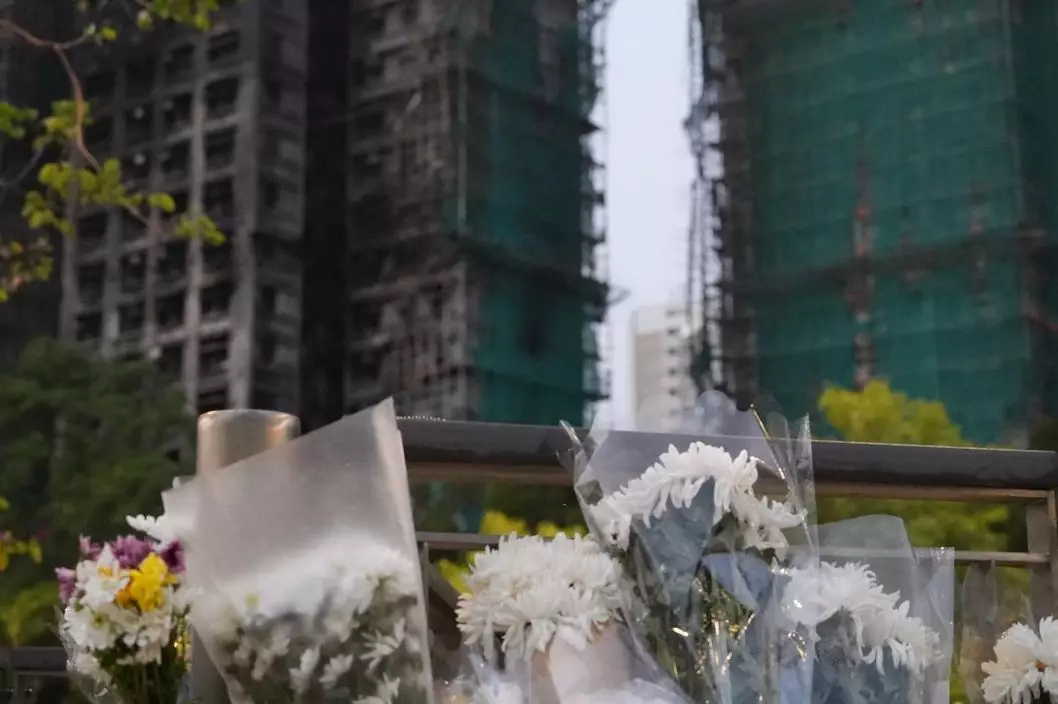
Today (April 30) marks the 11th day for Wang Fuk residents to return to their homes to retrieve their belongings in phases. Among them, Wang Tai House and Wang Cheong House are the most severely hit, with a high number of fatalities.

Today (April 30) marks the 11th day for Wang Fuk residents to return to their homes to retrieve their belongings in phases. Photo by Bastille Post

Mr. Ng, Photo by Bastille Post
Mr. Ng, a resident living on a lower floor of Wang Tai House, managed to retrieve a pair of ivory chopsticks and keepsakes related to his children's births. He described his home as "reduced to ashes, and nothing is left." He said he would think about whether anything else had been overlooked this time. "Having waited for four or five months, we could still manage to get something back. I suppose it's OK," he said.
Click to Gallery

Today (April 30) marks the 11th day for Wang Fuk residents to return to their homes to retrieve their belongings in phases. Photo by Bastille Post

Mr. Ng, Photo by Bastille Post

Mr. Chu, Photo by Bastille Post

Mrs. Chu, Photo by Bastille Post

The photo showing the current condition of Mr. and Mrs. Chu's unit, Photo by Bastille Post

The pots and bowls retrieved by Mr. and Mrs. Chu, Photo by Bastille Post

The pots and bowls retrieved by Mr. and Mrs. Chu, Photo by Bastille Post

The photo shown by Mr. and Mrs. Chu, Photo by Bastille Post

Wang Fuk residents continued to return to their units to retrieve personal belongings. Photo by Bastille Post

Mr. Chu, Photo by Bastille Post

Mrs. Chu, Photo by Bastille Post
Mr. and Mrs. Chu, who live on the middle floor of Wang Tai House, had lived in Kwong Fuk Estate for more than a decade before recently purchasing a unit at Wang Fuk Court. They had just finished renovations and had been living there for less than a month when the fire broke out.

The photo showing the current condition of Mr. and Mrs. Chu's unit, Photo by Bastille Post
Mr. Chu said, "The fire can be called a disaster-level. Everything turns to ashes. We have seen some photos of our unit, so we were mentally prepared. There wasn't much hope for the retrieval. We just managed to collect a few pots and bowls, which didn't burn through."
Mrs. Chu wept sorrowfully. "You really have to see it with your own eyes to know how terrible the inner condition can be," she said. Looking forward to the future, she hoped that every Wang Fuk resident could pull themselves up and that the government could provide some possible assistance. "Residents have lost their homes and are displaced. I really hope the government can do a better job to help us."

The pots and bowls retrieved by Mr. and Mrs. Chu, Photo by Bastille Post

The pots and bowls retrieved by Mr. and Mrs. Chu, Photo by Bastille Post
She mentioned that many residents originally lived in large units of 400 to 500 square feet, but the options provided by the government are limited, with only about 100 large units per location available through a ballot. "It still comes down to luck whether you can get one. It feels like everyone has to struggle for them. That doesn't feel good," she said.

The photo shown by Mr. and Mrs. Chu, Photo by Bastille Post
As for Mr. Chu, he said he would not return to the unit again. "There's no point," he said. "Just take a photo as a souvenir, and say goodbye to our past grief."

Wang Fuk residents continued to return to their units to retrieve personal belongings. Photo by Bastille Post