NEW YORK (AP) — Walks are up 7.3% as pitches in the strike zone dropped markedly and the average time of games increased by 5 minutes through the first full month of Major League Baseball’s initial season with robot umpires.
Average attendance increased 2.8% and the big league batting average went up by one percentage point to .243. Home runs are being hit at the same rate as last year and stolen bases and success rate dipped.
The Automatic Ball/Strike System has upheld 53.4% of challenges (1,030 of 1,928), with catchers far more successful than batters.
Walks are up from 6.8 per game through April of last year. Over a full season, the average would be the highest since 2000 and the ninth highest in major league history, but walks have declined since the season's start and averaged 6.98 per game from April 21-30.
“I think it’s the same thing that happened in the minor leagues. So I don’t think this is unexpected at all," Chicago Cubs president of baseball operations Jed Hoyer said Friday. “I think it’s our job to make those adjustments.”
Pitches in the strike zone were 47.3% of offerings according to MLB Statcast, down from a record high 50.6% last year. Since tracking began, the previous low of 47.5% was in 2019 and 2020.
This year is down from 50.1% through April 30 last year and the second-lowest through the first full month, above only 47.2% in 2010. Statcast switched its measurement to the ABS version of the strike zone this year.
“The strike zone was always the umpire behind home plate, his representation or judgment of the strike,” Baltimore Orioles manager Craig Albernaz said. “I think now is the first time ever we actually have a clear strike zone.”
Instead of using the cube strike zone in the rule book, ABS calls strikes solely based on where the ball crosses the midpoint of the plate, 8.5 inches from the front and the back. The top of the strike zone is 53.5% of batter height and the bottom 27% rather than the rule book definition of the top as the midpoint between the top of the shoulders and the top of the uniform pants, and the bottom as the hollow beneath the kneecap.
Strikeouts have increased slightly to an average of 16.9 per game from 16.6 through April last year and scoring is up slightly to 9 runs per game from 8.7.
Hitters have succeeded on 46% of challenges (409 of 890), catchers on 60.6% (605 of 997) and pitchers on 41.5% (17 of 41), leaving the fielding team at 59.8% (621 of 1,038).
“I do think that the catchers have a better vantage point just because they’re directly behind the zone,” Tampa Bay catcher Nick Fortes said.
Arizona manager Torey Lovullo, a former infielder, anticipated catchers' success.
“I think emotion gets involved on every level with every player. I think the catcher probably has the least emotion," Lovullo said. “I think with the pitcher, there’s a head jerk, the body’s moving, you don’t get a great look at it.”
Teoscar Hernández of the Los Angeles Dodgers is 4 for 4, the most successful challenges among batters who are at 100%. Miami’s Agustín Ramírez is 0 for 5, the most misses among batters with no successes.
Catchers with the best success rate among those with at least 10 challenges are Seattle's Mitch Garver (10 of 11), Detroit's Dillon Dingler (13 of 15) and the Chicago Cubs' Carson Kelly (12 of 14). Kansas City's Carter Jensen (3 of 10) and Houston's Christian Vázquez (4 of 13) are the lowest.
Among umpires who have worked more than two games behind the plate, Willie Traynor (95.3%) and Edwin Moscoso (95.2%) had the best accuracy rate, according to taptochallenge.com. Paul Clemens (91%), Chris Segal (91.1%) and Dan Iassogna (91.1%) were the lowest.
“I think you just see the umpires being really cognizant of the challenges,” Albernaz said, "because I don’t think anyone wants to be embarrassed at their job and get posted up there and see if it’s a ball of a strike.”
The average time of a nine-inning game has crept up to 2 hours, 42 minutes, up from 2:37 through April last year. MLB said it attributes 64 seconds of the increase to the ABS system.
Pitch clock violations through 468 games averaged 0.20 per game, up from 0.19. Of the violations, 0.16 were on the defensive team and 0.04 on batters.
Attendance has averaged 28,545 per game, up from 27,744 through April last year, when the final figure was 29,471 in the third straight season of increase.
Stolen bases have slid to 1.4 per game from 1.6 through April last season and the success rate decreased to 76.6% from 78.4.%.
AP Sports Writers Jay Cohen and Steve Megargee, and AP freelance writer Ken Powtak contributed to this report.
AP MLB: https://apnews.com/hub/mlb
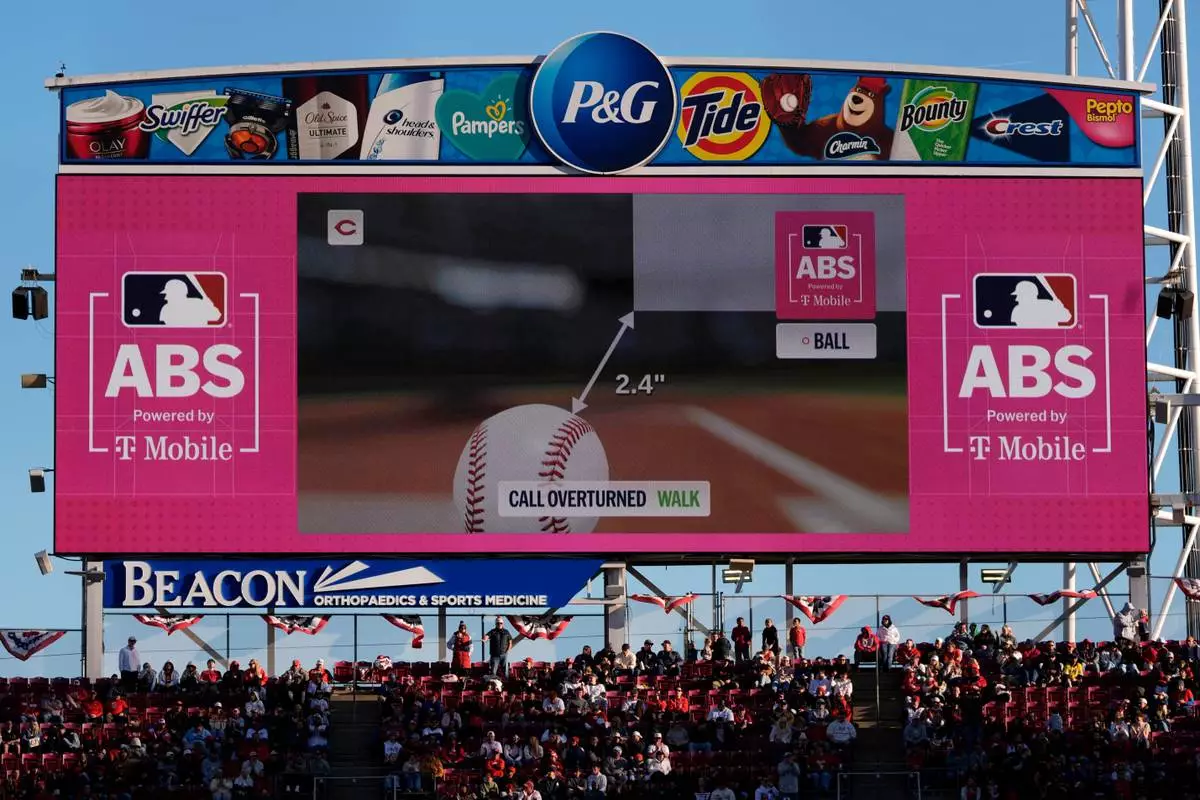
FILE - A call is overturned to a walk by the Automated Ball-Strike (ABS) Challenge System, displayed on the stadium screens, after Cincinnati Reds' Will Benson challenged at pitch result during the seventh inning of a baseball game against the Boston Red Sox in Cincinnati, March 28, 2026. (AP Photo/Carolyn Kaster, File)
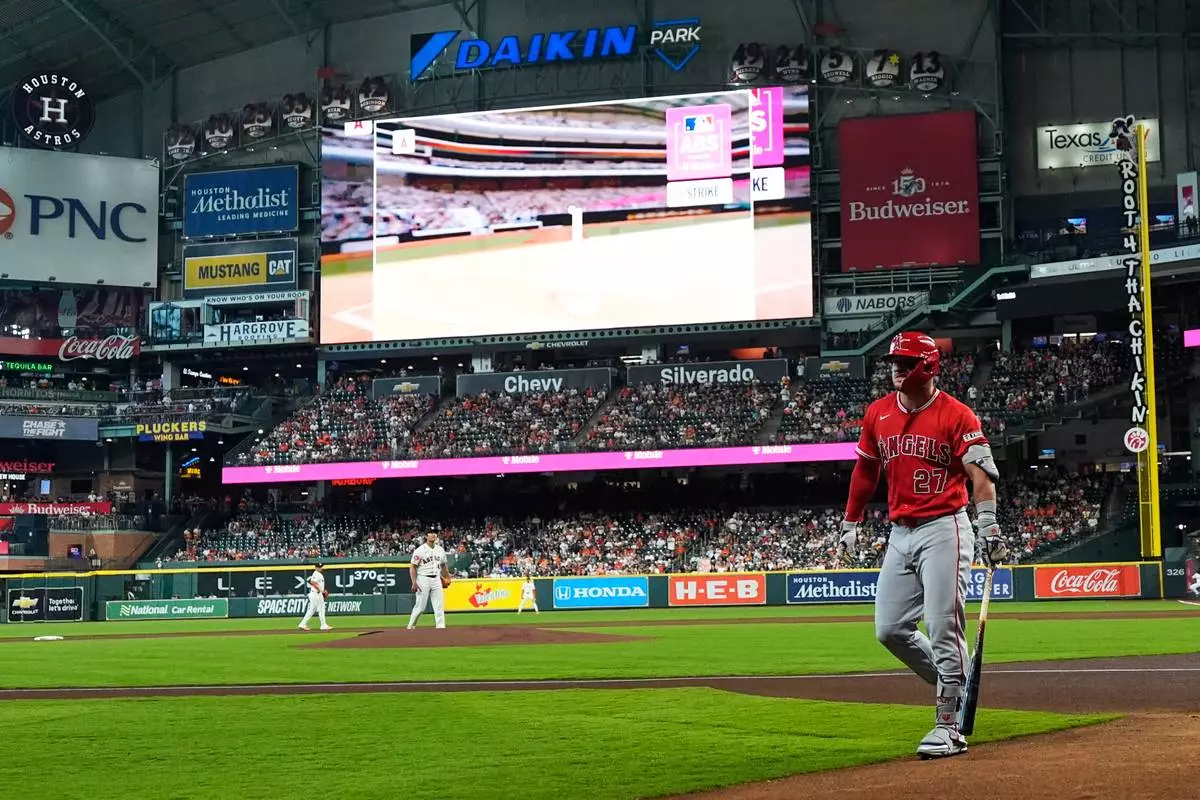
FILE - Los Angeles Angels designated hitter Mike Trout reacts after striking out as the ABS replay shows on the screen during the first inning of a baseball game against the Houston Astros in Houston, March 29, 2026. (AP Photo/Ashley Landis, File)