XUZHOU, China, May 4, 2026 /PRNewswire/ -- XCMG Machinery ("XCMG", SHE: 000425) announced that it has once again ranked third globally among construction equipment manufacturers based on sales revenue in the Yellow Table 2026, published by International Construction, a magazine under global construction media group KHL Group, with equipment sales reaching approximately USD 14.2 billion and a market share of 5.8%. As the highest-ranking Chinese company on the list, XCMG remains the only manufacturer from China in the global top five.
"XCMG's sustained ranking among the world's top three construction equipment manufacturers is a testament to our robust global footprint and long-term strategy," said Yang Dongsheng, Chairman of XCMG Group and XCMG Machinery. "Our strong performance in 2025 marks a new chapter as we are now poised to deepen international collaboration, accelerate the shift toward green and intelligent machinery, and deliver enduring value to our partners and the global industry."
Backed by its latest annual report, released on April 28, XCMG reported solid growth in 2025, with operating revenue reaching RMB 100.823 billion (up 8.37% YoY), and maintained growth momentum into the first quarter of 2026. During the first three months of 2026, XCMG recorded RMB 29.791 billion in revenue, representing a 9.26% year-over-year increase.
International operations continue to be a primary growth engine for XCMG. In 2025, overseas revenue surged 16.58% year over year to RMB 48.599 billion, accounting for nearly half (48.20%) of the company's total revenue, a 3.39 percentage point increase from the previous year. Meanwhile, domestic revenue remained steady at RMB 52.224 billion, representing a modest 1.70% increase.
In 2025, XCMG reported a Parent Company Net Profit of RMB 6.572 billion (+8.96% YoY), while Adjusted Parent Company Net Profit reached RMB 6.550 billion, representing a robust 13.68% year-over-year increase. For the first quarter of 2026, profitability remained stable, with net profit and adjusted net profit reaching RMB 2.056 billion and RMB 2.024 billion, respectively.
XCMG also reported operating cash flow of RMB 14.142 billion in 2025, up 148.42% year over year. In the first quarter of 2026, operating cash flow reached RMB 2.152 billion, up 153.12% year over year. The company reported a gross margin of 22.61%, up 0.04 percentage points, and a return on equity of 11.00%, up 0.63 percentage points.
In 2025, XCMG maintained steady growth across its primary product categories. The company's focus on sustainable innovation drove new-energy revenue to RMB 13.30 billion (a 23.6% YoY increase). Meanwhile, traditional segments continued to provide a solid foundation, with earthmoving machinery generating RMB 30.131 billion, hoisting equipment contributing RMB 20.983 billion. Emerging segments continued to expand steadily, with the mining machinery division reporting RMB 9.377 billion in revenue.
XCMG is committed to expanding its global footprint by advancing green, intelligent equipment and strengthening a manufacturing ecosystem driven by digital transformation and industrial IoT. By continuously refining its product portfolio and service reach, the company ensures world-class support for its customers and partners worldwide.
** This press release is distributed by PR Newswire through automated distribution system, for which the client assumes full responsibility. **
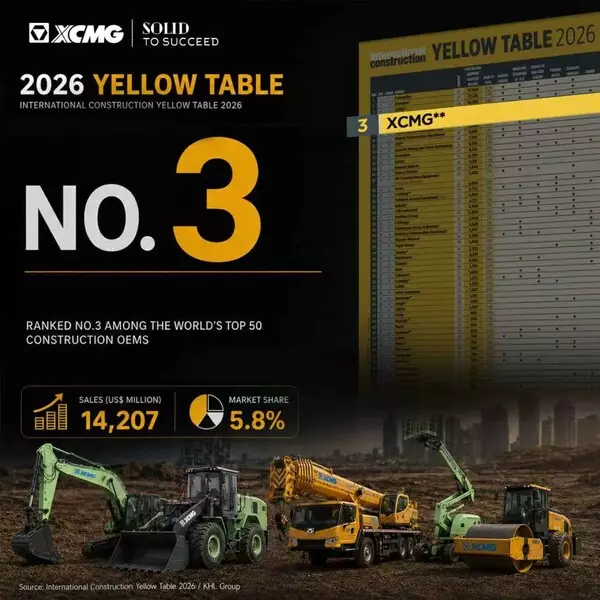
XCMG Again Ranks Among Global Top Three in KHL Group's 2026 Yellow Table
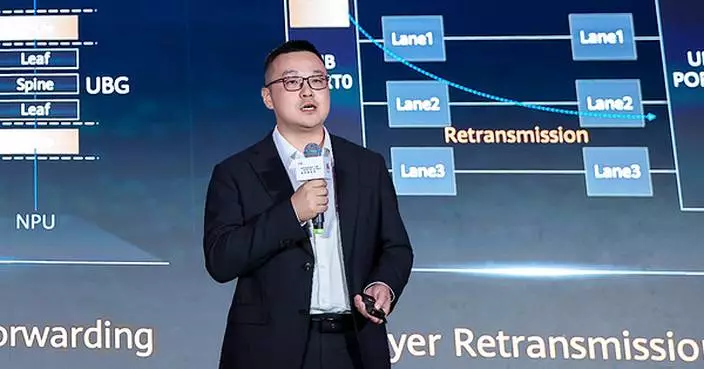
SHANGHAI, Sept. 21, 2026 /PRNewswire/ -- In a keynote speech on computing architecture innovation at HUAWEI CONNECT 2026, Yang Chaobin, Huawei's Executive Director of the Board and CEO of the ICT Business Group, unveiled new details about the UnifiedBus interconnect architecture, announced a series of computing products based on this architecture, and explained how the company has collaborated with open-source communities to enable application innovation by customers, partners, and developers.
In a traditional computing architecture, resource utilization declines as a cluster scales. As little as 20% of a 100,000-NPU cluster's computing capacity is actually utilized by models, with a vast amount of compute sitting idle during data communications. A 10 trillion-parameter model, which requires massive amounts of intermediate data to train, far exceeds the capacity of the memory on a single accelerator under traditional architectures. Interconnection and communications between components within a cluster have become a key performance bottleneck for computing systems.
According to Yang, Huawei's solution to this bottleneck is its new computing architecture, powered by the interconnect technology called UnifiedBus, which facilitates collaboration between clusters and SuperPoDs. This architecture has been designed to support the boom in compute demand that is emerging as new agentic applications hit the market. UnifiedBus-powered computing systems have four key features:
- Unified protocol and memory semantics: More than ten interconnect protocols have been combined under the UnifiedBus protocol, which increases interconnect bandwidth from 100 GB/s level to TB/s level and reduces round-trip time (RTT) latency from 7 microseconds to 2 microseconds. This protocol also enables unified global memory addressing within SuperPoDs.
- Heterogeneous compute collaboration: UnifiedBus directly interconnects CPUs, NPUs, memory, and solid-state drives (SSDs) to enable decentralized, peer-to-peer access between them and flexible CPU-NPU mixing. In addition, tiered hardware acceleration for Transformer enables Attention-FFN disaggregation (AFD).
- Tiered storage with global pooling: UnifiedBus uses hybrid-media resource pooling to support the caching of activations. Double Data Rate (DDR) memory serves as the alternative memory for NPUs, reducing latency for search, recommendation, and advertising services, and doubling the performance of vector retrieval for 100 billion-level data items with thousands of dimensions. This also reduces the per-NPU HBM capacity requirements for the training of 10 trillion-parameter models, and improves cluster model FLOPs utilization (MFU).
- Optoelectronic interconnect and flexible networking: UnifiedBus serves as a global ultra-high bandwidth, ultra-low latency "data highway", enabling flexible scaling of compute.
Yang then moved on to unveil Huawei's newest UnifiedBus interconnect products that cover interconnection within cabinets, between cabinets, and across clusters. This enables elastic scaling from a single cabinet to a million-NPU cluster.
- Within cabinets, the UnifiedBus LinkBlade eliminates circuit losses with a cable-free design, which reduces copper cabling within a 4,096-NPU SuperPoD by about 196 kilometers.
- Between cabinets, the UnifiedBus LinkDevice supports 176 ports, with 1.6 Tbit/s bandwidth per port, delivering 280 Tbit/s all-optical interconnection. This is the industry's highest-bandwidth, highest-port-count high-speed bus-protocol interconnect device, with an RTT latency as low as 2 microseconds.
- Across clusters, the UnifiedBus UBG switch provides a massive radix fan-out capacity of up to 1,024, meaning it can support a million-NPU SuperCluster and evolution towards supporting tens of trillions of model parameters.
Yang also launched Huawei's UnifiedBus-powered agentic AI SuperCluster, which is comprised of TaiShan 950 and Atlas 960 SuperPoDs, OceanStor M900 memory storage, and a Xinghe UBG switch. This cluster enables diverse compute collaboration and tiered resource pooling.
Beyond SuperPoDs, Huawei has also applied the UnifiedBus technology to its compute appliances. The company has developed a new series of UnifiedBus-based appliances (supporting one to eight NPUs) and Kunpeng and Ascend modules, which enable small and medium-sized enterprises to run trillion-parameter models locally.
On the ecosystem front, Yang said that Ascend is collaborating with open-source frameworks like DeepSeek Harness, OpenCode, and openJiuwen to develop fully open-source intelligent management, inference acceleration, and security framework agent plugins.
Yang promised, "Huawei is committed to innovating at the system level, building a computing-foundation product portfolio, and going open source and open system. We will continue working with customers, partners, and developers to help this ecosystem thrive and offer the world a new option for compute."
** This press release is distributed by PR Newswire through automated distribution system, for which the client assumes full responsibility. **
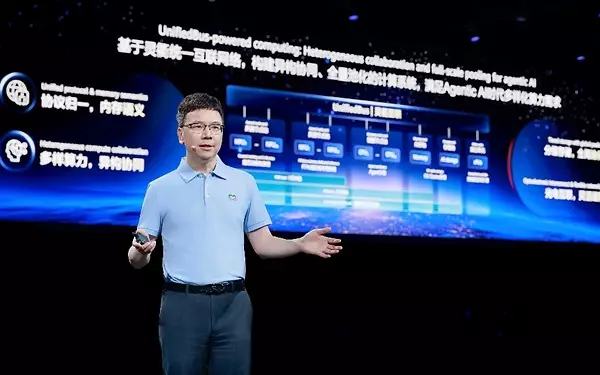
Huawei Unveils New UnifiedBus Computing Architecture for SuperPoDs and Clusters