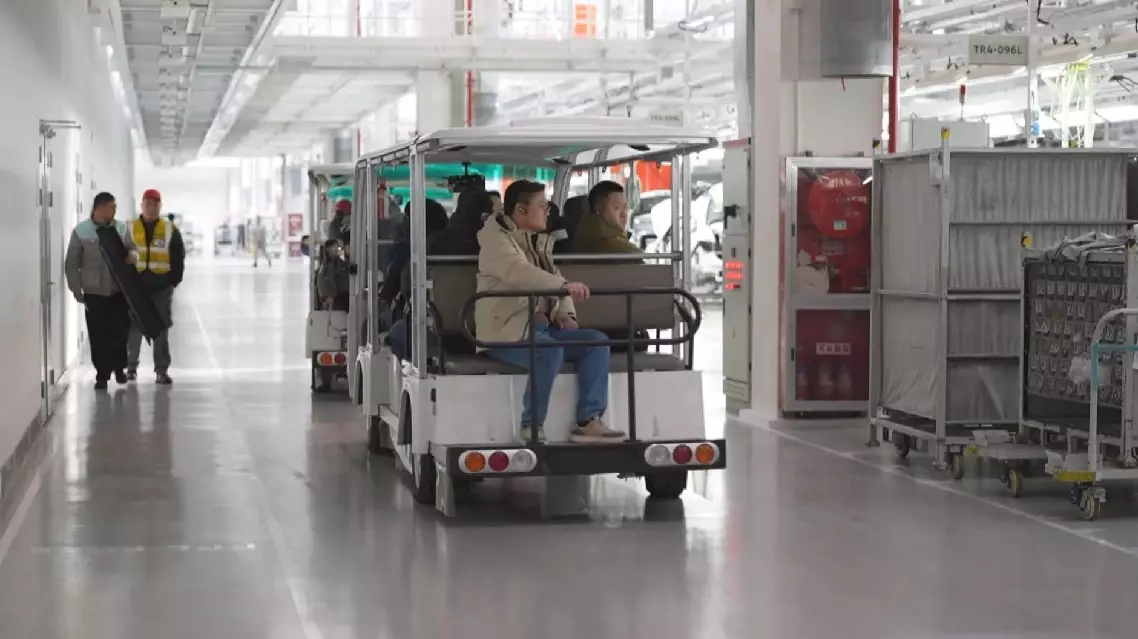
A digital intelligent car factory has become a popular destination for industrial tourism, drawing thousands of visitors eager to see how modern cars are built with smart technology.
The factory in Hefei, capital of east China's Anhui Province, spans the size of 136 football fields and integrates stamping, bodywork, painting and final assembly under one roof. As robots and cloud systems power production, the factory can complete 1,000 quality checks in three minutes and roll out a new energy vehicle every 60 seconds.
Zhao Bo, manager of production quality, said that an AI-powered intelligent inspection system independently developed by the enterprise has raised quality inspection efficiency.
"It's because our independently developed AI intelligent quality-checking system, called 'Tiantong,' has been used. When you come again in the future, you will see a more different scene, with faster and more efficient inspection," Zhao said.
The plant uses a digital vehicle storage and retrieval system known as "Magic Cube," which enables efficient, automated handling of car bodies, cutting delivery times and meeting demand for customized new energy vehicles (NEVs).
"This factory has six car models in more than 20 colors. We need to meet customers' demand for personalized ordering and deliver to them quickly -- whichever car I want, I can pick it right away," said Yin Liang, manager of NIO Second Advanced Manufacturing Base.
In the final assembly line, technologies such as data quantification and programmed monitoring have been used to ensure bolt fastening is error-free.
"It takes more than two months to grow from a green-hand to a skillful worker. Traditionally, bolt fastening would require manual inspection to detect possible faults. Now, we can monitor bolt fastening with the help of data quantification and programmed monitoring. Where there is a fault, it will trigger automatic alarms. Thanks to this, we can achieve zero error in bolt fastening," said Yang Tianpei, a worker from the manufacturing base.
Beyond the smart facilities and efficiency that captivate visitors, they can also visit and take photos in areas such as the brand center and battery swap stations that interest them.
In 2025, the factory received more than 40,000 domestic tourist visits and over 1,000 international visits.
"The factory is very clean, which overturns my impression of traditional industrial plants. Once inside the factory, the strong sense of technology and digitalization makes me feel the progress of the auto industry. Overall, the industrial tour is quite a good experience," said Wu Chaowei, a visitor.
China's smart auto plant becomes tourism hotspot