PALO ALTO, Calif.--(BUSINESS WIRE)--May 4, 2026--
Deepwatch, the leading autonomous SOC platform built on more than a decade of real-world security operations data, today announced the appointment of Brian Dhatt as Chief Executive Officer. Dhatt succeeds John DiLullo, who will remain with the company as an advisor.
This press release features multimedia. View the full release here: https://www.businesswire.com/news/home/20260504046027/en/
The company also announced the promotion of Chief Product and Technology Officer Anand Ramanathan to President, underscoring Deepwatch’s commitment to scaling its platform, accelerating product innovation, and strengthening its leadership position in AI-driven security operations.
Dhatt brings more than two decades of experience building and scaling global, enterprise-grade technology platforms. Most recently, he served as Chief Technology Officer at BigCommerce and prior to that, Borderfree. Both companies achieved successful IPOs during his tenure. Across his career, Dhatt has led large, distributed engineering and product organizations and driven transformation across high-growth, mission-critical platforms serving global enterprises.
“Deepwatch has a unique and powerful foundation—more than a decade of real-world security operations, a rich proprietary dataset, and AI-driven automation already delivering results at scale,” said Brian Dhatt, CEO of Deepwatch. “What sets Deepwatch apart is how we combine that automation with human expertise. As we continue to evolve toward an Agentic AI SOC model, our focus is on using AI to handle scale and speed while keeping humans in the loop to ensure accuracy, trust, and real-world outcomes.”
Deepwatch has established a differentiated market position through an AI-driven, human-led SOC model. The Deepwatch Guardian MDR Platform ™ combines:
This foundation enables organizations to accelerate adoption of autonomous security operations while maintaining the visibility, control, and expert oversight required for enterprise environments. Rather than replacing human analysts, Deepwatch’s approach uses AI to reduce noise, automate investigations, and surface the highest priority threats—allowing experts to focus on decision-making and response where it matters most.
“Brian is the ideal leader for Deepwatch’s next chapter,” said Bill Phelps, Chairman of Deepwatch’s Board of Directors. “His experience scaling complex technology platforms and leading organizations through periods of rapid growth will be invaluable as the company continues to extend its leadership in autonomous security operations.”
Ramanathan brings more than 20 years of product and go-to-market leadership across leading cybersecurity and cloud companies, including McAfee, Proofpoint, Cisco, and Skyhigh Security. Over his career, he has built and scaled market-leading security platforms, and driven category-defining innovation across cloud, endpoint, and data security. As President, Ramanathan will expand his responsibilities to oversee product, operations and marketing, ensuring tight alignment between innovation, go-to-market execution, and customer outcomes.
“Anand is a proven leader with deep domain expertise and a strong track record of building category-leading security platforms,” said Dhatt. “His expanded role ensures we continue to translate our unique combination of AI-driven automation and human expertise into scalable, differentiated outcomes for our customers.”
Backed by Springcoast Partners, Goldman Sachs, ABS Capital and Splunk Ventures, Deepwatch represents a fundamental shift from traditional managed security models toward autonomous SOC operations. By combining AI-driven operations with human oversight, the company delivers continuous improvement, higher accuracy, and enterprise-grade trust—enabling organizations to adopt autonomous security with confidence.
About Deepwatch
Deepwatch® is the leader in AI-driven, human-led security operations. We amplify human expertise with AI insights to reduce the risks that matter most to your business. Unlike one-size-fits-all MDR, Deepwatch delivers protection that is comprehensive, custom, clear, and ceaseless—stopping threats before and after they emerge with tailored responses at every step. Deepwatch is tuned to each customer’s environment, trained on their priorities and the stack they’ve invested in to strengthen defenses and focus on what matters most. There are no black boxes—customers get clarity on every detection, decision, and data source, along with the name of the analyst behind it. Around-the-clock protection is delivered by security experts who act on real-time threats, powered by AI. For more information about Deepwatch, visit www.deepwatch.com.

Deepwatch Appoints Brian Dhatt as Chief Executive Officer to Lead its Next Phase as a Scaled Autonomous SOC Platform
PHILADELPHIA (AP) — Jalen Hurts has a blood clot in his calf and has to miss at least one game — the type of news that might have left the Eagles reeling in a normal season.
He's somehow only the latest star to miss time — Saquon Barkley and DeVonta Smith had topped that list — and Philadelphia will have to adjust to another setback during a season on the brink of a meltdown.
Hurts delivered the breaking news of his diagnosis to second-stringer Tanner McKee on his way to the Eagles’ walk-through on Thursday.
“He just kind of turned to me and said, ‘Looks like you’re going to be the guy this week,’” McKee said.
Hey, sometimes backup QBs work out great for the Eagles. Just ask Nick Foles.
Hurts was ruled out for Sunday's game against Carolina because of a superficial blood clot in his calf. The Eagles said in a statement Thursday that Hurts was injured when he took a cleat to his calf area on Oct. 4 against the Los Angeles Rams.
A day earlier, Hurts spoke in vague terms about the injury.
“It was a very unique experience, to say the least,” Hurts said. “I don’t want to get into the details of kind of leading up to the game and whatnot. But got nicked up in the Rams game.”
Hurts practiced last week and informed the medical staff of the injury after practice on Oct. 8. The former Super Bowl MVP was back at practice the next day before the team left for London to play Jacksonville.
“Out of an abundance of caution, an ultrasound was performed on Saturday following the team’s flight to London and walk-through,” the Eagles said in a statement. “The ultrasound revealed a superficial blood clot. Our medical staff and doctors in London reviewed the results and concluded that activity and mobility were important and that Jalen could safely play. Doctors recommended a follow-up ultrasound within 72 hours of the game and the return flight to Philadelphia.”
Hurts completed 21 of 40 passes for 220 yards and one touchdown in a 19-17 loss to the Jaguars, the Eagles' third straight defeat after a 2-0 start.
Hurts did not emerge from the tunnel in London until just before the coin toss.
“I was trying to rest,” he said, laughing.
Hurts received treatment Monday and Tuesday this week when he returned to Philadelphia and was a full participant in Wednesday's practice.
Hurts underwent another ultrasound on Wednesday that revealed a “movement in the small blood clot.”
The kind of blood clot Hurts has often forms in a vein close to the surface of the skin but can be painful and requires treatment.
The Eagles said in a statement they would determine the appropriate course of treatment. There was no timetable on when Hurts could return.
The Eagles will turn to the 26-year-old McKee against the Panthers.
McKee had been the primary backup each of the past two seasons but lost that job in training camp to veteran Andy Dalton. Dalton was released last Friday after he threw an interception in the end zone on his lone pass attempt of the season in a Week 3 loss at Chicago.
Hurts absorbed a late hit and was pulled off the field to be checked for a concussion in that game.
McKee has two career starts, both in Week 18 the past two years. The Eagles had already clinched their playoff seeds and rested Hurts. McKee, a sixth-round pick in the 2023 draft, has completed 54 of 88 passes for five touchdowns and one interception.
“Every opportunity that you get to play is a huge opportunity, especially being a sixth-round pick,” McKee said.
McKee has familiarity with the Eagles after four seasons, even though he's learning a new offense under first-year coordinator Sean Mannion.
Hurts has eight touchdown passes and three interceptions with 933 yards passing this season. He's led the Eagles to two Super Bowl appearances and earned MVP honors after they beat the Kansas City Chiefs to win the championship in the 2024 season.
Hurts is in the midst of a five-year, $255 million extension, including $179.3 million guaranteed, that takes him through the 2028 season.
The Eagles stunned fans when they drafted Hurts out of Oklahoma in the second round in 2020. They seemingly had Carson Wentz entrenched at QB and had more pressing needs. But Hurts supplanted Wentz and became one of the top young quarterbacks in the NFL.
Jordan Mailata had called last week a “week from hell” after the sudden retirement of fellow offensive lineman Lane Johnson and the trade of another O-line starter, Cam Jurgens, to the Ravens.
“I might have jumped the gun on that one,” Mailata said with a laugh.
The Eagles hope Barkley (hamstring) and Smith (hamstring) can play Sunday.
Edge rusher Jonathan Greenard, linebacker Jalyx Hunt, defensive back Michael Carter, running back Will Shipley and cornerback Quinyon Mitchell were all hurt against the Jaguars. Philadelphia had previously ruled out center Drew Kendall, safety Marcus Epps and wide receiver WR Marquise Brown. Wide receiver Dontayvion Wicks (hamstring) missed practice Thursday.
“As much adversity as we've handled,” Mailata said, “it also has created so much opportunity for our young guys. That's what I keep focusing on.”
As crucial as those absences have been, playing without Hurts could sting the most.
The Eagles have no choice but to press on with McKee.
“We’ve been getting reps with him all year,” wide receiver Darius Cooper said. “It’s really not a drop-off.”
See AP’s full NFL coverage here
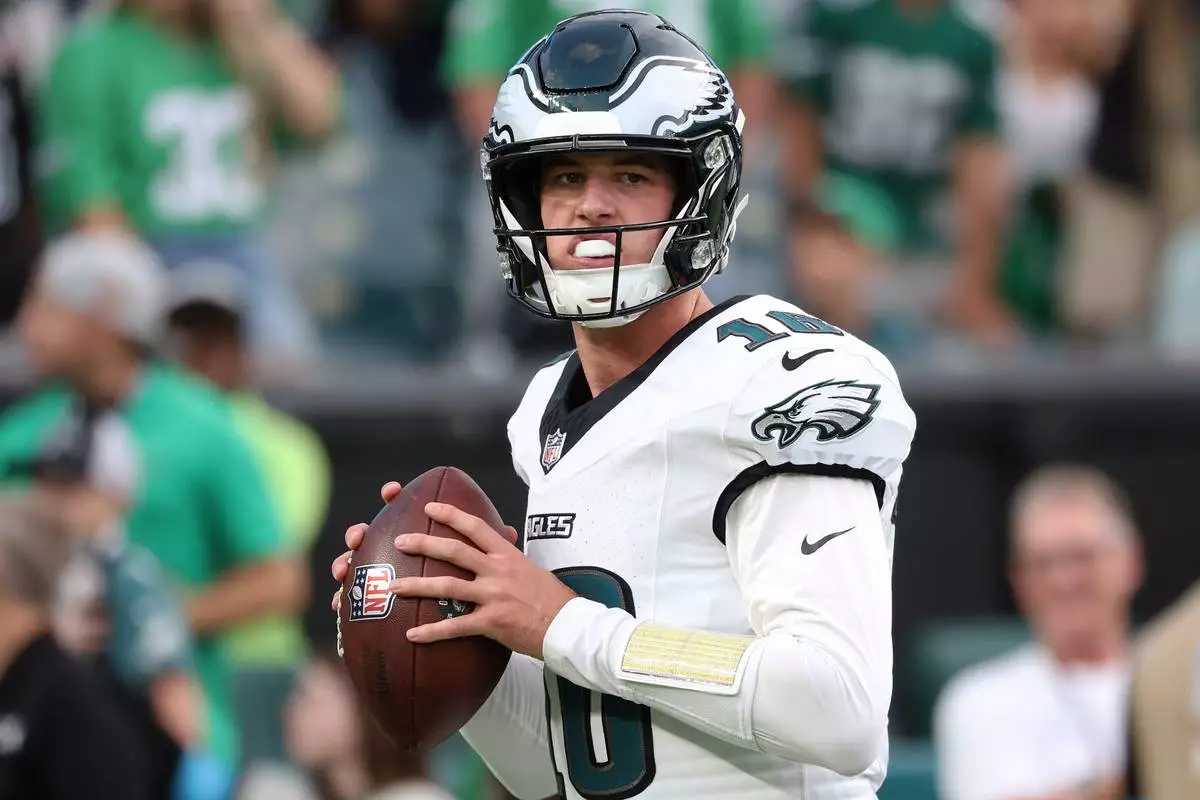
FILE - Philadelphia Eagles quarterback Tanner McKee (16) looks to throw the ball before an NFL football game against the Cincinnati Bengals, Aug. 28, 2026, in Philadelphia. (AP Photo/Daniel Kucin Jr., File)
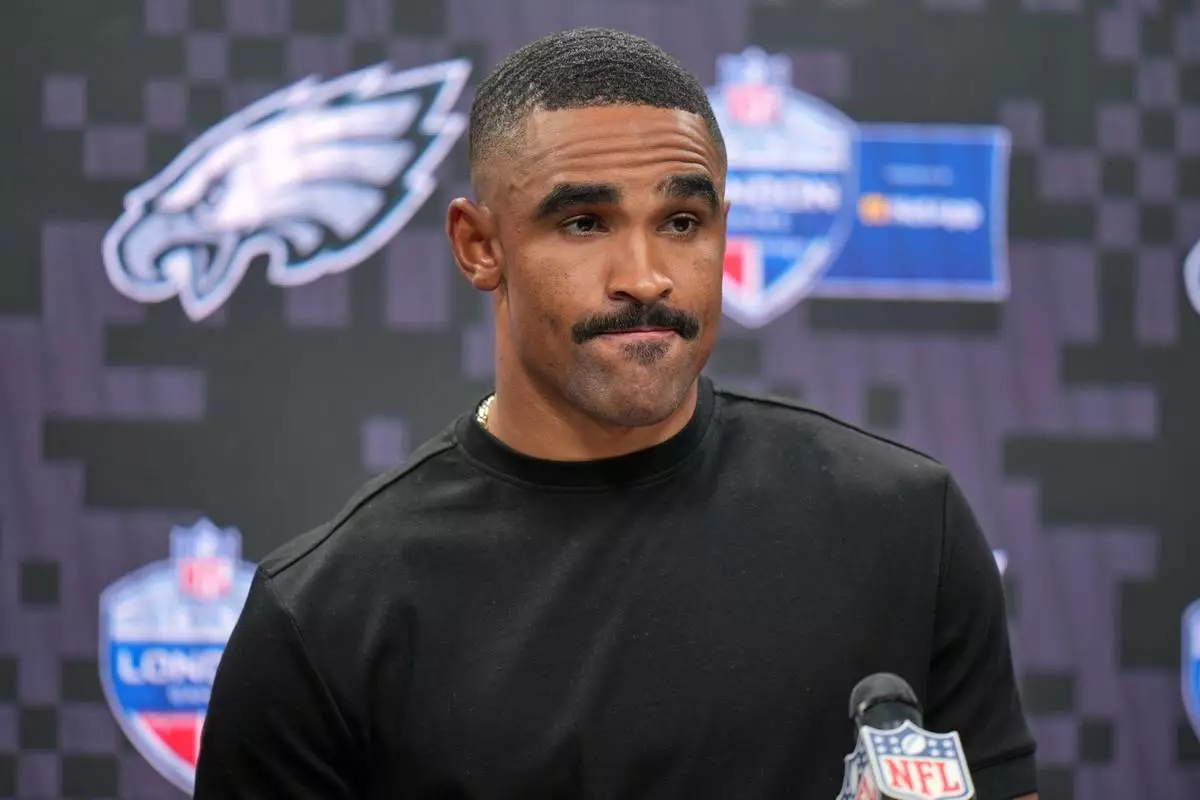
Philadelphia Eagles quarterback Jalen Hurts (1) attends a press conference after an NFL football game against Jacksonville Jaguars in London, Sunday, Oct. 11, 2026. (AP Photo/Alastair Grant)
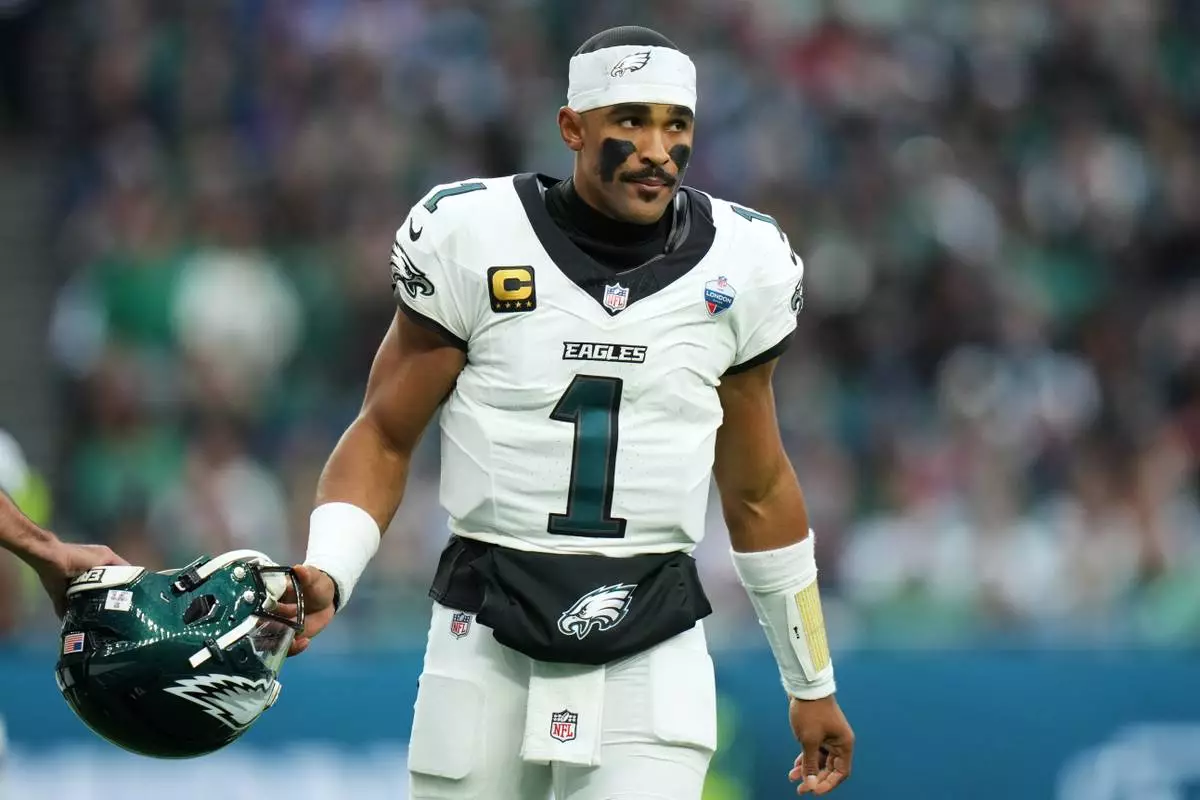
Philadelphia Eagles quarterback Jalen Hurts (1) stands on the field during an NFL football game against Jacksonville Jaguars in London, Sunday, Oct. 11, 2026. (AP Photo/Alastair Grant)