NEW YORK (AP) — Pulitzer Prize officials awarded the fiction prize to an author with a history of experimenting with genres and with language itself: Daniel Kraus, cited for “Angel Down,” a World War I narrative with a celestial twist that unfolds over some 300 pages in one long sentence. “Liberation,” Bess Wohl's look back at the feminist consciousness-raising groups of the 1970s received the drama prize.
Winners announced Monday included two books rooted in the country's founding. Jill Lepore's “We the People: A History of the U.S. Constitution” won for history, and Amanda Vaill's “Pride and Pleasure: The Schuyler Sisters in an Age of Revolution” was the winner for biography. Yiyun Li’s “Things in Nature Merely Grow,” her blunt account of the suicides of her two sons, was cited for memoir-autobiography. Brian Goldstone's “There is No Place for Us: Working and Homeless in America” won for general nonfiction.
The poetry prize went to Juliana Spahr's “Ars Poeticas,” and the music award was given to Gabriela Lena Frank for “Picaflor: A Future Myth,” a symphonic work inspired by Andean legend and California wildfires.
The 50-year-old Kraus has had a diverse and prolific career quite unlike the average Pulitzer fiction winner. He has written horror, science fiction, graphic novels and books for kids. He has collaborated with filmmakers George Romero and Guillermo del Toro, whose Oscar-winning “The Shape of Water” was conceived with Kraus' help. He has received numerous prizes over the years, including the Bram Stoker Award for horror, but had never imagined he'd win a Pulitzer. When he began receiving texts Monday — that included such messages as “Wow!” — he worried that he had somehow gotten himself in trouble.
Pulitzer officials praised “Angel Down” as “a stylistic tour-de-force that blends such genres as allegory, magical realism, and science fiction into a cohesive whole, told in a single sentence.” Kraus says that he at first used a conventional narrative but found that abandoning traditional punctuation better suited a story of war that seemingly had no end.
“It's like you have the feeling of being locked into the book forever,” he told The Associated Press during a telephone interview.
Wohl’s memory play collects second-wave feminists from all walks of life as they tackle misogyny, internalized homophobia, domestic abuse and gender roles. The play navigates between past and present, and six of the actors disrobe for the Act 2 opening scene. The win comes a day before the Tony Award nominations, when “Liberation” is expected to be named in the best new play category.
Lepore is a New Yorker staff writer and Harvard University professor whose Pulitzer helps confirm her as one of the country's most prominent historians, her previous honors including the Bancroft Prize for “The Name of War” and the Anisfield-Wolf Book Award for “New York Burning.” In 2023, she contributed an introduction to Paul McCartney's book of Beatles photos, “1964: Eyes of the Storm.”
Entertainment Writer Mark Kennedy contributed.

FILE - Signage for The Pulitzer Prizes appear at Columbia University, May 28, 2019, in New York. (AP Photo/Bebeto Matthews, File)

FILE - Bess Wohl attends the Glamour Women of the Year Awards at The Plaza Hotel on Tuesday, Nov. 4, 2025, in New York. (Photo by Evan Agostini/Invision/AP, File)
SANTA FE, N.M. (AP) — New Mexico state prosecutors are seeking fundamental changes to Meta's social media apps and algorithms to safeguard children in the second phase of a landmark trial on allegations that platforms such as Instagram have created a public safety hazard.
Opening statements began Monday in the three-week bench trial to decide whether the platforms of Meta, which also owns Facebook and WhatsApp, pose a public nuisance.
In the first phase, jurors ordered $375 million in civil penalties against Meta, determining that it knowingly harmed children’s mental health and concealed what it knew about child sexual exploitation on its platforms.
Prosecutors are now asking a judge impose fundamental changes aimed at reining in addictive features, improving age verification and preventing child sexual exploitation through default privacy settings and closer oversight.
Meta has vowed to appeal the jury verdict and warned that it could eliminate service in New Mexico entirely if forced to comply with impractical mandates and multibillion-dollar remedies.
“The fact that we’re having a trial on nuisance is itself a remarkable outcome,” said Eric Goldman, co-director of the High Tech Law Institute at Santa Clara University School of Law in California. “That theory is not well accepted as applied to the internet, and that theory doesn’t really fit the internet.”
As the trial reconvened Monday, state District Court Judge Bryan Biedscheid addressed concerns that the court might overreach its authority.
“I’m probably not the easiest sell on the idea where I would become a one-person legislator, judge and executive branch enforcer,” he said.
New Mexico Attorney General Raúl Torrez said the jury verdict punctured the aura of invincibility protecting tech companies from liability for material on their platforms under Section 230, a 30-year-old provision of the U.S. Communications Decency Act.
A Los Angeles jury separately found both Meta and YouTube liable for harms to children, validating long-standing concerns about dangers of social media.
New Mexico prosecutors are demanding that Meta help remedy a mental health crisis among children through a series of safeguards and changes, including a redesign of algorithms that make content recommendations so they no longer prioritize constant engagement.
New Mexico prosecution attorney David Ackerman outlined a $3.7 billion proposal for Meta to remedy harm to children that “recognizes the scope of the public nuisance that Meta has caused.”
“Across New Mexico, across the country, children are begging for help," he said in opening statements. “It is thorough and it is necessary. There are items in this abatement plan for public education, to assist schools, to assist law enforcement, to assist mental health providers."
Prosecutors are also targeting other app features linked to compulsive use such as “infinite scroll,” which continuously loads content; push notifications; and default settings that show tallies for “likes” and sharing. Their lawsuit also seeks improvements to age verification and other steps aimed at curbing child sexual exploitation.
And New Mexico wants child accounts on Meta platforms to have an associated parent or guardian, as well as a court-supervised child safety monitor to track safety improvements over time.
Executives have said the company continuously improves child safety and addresses compulsive use and that many demands from prosecutors are redundant.
In opening statements, Meta attorney Alex Parkinson disputed the idea that there is a public right to social media under public nuisance laws.
“Are bars a public nuisance because drinking alcohol is undeniably associated with car fatalities?” Parkinson said. “If individual (social media) users have been hurt, they have a remedy -- personal injury cases to cover the mental healthcare or any other care that they need. And that is what is happening in other lawsuits right now.”
The company also argues that its platforms are being singled out among hundreds of apps that teens use with less robust protections, while invoking free speech protections.
“The state’s proposed mandates infringe on parental rights and stifle free expression,” Meta said last week in a statement.
The case is the first to reach trial among lawsuits filed by more than 40 state attorneys general on allegations that Meta contributes to a youth mental health crisis. Most are pursuing remedies in U.S. federal court.
Torrez said he envisions a broad public education campaign to help parents and children navigate social media safely, with new public service warnings on Meta apps.
“All of those kids need help, they need counseling, they need therapy," Torrez said at a news conference Monday, accompanied by parent advocates for social media reforms.
Parkinson said the state’s $3.7 billion plan goes too far and would reshape the way all mental and behavioral healthcare is delivered to New Mexico teens.
“The state is asking you to develop from scratch a completely new regulatory regime that far exceeds anything in Europe, in Australia, anywhere,” Parkinson said in reference to a bevy of recent and planned restrictions on children’s online activities beyond the U.S.
Goldman said prosecutors may be venturing into uncertain legal waters just in seeking age verification mandates.
“In practice a court order saying that Facebook had to impose age authentication would have no Supreme Court textual support,” he said. “The Supreme Court might bless it. We don’t know.”

FILE - Visitors take photos at a sign outside Meta headquarters March 26, 2026, in Menlo Park, Calif. (AP Photo/Noah Berger, File)
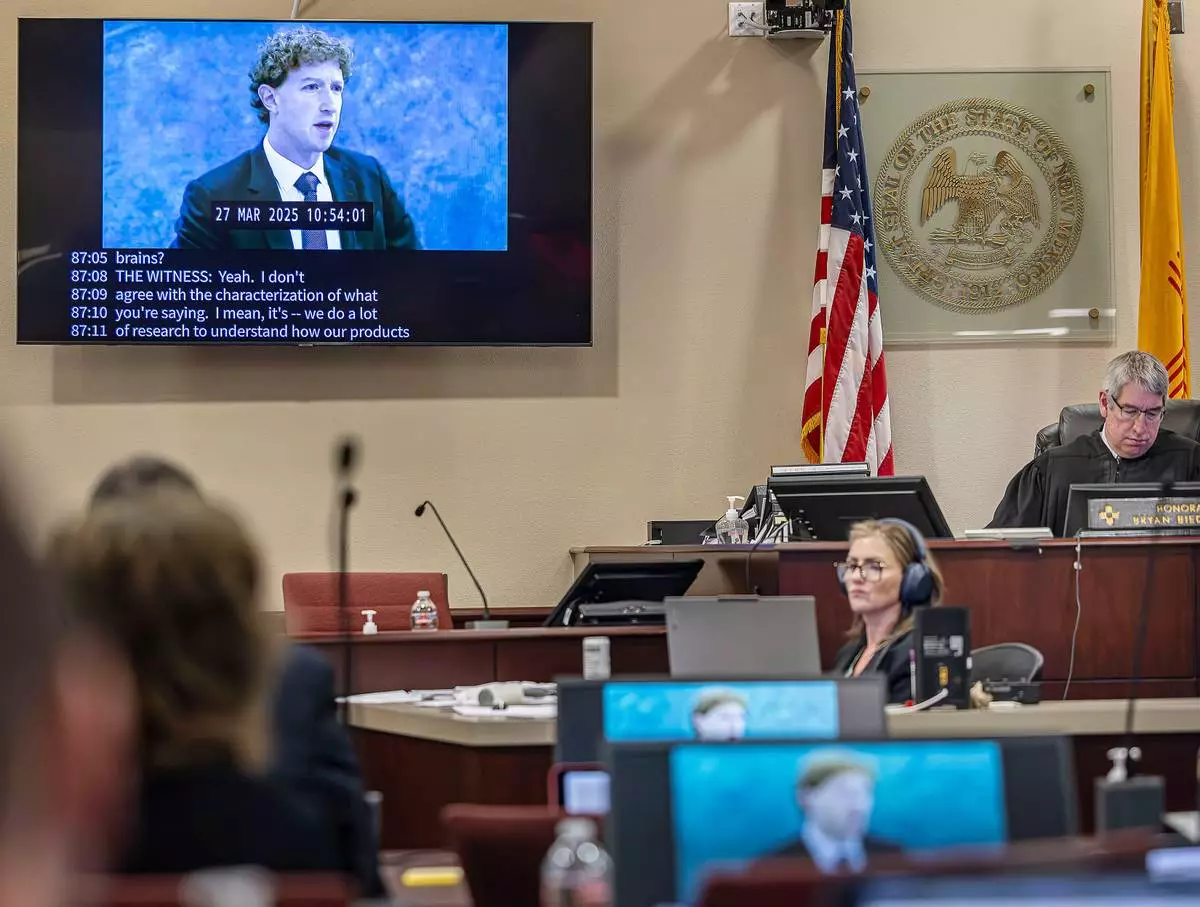
FILE - A recording of Meta Founder and CEO Mark Zuckerberg's deposition is played for the jurors on March 4, 2026, in Santa Fe, N.M. (Jim Weber/Santa Fe New Mexican via AP, Pool, File)