Advance estimates on Gross Domestic Product for first quarter of 2026
The Census and Statistics Department (C&SD) released today (May 5) the advance estimates on Gross Domestic Product (GDP) for the first quarter of 2026.
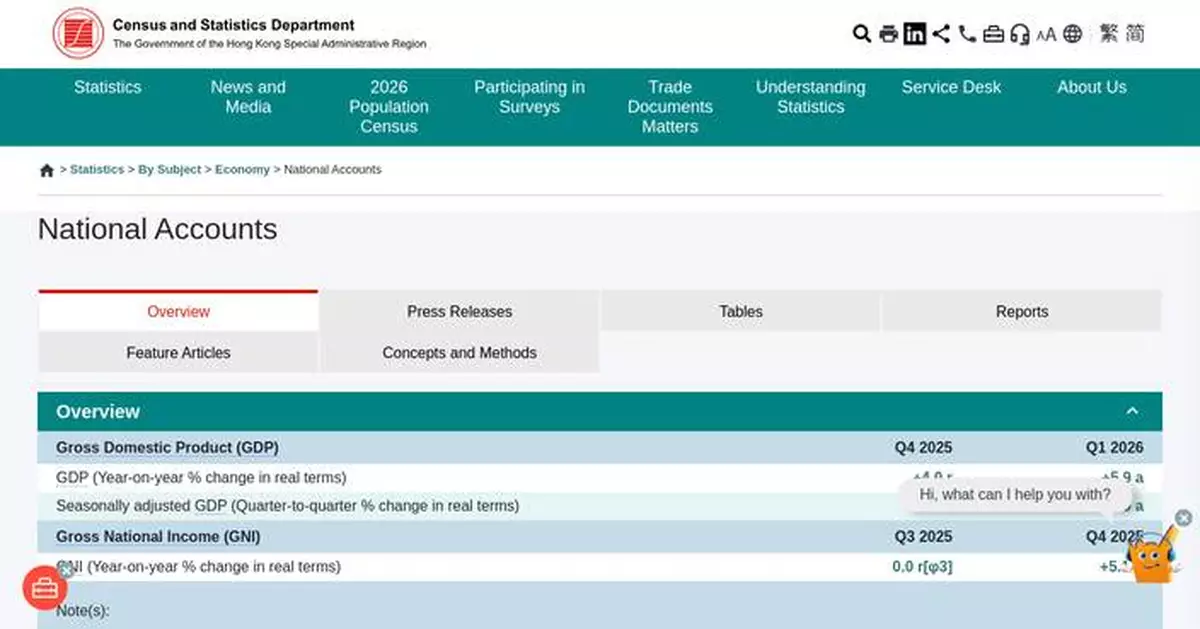
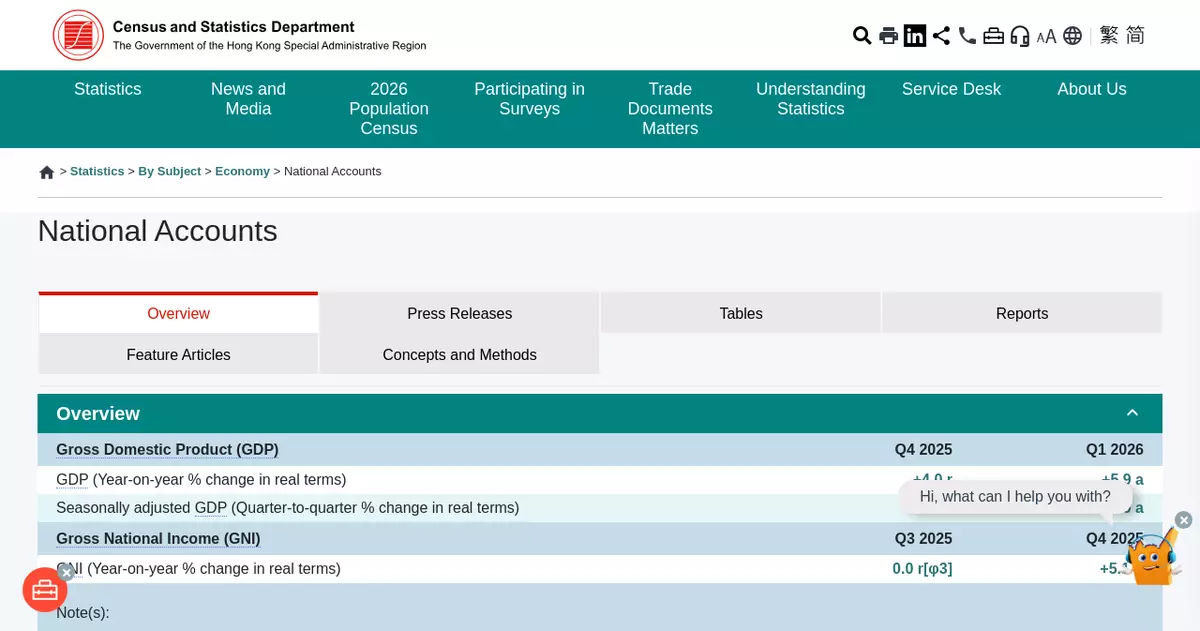
According to the advance estimates, GDP increased by 5.9% in real terms in the first quarter of 2026 over a year earlier, compared with the increase of 4.0% in the fourth quarter of 2025.
Analysed by major GDP component, private consumption expenditure increased by 5.0% in real terms in the first quarter of 2026 over a year earlier, faster than the increase of 2.5% in the fourth quarter of 2025.
Government consumption expenditure measured in national accounts terms recorded an increase of 2.9% in real terms in the first quarter of 2026 over a year earlier, compared with the increase of 1.5% in the fourth quarter of 2025.
Gross domestic fixed capital formation increased further by 17.7% in real terms in the first quarter of 2026 over a year earlier, following the increase of 11.7% in the fourth quarter of 2025.
Total exports of goods measured in national accounts terms recorded an increase of 23.8% in real terms in the first quarter of 2026 over a year earlier, accelerated further from the growth of 15.4% in the fourth quarter of 2025. Over the same period, imports of goods measured in national accounts terms grew by 29.9% in real terms, compared with the increase of 18.2% in the fourth quarter of 2025.
Exports of services rose by 3.5% in real terms in the first quarter of 2026 over a year earlier, after the increase of 4.7% in the fourth quarter of 2025. Imports of services increased by 3.9% in real terms in the first quarter of 2026, compared with the increase of 3.7% in the fourth quarter of 2025.
On a seasonally adjusted quarter-to-quarter comparison basis, GDP increased by 2.9% in real terms in the first quarter of 2026 when compared with the fourth quarter of 2025.
Commentary
A Government spokesman said that the Hong Kong economy expanded robustly in the first quarter of 2026. According to the advance estimates, real GDP grew by 5.9% over a year earlier in the first quarter, accelerating from the revised 4.0% growth in the preceding quarter (up from the earlier estimate of 3.8%), and marking the strongest quarterly growth in nearly five years. On a seasonally adjusted quarter-to-quarter basis, real GDP rose notably by 2.9%.
Looking ahead, Hong Kong's economic growth outlook remains positive, underpinned by strong global demand for artificial intelligence-related electronics, sustained growth in visitor arrivals and robust cross-boundary financial activities. Relatively solid business and consumer sentiment is expected to continue supporting domestic demand. However, persistent tensions in the Middle East pose downside risks to the economic outlook. In response, the Government has taken targeted measures to safeguard energy supply stability and mitigate the impacts on affected sectors. The Government will stay vigilant and continue to closely monitor the developments.
The revised figures on GDP and more detailed statistics for the first quarter of 2026, as well as the revised GDP forecast for 2026, will be released on May 15, 2026.
Further information
The year-on-year percentage changes of GDP and selected major expenditure components in real terms from the first quarter of 2025 to the first quarter of 2026 are shown in Table 1.
When more data become available, the C&SD will compile revised figures on GDP. The revised figures on GDP and more detailed statistics for the first quarter of 2026 will be released at the C&SD website (www.censtatd.gov.hk/en/scode250.html) and the Gross Domestic Product by Expenditure Componentreport (www.censtatd.gov.hk/en/EIndexbySubject.html?pcode=B1030001&scode=250) on May15,2026.
For enquiries about statistics on GDP by expenditure component, please contact the National Income Branch (1) of the C&SD (Tel: 3863 2727 or email: gdp-e@censtatd.gov.hk).
Source: AI-found images
An exceptionally warm April
The exceptionally warm weather in the first quarter of 2026 continued into April 2026, mainly attributed to the warmer-than-normal sea surface temperatures and a stronger-than-usual southerly flow in the lower atmosphere over the northern part of the South China Sea. The monthly mean minimum temperature of 23.8 degrees, mean temperature of 25.5 degrees, and mean maximum temperature of 27.9 degrees were respectively 2.7 degrees, 2.5 degrees, and 2.3 degrees above their corresponding normals. All three values were the second highest on record for April. The monthly rainfall was 160.4 millimetres, about 5 per cent above the normal of 153.0 millimetres. The accumulated rainfall recorded for the first four months of the year was 359.6 millimetres, about 20 per cent above the normal of 300.4 millimetres for the same period.
Under the influence of the northeast monsoon and a band of clouds covering the coast of Guangdong, local weather was mainly cloudy with a slightly cooler morning on the first day of the month. There were also one or two showers at night. Affected by an easterly airstream and a subsequent southerly airstream, the weather of Hong Kong remained cloudy with a few showers on the next two days. With a trough of low pressure lingering over the coastal areas of Guangdong, there were occasional showers and a few squally thunderstorms on April 4 and 5. Showers were heavy at times. More than 40 millimetres of rainfall were generally recorded over the eastern part of Hong Kong, and rainfall even exceeded 80 millimetres over Tai Po District on these two days. The Observatory registered a daily rainfall of 45.1 millimetres on April 5, the second highest on record for the Ching Ming Festival since 1884.
As a southerly airstream set in, the weather of Hong Kong became hot with sunny intervals during the day on April 6 and 7. Under the influence of a strong easterly airstream and associated cloud bands over the coast of Guangdong on April 8, local weather turned windier and cloudy with a few rain patches. Visibility was relatively low in some areas. With the easterly airstream being replaced by a southerly airstream the following day, local weather was misty with one or two light rain patches in the morning. The visibility in the harbour once fell below 3000 metres in the morning. It was hot with sunny intervals during the day. The southerly airstream continued to affect the coast of Guangdong from April 10 to 16. Local weather remained mainly cloudy from April 10 to 12 and it was hot during the day. An anticyclone aloft brought sunny periods and hot weather during the day to Hong Kong from April 13 to 16. With abundant sunshine, the temperature at the Observatory rose to a maximum of 30.2 degrees in the afternoon on April 16, the highest of the month.
An area of intense thundery showers associated with a trough of low pressure affected the vicinity of the Pearl River Estuary on the afternoon of April 17. Locally, heavy showers with severe squally thunderstorms were recorded that afternoon, with over 30 millimetres of rainfall on Hong Kong Island and Lantau Island. Hail was reported on Lamma Island. Winds were weak on the next three days. The weather of Hong Kong was mainly fine, hot and dry during the day on April 18 and 19, then turned mainly cloudy with a few showers on April 20. Under light wind conditions, visibility was rather low in some areas on April 18 and the mornings of April 19 and 20. Showers and thunderstorms associated with upper-air disturbances affected the coast of Guangdong on April 21. Locally, the weather was mainly cloudy with a few showers in the morning. Showers were heavier with squally thunderstorms over the eastern part of Hong Kong Island and Sai Kung District. With the departure of upper-air disturbances, the weather improved on the afternoon of April 21 with sunny intervals. Local weather remained hot with sunny periods during the day on April 22 under the influence of a southerly airstream.
A cold front moved across the coast of Guangdong around noon on April 23. The associated northeast monsoon brought cooler weather later that day with temperatures generally 3 to 5 degrees lower than those of the day before. With the continual influence of the northeast monsoon on the next day, the temperature at the Observatory dropped to a minimum of 19.7 degrees on the afternoon of April 24, the lowest of the month. Upper-air disturbances also brought showers and squally thunderstorms to the territory on April 23 and 24. Around 20 millimetres of rainfall were recorded in the New Territories in the evening on April 23, and rainfall exceeded 30 millimetres over many places on April 24. As the northeast monsoon and a cloud band lingered, local weather was mainly cloudy on April 25 with one or two light rain patches in the morning. A drier easterly airstream affected the coast of Guangdong on the next two days, bringing generally fine and dry weather during the day on April 26 and 27. Upper-air disturbances affected Guangdong on the next two days. Local weather was mainly cloudy with sunny intervals during the day on April 28. There were a few showers and isolated thunderstorms in the afternoon. A cold front moved across the coastal areas of Guangdong on the afternoon of April 29. Locally, it was mainly cloudy with occasional showers and a few squally thunderstorms that day. Showers were heavy at times. Around 30 millimetres of rainfall were recorded over many places, and rainfall even exceeded 50 millimetres over Hong Kong Island. Temperatures started to drop in the late afternoon due to the associated northeast monsoon. As the upper-air disturbances departed and under the influence of the northeast monsoon, local weather was dry during the day with sunny intervals on the last day of the month. It was cooler in the morning. The relative humidity over most parts of the territory during the day fell to around 50 per cent.
One tropical cyclone occurred over the South China Sea and the western North Pacific in April 2026.
Source: AI-created image