VADNAIS HEIGHTS, Minn.--(BUSINESS WIRE)--May 6, 2026--
H.B. Fuller Company (NYSE: FUL), the world’s largest pureplay adhesives provider, today announced the establishment of a new Aerospace Manufacturing Center of Excellence—a purpose-built, certified manufacturing and innovation facility designed to accelerate growth across the aviation, space, and defense markets.
This press release features multimedia. View the full release here: https://www.businesswire.com/news/home/20260506555246/en/
The investment marks a significant milestone in H.B. Fuller’s long-term growth strategy. It also represents a key execution step within Project Quantum Leap, the company’s enterprise-wide initiative to optimize its global footprint and concentrate resources on the highest-value, highest-margin segments of its portfolio.
Located in Charlotte, N.C., and expected to open in early 2027, the Aerospace Manufacturing Center of Excellence will consolidate specialized manufacturing, packaging, testing, and quality operations into a single, tightly controlled site engineered specifically to meet stringent aerospace requirements. The facility will expand capacity to support current and future demand while enhancing quality, reliability, and long-term program continuity for customers.
“The aerospace market demands consistency, precision and long-term commitment,” said João Magalhães, senior vice president, Engineering Adhesives. “This Manufacturing Center of Excellence brings together advanced infrastructure, deep technical expertise, and rigorous quality systems in one purpose-built operation, enabling customers to qualify new platforms with confidence and rely on H.B. Fuller across extended product lifecycles.”
Designed to meet the industry’s most rigorous regulatory and quality standards, the Aerospace Manufacturing Center of Excellence will support long qualification timelines, strict change-management requirements, and fully traceable production environments. The site will feature purpose-designed manufacturing systems, specialized mixing and packaging equipment, and dedicated laboratories for product development, validation, and release conformance testing.
The new Aerospace Manufacturing Center of Excellence will join H.B. Fuller’s global network of aerospace-accredited facilities and is expected to achieve AS9100 certification, the benchmark quality management standard for aviation and defense. The company also plans to pursue Nadcap accreditation, the aerospace industry’s gold standard for special process quality assurance, further reinforcing H.B. Fuller’s commitment to operational excellence and customer trust.
About H.B. Fuller
As the largest pureplay adhesives company in the world, H.B. Fuller’s (NYSE: FUL) innovative, functional coatings, adhesives and sealants enhance the quality, safety and performance of products people use every day. Founded in 1887, with 2025 revenue of $3.5 billion, our mission to Connect What Matters is brought to life by more than 7,100 global team members who collaborate with customers across more than 30 market segments in 150 countries to develop highly specified solutions that enable customers to bring world-changing innovations to their end markets. Learn more at www.hbfuller.com.

Rendering of H.B. Fuller Aerospace Center of Excellence in Charlotte, N.C.
WASHINGTON (AP) — The United States and Iran appeared to be moving closer Wednesday to an initial agreement to end the war, as U.S. President Trump sought to pressure Tehran with threats of a new wave of bombing if a deal is not reached.
Trump posted on social media that the two-month war could soon end and that oil and natural gas shipments disrupted by the conflict could restart. But he said that depends on Iran accepting a reported agreement that the president did not detail.
“If they don’t agree, the bombing starts,” Trump wrote.
Trump made his latest comments after he suspended a short-lived U.S. effort to force open a safe passage for commercial ships through the Strait of Hormuz, a vital waterway through which major oil and gas supplies, fertilizer and other petroleum products passed before the war.
Iran’s effective closure of the strait has sent fuel prices skyrocketing, rattled the global economy and put enormous economic pressure on countries, including major powers such as China.
Elsewhere, China's foreign minister called for a comprehensive ceasefire Wednesday after meeting in Beijing with Iran's top envoy. Wang Yi said his country was “deeply distressed” by the conflict, which began Feb. 28 when the U.S. and Israel launched strikes against Iran.
China’s close economic and political ties to Tehran give it a unique position of influence. The Trump administration is pressing China to use that relationship to urge the Islamic Republic to open the strait.
The White House believes it is near an agreement with Iran on a one-page memorandum to end the war, according to reporting by Axios. There is not an agreement yet, but the provisions include a moratorium on Iranian uranium enrichment, a lifting of U.S. sanctions and the distribution of frozen Iranian funds and opening the strait for ships.
The White House did not immediately respond to questions about the possible agreement.
Trump said in his social media post that it was “perhaps a big assumption” that Iran would agree to the terms being offered by the United States.
“If they don’t agree, the bombing starts, and it will be, sadly, at a much higher level and intensity than it was before,” Trump said.
A shaky ceasefire between the U.S. and Tehran has largely held since it began April 8. Pakistan hosted in-person talks last month between Iran and a U.S. delegation led by Vice President JD Vance, but the talks failed to result in a deal.
Iranian Foreign Minister Abbas Araghchi's visit to China was his first since the war began.
His arrival came ahead of a planned visit by Trump to Beijing for a high-profile summit on May 14 and 15 with Chinese President Xi Jinping. The trip would be Trump’s first to China during his second term and the first by a U.S. president since Trump visited in 2017.
“We believe that a comprehensive ceasefire is urgently needed, that a resumption of hostilities is not acceptable, and that it is particularly important to remain committed to dialogue and negotiations,” Wang said in a video of the meeting.
The Chinese foreign minister said the conflict “has already lasted for more than two months. It has not only caused serious losses to the Iranian people, but also had a severe impact on regional and global peace. China is deeply distressed by this.”
In a televised interview with Iran’s state media from Beijing, Araghchi said his visit included discussions of the Strait of Hormuz as well as Iran's nuclear program and sanctions imposed on Tehran.
Iran has attained “an elevated international standing” after the war, having proven its capabilities and strength, Araghchi said.
U.S. Secretary of State Marco Rubio expressed hope that Beijing would reiterate the need for Iran to release its chokehold on the strait, its main source of leverage, as Trump demands a major rollback of its disputed nuclear program.
“I hope the Chinese tell him what he needs to be told,” Rubio said Tuesday during a White House briefing. “And that is that what you are doing in the strait is causing you to be globally isolated. You’re the bad guy in this.”
Chinese Foreign Ministry spokesperson Lin Jian said Beijing has made clear that the relevant sides must act “with prudence” and resolve the conflict through dialogue in order to restore peace. He added that China has been actively promoting peace talks and will continue to do so.
In a statement published on the ministry's website about Wang's meeting with Araghchi, the foreign ministry said China values Iran’s pledge not to pursue nuclear weapons while affirming its “legitimate right to the peaceful use of nuclear energy.”
Hundreds of merchant ships remain bottled up in the Persian Gulf. The U.S. said it had opened a safe shipping lane Monday and sunk six small Iranian boats that had threatened commercial ships in the strait. Only two merchant ships are known to have passed through the U.S.-guarded route.
But Trump announced he was pausing the effort, dubbed Project Freedom, to see whether an agreement with Tehran on ending the war could be reached.
The spot price of Brent crude oil, the international standard, fell to around $100 per barrel Wednesday, easing significantly from big price jumps earlier in the week. The prices are still well above the roughly $70 a barrel that crude was selling for before the war began.
Also Wednesday, Pakistani Prime Minister Shehbaz Sharif thanked Trump for what he described as a timely announcement of a pause in the effort to guide ships out of the strait.
In a post on X, Sharif said Trump’s response to requests from Pakistan and other countries, particularly Saudi Arabia, would help advance regional peace, stability and reconciliation.
“Pakistan remains firmly committed to supporting all efforts that promote restraint and a peaceful resolution of conflicts through dialogue and diplomacy,” Sharif said. “We are very hopeful that the current momentum will lead to a lasting agreement that secures durable peace and stability for the region and beyond.”
Castillo reported from Beijing. Becatoros reported from Athens, Greece. Associated Press writers Munir Ahmed in Islamabad, Pakistan; Toqa Ezzidin in Cairo; and Russ Bynum in Savannah, Georgia, contributed to this report.
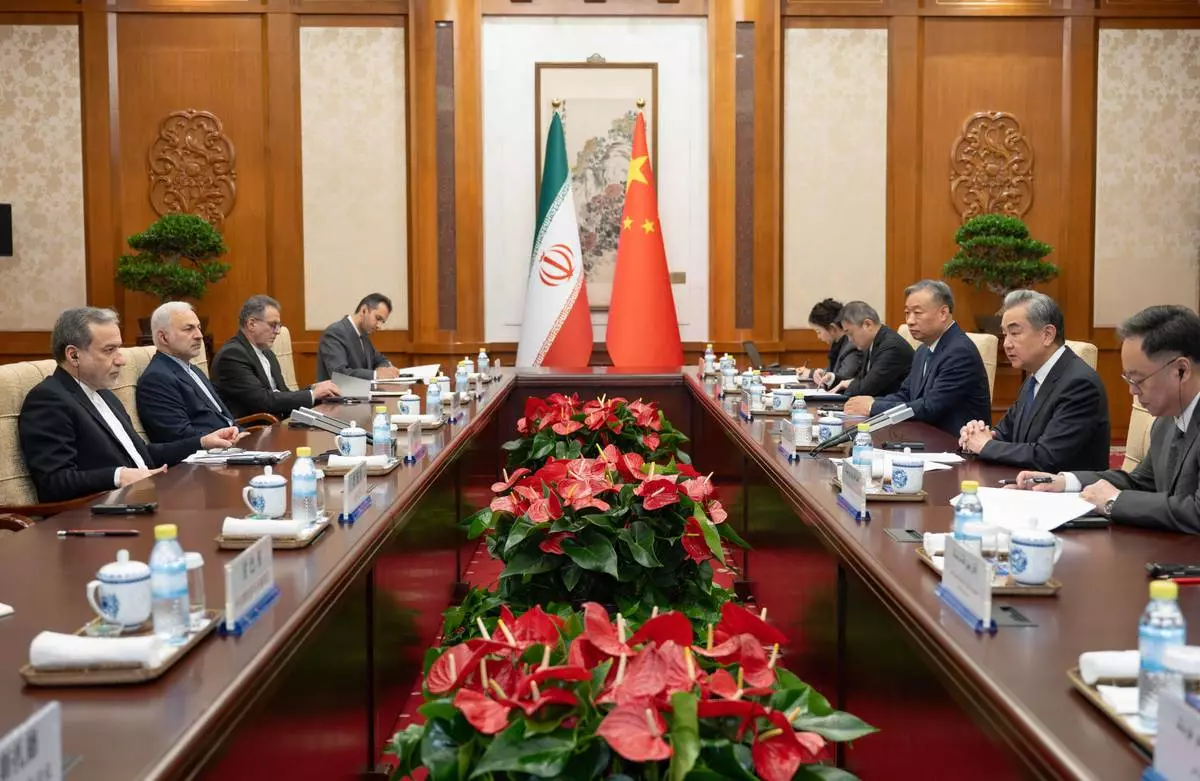
In this photo released by Xinhua News Agency, Chinese Foreign Minister Wang Yi, second right, talks to his Iranian Counterpart Abbas Araghchi, left, during the bilateral meeting in Beijing, Wednesday, May 6, 2026. (Cai Yang/Xinhua via AP)
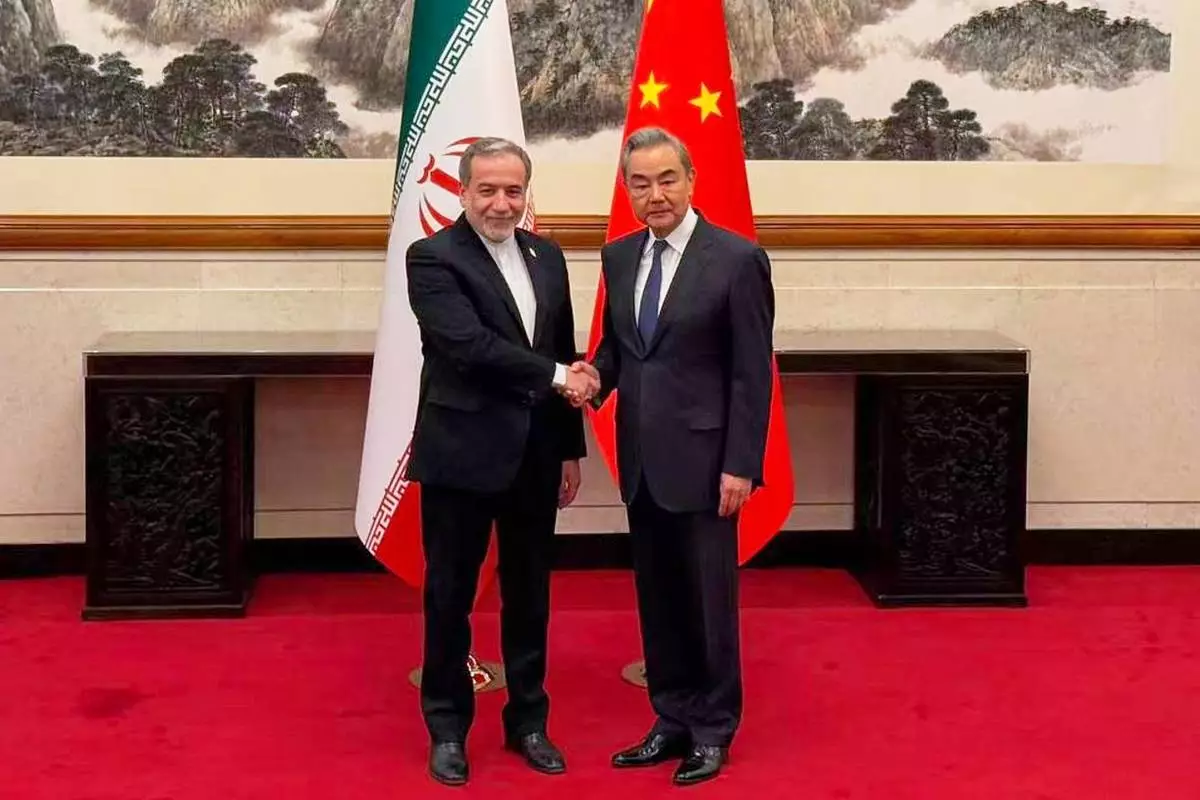
In this photo released by the Telegram channel of Iranian Foreign Minister Abbas Araghchi, China's Foreign Minister Wang Yi, right, meets with Iran's Foreign Minister Abbas Araghchi in Beijing, China, Wednesday, May 6, 2026. (Telegram channel of the Iranian Foreign Minister via AP)