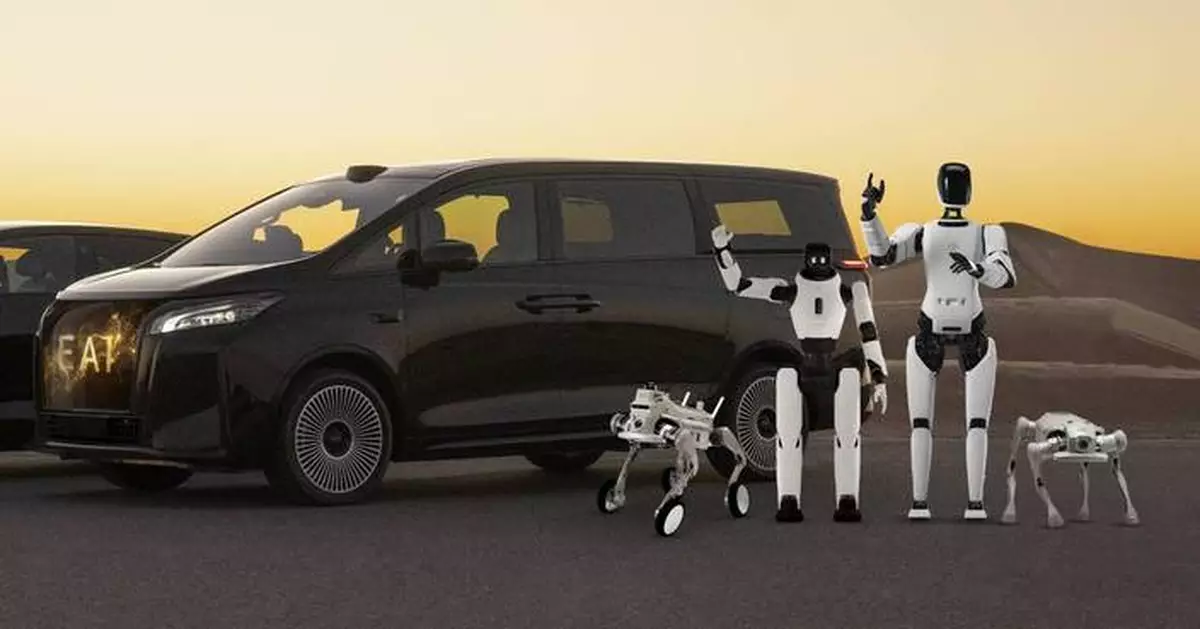
LOS ANGELES--(BUSINESS WIRE)--May 6, 2026--
Faraday Future Intelligent Electric Inc. (NASDAQ: FFAI) (“Faraday Future,” “FF” or the “Company”), a California-based global Embodied AI (EAI) ecosystem company, today announced that, based on strategic cooperation with its bridge strategy partner, the Company plans to upgrade the FX Super One to an 800V architecture or accelerate the AIHER project, while pausing the original Super One 400V cooperation project.
This press release features multimedia. View the full release here: https://www.businesswire.com/news/home/20260506083292/en/
This adjustment represents a proactive optimization and upgrade of the Company’s strategic execution. It is highly significant for the “EAI Robotics + EAI EV” Dual-Engine Strategy and is expected to accelerate the implementation of the overall strategy, more quickly form an operational closed loop, and unlock value across the entire Company.
First Batch of Mass-Production Super One Deliveries Will Be the More Competitive 800V BEV or AIHER Model, Creating Greater Value for Users
The Company believes that the 800V architecture model offers stronger product competitiveness and user value compared to the originally planned Super One 400V model. By adopting a “high-voltage, low-current” approach, the Company expects to fundamentally optimize the electrical architecture, delivering longer range, faster charging speeds, and superior powertrain efficiency. These are the core experiences U.S. users prioritize most for long-distance travel and daily driving.
In parallel, the Company is also advancing development of the AIHER model. As the world's first AI-driven extended-range plus hybrid fusion technology featuring a “strong extended-range, light hybrid” architecture, AIHER is expected to overcome the weaknesses of conventional hybrid and plug-in hybrid systems. It is particularly well-suited to extreme-cold winter regions such as the U.S. East Coast, demonstrating outstanding adaptability and energy efficiency.
Accordingly, the Company's goal is for the first batch of mass-production Super One deliveries to be either the 800V BEV or the AIHER model, in order to create greater value for users. Subject to securing financing from strategic or medium-to-long-term investors and sufficient to support mass-production deliveries, the Company will fully launch Super One mass-production deliveries.
The updated delivery timeline is as follows: once the necessary funding is in place, the Super One 800V BEV is expected to achieve its first phase of delivery within 6 to 9 months, second phase of delivery within 12 to 15 months, and third phase of delivery within 21 to 24 months; the AIHER hybrid model is expected to achieve its first phase of delivery within 9 to 12 months, second phase of delivery within 21 to 24 months, and third phase of delivery within 24 to 28 months.
Optimizing EAI Strategy Execution Cadence, Accelerating an Operational Closed Loop, and Putting Stockholders First
Although FF’s EAI Bridge Model has already enabled relatively asset-light operations, the EV business remains capital-intensive compared to the robotics business. Until the Company secures necessary funding from strategic or medium-to-long-term investors, it will continue to advance prudently in a manner that minimizes cost and investment, prioritizes efficiency, and maximizes stockholder value.
While this adjustment will affect the Super One delivery timeline, concentrating more resources in the robotics business during its critical ramp-up period is expected to substantially reduce near-term cash outflows, accelerate the formation of an operational closed loop, and lower financial risk. As a result, the Company expects to fundamentally move out of a high-risk position, move away from the highly dilutive convertible bond financing model, minimize share dilution, and maximize stockholder value.
The Company has also continued to advance discussions with potential strategic and medium-to-long-term investors, with feedback in recent weeks improving meaningfully relative to earlier periods. The Company recently successfully secured $45 million in financing from a U.S. mid-to-large institutional investor, reflecting capital markets’ growing recognition of and confidence in the “EAI Robotics + EAI EV” Dual-Engine Strategy, particularly the progress of the robotics business and the Bridge Model.
“Three-in-One” EAI Robotics Strategy Accelerates Deployment, Working to Convert First-Mover Advantage into a Sustainably Leading Position
FF's EAI Robotics business is rapidly entering scaled deployment and has been validated by both the education sector and the capital markets. This reflects the Company's first-mover advantage as the first U.S. company to deliver both humanoid and bionic robots and to comprehensively expand into the education market.
As of April 30, 2026, FF has shipped 68 EAI robots with a positive product gross margin. May shipments are expected to continue to accelerate as the Company progresses steadily toward its first delivery quarter target of 200 units. The Company expects cumulative shipments to exceed 1,000 units in 2026. More importantly, market recognition of FF's EAI Robotics strategy and execution continues to grow, laying the foundation for subsequent scaled deployment.
Through ongoing robot deliveries, ramp-up, and use case expansion, FF is building a self-reinforcing “Device-Data-Brain” business model, where scaled device deliveries and deployment drive data collection and training, which feeds the AI brain, which improves product capability, which accelerates sales and deployment, which generates more data, which advances an even smarter AI brain. Through this accelerating flywheel, FF aims to rapidly convert its first-delivery first-mover advantage in robotics into a sustainably leading position. Looking ahead, on the B2B education front, the Company will focus on advancing strategic partnerships and robot procurement agreements with the first batch of K-12 schools and universities, as well as EAI education summer camps and similar initiatives. On the B2C family education front, FF expects to accelerate execution of its strategy to bring education robots into households, continuing to drive the deployment of the first scaled EAI education system in the United States. Driven by the “EAI Robotics + EAI EV” Dual-Engine Strategy, the Company is entering a new phase of growth.
ABOUT FARADAY FUTURE
Faraday Future is a California-based global intelligent Company founded in 2014 and is dedicated to reshaping the future of mobility through vehicle electrification, intelligent technologies, and AI innovation. Its flagship vehicle, the FF 91, began deliveries in 2023 and reflects the brand's pursuit of ultra-luxury, cutting-edge technology, and high performance. FF's second brand, FX, targets the high-volume mainstream vehicle market. Its first model, Super One, is positioned as a first-class EAI-MPV, with deliveries planned to begin in 2026. FF recently announced its entry into the Embodied AI Robotics business with sales beginning this year, connecting its future strategy of bringing a new era of EAI vehicles and EAI robotics. For more information, please visit https://www.ff.com/.
FORWARD LOOKING STATEMENTS
This press release includes "forward-looking statements" within the meaning of the safe harbor provisions of the United States Private Securities Litigation Reform Act of 1995. When used in this press release, the words "plan to," "can," "will," "should," "future," "potential," and variations of these words or similar expressions (or the negative versions of such words or expressions) are intended to identify forward-looking statements. These forward-looking statements, which include statements regarding FX Super One production and delivery, the Company's EAI robotics business, and future financings, involve a number of known and unknown risks, uncertainties, assumptions and other important factors, many of which are outside the Company's control, which could cause actual results or outcomes to differ materially from those discussed in the forward-looking statements.
Important factors, among others, that may affect actual results or outcomes include, among others: the Company's ability to maintain its listing on Nasdaq; the availability of sufficient share capital to execute on its strategy, which the Company currently lacks; the agreement of stockholders to substantially increase the Company's share capital, which could result in substantial additional dilution; the Company's ability to homologate FX vehicles for sale; the Company's ability to secure the necessary funding to execute on the FX strategy, which will be substantial; demand for the Super One; demand for the Company's robotics products; competition in the robotics industry, which includes companies with far superior experience, funding and name recognition; the Company's reliance on a single OEM for most of its robotics products; the Company's ability to get the planned robotics products to comply with all applicable U.S. rules and regulations; the ability of the robotics OEM to timely supply robotics to the Company; tariff uncertainty for imported products, particularly from China; the ability of the U.S. Department of Commerce to review, condition, or prohibit robotics-related transactions with a China OEM; demand from automobile dealers for robotics products; the Company’s ability to maintain its listing on Nasdaq; the Company’s ability to timely regain compliance with Nasdaq’s $1.00 minimum bid price requirement; that the Company’s common stock will be suspended from trading on Nasdaq if the closing price of its Class A common stock is $0.10 or less for 10 consecutive trading days; the availability of sufficient share capital to execute on its strategy, which the Company currently lacks; the agreement of stockholders to substantially increase the Company’s share capital, which could result in substantial additional dilution; the ability to secure the necessary agreements to upgrade the Super One to an 800V architecture or to develop the AIHER model, none of which have been finalized; the Company's ability to design and develop AIHER technology; the Company’s ability to secure financing for the 800V architecture of the Super One; the Company's ability to secure an occupancy certificate for its Hanford facility; the Company's ability to continue as a going concern and improve its liquidity and financial position; the Company's ability to pay its outstanding obligations; the Company's ability to remediate its material weaknesses in internal control over financial reporting and the risks related to the restatement of previously issued consolidated financial statements; the Company's limited operating history and the significant barriers to growth it faces; the Company's history of losses and expectation of continued losses; the success of the Company's payroll expense reduction plan; the Company's ability to execute on its plans to develop and market its vehicles and robots and the timing of these development programs; the Company's estimates of the size of the markets for its vehicles and robots and cost to bring those vehicles to market; the rate and degree of market acceptance of the Company's vehicles; the Company's ability to cover future warranty claims; the success of other competing manufacturers; the performance and security of the Company's vehicles; current and potential litigation involving the Company; the Company's ability to receive funds from, satisfy the conditions precedent of and close on the various financings described elsewhere by the Company; the result of future financing efforts, the failure of any of which could result in the Company seeking protection under the Bankruptcy Code; the Company's indebtedness; the Company's ability to use its "at-the-market" program; insurance coverage; general economic and market conditions impacting demand for the Company's products; potential negative impacts of a reverse stock split; potential cost, headcount and salary reduction actions may not be sufficient or may not achieve their expected results; circumstances outside of the Company's control, such as natural disasters, climate change, health epidemics and pandemics, terrorist attacks, and civil unrest; risks related to the Company's operations in China; the success of the Company's remedial measures taken in response to the Special Committee findings; the Company's dependence on its suppliers and contract manufacturer; the Company's ability to develop and protect its technologies; the Company's ability to protect against cybersecurity risks; and the ability of the Company to attract and retain employees, any adverse developments in existing legal proceedings or the initiation of new legal proceedings, and volatility of the Company's stock price. You should carefully consider the foregoing factors and the other risks and uncertainties described in the "Risk Factors" section of the Company's Form 10-K for the year ended December 31, 2025 filed with the SEC on March 31, 2026, and other documents filed by the Company from time to time with the SEC.

Faraday Future Announces Plans to Upgrade FX Super One MPV to More Competitive 800V EV or Accelerate AIHER Hybrid Project with Bridge Strategy Partner as the Company Continues Strong Push in Parallel with Its EAI Robotics Business