Speech by FS at LME Asia Metals Seminar 2026
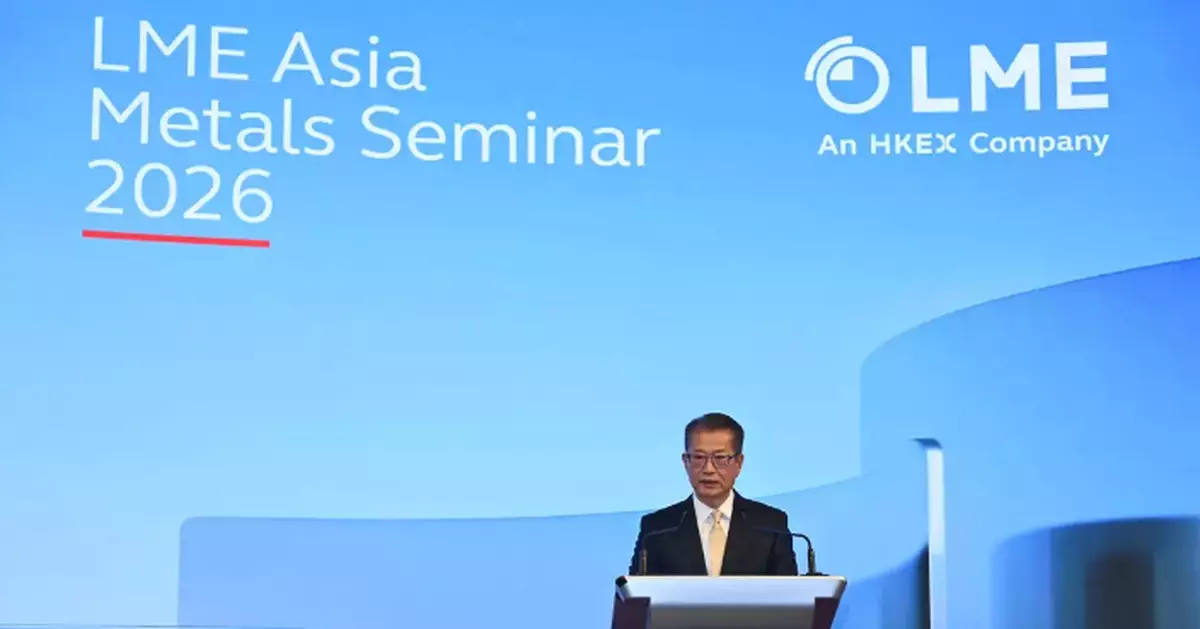
Following is the speech by the Financial Secretary, Mr Paul Chan, at the LME Asia Metals Seminar 2026 today (May 7):
Carlson (Chairman of the Hong Kong Exchanges and Clearing Limited (HKEX), Mr Carlson Tong), Bonnie (Chief Executive Officer of the HKEX, Ms Bonnie Chan), Matthew (Chief Executive Officer of the London Metal Exchange (LME), Mr Matthew Chamberlain), distinguished guests, ladies and gentlemen,
Good morning.
It is a pleasure to join you once again at the LME Asia Metals Seminar. My thanks go to HKEX and the LME for hosting this annual event. To international visitors who have travelled from around the world, a very warm welcome. Your presence testifies to Hong Kong's pivotal role as a global financial and trading hub, and increasingly, as an important member of the global metals community.
A changing landscape of metals
When we met here last year, I spoke about the strong momentum in global non-ferrous metals trade. Over the past year, that momentum has not only continued, but strengthened. In 2025, global LME trading volumes averaged around 760 000 lots a day, an 8 per cent increase over the record set in 2024. In 2026, the figure so far has further risen to close to 900 000 lots per day.
Driving the structural demand are forces we all know well: the global push for AI and data infrastructure, electric vehicles, renewable energy systems and advanced manufacturing, for which non-ferrous metals are essential input materials. Indeed, as technological innovation accelerates across applications, so will the demand for the metals that make them possible.
But the world we face today has grown more complex and, sadly, more uncertain and volatile.
Over the past few years, tariffs, conflicts and supply chain shocks have fundamentally reshaped global trade patterns. Trade flows are being rerouted. The geography of metals trade is being reconfigured in ways that are likely to endure.
The ongoing war in the Middle East has added further pressure to the metals trade. Many base metals, such as aluminium, copper and zinc, are seeing heightened volatility as shipping routes are disrupted, and market participants price in geopolitical risk.
The implications of these developments are clear: reliable, stable supply chains for non-ferrous metals have become a strategic imperative.
Hong Kong's strategic position
It is against this backdrop that Hong Kong's role as a trading hub for these metals takes on an even greater significance and a deeper strategic purpose.
Global trade is becoming more regionalised. Buyers increasingly value resilience over efficiency alone. At the same time, China and ASEAN (Association of Southeast Asian Nations) countries are deepening industrial integration and supply chain collaboration. In this environment, the region needs a platform it can trust: for trading, for price discovery, and for getting deals done.
Our country's 15th Five-Year Plan, for the first time, explicitly supports Hong Kong to build a commodity trading ecosystem. This is a mandate that Hong Kong can - and should - become: a commodity trading hub that connects the Chinese Mainland and regional supply chains with the international market.
Hong Kong's unique business proposition rests on two important foundations under the "one country, two systems" framework.
First, Hong Kong is a free port - with zero tariffs, super efficient customs, unrestricted movement of goods and capital, as well as world-class logistics and maritime connectivity. As geopolitical tensions rise and global supply chains are being reconfigured, our role as a regional re-export hub is becoming even more important. Last year, despite the tariff war, Hong Kong's total goods exports went up by more than 15 per cent year-on-year.
Particularly noteworthy is the performance of non-ferrous metals exports, which rose by nearly 35 per cent last year. That strong momentum has continued. In the first quarter of this year, such exports grew by 170 per cent year on year.
Second, Hong Kong has exceptional institutional strengths and deep capabilities in financial and professional services. We maintain full alignment with international standards, the common law system, and independent dispute resolution mechanisms. And we offer a full range of services, from trade finance and marine insurance to derivatives and risk management tools. The depth of this ecosystem is what can elevate a trading and logistics hub into a trading, logistics and pricing centre for metals.
What we are building
Indeed, over the past year, we have moved decisively to realise our strategic vision. We are building tangible infrastructure and offering attractive incentives.
We have established a Strategic Committee on Commodities, which I chair. The Committee is developing a long-term strategy covering physical trade, financial transactions, logistics, and connectivity with the Chinese Mainland. It takes a whole-of-ecosystem approach that goes well beyond any single initiative.
Our warehousing collaboration with the LME is an important part of this effort. A strong physical market, supported by ample delivery points, is what anchors credible benchmark prices. As Bonnie mentioned earlier, since the LME approved Hong Kong as a delivery point last year, our network has rapidly grown to 15 warehouses. More than 24 000 tonnes of LME metals are already on warrant.
We know this network must continue to expand, given the sheer and growing scale of trading activities in this region.
A strong physical delivery network does more than improve supply reliability for regional buyers. It also strengthens the price discovery process by bringing regional demand more directly into the LME’' pricing and settlement infrastructure. In addition, it helps reduce the premium that regional buyers have historically paid because of longer delivery distances from other Asian delivery points.
On the legal and tax front, we will introduce legislation in the first half of this year to provide a 50 per cent profits tax concession for eligible commodity trading activities. This will make Hong Kong more cost competitive when compared with other leading global commodity hubs.
Gold deserves some mention here, because it goes hand in hand with our broader strategy to develop commodity trading. The centre of gravity in gold trading is shifting eastward, as Asia accounts for around 60 per cent of the world's annual gold demand.
To better capture these opportunities, we are building a central clearing system for gold, with trial operations scheduled for this year. Meanwhile, the Hong Kong Airport Authority is fast expanding the gold storage capacity, with a target of exceeding 2 000 tonnes within three years. Last month, Hong Kong also listed a new gold ETF (exchange-traded fund) with physical redemption options.
&bsp;As the global commodities market continues to grow in both scale and complexity, the need for efficient and specialised dispute resolution mechanisms is becoming ever more pressing. We believe Hong Kong, as an international dispute resolution centre, can make a meaningful contribution in this regard.
I am pleased to let you know that the HKSAR (Hong Kong Special Administrative Region) Government and the International Organization for Mediation, or the IOMed, are exploring the feasibility of establishing a special panel of mediators for commodities market disputes under the IOMed. This will provide a neutral, expert-led mediation mechanism for disputes arising across the commodities value chain, covering upstream mining and production, midstream trading and clearing, as well as downstream warehousing and delivery.
This initiative complements our strategy to develop Hong Kong into a leading gold and commodities trading hub, and helps facilitate cross-border transactions, mitigate risks and strengthen market confidence among global market participants.
Future directions
Looking ahead, the prospect for Hong Kong's metals business is highly promising. In this year's Budget, I set out the Finance+ strategy to foster greater synergy between our financial services sector and other key industries. Metals is one of the most compelling areas for this application. There are several directions with particularly strong potential.
First, building a full financial lifecycle for metals. Our ambition is for Hong Kong to be a place where every major financial need of a commodity business can be satisfied: from commodity-backed finance and derivatives, to marine and trade insurance, as well as sustainability-linked instruments.
We are also pleased to see more metals and minerals companies establishing in Hong Kong. We welcome them to list on our stock exchange to access both international and Mainland capital. They are also welcome to manage their global operations and corporate treasury activities from this city.
Last year, a mining company operating Kazakhstan's largest tungsten mine did a concurrent listing on both our stock exchange and the Astana International Exchange. It was the first of its kind. We are sure more will follow.
Second, promoting the use of RMB (Renminbi) in commodity pricing. China now accounts for over half of global base metal consumption. Its continued investments in new energy, AI and the tech sector will certainly sustain this demand for years to come. Looking ahead, there is clear room for more RMB-denominated commodity products in Hong Kong for both Mainland and international participants. This will help them manage their currency risks, and give China a more proportionate voice in global commodity benchmark pricing.
Third, enhancing market connectivity. For metals users across the region, deeper connectivity means greater liquidity, sharper price discovery and lower hedging costs. We will actively explore mutual market access in metals between Hong Kong and key markets around the world. This could include the cross listing or mutual listing of products such as metals ETFs and other exchange-traded instruments.
Just as Stock Connect and Bond Connect have transformed Hong Kong's equity and fixed income markets, there is clear potential to explore similar "Connect" arrangements in commodities. This is a longer-term project, but one that we are working towards with our partners on the Chinese Mainland.
Concluding remarks
Ladies and gentlemen, let me conclude with a thought about purpose.
If one word sums up the changes driving the world today, it is "innovation". The AI era is reshaping economies and industries through advances in technology, products, business models and applications. In that process, metals are coming back into sharper focus as the building blocks of the real economy. They are no longer seen only as industrial inputs, but increasingly as part of the technologies, products and investment themes that people can readily relate to.
Developing a more vibrant metals ecosystem here in China and Asia, where production and supply chains are closely interlinked, will be vital not only to supporting more stable economic growth across our region and the world, but also to creating new opportunities for industrial development, investment, and financial market development.
Hong Kong has the infrastructure, the institutions, the connections, the capital, the talent and now the national mandate to serve that purpose well. We are committed to doing so, in partnership with the LME, HKEX, and all of you here today.
On that note, I wish you all productive discussions at this seminar and every success in the year ahead. Thank you very much.
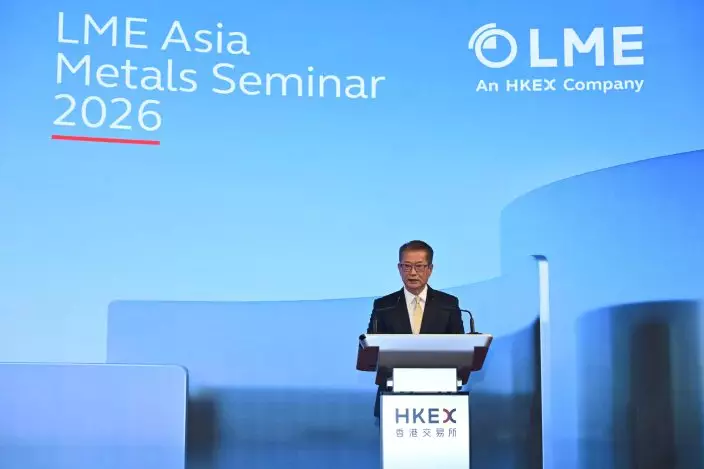
The Financial Secretary, Mr Paul Chan, speaks at the LME Asia Metals Seminar 2026 today (May 7). Source: HKSAR Government Press Releases