Industry leaders at Shanghai's second summit on embodied AI highlighted a shifting focus in Chinese robotics development that prioritizes breakthroughs in core components and virtual training systems.
The three-day event, officially the Shanghai International Embodied AI Robot Industry Innovation Summit, opened Wednesday, gathering government officials, researchers and investors to discuss the practical applications of embodied AI and the building of a new innovation ecosystem.
Despite expectations of flashy humanoid robot demonstrations, the spotlight at this year's summit fell on chips, sensors and compact black control units displayed across booths. Industry insiders said these components represent the true competitive frontier of robotics.
"Our products function more like the brain of a robot. After receiving a task, the system breaks it down, understands it and then executes it," said Shen Bin, product director at Qingyi (Shanghai) Intelligent Technology.
Qingyi is not alone at the summit in having turned its attention from robots' physical actuators to the computing systems that control them. While China now produces more than 70 percent of core humanoid robot components domestically, high-end sensors and precision parts that define performance limits still lag in commercialization. Industry consensus holds that solidifying the robot's "brain" is the next critical step.
Yet, building that intelligence requires not only better chips, but crucially high-quality data. Embodied AI systems learn through vast amounts of real-world interaction, but collecting it with physical robots is costly and slow. A new approach showcased at the summit uses on-screen virtual environments as training grounds, allowing robots to practice and solve tasks in simulation before deploying to the real world.
"We expect that in future unstructured environments, machines will gradually develop reliability and generalization capabilities to allow them to think, act and make decisions autonomously," said Zhang Heng, a researcher at the Institute of Software of the Chinese Academy of Sciences.
The summit this year also marked the official launch of the "embodied AI industry alliance." During the launch event, the first batch of 12 supply-chain enterprises signed agreements to set up operations at a high-tech innovation community in Shanghai's Lingang New Area, where resources will be pooled to tackle key technological bottlenecks through industrial clustering.
"Moving into this industrial park is primarily about synergizing with upstream and downstream resources," said Pan Rui, general manager of Shanghai Taifang Technology.
As robots develop highly intelligent capabilities, Chinese producers are well-positioned to bridge the gap between advanced software and mass production. In 2025, the number of domestic humanoid robot manufacturers in China had exceeded 140, with annual shipments reaching around 14,400 units, accounting for more than 80 percent of the global market. As for the year of 2026, shipments are projected to surpass 60,000 units.
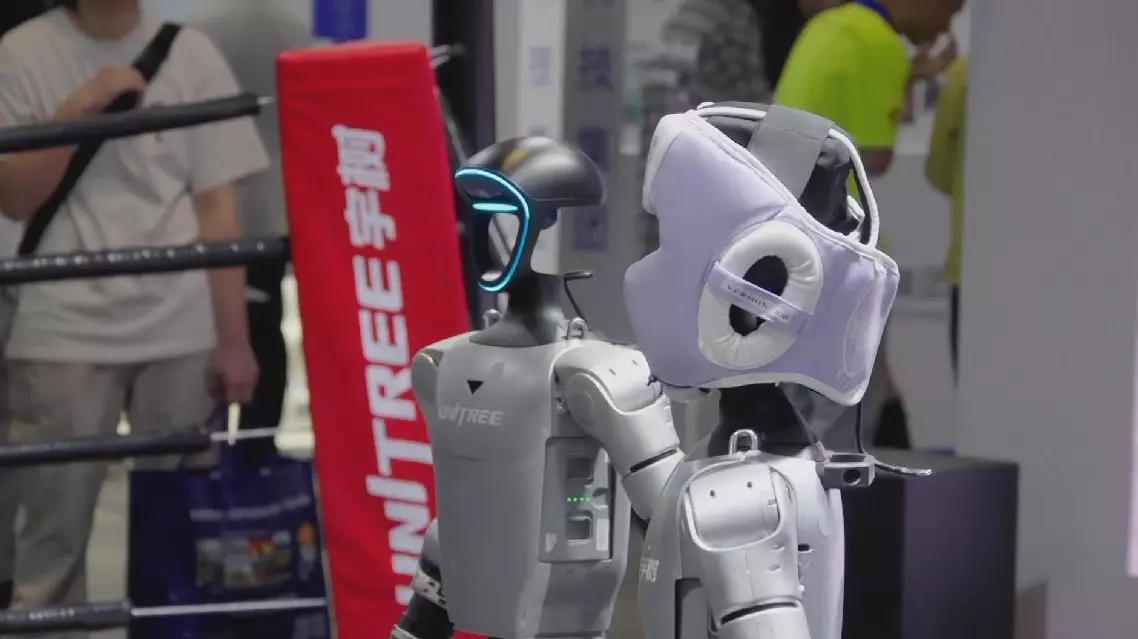
Robotics innovation summit in Shanghai witnesses pivot in focus to chips, sensors