BALTIMORE--(BUSINESS WIRE)--May 7, 2026--
Kallisio, a company focused on advancing precision oncology through patient-specific, technology-enabled solutions, today announced that Stentra ™ has received “Best New Radiology Technology Solution” in the 10 th annual MedTech Breakthrough Awards program conducted by MedTech Breakthrough, an independent market intelligence organization that recognizes the most innovative companies, technologies and products in the global digital health and medical technology market.
This press release features multimedia. View the full release here: https://www.businesswire.com/news/home/20260507479243/en/
“Kallisio redefines how precision oncology solutions are designed, governed, and scaled. Radiation should treat cancer without the risk of compromising healthy tissue, but inconsistent immobilization can lead to patient risk. Generic or handcrafted oral appliances are variable in quality, contributing to toxicities, treatment interruptions, and operational inefficiencies,” said Steve Johansson, managing director, MedTech Breakthrough. “Kallisio’s Stentra transforms variability into precision. Combining leadership, evidence, and economic relevance, Stentra is not just digital health; it is digitally enabled medical technology with proven real-world impact.”
FDA-cleared and CE-marked, Kallisio’s governance-ready Stentra solution combines optical scanning, automated design, and rapid additive manufacturing to deliver millimeter-accurate, 3D-printed devices built specifically for head and neck cancer patient’s oral anatomy and radiation treatment plan. Stentra effectively immobilizes the oral cavity and displaces critical structures such as the tongue. Through consistent tissue displacement and reproducible positioning, the solution drives enhanced radiation dose deliver precision and improved protection of organs-at-risk (OARs). Stentra devices are delivered within 72 hours, supported by ISO 13485-aligned quality systems, and CPT-reimbursable
“Behind every personalized solution is a measurable reduction in patient pain, treatment delays, and clinical workflow complexity, all backed by real-world evidence. Early Stentra data shows up to seven minutes saved per treatment fraction, four hours of LINAC capacity recovered per patient course, and significant decreases in simulation re-scans and unplanned interventions for side effects,” said Rajan Patel, CEO of Kallisio. “We’re honored to be recognized by MedTech Breakthrough, and proud to serve as a strategic partner to hospitals and clinics seeking anatomy-driven solutions that improve outcomes while easing the burden on care teams.”
Honoring the innovations reshaping how care is delivered worldwide, the MedTech Breakthrough Awards program has spent a decade recognizing the companies driving meaningful progress and improving patient care across the global health and medical technology industry.

FDA-cleared Stentra™ patient-tailored oral immobilization solution delivers a custom fit and case-specific tongue displacement to optimize dose delivery and protect healthy tissues in head and neck cancer radiation therapy.
NASHVILLE, Tenn. (AP) — Republican lawmakers in Tennessee forged ahead with a plan Thursday that could carve up a majority-Black congressional district, reshaping it to the GOP's advantage as part of President Donald Trump's strategy to try to hold on to a slim House majority in the November midterm elections.
Protesters shouted “No Jim Crow” outside the House and Senate chambers as lawmakers convened to consider the legislation. Some protesters later were cleared out of the House chamber after interrupting debate with chants of “Who's House? Our House!”
The redistricting effort in Tennessee is one of several rapidly advancing plans in Southern states as Republicans try to leverage a U.S. Supreme Court ruling that weakened the federal Voting Rights Act.
The court ruled that Louisiana relied too heavily on race when creating a second Black-majority House district as it attempted to comply with the federal law. The high court's decision altered a decades-old understanding of the law, giving Republicans grounds to try to eliminate majority-Black districts that have elected Democrats.
Louisiana has postponed its congressional primary to give time for state lawmakers to craft a new House map. Legislation awaiting a final vote in Alabama also would upend the state’s congressional primaries if courts allow the state to change its U.S. House districts. In South Carolina, meanwhile, Republican lawmakers urged on by Trump have taken initial steps to add congressional redistricting to their agenda.
The states are the latest to join an already fierce national redistricting battle. Since Trump prodded Texas to redraw its U.S. House districts last year, eight states have adopted new congressional districts. From that, Republicans think they could gain as many as 13 seats while Democrats think they could gain up to 10. But some competitive races mean the parties may not get everything they sought in the November elections.
A package of bills in Tennessee would repeal a state law prohibiting mid-decade redistricting and reopen a candidate qualifying until May 15 to allow time for new people to enter the primary and existing candidates to switch districts. The proposed House map would break up Tennessee’s lone Democratic-held district, centered on the majority-Black city of Memphis, creating a ripple effect of alterations to districts throughout the western and central parts of the state.
Republican House Speaker Cameron Sexton said the proposed districts were drawn based on population and politics, not racial data.
But Democrats dismissed such assertions.
“This is being done because of race,” Democratic state Rep. Jason Powell said during Thursday's debate.
The proposal “is Black vote dilution at an industrial scale,” said Sekou Franklin, a political science professor at Middle Tennessee State University who is part of the Tennessee branch of the NAACP.
Democrats noted that the state Supreme Court in April 2022 rejected a challenge to the current congressional map, finding it was too close to the election to make changes. This year, there’s even less time before the Aug. 6 primary, raising the potential of confusion for both candidates and voters, Democrats said.
The Alabama House passed legislation Wednesday authorizing special congressional primaries as Republicans eye the possibility of getting a different congressional map in place for the November elections. The bill could receive a Senate vote by Friday.
Alabama is seeking to lift a federal court order that created a second House district with a near-majority of Black voters. That map led to the 2024 election of Rep. Shomari Figures, a Black Democrat. Republicans want instead to use a 2023 map drawn by state lawmakers that would give the GOP an opportunity to reclaim Figures’ district.
The legislation won approval on a party-line vote after four hours of fiery debate during which Black legislators recalled the state’s history. Democratic state Rep. Juandalynn Givan likened the legislation to poll taxes and counting jelly beans in a jar — a virtually impossible task that was used to suppress Black voters during the Jim Crow era.
“It is a calculated political maneuver born out of fear, a fear that is of Black people and most importantly Black political power,” Givan said.
Alabama’s primaries are May 19. If a court grants the state’s request, the legislation would ignore the results for congressional seats and direct the governor to schedule a new primary under the revised districts.
The South Carolina Senate could take up a resolution Thursday giving lawmakers permission to return later, after their regular work ends, to redraw congressional districts that could eliminate the state’s only Democratic-held district. The proposal, which passed the House on Wednesday, needs a two-thirds vote in both chambers.
Republican House leaders said after the vote that they plan to introduce a new map Thursday and hold committee meetings on Friday. But during debate Wednesday, Republicans fended off specific questions from Democrats, including why they were willing to stop the June 9 U.S. House primary elections well after candidates filed and how much a rescheduled primary could cost.
Democratic Rep. Justin Bamberg said he felt sorry for Republicans who, he said, were giving up their principles to follow the whims of Trump.
“The president of the United States is a very powerful man. Wields a heavy, heavy thumb — Truth Social, X, Meta, Instagram. To be honest I don’t envy our Republican colleagues,” Bamberg said.
Chandler reported from Montgomery, Alabama; Collins from Columbia, South Carolina; and Lieb from Jefferson City, Missouri. Associated Press reporter Kristin M. Hall contributed.

House Speaker Cameron Sexton, R-Crossville, sits alone after a House committee meeting during a special session of the state legislature to redraw U.S. Congressional voting maps Wednesday, May 6, 2026, in Nashville, Tenn. (AP Photo/George Walker IV)

State troopers clear a House committee meeting after it was disrupted by protesters during a special session of the state legislature to redraw U.S. Congressional voting maps Wednesday, May 6, 2026, in Nashville, Tenn. (AP Photo/George Walker IV)
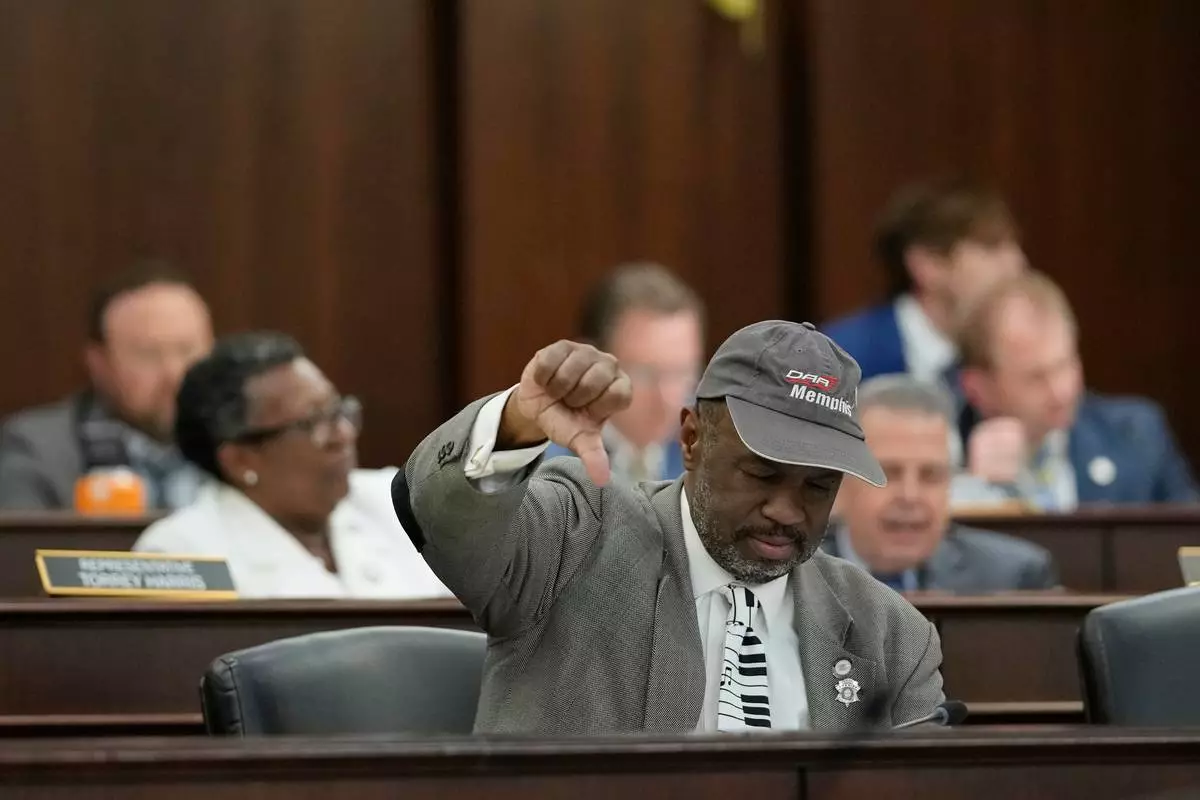
Rep. Joe Towns Jr., D-Memphis, gestures during procedural vote in a House committee meeting of a special session of the state legislature to redraw U.S. Congressional voting maps Wednesday, May 6, 2026, in Nashville, Tenn. (AP Photo/George Walker IV)