OMAHA, Neb.--(BUSINESS WIRE)--May 8, 2026--
Faraday Future Intelligent Electric Inc. (NASDAQ: FFAI) (“Faraday Future”, "FF" or the “Company”), a California-based global Embodied AI (EAI) ecosystem company, today announced the execution of a Memorandum of Understanding establishing a strategic partnership between FF AI-Robotics and Boston International Business School (“BIBS”) to jointly establish the BIBS–FF AI Robotics Institute (the “Institute”). The signing and launch ceremony were held in Omaha during the Berkshire Hathaway Annual Shareholders Meeting. Definitive agreements will be negotiated and are subject to approval by the FF Board of Directors.
This press release features multimedia. View the full release here: https://www.businesswire.com/news/home/20260507040912/en/
The Institute is positioned as the first industry-driven Physical AI and Robotics Institute in the United States integrating education, robot deployment, and data infrastructure.
This collaboration marks a significant milestone in advancing Physical AI and robotics education by deeply integrating real-world robot deployment, educational systems, and large-scale data generation to build next-generation Physical AI infrastructure.
Building the Ecosystem for the Physical AI Era
In recent years, artificial intelligence has been transitioning from the digital world into the physical world. As the first company in the United States to deliver both humanoid robots and bionic quadruped robots, FF AI-Robotics is committed not only to developing advanced robotic products, but also to building a comprehensive ecosystem that integrates EAI Device, EAI Brain & open-source open platform, and a decentralized data factory.
The Institute is not building a school, but aims to build the infrastructure layer for Physical AI talent, deployment, and data.
More importantly, the Institute aims to define talent standards for the Physical AI era, data standards for real-world AI training, application and deployment standards for large-scale use cases, and industry-level certification standards for robotics and Physical AI.
Education as the First FF AI-Robotics Application Scenario
Within the Institute, every student, every robot, and every deployment will continuously generate data to train the next generation of Physical AI systems.
By deeply integrating robotics into educational environments, the Institute will not only serve as a talent development platform, but also as a critical source of data and a key entry point for the continuous evolution of AI systems.
Boston International Business School (“BIBS”) was co-founded by Professor Pedro Nueno, Co-founder and Founding Dean of CEIBS and Professor at IESE Business School, widely recognized as one of the key architects of modern global business education systems, and professor Liya Rong, Co-founder of BIBS, former publisher of Harvard China Review, former co-founder of Peking University School of Transnational Law, and former advisor to the President of Cornell University.
Both founders bring extensive experience in global education systems, particularly in modern business school development, entrepreneurship, and international resource integration.
The Institute also announced its inaugural faculty and co-program directors, including: Prof. Peng Jin of Peking University; Jing Zhao Cesarone, Chair of the Global CSR Foundation and Global Chair of AI Universal Education Day; John Li, Senior Specialist in Information Security and AI Risk Management at Stanford University; Dr. Jason Dou, Harvard postdoctoral researcher and founder of Marbella AI; Dr. Mark Tang, globally recognized cross-border biopharma leader, healthcare investor, and Harvard T.H. Chan School of Public Health alumnus; Frank Cownie, former Mayor of Des Moines; Dr. Selena Wu, University of Pennsylvania postdoctoral researcher and founder of the Global Artificial Intelligence Alliance (GAIA) and Penn Global Artificial Intelligence Alliance (PGAIA); Xiaozhe Yan, President of US Education Without Borders; He Ping, renowned AI novelist and founder of Binghe AI Arts; QiQi Zhang, Co-Founder of StoryClaw; Joseph Cirnigliaro, distinguished media host and political strategist; Ugoji A. Eze, distinguished barrister; Dr. Jeannie Yi, prominent New York–based AI film producer; Jeff Ye, renowned New York–based RWA art expert; along with a number of Silicon Valley AI experts, New York AI investors, and other Ph.D.s from top universities and AI industry leaders.
This partnership represents a deep integration of world-class educational resources and cutting-edge AI robotics technology, laying the foundation for the next-generation Physical AI ecosystem.
Institute Focus and Certification System
The BIBS–FF AI Robotics Institute will focus on cultivating professional talent for the AI and robotics industry, delivering strategic thinking, domain knowledge, and practical skills to young learners, industry professionals, and entrepreneurs.
Key areas will include developer talent incubation for both professionals and youth, robotics vocational skills training and certification systems, entrepreneur empowerment and industrial innovation, as well as robotics research and applied education.
At the same time, the Institute will establish a global Physical AI certification system, covering:
robot operation and deployment capabilities, AI development and system integration, multi-scenario automation and solution design, robotic data collection and teleoperation, as well as robot maintenance and upgrades.
The goal is to become a standard-setting authority for talent development and professional certification in the Physical AI field.
Global Call for Academic Partners
The Institute is now officially launching its first global call for partner institutions, including vocational training organizations, K-12 schools, community colleges, universities, and engineering and technical institutions.
Partner institutions will gain access to real robotic system deployment and teaching resources, standardized curriculum and certification systems, hands-on opportunities connected to real industry scenarios, and internship opportunities for outstanding students at FF AI-Robotics.
Through this collaboration, partners can significantly enhance student employability and competitiveness.
Together, we aim to build the talent development system for the Physical AI era and drive the deep integration of education and industry.
“Education must evolve alongside industry. This collaboration represents a new model that closely integrates learning, practice, and innovation, and will cultivate truly industry-ready talent for the Physical AI era.” Pedro Nueno, Co-founder of BIBS said.
Professor Liya Rong, Co-founder of BIBS and Founding Co-Dean of the Institute, said: “The Institute is not only an educational platform, but also an important bridge connecting global educational resources with industrial innovation. We hope this platform will enable more students and institutions to participate in the development of Physical AI.”
“We are entering a new era of Physical AI, where intelligence moves from the digital world into the real world. Education is the first application scenario for our robots,” said Chris Chen, Co-CEO of FF AI-Robotics. Liya Rong, Founding Co-Dean of the Institute said, "the Institute will build a comprehensive platform integrating talent, robot deployment, developers, and Physical AI data. This is not just an educational collaboration—it is an infrastructure-level innovation in AI and robotics, and a step toward establishing industry standards."
ABOUT FARADAY FUTURE
Faraday Future is a California-based global Embodied AI (EAI) ecosystem Company founded in 2014 and is dedicated to reshaping the future of mobility through vehicle electrification, intelligent technologies, and AI innovation. Its flagship vehicle, the FF 91, began deliveries in 2023 and reflects the brand's pursuit of ultra-luxury, cutting-edge technology, and high performance. FF's second brand, FX, targets the high-volume mainstream vehicle market. Its first model, Super One, is positioned as a first-class EAI-MPV, with fast first deliveries planned to begin in 2026. FF recently announced its entry into the Embodied AI Robotics business, with sales and deliveries beginning in February 2026, marking a new chapter in its strategy to usher in a new era of EAI vehicles and EAI robotics. Learn more at: https://robotics.ff.com/us/
FORWARD LOOKING STATEMENTS
This press release includes "forward looking statements" within the meaning of the safe harbor provisions of the United States Private Securities Litigation Reform Act of 1995. When used in this press release, the words "plan to," "aim to," "intend to," "can," "will," "should," "future," "potential," and variations of these words or similar expressions (or the negative versions of such words or expressions) are intended to identify forward-looking statements. These forward-looking statements, which include statements regarding the launch and operation of the BIBS–FF AI Robotics Institute as the first industry-driven Physical AI and Robotics Institute in the United States, the deployment of robotic systems in educational environments, the development of Physical AI talent, certification, and curriculum systems, the establishment of industry-level standards for Physical AI and robotics, the generation and use of real-world data to train next-generation Physical AI systems, partnerships with global vocational, K-12, higher education, and engineering institutions, internship and developer pipeline programs at FF AI-Robotics, and the build-out of FF's Physical AI infrastructure and ecosystem, involve a number of known and unknown risks, uncertainties, assumptions and other important factors, many of which are outside the Company's control, which could cause actual results or outcomes to differ materially from those discussed in the forward-looking statements. Important factors that may affect actual results or outcomes include, among others: demand for our robotics products; competition in the robotics industry, which includes companies with far superior experience, funding and name recognition; our reliance on a single OEM for robotics products; our ability to get the planned robotics products to comply with all applicable U.S. rules and regulations; the ability of the robotics OEM to timely supply robotics to the Company; tariff uncertainty for imported products, particularly China; demand from automobile dealers for robotics products; the Company’s ability to maintain its listing on Nasdaq; the Company’s ability to timely regain compliance with Nasdaq’s $1.00 minimum bid price requirement; that the Company’s common stock will be suspended from trading on Nasdaq if the closing price of its Class A common stock is $0.10 or less for 10 consecutive trading days; the availability of sufficient share capital to execute on its strategy, which the Company currently lacks; the agreement of stockholders to substantially increase the Company’s share capital, which could result in substantial additional dilution;
You should carefully consider the foregoing factors and the other risks and uncertainties described in the "Risk Factors" section of the Company's Form 10-K filed with the SEC on March 31, 2026; and other documents filed by the Company from time to time with the SEC.
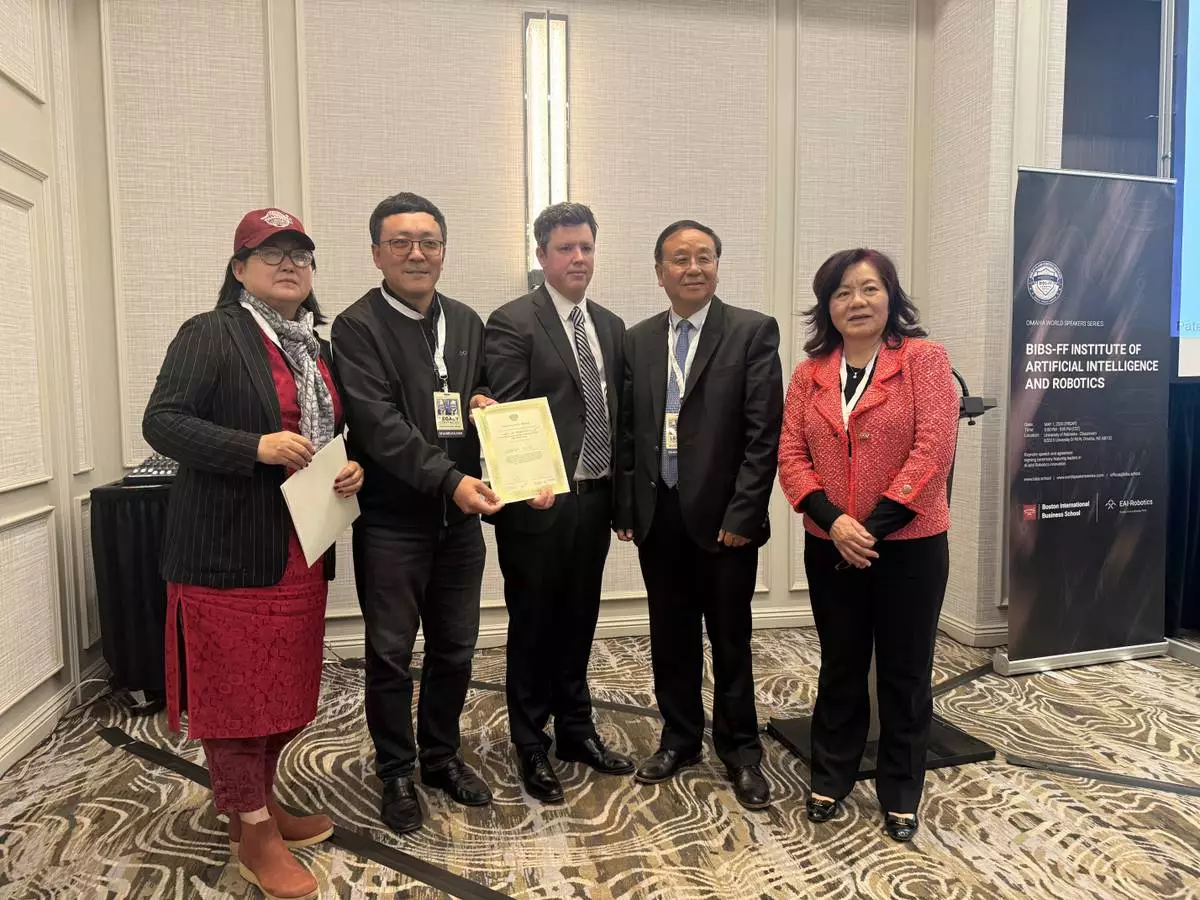
Faraday Future Announces Strategic Partnership Between FF AI-Robotics and Boston International Business School to Launch the BIBS–FF AI Robotics Institute, the First Industry-Driven Physical AI and Robotics Institute in the United States