The Carolina Hurricanes have secured their long-sought shot at breaking through a familiar roadblock in the Eastern Conference final.
Now the Hurricanes — the only undefeated team left in the NHL playoffs — are set for another a lengthy wait to get started in the third round.
Carolina beat the Philadelphia Flyers 3-2 in overtime on Saturday night, becoming the first team to sweep through the first two rounds since the league went to best-of-seven series in all four rounds in 1987. That has them back in the conference final for the third time in four seasons and fourth time in the current eight-year playoff run under coach Rod Brind'Amour.
The Hurricanes will face the Montreal-Buffalo winner, a series running through at least Thursday. The East's top seed had nearly a full week off after sweeping Ottawa in Round 1.
“I think it's probably going to be an even longer break this time,” veteran forward Taylor Hall said after Saturday's win in Philadelphia.
“The big positive is we're on to the third round relatively unscathed and healthy. You don't want to see injuries per se, but we hope these series go far and these teams have battles. That's the advantage we're going to have. ... Rod, our strength staff, all of our staff, do a good job of making sure that we're ready athletically to play. And from there, we get our footing pretty quickly.”
The Hurricanes have done exactly that since winning the first game of the NHL playoffs on April 18. They already have proven they can start quickly after a long break, opening the Flyers series with a dominating first period on the way to a 3-0 win.
“We had a plan, and clearly it was OK,” Brind'Amour said, "so we can follow that and run with it."
Carolina’s game plan relies on grinding effort and energy: an aggressive forecheck to pressure opponents into mistakes, possessing the puck in the offensive zone and staying there and firing chances at goaltenders and chasing rebounds — all of which minimizes scoring chances going the other way.
That's why the benefit of fresh legs and recharged minds has mattered more than the risk of rust so far.
Consider veteran goaltender Frederik Andersen. The 36-year-old Dane had started 32 playoff games for Carolina the past three years and the question lingered as to how much to lean on Andersen with 31-game winner Brandon Bussi also available.
But Andersen has been the best goaltender of the playoffs so far, with a 1.12 goals-against average and a .950 save percentage. He has two shutouts and has faced 25 or fewer shots in five of his eight games. Now he'll get another break to stay fresh.
As Andersen put it: “You don't really want to add extra games if you can avoid it.”
Or there's the case of defenseman Sean Walker.
It was in the hours after Thursday's Game 3 road win that he got the call from wife Taylor back in North Carolina that their first baby was on the way. So, he hopped an early morning flight home for the arrival of a daughter just in time for Mother's Day. He ate his pregame meal in the hospital cafeteria, then flew to Philadelphia around 2 p.m. Saturday ahead of the 6:15 p.m. puck drop.
“I didn’t want to get on the boys and tell them we better win tonight, but I’m really appreciative that everybody dug in,” Walker said. “The sweep's huge for everybody. But to take this time to just be with my family is going to be really special.”
Carolina has been elite on the penalty kill, a recurring strength, shutting down 38 of 40 chances (95%) while getting a shorthanded goal in Game 3 at Philadelphia. Offensively, the second line of Hall, Logan Stankoven and Jackson Blake has been dominant, with 14 goals and 31 points through eight games.
That's more than offsetting a quiet start for the Sebastian Aho-Andrei Svechnikov-Seth Jarvis top line, as well as a power play that is just 5 of 37 (13.5%) in the playoffs after ranking fourth in the regular season at 24.9%.
Still, the Hurricanes never trailed in their first five postseason games, and have won their last five games with a chance to close out an opponent.
Next comes a familiar roadblock.
Boston swept a happy-to-be-here Carolina team in the 2019 East final after the Hurricanes ended a nine-year playoff drought in Brind'Amour's first season. Florida swept Carolina in 2023 with four one-goal wins, then beat Carolina in five games last year.
Now the Hurricanes get another shot.
“The season is so long and there's that 82-game season we talk about that no one really gives much credit to, and yet this team’s played well for eight months," Brind'Amour said. "They didn’t just get hot at the end. It’s been night in, night out like this. And that’s the biggest takeaway for me. Probably the thing I’m most proud of about this group is that.
"And now, here we are. We've got to find a way to get that next step.”
AP NHL playoffs: https://apnews.com/hub/stanley-cup and https://apnews.com/hub/nhl

Carolina Hurricanes' Alexander Nikishin battles with Philadelphia Flyers' Garnet Hathaway (19) during the second period of Game 4 in a second-round NHL hockey Stanley Cup playoff series, Saturday, May 9, 2026, in Philadelphia. (AP Photo/Matt Slocum)

Carolina Hurricanes' Jackson Blake reacts after scoring the game-winning goal in overtime during Game 4 in a second-round NHL hockey Stanley Cup playoff series against the Philadelphia Flyers, Saturday, May 9, 2026, in Philadelphia. (AP Photo/Matt Slocum)
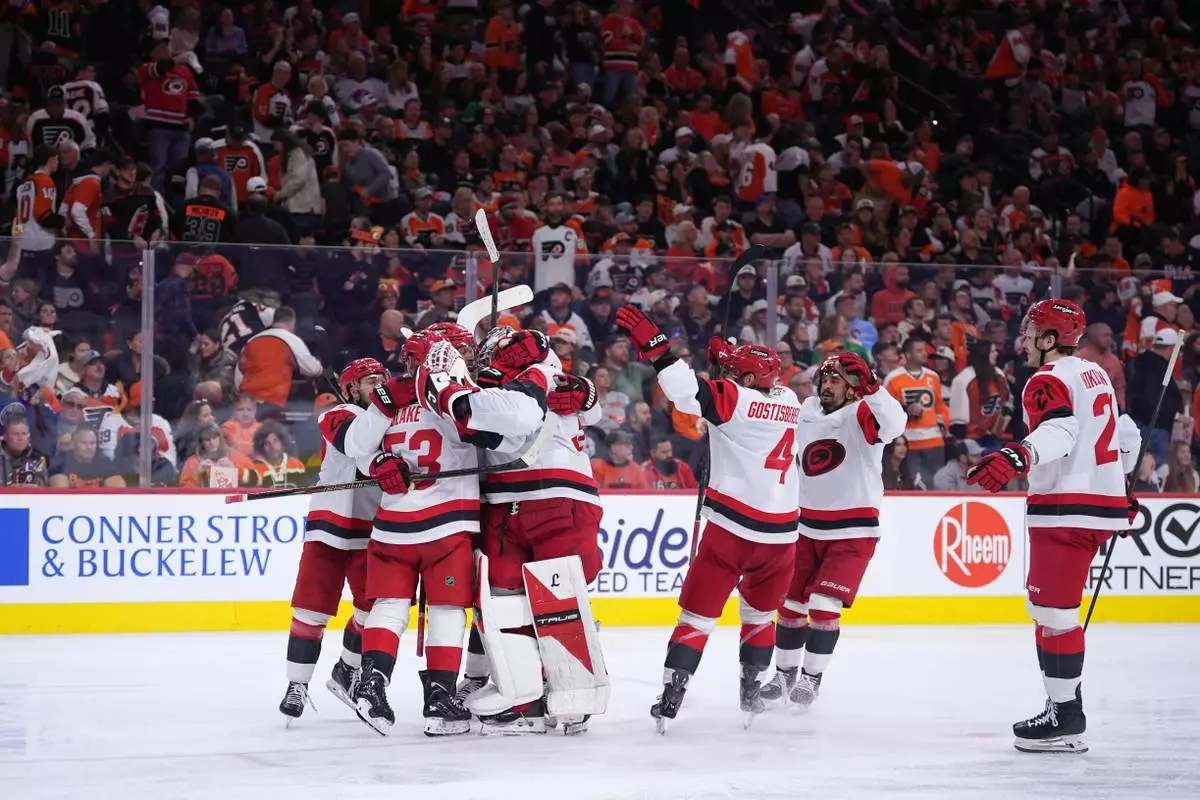
Carolina Hurricanes' players celebrate after winning Game 4 against the Philadelphia Flyers in a second-round NHL hockey Stanley Cup playoff series Saturday, May 9, 2026, in Philadelphia. (AP Photo/Matt Slocum)
DUBAI, United Arab Emirates (AP) — Iran has sent its response to the latest U.S. ceasefire proposal via Pakistani mediators and wants negotiations to focus on permanently ending the war, Iran’s state-run media said Sunday. Pakistan confirmed receiving it.
Iran seeks to end the war on all fronts, including in Lebanon, where Israel is fighting the Iranian-backed Hezbollah militant group, and to ensure the security of shipping, its state TV said. Washington’s latest proposal addressed a deal to end the war, reopen the Strait of Hormuz and roll back Iran’s nuclear program, an issue that Tehran would rather discuss later.
The White House had no immediate comment about Iran’s reply. President Donald Trump is giving diplomacy “every chance we possibly can before going back to hostilities,” the U.S. ambassador to the United Nations, Mike Waltz, told ABC.
Iran's new supreme leader, Mojtaba Khamenei, who has not been seen or heard publicly since the war began, “issued new and decisive directives for the continuation of operations and the powerful confrontation with the enemies” while meeting with the head of the joint military command, the state broadcaster reported, with no details.
The fragile ceasefire was tested when a drone ignited a small fire on a ship off Qatar and the United Arab Emirates and Kuwait reported drones entering their airspace. The UAE’s Defense Ministry said it shot down two drones and blamed Iran. No casualties were reported, and no one immediately claimed responsibility.
Qatar's Foreign Ministry called it a “dangerous and unacceptable escalation that threatens the security and safety of maritime trade routes and vital supplies in the region." The United Kingdom Maritime Trade Operations Center said the ship attack happened 23 nautical miles (43 kilometers) northeast of Doha. It gave no details about the ship's owner or origin.
Kuwait Defense Ministry spokesperson Brig. Gen. Saud Abdulaziz Al Otaibi said forces responded to drones “in accordance with established procedures” but did not say where they came from.
Iran and armed allied groups like Hezbollah in Lebanon have used drones to carry out hundreds of strikes since the war began with U.S. and Israeli attacks on Feb. 28.
Trump has reiterated threats to resume full-scale bombing if Iran does not accept an agreement to reopen the strait and roll back its nuclear program. Iran has largely blocked the strategic waterway that's key to the global flow of oil, natural gas and fertilizer since the war began, rattling world markets.
The U.S. in turn has blockaded Iranian ports and on Friday struck two Iranian oil tankers it said were trying to breach the blockade. Iran’s Revolutionary Guard navy says any attack on Iranian oil tankers or commercial vessels would be met with a “heavy assault” on one of the U.S. bases in the region and enemy ships.
The American military said Sunday that it has turned back 61 commercial vessels and disabled four since the blockade began April 13.
Another sticking point in negotiations is Iran’s highly enriched uranium. The U.N. nuclear agency says Iran has more than 440 kilograms (970 pounds) of uranium that is enriched up to 60% purity, a short, technical step from weapons-grade levels.
In an interview with state media posted late Saturday, an Iranian military spokesperson said its forces were on “full readiness” to protect nuclear sites where uranium is stored.
“We considered it possible that they might intend to steal it through infiltration operations or heli-borne operations,” Brig. Gen. Akrami Nia told the IRNA news agency.
Israeli Prime Minister Benjamin Netanyahu in an excerpt of an interview with CBS scheduled to air later Sunday said the war isn't over because the enriched uranium needs to be taken out of Iran. “Trump has said to me, ‘I want to go in there,’ and I think it can be done physically,” he said.
Russian President Vladimir Putin said Saturday that Moscow’s proposal to take enriched uranium from Iran to help negotiate a settlement remains on the table.
The majority of Iran’s highly enriched uranium is likely at its Isfahan nuclear complex, the International Atomic Energy Agency director-general told The Associated Press last month. The facility was bombarded by U.S.-Israeli airstrikes in the 12-day war last year and faced less intense attacks this year.
Pakistan oversaw face-to-face talks between the U.S. and Iran last month and continues to pursue mediation. In rare public comments, army chief Field Marshal Asim Munir said Islamabad remains committed to helping end the conflict. Prime Minister Shehbaz Sharif spoke by phone with his Qatari counterpart.
Iran's deputy foreign minister warned against a planned French-British effort that aims to support maritime security in the Strait of Hormuz after hostilities are over.
“The presence of French and British vessels, or those of any other country, for any possible cooperation with illegal U.S. actions in the Strait of Hormuz that violate international law will be met with a decisive and immediate response from the armed forces,” Kazem Gharibabadi said on social media.
French President Emmanuel Macron responded by saying it won't be a military deployment but an international mission to secure shipping once conditions allow.
Several attacks against ships in the Persian Gulf have occurred over the past week, and a U.S. effort to “guide” ships through the strait was quickly paused.
South Korea announced initial findings from an investigation that said two unidentified airborne objects struck the South Korean-operated vessel HMM NAMU about one minute apart while it was anchored in the strait last week, causing an explosion and fire. A foreign ministry spokesperson said officials have yet to determine who was responsible.
Magdy reported from Cairo. Associated Press writers Munir Ahmed in Islamabad; Melanie Lidman in Tel Aviv, Israel; Tong-hyung Kim in Seoul; Julia Frankel in Jerusalem; and Josh Boak in Washington contributed to this report.

The South Korean-operated vessel HMM NAMU is docked after being damaged from a fire following an explosion in the Strait of Hormuz, at a port in Dubai, United Arab Emirates, Friday, May 8, 2026. (Kim Sang-hun/Yonhap via AP)
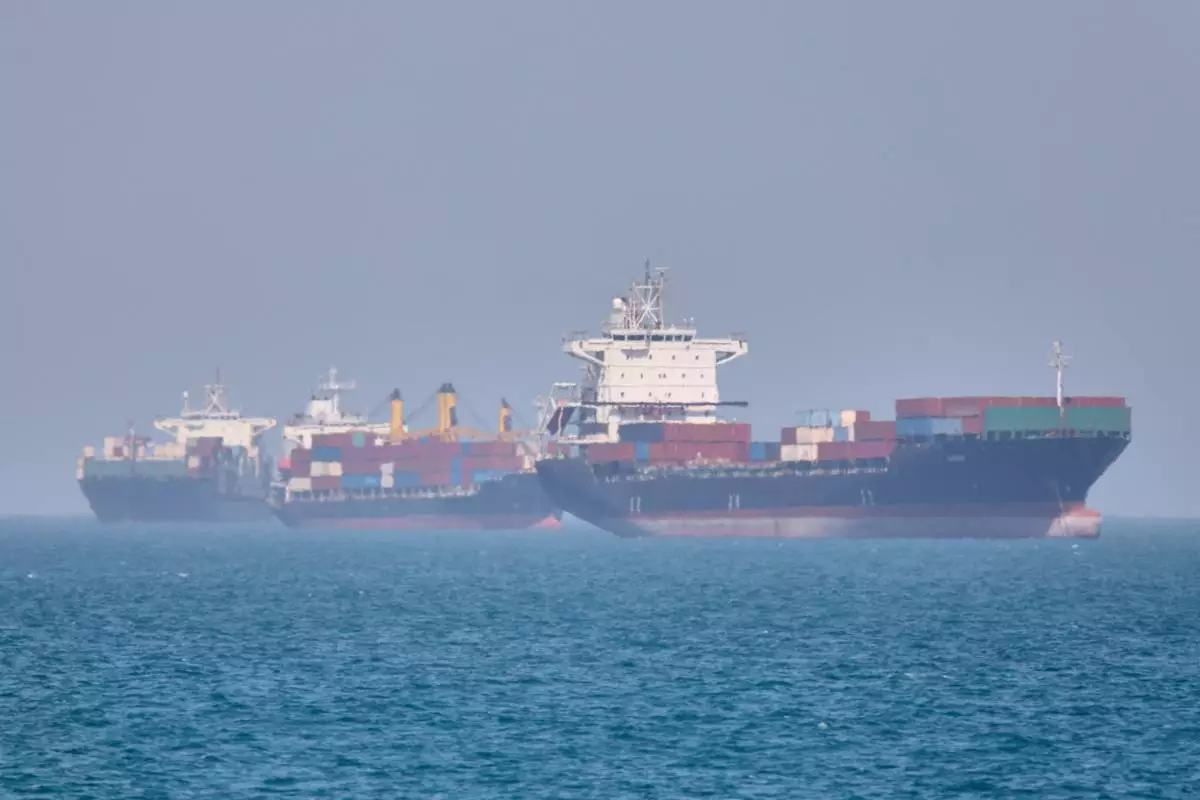
Container ships sit at anchor in the Strait of Hormuz off Bandar Abbas, Iran, Saturday, May 2, 2026.(Amirhosein Khorgooi/ISNA via AP)