Skip to Content Facebook Feature Image

Edwards guides the Timberwolves past the Spurs 114-109 to tie the series after Wembanyama's ejection

Sport

Edwards guides the Timberwolves past the Spurs 114-109 to tie the series after Wembanyama's ejection
Sport

Sport

Edwards guides the Timberwolves past the Spurs 114-109 to tie the series after Wembanyama's ejection

2026-05-11 11:51 Last Updated At:12:00

MINNEAPOLIS (AP) — Anthony Edwards had 16 of his 36 points in the fourth quarter to help the Minnesota Timberwolves even their second-round NBA playoff series against the San Antonio Spurs with a 114-109 victory, following the stunning ejection of star Victor Wembanyama early in the second quarter of Game 4 on Sunday.

Naz Reid took the fateful elbow to the neck from a frustrated Wembanyama and finished with 15 points and nine rebounds to help the Timberwolves finish strong after some shaky stretches.

More Images
San Antonio Spurs head coach Mitch Johnson talks to his players during the first half in Game 2 of a second-round NBA playoffs basketball series against the Minnesota Timberwolves in San Antonio, Wednesday, May 6, 2026. (AP Photo/Eric Gay)

San Antonio Spurs head coach Mitch Johnson talks to his players during the first half in Game 2 of a second-round NBA playoffs basketball series against the Minnesota Timberwolves in San Antonio, Wednesday, May 6, 2026. (AP Photo/Eric Gay)

Minnesota Timberwolves head coach Chris Finch calls for the review of a play during the first half of Game 4 of an NBA basketball second-round playoffs series against the San Antonio Spurs in Minneapolis, Sunday, May 10, 2026. (AP Photo/Abbie Parr)
Minnesota Timberwolves head coach Chris Finch calls for the review of a play during the first half of Game 4 of an NBA basketball second-round playoffs series against the San Antonio Spurs in Minneapolis, Sunday, May 10, 2026. (AP Photo/Abbie Parr)

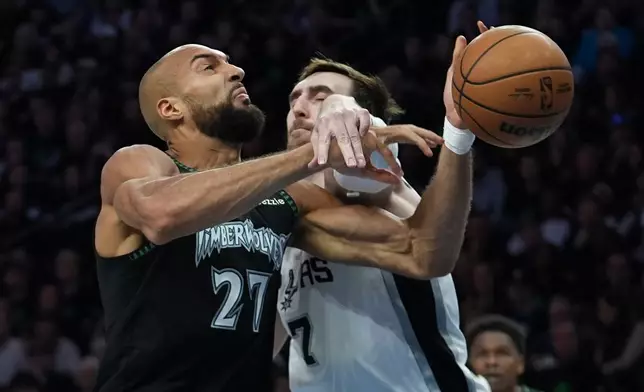
Minnesota Timberwolves center Rudy Gobert (27) is fouled as he drives to the basket against San Antonio Spurs center Luke Kornet (7) during the first half of Game 4 of an NBA basketball second-round playoffs series in Minneapolis, Sunday, May 10, 2026. (AP Photo/Abbie Parr)

Minnesota Timberwolves center Rudy Gobert (27) is fouled as he drives to the basket against San Antonio Spurs center Luke Kornet (7) during the first half of Game 4 of an NBA basketball second-round playoffs series in Minneapolis, Sunday, May 10, 2026. (AP Photo/Abbie Parr)

Minnesota Timberwolves guard Anthony Edwards, left, looks to shoot against San Antonio Spurs forward Victor Wembanyama (1) during the first half of Game 4 of an NBA basketball second-round playoffs series in Minneapolis, Sunday, May 10, 2026. (AP Photo/Abbie Parr)

Minnesota Timberwolves guard Anthony Edwards, left, looks to shoot against San Antonio Spurs forward Victor Wembanyama (1) during the first half of Game 4 of an NBA basketball second-round playoffs series in Minneapolis, Sunday, May 10, 2026. (AP Photo/Abbie Parr)

Minnesota Timberwolves guard Anthony Edwards reacts after scoring against the San Antonio Spurs during the first half of Game 4 of an NBA basketball second-round playoffs series in Minneapolis, Sunday, May 10, 2026. (AP Photo/Abbie Parr)

Minnesota Timberwolves guard Anthony Edwards reacts after scoring against the San Antonio Spurs during the first half of Game 4 of an NBA basketball second-round playoffs series in Minneapolis, Sunday, May 10, 2026. (AP Photo/Abbie Parr)

“Pain is weakness in the body,” Reid said. “That’s it.”

Edwards hit a 27-footer to bring the Wolves within 94-91, turning to shout at the crowd for some help down the stretch as the Spurs. His catch-and-shoot 3-pointer from the wing with 5:12 left put them up 98-97, their first lead since midway through the third quarter.

Then the big men went to work without Wembanyama patrolling the paint. Rudy Gobert, who had 11 points and 13 rebounds, converted a three-point play with 3:02 left off a high-low feed from Reid and later threw down a dunk for a 107-101 lead with 1:56 to go after a slick pass from Julius Randle.

Reid’s follow shot with 40 seconds left gave the Wolves a seven-point lead, before Dylan Harper had a rebound, a drawn foul, a steal, and two free throws to help the Spurs pull within three.

After managing to corral a full-court baseball toss from inbound passer Jaden McDaniels as De'Aaron Fox undercut his leaping catch and caused a loose ball, Ayo Dosunmu drew a foul and sank two free throws with 9.8 seconds left to put the game out of reach and tie the series at two games apiece.

San Antonio hosts Game 5 on Tuesday, with Wembanyama’s status to be determined by the league following the Flagrant 2 foul call and automatic ejection he was levied for the excessive contact to Reid.

Harper and Fox each scored 24 points and Stephon Castle added 20 as the Spurs guards unflinchingly took the baton from their 7-foot-4 superstar and turned the rest of the night into a mid-range clinic with an array of pull-up jumpers in and around the paint.

“Just trying to be what the team needed me to be,” said Harper, the second overall pick in the NBA draft last year. “I think I did OK. Obviously the main goal is to win. We didn't get that done.”

The crowd at Target Center went wild when Wembanyama walked off the floor with Minnesota leading by two, but the Wolves never fully took advantage of the gift created by his absence. They've long had a tendency of losing their edge, particularly defensively, when an opponent's star player is missing.

“When every team is missing their best player, everybody plays free. They get more shots, more confident,” Edwards said. “So I think it was a lot harder on us.”

After committing six turnovers in a 20-point third quarter, the Wolves found themselves in another eight-point hole early in the fourth following Fox's 3-pointer before delivering another clutch finish.

“We have a resilient group of guys. No matter the circumstances, we are going to keep fighting and give everything we have and keep trusting one another,” Gobert said. “Just making the right play. That’s who we are. We might not be always consistent with that, but I feel like when it matters, we raise our level.”

AP NBA: https://apnews.com/hub/NBA

San Antonio Spurs head coach Mitch Johnson talks to his players during the first half in Game 2 of a second-round NBA playoffs basketball series against the Minnesota Timberwolves in San Antonio, Wednesday, May 6, 2026. (AP Photo/Eric Gay)

San Antonio Spurs head coach Mitch Johnson talks to his players during the first half in Game 2 of a second-round NBA playoffs basketball series against the Minnesota Timberwolves in San Antonio, Wednesday, May 6, 2026. (AP Photo/Eric Gay)

Minnesota Timberwolves head coach Chris Finch calls for the review of a play during the first half of Game 4 of an NBA basketball second-round playoffs series against the San Antonio Spurs in Minneapolis, Sunday, May 10, 2026. (AP Photo/Abbie Parr)

Minnesota Timberwolves head coach Chris Finch calls for the review of a play during the first half of Game 4 of an NBA basketball second-round playoffs series against the San Antonio Spurs in Minneapolis, Sunday, May 10, 2026. (AP Photo/Abbie Parr)

Minnesota Timberwolves center Rudy Gobert (27) is fouled as he drives to the basket against San Antonio Spurs center Luke Kornet (7) during the first half of Game 4 of an NBA basketball second-round playoffs series in Minneapolis, Sunday, May 10, 2026. (AP Photo/Abbie Parr)

Minnesota Timberwolves center Rudy Gobert (27) is fouled as he drives to the basket against San Antonio Spurs center Luke Kornet (7) during the first half of Game 4 of an NBA basketball second-round playoffs series in Minneapolis, Sunday, May 10, 2026. (AP Photo/Abbie Parr)

Minnesota Timberwolves guard Anthony Edwards, left, looks to shoot against San Antonio Spurs forward Victor Wembanyama (1) during the first half of Game 4 of an NBA basketball second-round playoffs series in Minneapolis, Sunday, May 10, 2026. (AP Photo/Abbie Parr)


Minnesota Timberwolves guard Anthony Edwards, left, looks to shoot against San Antonio Spurs forward Victor Wembanyama (1) during the first half of Game 4 of an NBA basketball second-round playoffs series in Minneapolis, Sunday, May 10, 2026. (AP Photo/Abbie Parr)

Minnesota Timberwolves guard Anthony Edwards reacts after scoring against the San Antonio Spurs during the first half of Game 4 of an NBA basketball second-round playoffs series in Minneapolis, Sunday, May 10, 2026. (AP Photo/Abbie Parr)
Minnesota Timberwolves guard Anthony Edwards reacts after scoring against the San Antonio Spurs during the first half of Game 4 of an NBA basketball second-round playoffs series in Minneapolis, Sunday, May 10, 2026. (AP Photo/Abbie Parr)
DHAKA, Bangladesh (AP) — Tariqul Islam lost his savings after setbacks in his clothing business about a year and a half ago and turned to ride-sharing on his motorbike to make ends meet. Until recently, he spent hours in fuel lines as supply disruptions linked to the war in Iran ripple into Bangladesh.

The 53-year-old father of four fears the strain will worsen if the war drags on, saying long hours waiting for fuel have sharply cut his income and made it increasingly difficult to support his family in Dhaka, the nation's capital, including a daughter at university and a son in college.

“My family was managing fairly well through ride-sharing," he said. “But after the fuel shortage began, I would buy fuel one day and run the bike for two days. As a result, I had to sit idle for one day, which reduced my income.”

The strain in Islam's household reflects a broader squeeze in Bangladesh, heavily dependent on imported fuel, where energy shortages have disrupted daily life, slowed industrial output and raised concerns about economic growth as global tensions push up costs and strain supplies.

Conditions have eased slightly in recent days, with shorter queues at fuel stations after the government increased supplies, but concerns persist across sectors.

Across Asia, governments are facing similar strains as the war-driven surge in energy prices rattles economies dependent on imported oil and gas.

The continent is exposed because it relies on imported fuel, much of it passing through the Strait of Hormuz — a chokepoint for about a fifth of global oil and natural gas trade.

Higher fuel costs are leading to inflation and squeezing household budgets, while industries from manufacturing to transport are facing rising operating costs and supply disruptions.

The Asian Development Bank in late April cut growth forecasts for developing Asia and the Pacific, warning that war-driven energy disruptions would slow economies and fuel inflation. It now expects growth of 4.7% in 2026, with inflation rising to 5.2% as oil prices climb and financial conditions tighten.

Many are hoping for a quick end to the conflict and a return to normal.

“If this situation continues, we will have to move back to our village and find some other way to earn a living,” Islam, the struggling father said. It is not possible to survive in Dhaka by doing ride-sharing under these conditions.”

Rising energy prices are also expected to strain Bangladesh’s finances, with the government likely to spend an additional $1.07 billion on LNG subsidies in the April-June quarter alone if global prices remain high.

Bangladesh has sought supplies from its big neighbor India, which has responded positively as it has diversified sources, including Russia, of fuel.

Already, authorities have imposed austerity measures to manage the crisis as global lenders warn of slower growth in the nation of more than 170 million people. Gas and diesel shortages have triggered more frequent power cuts in industrial zones.

The government has also shut fertilizer factories to divert gas to power plants, restricted evening hours for shopping malls and introduced fuel rationing.

The World Bank said in April it expects growth in Bangladesh to slow to 3.9% in the fiscal year ending in June 2026, warning that a prolonged Middle East conflict could fuel inflation, widen the current account deficit and strain public finances through higher energy subsidies.

Jean Pesme, the World Bank’s division director for Bangladesh and Bhutan, said the economy already faced “pre-existing vulnerabilities and challenges, in particular on the economic and employment front.”

The rising costs now are “obviously making the fiscal situation more difficult.”

He also warned that authorities should be cautious in raising fuel prices, saying higher costs could hurt farmers and agriculture.

The energy crunch is also driving up costs and threatening Bangladesh’s garment exports, the backbone of its economy, business leaders say.

Anwar-Ul Alam Chowdhury, president of the Bangladesh Chamber of Industries, said exports to Europe and the U.S. could face a significant setback. Shipments have fallen between 5% and 13% in recent months, he said. He worries that customers could lose confidence in Bangladesh’s ability to deliver and that competitor nations such as India, Vietnam and Cambodia could gain market share if the crisis persists.

Chowdhury said factory output has dropped by 30% to 40% for various reasons and that the situation has worsened since the U.S. and Israel launched their war against Iran, while business costs have risen by about 35% to 40%.

Bangladesh, the world’s second-largest garment exporter after China, earns about $39 billion annually from the sector, which employs around 4 million workers, mostly women from rural areas.

Alvi Islam, director of Arrival Fashion Limited, said manufacturers are facing higher costs for petroleum-based materials such as sewing threads, poly bags — plastic bags used in packaging — and cartons, while spending more on diesel generators to cope with frequent power cuts.

His company, which exports products worth about $40 million annually, now runs generators at least four hours a day during production.

“For that reason, the cost of doing business for exporting garments has increased quite significantly in past one month,” he said.

Garment worker Mosammet Runa, 35, said she fears for her family’s future if the war continues.

“Millions of people like us depend on this industry. It is how we survive,” said Runa, who, along with her husband, earns about $400 a month to support their family of six.

She said a prolonged conflict could wipe out jobs and called for an end to the fighting.

“We are innocent people. The world should not make us victims," she said.

AP journalist Al Emrun Garjon contributed to this report.

Women workers assemble apparel at a garment factory in Dhaka, Bangladesh, Tuesday, April 28, 2026. (AP Photo/Abdul Goni)

Women workers assemble apparel at a garment factory in Dhaka, Bangladesh, Tuesday, April 28, 2026. (AP Photo/Abdul Goni)

A motorcyclist rests under an umbrella while waiting in line for fuel at a petrol station in Dhaka, Bangladesh, Thursday, April 23, 2026. (AP Photo/Abdul Goni)

A motorcyclist rests under an umbrella while waiting in line for fuel at a petrol station in Dhaka, Bangladesh, Thursday, April 23, 2026. (AP Photo/Abdul Goni)

Alvi Islam, director of Arrival Fashion Limited, talks to The Associated Press, in Dhaka, Bangladesh, Tuesday, April 28, 2026. (AP Photo/Abdul Goni)

Alvi Islam, director of Arrival Fashion Limited, talks to The Associated Press, in Dhaka, Bangladesh, Tuesday, April 28, 2026. (AP Photo/Abdul Goni)

Tariqul Islam, a ride-share driver, waits in a long queue of petrol for his motorcycle in Dhaka, Bangladesh, Tuesday, April 23, 2026. (AP Photo/Abdul Goni)

Tariqul Islam, a ride-share driver, waits in a long queue of petrol for his motorcycle in Dhaka, Bangladesh, Tuesday, April 23, 2026. (AP Photo/Abdul Goni)

Tariqul Islam, a ride-share driver, waits in a long queue of petrol for his motorcycle in Dhaka, Bangladesh, Tuesday, April 23, 2026. (AP Photo/Abdul Goni)

Tariqul Islam, a ride-share driver, waits in a long queue of petrol for his motorcycle in Dhaka, Bangladesh, Tuesday, April 23, 2026. (AP Photo/Abdul Goni)

Recommended Articles