U.S. President Donald Trump's upcoming state visit to China is attracting global attention as China-U.S. relations and the international landscape undergo a profound realignment, with the Middle East standing at a fragile crossroads.
At the invitation of Chinese President Xi Jinping, Trump will pay a state visit to China from May 13 to 15, a Chinese foreign ministry spokesperson announced on Monday. The trip marks the first visit to China by a U.S. president since Trump visited in 2017. Xi and Trump last met in October 2025 in Busan, the Republic of Korea (ROK).
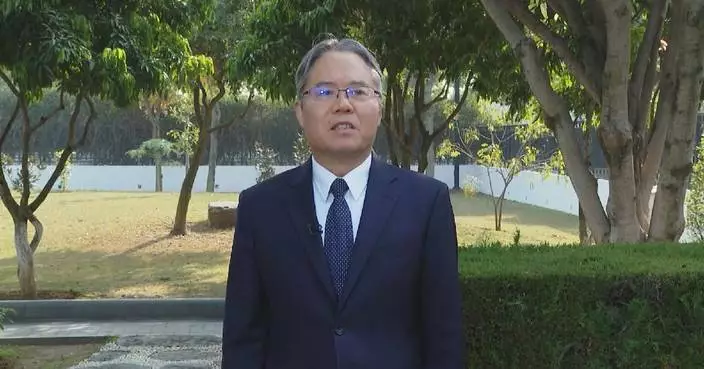
"This is the first time in nine years that a U.S. president has set foot on Chinese soil. Both China and the United States are major powers -- they are political heavyweights as permanent members of the UN Security Council, and they are the world's two largest economies. How they interact profoundly impacts the future development of the international situation. Therefore, this visit is, to a certain extent, very important for both countries and for the future direction of global politics and economics," said Gao Fei, President of the China Foreign Affairs University (CFAU).
Head-of-state diplomacy plays an irreplaceable strategic guiding role in China-U.S. relations. Since last year, Trump has repeatedly expressed his willingness to visit China, with both sides maintaining steady communication over the arrangements for the trip.
As China-U.S. ties and the international landscape undergo a profound realignment, global attention will focus on how both sides will use this visit to hold in-depth exchanges on economic and trade cooperation, as well as other core concerns.
"Since the beginning of 2025, the two heads of state have held five phone calls, and of course, the Busan meeting was equally important. One of the core issues in these interactions remains economy and trade, and this visit will also focus heavily on economic and trade matters. In this field, both sides should adhere to the principle of looking at the big picture and taking a long-term view. They should make continuous efforts to work in the same direction, expand the cooperation list, and narrow the disagreement list. This will be conducive to the respective interests of both parties and meet the general expectations of the international community," said Diao Daming, Vice Dean of the National Academy of Development and Strategy at Renmin University of China.
In the run-up to the state visit, as agreed by both countries, Chinese Vice Premier He Lifeng, also a member of the Political Bureau of the Communist Party of China Central Committee, will lead a delegation to the ROK from May 12 to 13 to hold economic and trade consultations with a senior U.S. delegation.
For the state visit to Beijing, Trump is expected to be accompanied by a delegation of prominent U.S. business leaders.
Data from the American Chamber of Commerce in China earlier this year showed a significant rise in optimism among U.S. firms regarding the future growth of the Chinese market. More than half of those surveyed reported either profitability or strong profitability in the past year, while over 70 percent have no plans to relocate operations outside of China, and nearly 60 percent intend to increase their investments. These figures underscore the reality that "cooperation benefits both while confrontation hurts both" is not mere political rhetoric, but a profound conclusion drawn from years of experience.
"We have repeatedly emphasized that China and the U.S. gain from cooperation and lose from confrontation; cooperation is the only correct choice. Over the recent stretch, whether during periods of friction or the general stability maintained over the last year, the contrasting outcomes of these different paths have been clearly demonstrated. Clearly, the overall stability of the recent period is a positive result of choosing the direction of dialogue and cooperation," Diao said.
Notably, the visit comes amid a flurry of frequent exchanges at all levels and across various sectors. Last week, the first U.S. bipartisan congressional delegation to visit China since Trump took office was led by Steve Daines, a U.S. Republican senator from Montana.
More pragmatic voices are also emerging from the U.S. strategic community. Michael Froman, President of the Council on Foreign Relations, recently remarked that the world is safer when the two most influential and largest economies maintain open lines of communication.
"I think the outcome will be just the fact of the visit, the fact that the two leaders connect and talk about a whole range of strategic issues. I think they want to make sure that we can continue this stability that we've found over the last year, which is something that needs to continue in to the future. So I think these meetings will help to do that," said Susan Thornton, a senior fellow at Yale Law School.
"Seeing China-U.S. relations from an objective perspective, the two countries certainly cannot solve all problems through a single high-level exchange. However, I believe this interaction can at least push the two countries to re-establish new perceptions and find a new and correct path to coexistence," Gao said.
Trump's landmark visit to China attracts global attention
Trump's landmark visit to China attracts global attention
Trump's landmark visit to China attracts global attention