Skip to Content Facebook Feature Image

Lingnan University develops AI smart trolley that reduces pushing force by up to 90 per cent

HK

HK

HK

Lingnan University develops AI smart trolley that reduces pushing force by up to 90 per cent

2026-05-12 12:38 Last Updated At:12:38

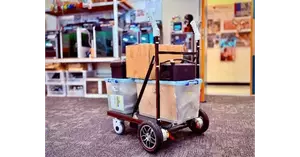
With the rapid growth of Hong Kong’s logistics and delivery services, frontline movers and delivery workers have to cope with physically demanding labour over long periods of time. The United Nations University Hub on Humanitarian Innovation and Technology at Lingnan University (UNU Hub at Lingnan University), the first UNU Hub in Asia and jointly established by Lingnan University and the United Nations University (UNU), recently developed the “IntuCREW – Intelligent Power Assist System”, an AI-powered smart trolley solution that upgrades conventional handcarts into intelligent, power-assisted transport platforms. The system can reduce the pushing effort required to move loads of about 200 kilograms by up to 90 per cent, a force comparable to pushing a 20-kilogram load, significantly easing the physical strain on logistics and delivery workers.

The AI smart trolley integrates advanced Edge AI and haptic sensing technology, enabling the trolley to collect data and process calculations instantly without requiring an internet connection. By detecting the user’s pushing force and direction, the built-in electric drive acts as a mechanical power assist, automatically providing corresponding support. Users need only push, and the system immediately increases the force to move heavy loads forward.

More Images
The UNU Hub at Lingnan University has developed an AI smart trolley capable of reducing pushing force by up to 90 per cent
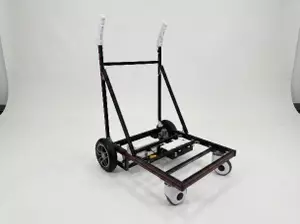
The UNU Hub at Lingnan University has developed an AI smart trolley capable of reducing pushing force by up to 90 per cent

The AI smart trolley significantly eases the physical burden on logistics and delivery workers
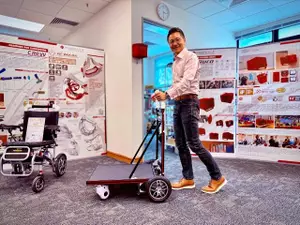
The AI smart trolley significantly eases the physical burden on logistics and delivery workers

Prof Albert Ko, Founding Director of the UNU Hub at Lingnan University

Prof Albert Ko, Founding Director of the UNU Hub at Lingnan University

Mr Yim, a self-employed logistics worker participating in the trial, using the AI smart trolley
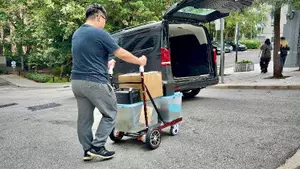
Mr Yim, a self-employed logistics worker participating in the trial, using the AI smart trolley

The AI smart trolley in operation
The AI smart trolley in operation

Experimental testing has shown that the AI smart trolley can lessen pushing effort by up to 90 per cent, even on slopes, around corners, and in narrow passageways, while maintaining smooth and stable movement, largely overcoming the difficulties of transporting heavy goods. Built on the design concept of “the greater the pushing force, the greater the reduction in effort”, the system can further reduce the required pushing force by approximately 96.4 per cent when users push the trolley uphill on a 15-degree slope. In addition, the system is equipped with a safety braking mechanism that activates immediately when the handle is released, reducing the risk of the trolley surging forward or sliding backward.

Prof Albert Ko, Founding Director of the UNU Hub at Lingnan University, said that the concept behind the AI smart trolley derives from another Lingnan University innovation originally designed for conventional wheelchairs, the “CREW Intelligent Wheelchair Control System”. Through AI algorithm enhancement and increased load-bearing capability, the technology has evolved into the “IntuCREW – Intelligent Power Assist System” for industrial and logistics applications, representing a cross-sector breakthrough, and extending technology initially designed to assist elderly mobility and relieve caregivers’ physical burden to commercial and industrial use.

Prof Ko said, “Hong Kong has a massive logistics and retail delivery market, where labour costs and physically intensive work have always been major industry challenges. The breakthrough of this technology lies in combining artificial intelligence with haptic sensing technology to create an AI-powered assistive system capable of understanding human pushing behaviour and providing instant power assistance. This addresses pain points in logistics and delivery work by considerably reducing the physical exertion necessary, while improving efficiency and safety. The system has strong potential for application in warehouse management, delivery logistics, hotel services, and retail restocking, and not only demonstrates the wider possibilities of AI technology across different sectors and user groups, but also the considerable opportunities for commercialisation.”

The AI smart trolley has now entered its field-testing stage in Hong Kong, where self-employed delivery workers, warehouse operators, and logistics practitioners, have been recruited, and the project team is collecting usage data and feedback from different working environments to optimise the design and AI algorithms, while also seeking collaboration with logistics and technology companies for commercialisation and large-scale application.

Mr Yim, a self-employed logistics worker participating in the trial, said that using the AI smart trolley when transporting heavy goods during long working hours greatly relieves the strain on his waist and arms reducing fatigue, and improving work sustainability.

Prof Ko added that the AI smart trolley reflects the Hub’s human-centred technology approach, integrating artificial intelligence, engineering design, and social needs to develop practical innovation solutions. The Hub has already developed a number of award-winning humanitarian technology projects, including the mini air purifier designed to improve the living conditions of low-income families, and infant incubators for remote regions. The UNU Hub at Lingnan University will continue to promote research and development in humanitarian innovation and technology, and to explore the practical potential of AI in society, with the aim of improving the working and living conditions of different communities through technology.

The UNU Hub at Lingnan University has developed an AI smart trolley capable of reducing pushing force by up to 90 per cent

The UNU Hub at Lingnan University has developed an AI smart trolley capable of reducing pushing force by up to 90 per cent

The AI smart trolley significantly eases the physical burden on logistics and delivery workers

The AI smart trolley significantly eases the physical burden on logistics and delivery workers

Prof Albert Ko, Founding Director of the UNU Hub at Lingnan University

Prof Albert Ko, Founding Director of the UNU Hub at Lingnan University

Mr Yim, a self-employed logistics worker participating in the trial, using the AI smart trolley

Mr Yim, a self-employed logistics worker participating in the trial, using the AI smart trolley

The AI smart trolley in operation

The AI smart trolley in operation

DH reminds public to take precautions against heat-related illnesses during very hot weather

The Centre for Health Protection (CHP) of the Department of Health (DH) today (September 27) reminded members of the public to take appropriate precautions against heat-related illnesses, such as heat cramps, heat exhaustion and heat stroke, during very hot weather.

In a high-temperature environment, excessive sweating and difficulty in heat dissipation can cause stress to the body. Members of the public should take the following precautions:

  • Hydrate in a timely manner to prevent dehydration;
  • Wear light-coloured, loose-fitting and breathable clothing to minimise heat absorption and facilitate perspiration and heat dissipation;
  • Keep indoor areas well ventilated and maintain appropriate temperature and humidity, e.g. by opening windows or using a fan or air-conditioning;
  • Avoid strenuous exercise and prolonged activities such as hiking or trekking;
  • Arrange outdoor activities in the morning or the late afternoon, if possible, and bring enough water; and
  • Avoid beverages containing caffeine, such as coffee and tea, as well as alcoholic beverages, which may speed up water loss through the urinary system.

In addition, infants and children, the elderly, pregnant women, individuals with chronic illnesses such as heart disease or high blood pressure, overweight people and outdoor/manual workers are more susceptible to heat stroke. These groups should pay special attention to the following:

  • Infants and young children: Avoid going outside when the temperature is high. If they must go outside, adults should ensure they stay in places with moderate temperatures and good ventilation or air-conditioning. Infants and young children should never be left unattended in a confined space such as a vehicle;
  • The elderly, pregnant women, individuals with chronic illnesses and overweight people: Pay close attention to health conditions and seek help as soon as possible if experiencing any abnormalities in health indicators such as blood pressure, heart rate, etc or if there are fluctuations in health conditions. Avoid going out when the temperature is high. Make sure there is good ventilation, or turn on a fan or air-conditioner to keep an appropriate temperature indoors. High temperatures can also worsen the condition of people with chronic illnesses (such as cardiovascular and respiratory diseases). Therefore, they should have an ample supply of their usual medication and keep in contact with family members, neighbours and the community. People should seek immediate help if they feel unwell.
  • Outdoor/manual workers: Reschedule work to cooler hours as far as feasible. If working in a hot environment is unavoidable, provide shade where practicable and use ventilation and heat dissipation equipment. Once work has begun, gradually adjust the pace of work and take breaks in the shade to regain strength.

The DH reminded the public that heat stroke is one of the most common health risks in hot weather. Over the past five years, there have been over 200 hospital admissions due to heat stroke each year in Hong Kong, with two to five fatal cases occurring mainly during the summer months from May to September. Vulnerable groups are more susceptible to heat stroke. Symptoms include dizziness, headache, nausea, shortness of breath or confusion. In severe cases, patients may suffer from convulsions or become unconscious, which can be life-threatening if they are not cooled down and resuscitated in a timely manner.

Members of the public are also advised to pay attention to the latest weather, as well as the real-time and forecasted ultraviolet (UV) index released by the Hong Kong Observatory (HKO). When the UV index is high (6 or above), the public should note the following:

  • Avoid direct sunlight exposure to the skin and the eyes;
  • Apply broad-spectrum, water-resistant sunscreen liberally, with a sun protection factor (SPF) of at least 30 or higher, when participating in outdoor activities. Reapply every two hours if staying outdoors for long periods, or after swimming, sweating or towelling off;
  • While using DEET-containing insect repellents for personal protection against mosquito-borne diseases, apply sunscreen before insect repellent;
  • Seek shade;
  • Wear UV-blocking sunglasses;
  • Wear loose-fitting clothing with long-sleeves; and
  • Wear a wide-brimmed hat or use an umbrella.

If symptoms develop, such as dizziness, headache, nausea, shortness of breath or confusion, rest and seek help immediately, and seek medical advice as soon as possible.

For more health information, the public may visit theCHP's heat strokepage andUV radiation page; the HKO's Dial-a-Weather (1878 200),latestweather report and forecast,UV Indexand weather information forhiking and mountaineering; andpress releasesof the Labour Departmenton precautions against heat stroke for outdoor workers and their employers when the Heat Stress at Work Warning is in force.

Source: AI-found images

Source: AI-found images