Endangered finless porpoises are now being released into China's Yangtze River after years of ex-situ conservation, which helps the rapid recovery of their natural populations.
Known as "smiling angel", the Yangtze finless porpoise is a unique species in China, where it is under national first-class protection. Its population status serves as a barometer of the Yangtze River's ecological environment.
According to official data released in January, the population of the Yangtze finless porpoise has increased to 1,426, up 177 from the 2022 survey, thanks to a 10-year fishing ban in the Yangtze River that started from Jan 1, 2021.
As ex-situ populations thrived and approached their environmental capacity, scientists began a new effort to reintroduce them into the Yangtze's mainstream.
Scientists chose Laowan, an oxbow in the Xinluo section of the Yangtze, as China's first finless porpoise rewilding base. There, finless porpoises learn to swim and hunt in currents, and adapt to ship noises.
Qiu Jiansong, a postdoctoral researcher at the Institute of Hydrobiology under the Chinese Academy of Sciences, stressed that Laowan's seasonal water level changes mimic the Yangtze's main stem.
"[This place] is connected to the Yangtze. Therefore, it experiences seasonal changes in flow velocity, which is very similar to the natural environment of the Yangtze River. Since no artificial feeding of fish fry has been carried out here, nor has there been any human intervention, the abundance and diversity of fish resources here are very close to those of the Yangtze River," he said.
At the end of last year, the rewilding base welcomed two new porpoises. Currently, they are undergoing training in the Laowan oxbow, slated for release later this year. "We also conduct regular health checks on them. We catch them, perform physical examinations, and assess their health indicators. We examine their appearance, body condition, weight, and body length to see if there has been any measurable growth," he said.
After the release, researchers will continue to track and monitor these finless porpoises, observing their movement patterns and whether they are able to integrate into wild finless porpoise groups, so as to gather data for future large-scale release efforts.
"Among the group of finless porpoises released at the end of 2025, we observed, using drones, that they had already integrated into wild groups just one day after the release," he said.
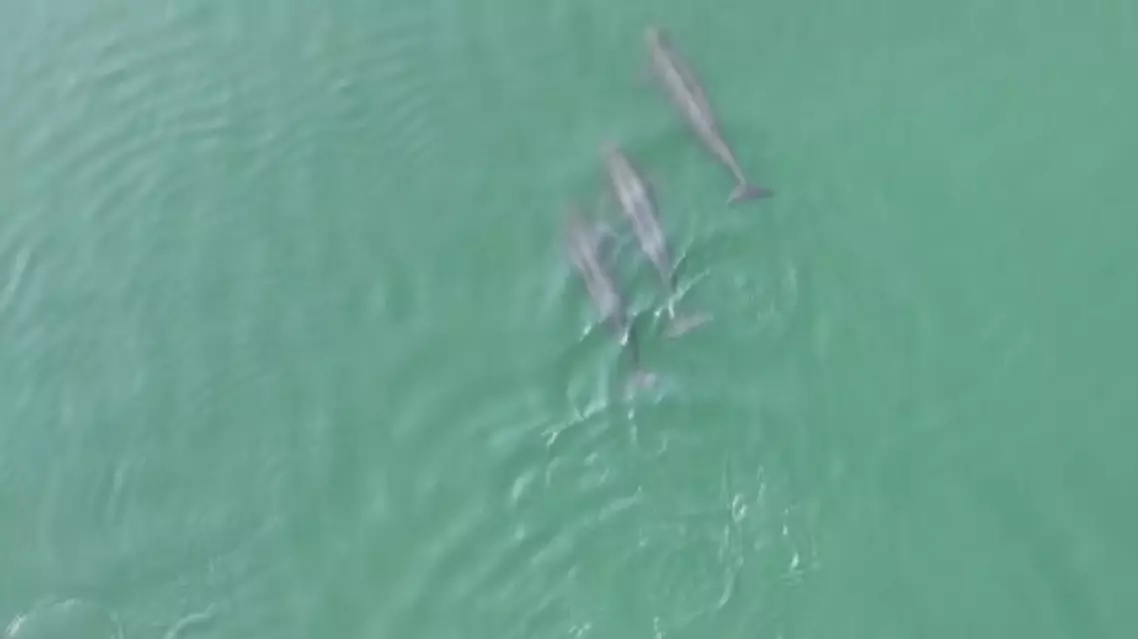
Rare finless porpoises released into Yangtze River after years of ex-situ conservation