BEIRUT (AP) — Israeli drones struck three vehicles on the main highway south of Beirut Wednesday, killing eight people, including a woman and her two children, the Lebanese Health Ministry said.
The Israeli military said it struck Hezbollah infrastructure in several areas in southern Lebanon, hours after telling residents of six southern villages to evacuate.
Lebanon and Israel are scheduled to hold another round of direct talks in Washington on Thursday as the Trump administration pushes for a breakthrough between the two neighbors that have been at a state of war since Israel was created in 1948.
The Health Ministry confirmed in a statement the three strikes, but didn't detail the number of people in each vehicle.
Two of Wednesday’s drone attacks hit a highway linking Beirut with the southern port city of Sidon, while a third, reported the state-run National news agency, struck the town of Saadiyat, near the busy freeway. A fourth strike on Sidon’s northern entrance happened in the early afternoon, hitting a car, according to state media.
An Associated Press photographer saw the bodies of three people killed in two of the strikes near the coastal towns of Barja and Jiyeh.
In southern Lebanon, Israeli airstrikes were reported in different towns and villages while Hezbollah claimed launching more attacks on Israel as both sides keep exchanging fire despite a U.S.-brokered ceasefire that went into effect on April 17.
The latest Israel-Hezbollah war started on March 2, when the Lebanese militant group fired rockets into northern Israel two days after the United States and Israel attacked Iran.
Lebanese Health Minister Rakan Nassereddine told reporters Tuesday that since the ceasefire went into effect, 380 people have been killed and 1,122 have been wounded. That brings the toll since the war began to 2,882 killed and 8,786 wounded.

Security forces and emergency responders gather around a burning vehicle at the scene of an Israeli airstrike that hit a car, as a man attempts to put out the flames, in the coastal town of Jiyeh, south of Beirut, Lebanon, Wednesday, May 13, 2026. (AP Photo/Mustafa Jamalddine)

Security forces and emergency responders gather around a charred vehicle at the scene of an Israeli airstrike that hit a car, as a covered body lies on the ground, in the coastal town of Jiyeh, south of Beirut, Lebanon, Wednesday, May 13, 2026. (AP Photo/Mustafa Jamalddine)

A person is seen inside a burning vehicle as men attempt to put out the fire after an Israeli airstrike hit a car in the coastal town of Barja, south of Beirut, Lebanon, Wednesday, May 13, 2026. (AP Photo/Mustafa Jamalddine)
MADISON, Wis.--(BUSINESS WIRE)--May 13, 2026--
Navitus today released its 10 th annual Drug Trend Report, “Clarity for Action,” the company’s flagship annual analysis of prescription drug cost trends. The report details how utilization growth and therapeutic innovation drove prescription drug costs in 2025 and outlines clear actions for health plans and plan sponsors to counter accelerating pressure.
This press release features multimedia. View the full release here: https://www.businesswire.com/news/home/20260513505747/en/
Across the Navitus commercial book of business, net prescription drug costs increased 8.4%, up from 7% in 2024, largely reflecting demand for high‑cost specialty medications. Despite industry pressures, Navitus enabled 32% of clients to pay less in 2025 than in 2024, and 44% to limit increases to no more than 5%. The Navitus trend also remained below double-digit increases seen in the industry.
“Drug trend is no longer driven primarily by price inflation. It’s also being driven by increased utilization and expanded indications,” said Sharon Faust, Navitus Senior Vice President and Chief Pharmacy Officer. “Existing therapies with broader indications are gaining earlier adoption. These advances demand deliberate, informed management to ensure that costs remain sustainable.”
Specialty and non‑specialty trends shape drug trend
Specialty medications remained the largest driver of drug costs in 2025, with an 11.1% increase. Growth came from increased utilization, particularly in oncology, immunology and dermatology. Biosimilars provided relief by lowering unit costs, but utilization of high‑impact therapies continued to exert upward pressure.
Non‑specialty drug costs increased 5.6%, reflecting rising utilization and steady unit‑cost growth. Diabetes therapies, especially GLP‑1 medications, played a major role, with Mounjaro representing the single largest cost-growth medication. Without GLP-1s, the overall Navitus drug trend was 7.9%. Migraine treatments added trend pressure as well. These increases were partially offset by generic drug launches and reduced utilization in ADHD, cardiovascular and antiviral medications.
“What stands out is how quickly utilization patterns are changing,” Faust said. “Members and prescribers are moving rapidly toward newer and more effective therapies. That shift is happening across nearly every major category.”
Looking ahead: Trend pressures expected to intensify
Drug trend is expected to accelerate in 2026 and beyond, with new biologics and targeted therapies entering the market at premium prices. Utilization is also expected to climb as therapies gain earlier and expanded use. In non‑specialty categories, GLP‑1 medications are expected to remain a dominant cost driver, supported by broader prescriber adoption and patient demand. Migraine care also is expected to continue shifting toward higher‑cost brand-name medications.
What health plans and plan sponsors can do
The report emphasizes that rising drug trend is not inevitable or uncontrollable, but it does require early, informed action. Navitus experts identify proven strategies for managing trend, including:
“Plans have more control than they often realize,” Faust said. “The key is clarity to know what’s driving trend early and having a pharmacy solutions partner that acts quickly with disciplined, evidence‑based options.”
To access the full report, visit: https://navitus.com/drug-trend-reports/2025-drug-trend-report/?utm_campaign=100247_2025_drug_trend_report_dtr&utm_medium=press_release&utm_source=businesswire
“This report is about understanding what forces are driving costs and what actions make a difference,” Faust said. “As drug trend accelerates, plans and plan sponsors need insight they can trust and strategies they can deploy in time to matter.”
About Navitus
Navitus remains the nation’s first transparent, pass-through pharmacy benefit manager (PBM), serving more than 13 million lives nationwide. It uniquely brings clarity to drug pricing and takes costs out of the drug supply chain. Unlike traditional PBMs that generate profit by retaining an undisclosed portion of rebates and discounts negotiated with drug manufacturers and pharmacies, Navitus passes along the complete savings to clients, enabling them to make medication more affordable for their members. The Navitus PBM was established more than 20 years ago by Navitus Health Solutions, LLC, a pioneering pharmacy solutions company. The organization delivers a range of services through portfolio brands including Navitus, Lumicera, Archimedes and Clarventa. Owned by SSM Health and Costco, Navitus Health Solutions serves nearly 20 million lives across 800 clients including employers, unions, government plans, payers and health systems.
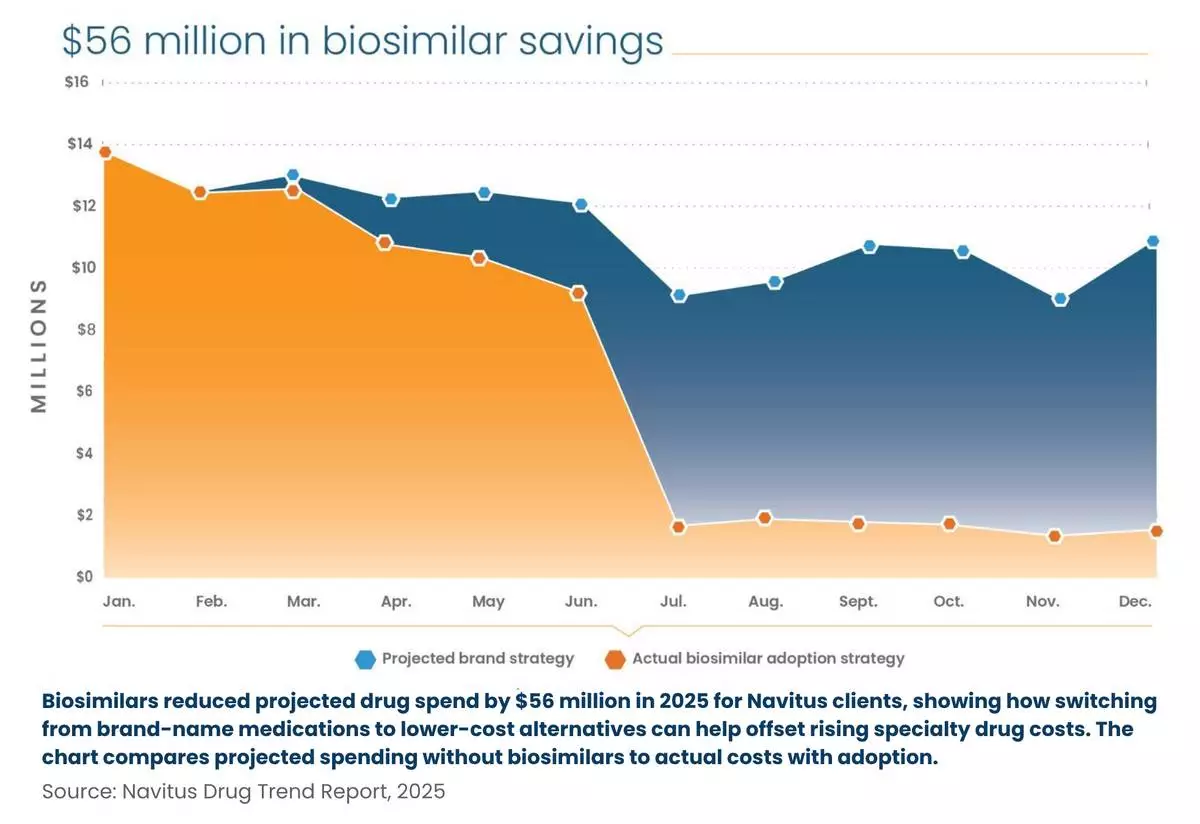
Biosimilars reduced projected drug spend by $56 million in 2025 for Navitus clients, showing how switching from brand-name medications to lower-cost alternatives can help offset rising specialty drug costs. The chart compares projected spending without biosimilars to actual costs with adoption.
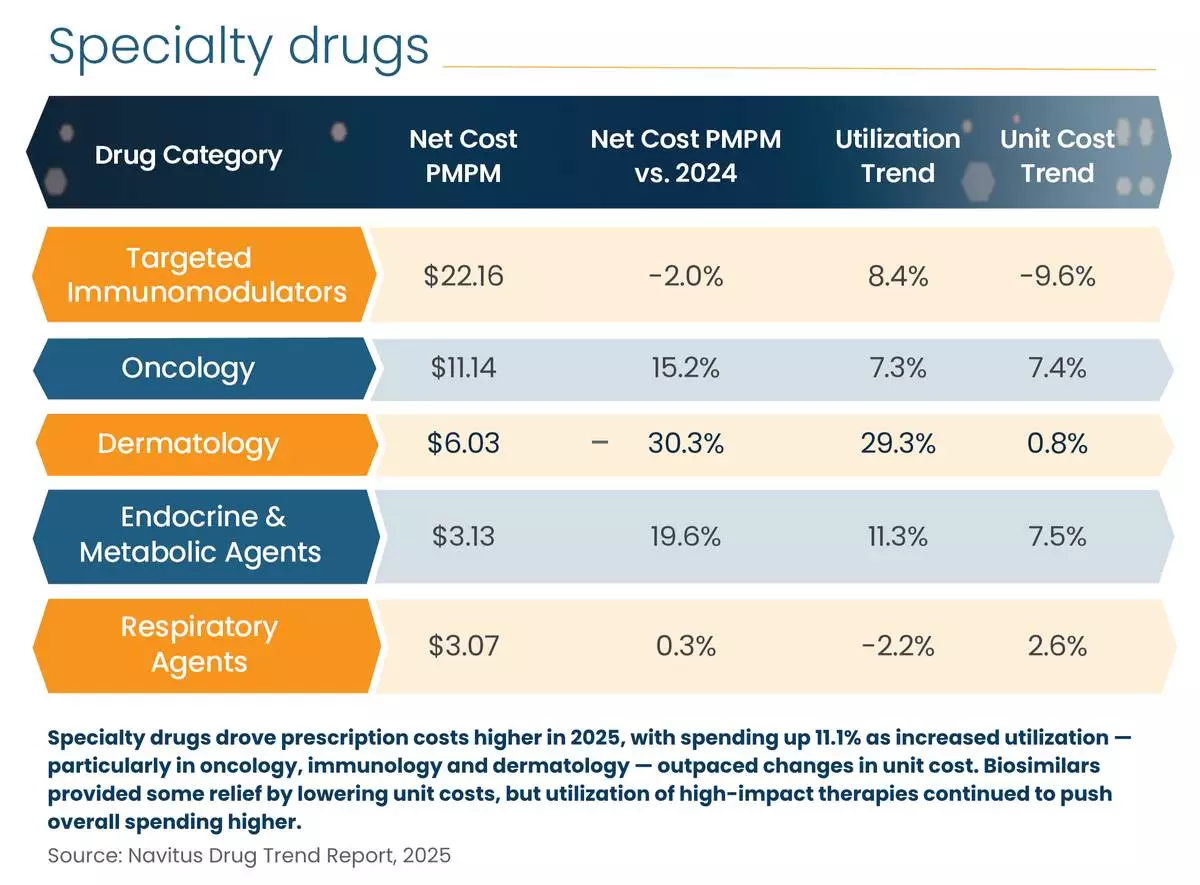
Specialty drugs drove prescription costs higher in 2025, with spending up 11.1% as increased utilization — particularly in oncology, immunology and dermatology — outpaced changes in unit cost. Biosimilars provided some relief by lowering unit costs, but utilization of high-impact therapies continued to push overall spending higher.