MONTREAL--(BUSINESS WIRE)--May 13, 2026--
During the 2026 Mercuriades Awards ceremony, Lassonde Industries Inc. took home the Mercure award in the High-Performance Manufacturing Company category, highlighting the strength of its industrial operations and its innovative leadership in the food and beverage industry.
This press release features multimedia. View the full release here: https://www.businesswire.com/news/home/20260513963224/en/
This distinction highlights the company’s strategic investments to modernize its facilities and increase the flexibility of its production capabilities. Among the recognized initiatives is the 2025 commissioning of a multi-format aseptic line at one of Lassonde’s Rougemont plants. This investment of more than $10 million enables the production of concentrates in formats ranging from 4 to over 2,000 litres on a single line, enhancing the company’s ability to serve institutional, industrial, and fast-food customers across North America.
“Receiving this Mercure is a great source of pride for all our teams,” stated Vince Timpano, Chief Executive Officer of Lassonde. “This recognition reflects the quality with which we continue to advance our operations and invest in technologies that enhance our manufacturing efficiency and our ability to serve our customers.”
Accepting the award was Martin Lauzière, General Manager, Beverages Canada, who emphasized the contribution of the company’s teams. “Behind every innovation and every industrial achievement are, above all, dedicated people who push the limits of what we can accomplish. This Mercure belongs to the many teams in our plants and offices, who contribute to moving Lassonde forward every day.”
A finalist in the Technological Innovation category as well, Lassonde has sustained its growth for over 100 years by making operational excellence, continuous improvement, and innovation the focus of its manufacturing operations. Since its beginnings in Rougemont, a region renowned for its abundant orchards, the company has grown into a major North American player in the food and beverage industry, while maintaining strong roots in Quebec.
The awards were presented on May 11, 2026, as part of the Mercuriades gala, organized by the Fédération des chambres de commerce du Québec and held at Palais des congrès de Montréal.
About Lassonde
Headquartered in Canada and with operations across North America, Lassonde Industries Inc. is a leader in the food and beverage industry in North America. The Corporation develops, manufactures, and markets a wide range of national brand and private label products. The Corporation’s products include fruit juices and drinks, pasta sauces, cranberry sauces, condiments, soups, broths, fruit-based snacks as well as alcoholic beverages such as ciders and wines. Altogether, Lassonde distributes over 3,500 unique products in approximately 200 formats across shelf-stable, chilled, and frozen categories.
The Corporation’s go-to-market strategy consists of (i) sales to food retailers and wholesalers such as supermarket chains, independent grocers, superstores, warehouse clubs, convenience stores, and major pharmacy chains and (ii) food service sales to restaurants, hotels, hospitals, schools, and wholesalers serving these institutions.
Lassonde operates 19 plants located in Canada and the United States through the expertise of over 2,900 full-time equivalent employees. To learn more, visit www.lassonde.com.

Martin Lauzière, General Manager, Beverages Canada, accepted the Mercure award in the High-Performance Manufacturing Company category on behalf of Lassonde Industries Inc. at the Mercuriades gala, which was held on May 11, 2026. (Photo: FCCQ)
WASHINGTON (AP) — U.S. wholesale inflation came in hot last month. Producer prices rose 6% from a year earlier, most since December 2022, as the 10-week Iran war pushed up energy prices and put pressure on companies to pass along higher costs to consumers.
The Labor Department reported Wednesday that its producer price index — which tracks inflation before it hits consumers — shot up 1.4% in April, biggest monthly gain since March 2022.
Energy prices climbed 7.8% from March to April and 22.7% from a year earlier. Gasoline soared 15.6% from March and diesel, the dominant fuel used in shipping, jumped 12.6%.
Excluding volatile food and energy costs, so-called core producer prices rose 1% from March and 5.2% from April 2025.
All the numbers were much higher than economists had expected and it alters the dynamic at the U.S. Federal Reserve and its fight against inflation.
Prices are rising at time when Americans are already frustrated by the high cost of living. Affordability is likely to be a key issue when voters go to the polls Nov. 3 to determine whether President Donald Trump’s Republican Party maintains control of the U.S. Senate and House of Representatives.
“This report will set off alarm bells at the Fed and add fuel to the political conversation about affordability,″ Carl Weinberg, chief economist at High Frequency Economics, wrote in a commentary. ”The results are so far above expectations that this update will set off alarm bells in the financial markets, too.″
The United States and Israel attacked Iran on Feb. 28, and Tehran responded by shutting off access to the Gulf of Hormuz, through which a fifth of the world’s oil and liquefied natural gas passes. Energy prices raced higher.
Wholesale prices can offer an early look at where consumer inflation might be headed. Economists also watch it because some of its components, notably measures of health care and financial services, flow into the Fed’s preferred inflation gauge — the Commerce Department’s personal consumption expenditures, or PCE, price index.
Already this week, the Labor Department said that its closely watched consumer price index jumped 3.8% last month from April 2025 — the biggest year-over-year increase in more than three years — as energy prices continued to climb.
Walmart, a company famous for its intense focus on low prices, already announced rare price hikes last year, and the rising costs may intensify pressure to do so again. It is not alone.
Whirlpool, which makes KitchenAid and Maytag appliances, reported this month that its revenue dropped nearly 10% in its most recent quarter and said that the war has caused a “recession-level industry decline″ that has undermined consumer confidence. It had announced a 10% price hike in April, its largest in a decade, and said that a separate 4% price increase is coming in July.
The company had absorbed the higher costs, choosing not to pass them on to customers, but that is changing.
Before the Iran war, the Fed had been expected to cut its benchmark interest rate in 2026. But it has turned cautious as it waits to see how long the conflict lasts and whether higher energy prices spill over into other products and cause a broader inflationary outbreak.
Trump has attacked the Fed and its outgoing chair, Jerome Powell, for refusing to slash rates to boost the economy. Kevin Warsh, the president’s hand-picked choice to succeed Powell, is expected to be confirmed by the Senate this week; but it’s unclear whether Warsh would pursue lower rates given the uncertainty caused by the war — or whether he could persuade his colleagues on the Fed’s rate-setting committee to go along if he tried.
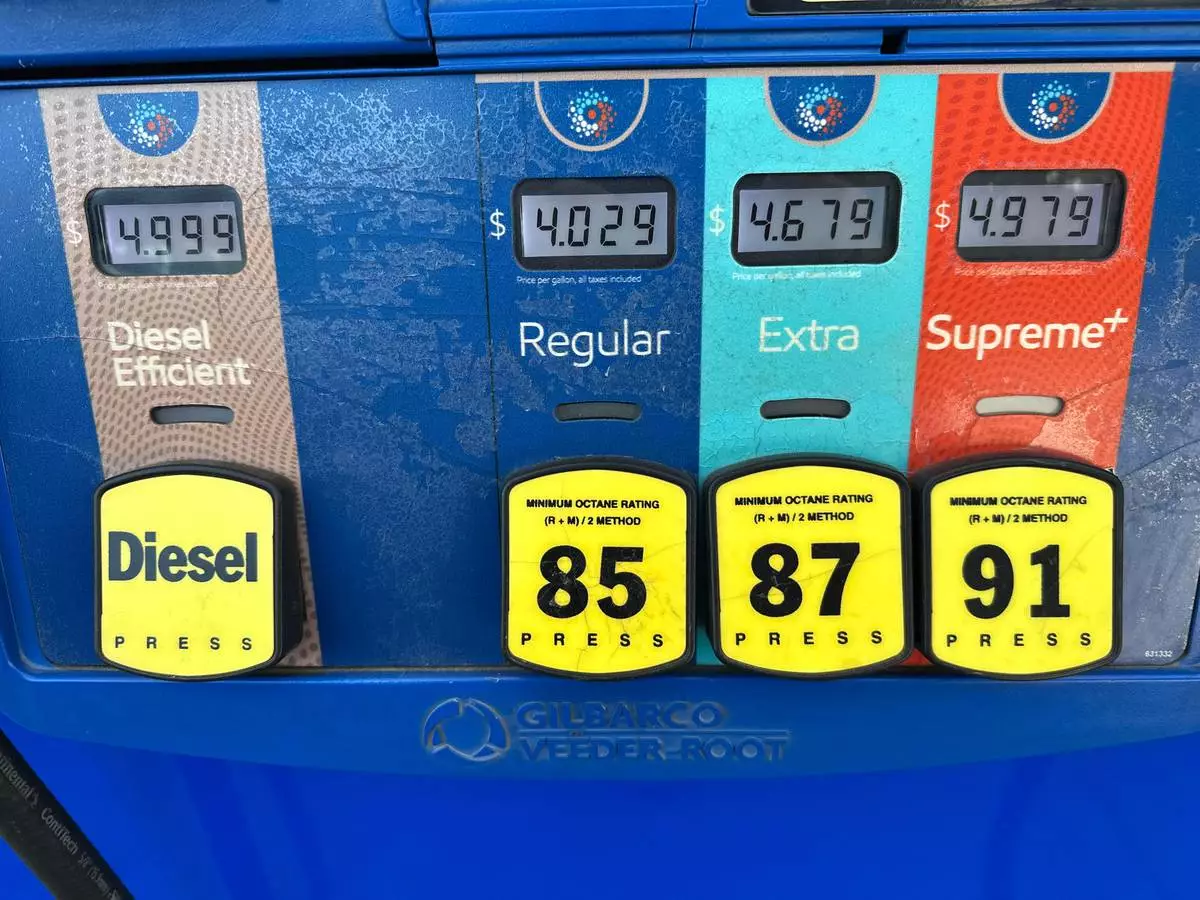
The per-gallon price is displayed electronically above the grades of gasoline available from a pump at an Exxon gasoline station in Litttleton, Colo., Tuesday, May 12, 2026. (AP Photo/David Zalubowski)
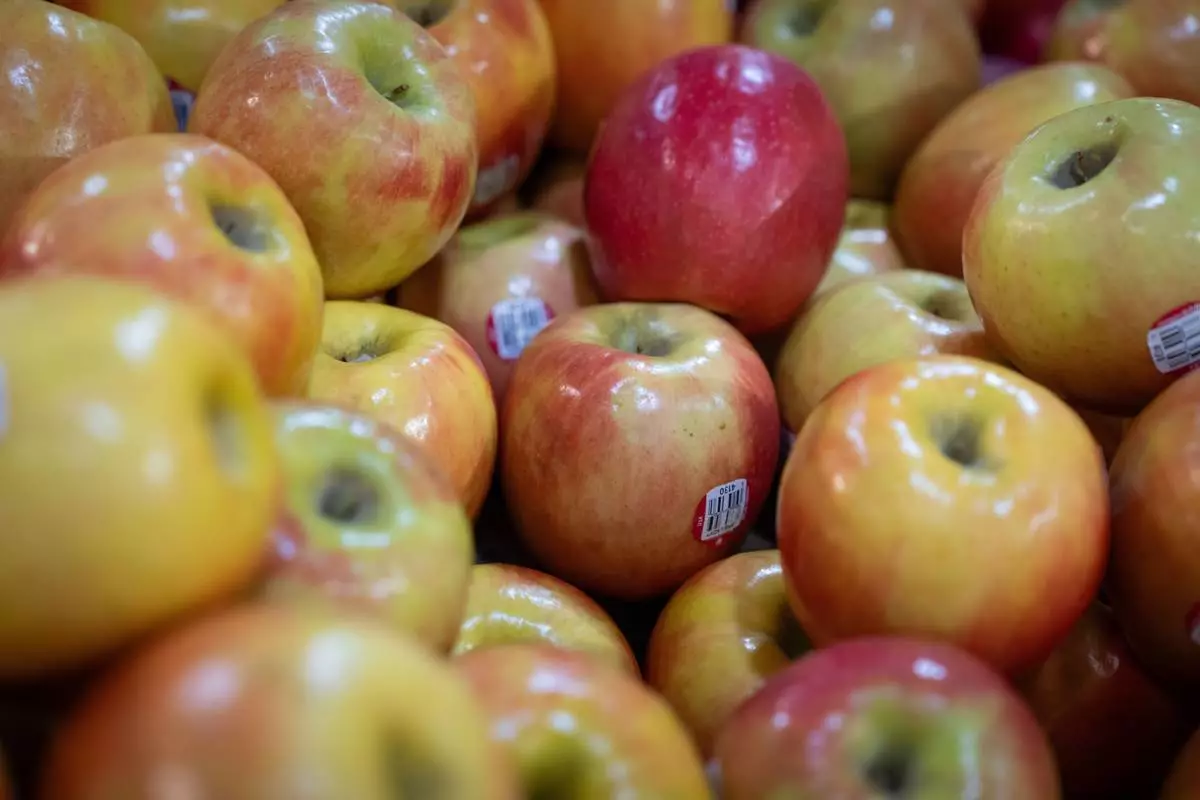
Apples are displayed for sale in the produce section of a grocery store on Monday, May 11, 2026, in Portland, Ore. (AP Photo/Jenny Kane)

A customer picks up scallions for sale in the produce section of a grocery store on Monday, May 11, 2026, in Portland, Ore. (AP Photo/Jenny Kane)
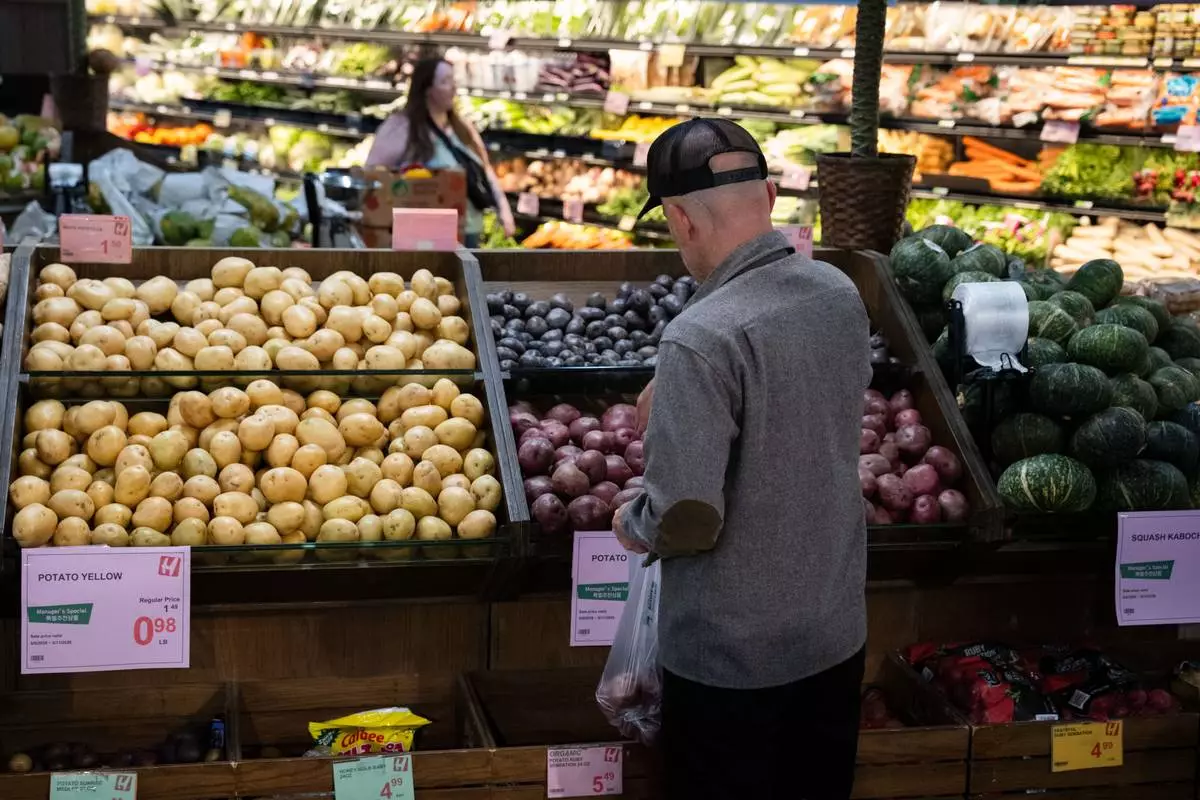
Customers shop in the produce section of a grocery store on Monday, May 11, 2026, in Portland, Ore. (AP Photo/Jenny Kane)