Micro-dramas born in China are now taking the U.S. market by storm, and according to a popular American actor, the U.S. film and television industry is looking to copy China's playbook to replicate the commercial success of its vertical-screen short dramas.
Matt William Knowles is the first non-Asian to graduate in acting from the Beijing Film Academy and has starred in multiple hit Chinese TV dramas, including "Red Sorghum" and "Eastern Battlefield". Now, as he has become the face of America's vertical micro-drama boom, he said the experience feels nothing short of surreal.
"I didn't expect that the vertical series would be a thing several years ago, and now they've popped up and grown so fast," said Knowles.
In his view, vertical micro-dramas have long ceased to be a niche phenomenon. In the U.S., they've already built a huge and fast-growing audience.
"I think a couple of years ago, there was a smaller market or type of person who was watching this series, and now there are more and more people who are watching. I had a friend who said he was on a construction site recently, and there were a bunch of construction workers, and they were all watching a vertical series together," he said.
As an insider, Knowles has observed a notable shift in the U.S. film and television industry in recent years: a growing trend of looking to China for inspiration. Backed by hard market data, the once-supreme Hollywood is now filled with professionals eager to decode the business secrets behind China's micro-drama success.
"Several years ago, China was usually bringing over talent from Hollywood to China to learn from them. But now you have this interesting thing that's happening with vertical series, where vertical series started in China. And now people in America are trying to figure out: how can we copy this thing and make money off it? I think a lot of people are studying what's going on in China," he said.

Hollywood taking notes from China's micro-drama playbook: U.S. actor

Hollywood taking notes from China's micro-drama playbook: U.S. actor
China will push for the rollout of next-generation communication networks ahead of market demand in the coming five years, a senior official with the Ministry of Industry and Information Technology (MIIT) said on Wednesday at the annual International Postal and Telecommunications Expo (PT Expo).
The push mirrors the development plan recently issued by the ministry for the information and communications industry during the 15th Five-Year Plan period (2026-2030).
According to the plan, a new-generation communications network with comprehensive coverage and leading performance is expected to be fully established by 2030, the 5G user penetration rate will reach 95 percent, gigabit-capable broadband will connect to 320 million households, and intelligent computing power will reach 9,800 EFLOPS -- a unit of computing performance, with each unit representing one quintillion floating-point operations per second.
"We will systemically promote the development of an application-driven and appropriately future-oriented next-generation communications network, push broadband networks toward dual 10-gigabit evolution, and advance the construction of low-Earth orbit satellite internet systems. We will also holistically optimize a communications network that links ground and sea, expand and improve computing facilities, and strengthen computing-network integration and the interconnection of computing power, so as to better support the national integrated computing network," said Yu Xiaohui, vice minister of the Ministry of Industry and Information Technology.
The move came as breakthroughs in digital intelligence technologies -- represented by artificial intelligence -- brought opportunities for the development of information and communication.
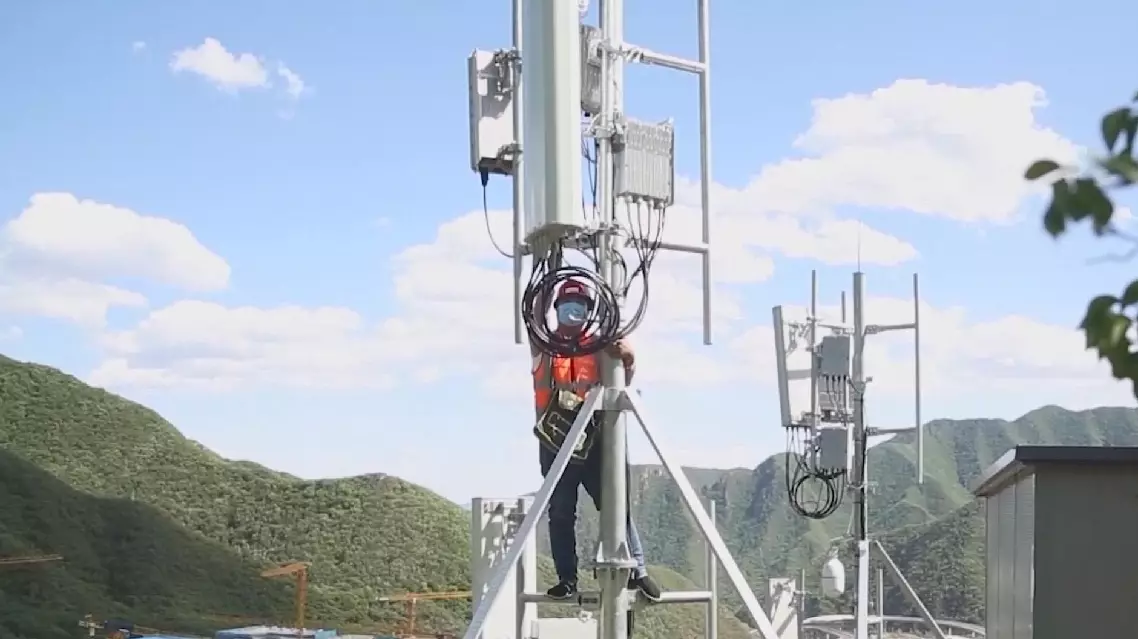
As of the end of July, China had deployed over 5.15 million 5G base stations, with early-stage deployment of 10-gigabit optical networks already underway and intelligent computing power standing at 2,185 EFLOPs, according to official data.
China will also deepen the integration of terrestrial and satellite networks, including commercial applications for smartphone direct-to-satellite services and the Internet of Things (IoT), ramp up research and development for 6G base stations, and advance the development of standards in key information and communication sectors, such as computing power networks and quantum communication, according to the development plan.
The PT Expo this year is being held from Tuesday to Thursday in Beijing.
China to push ahead-of-demand rollout of next-generation communications networks