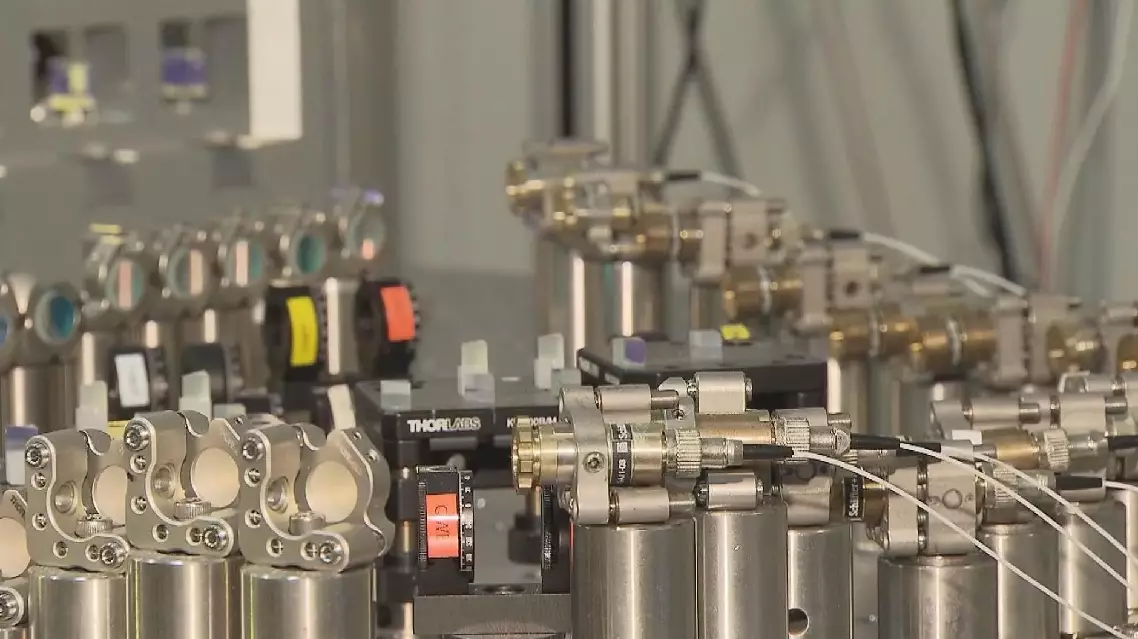
Chinese scientists have developed a programmable quantum computing prototype called "Jiuzhang 4.0" that has set a new world record for optical quantum information technology, according to a study published on Wednesday in the journal Nature.
Led by the University of Science and Technology of China, the team used the prototype to solve the Gaussian boson sampling problem at a speed more than 10 to the 54th times that of the world's most powerful supercomputer, the study said.
The researchers said they manipulated and detected quantum states of up to 3,050 photons -- a significant leap from the 255 photons achieved with the previous "Jiuzhang 3.0."
Current mainstream quantum computing technological routes include superconducting, ion trap, photonic, and neutral atom systems. The "Jiuzhang" series of prototypes encodes quantum bits using photons and performs quantum computation through the manipulation and measurement of these photons.
Since its successful construction in 2020, the series has undergone several upgrades, achieving "quantum computational advantage" and repeatedly setting world records.

Chinese scientists develop 'Jiuzhang 4.0,' setting new world record in quantum computing
Chinese scientists develop 'Jiuzhang 4.0,' setting new world record in quantum computing
Hundreds of exhibitors from Asia-Pacific Economic Cooperation (APEC) economies at the 9th China International Import Expo (CIIE) in Shanghai have hailed China as far more than a vast market, describing it as a gateway to the wider Asia-Pacific region and beyond.
The timing gives that message particular resonance, with the southern Chinese city of Shenzhen preparing to host the 33rd APEC Economic Leaders' Meeting in a matter of days.
For its part, the CIIE has offered a living preview of the priorities APEC champions, among them openness, innovation and cooperation, as companies from across the region pursue deals and partnerships on its exhibition floor, where opportunity has emerged as the prevailing theme.
"CIIE offers Indonesian businesses more than just a place to display their products. It gives them an opportunity to meet potential buyers, find local distributors, build business partnerships, and better understand what Chinese consumers want," said Angga Handian Putra, director, Indonesia Trade Promotion Center (ITPC) Shanghai.
Many longtime participants see the same spirit as a sustained commitment written into China's policy agenda.
"I think what China's been doing over the last few years, and [which] is also carrying on into their next Five-Year Plan is that they've got that openness and are trying to get cooperation and win-win partnerships with countries around the world and businesses around the world," said Roy Van Den Hurk, CEO of Milk New Zealand Dairy Limited.
The benefits, however, are not confined to China's borders, as business connections forged in Shanghai frequently travel far beyond them.
"More importantly, the opportunities do not stop in China. Business connections made at CIIE can open doors to other markets across the Asia-Pacific region. Ultimately, CIIE helps Indonesian businesses grow from simply selling products overseas to building strong brands and long-term business relationships," Angga Handian Putra said.
Shenzhen will host the 33rd APEC Economic Leaders' Meeting later this month under the theme of 'Building an Asia-Pacific Community to Prosper Together,' with the preceding CEO Summit on Nov. 17-18 set to carry conversations first heard on the CIIE floor into the summit's halls.

CIIE opens doors for APEC businesses to China, beyond