Nestled in the mountains on the northern outskirts of Fuzhou, capital of east China's Fujian Province, the summer resort of Kuliang is where a century-old China-U.S. friendship is being kept alive.
Descendants of American families who once lived there have passed it on -- and now, a new generation of Chinese and American youth are building their own ties, right where their great-grandparents once called home.
One of those descendants is Elyn Gregg Cheney MacInnis, whose Chinese name is Mu Yanling. Her father-in-law first came to Fuzhou in 1940, teaching English at a middle school for a year. A few years later, he joined a U.S. aviation unit. Serving as a "coast watcher," he became the "eyes" of the Flying Tigers -- the American Volunteer Group of the Chinese Air Force, formed in 1941 by U.S. General Claire Lee Chennault to help China fight against the invading Japanese forces.
In 2015, MacInnis made her own journey to Kuliang, setting foot on the place her ancestors had once called home. As she delved deeper into the local history, she uncovered many stories of the American community that once lived there.
Determined to preserve those memories, she began collecting historical materials and, in 2016, founded "Kuliang Friends" -- a network that has since grown to include some 50 descendants of American families who had lived in Kuliang.
Many of them have taken Chinese names, and most still carry the Chinese surnames their ancestors once used -- a way to remember and carry forward the century-old "Kuliang bond."
One of the members of Kuliang Friends is 82-year-old Gordon Trimble, whose Chinese name is Cheng Gaodeng. He is a descendant of Lydia A. Trimble, an American who once lived in Kuliang and played a key role in establishing the first girls' school in southern China. Today, Gordon Trimble teaches at Fujian South China Women's Vocational College, the very institution that grew out of that school his ancestor founded more than a century ago.
For over 20 years, he has volunteered to teach in China, promoting exchanges between Chinese and American youth. Inspired by his efforts, 20 young Americans have come to teach at the college, while eight Chinese students and teachers have traveled to the United States for academic exchanges.
"When I told friends that I was going to teach in China, they'd say, 'Oh.' And they said, 'What do you mean?' I said, 'it's not about me. It's a family responsibility." That's five generations. It is my home. It's been my home. The people of both cultures have things they can offer each other. So we're not thinking in terms of zero sum games. We're trying to make every game additive, cumulative by picking out people and things and promoting, helping them become better. I hope that what we've done for five generations can continue for another five," he said.
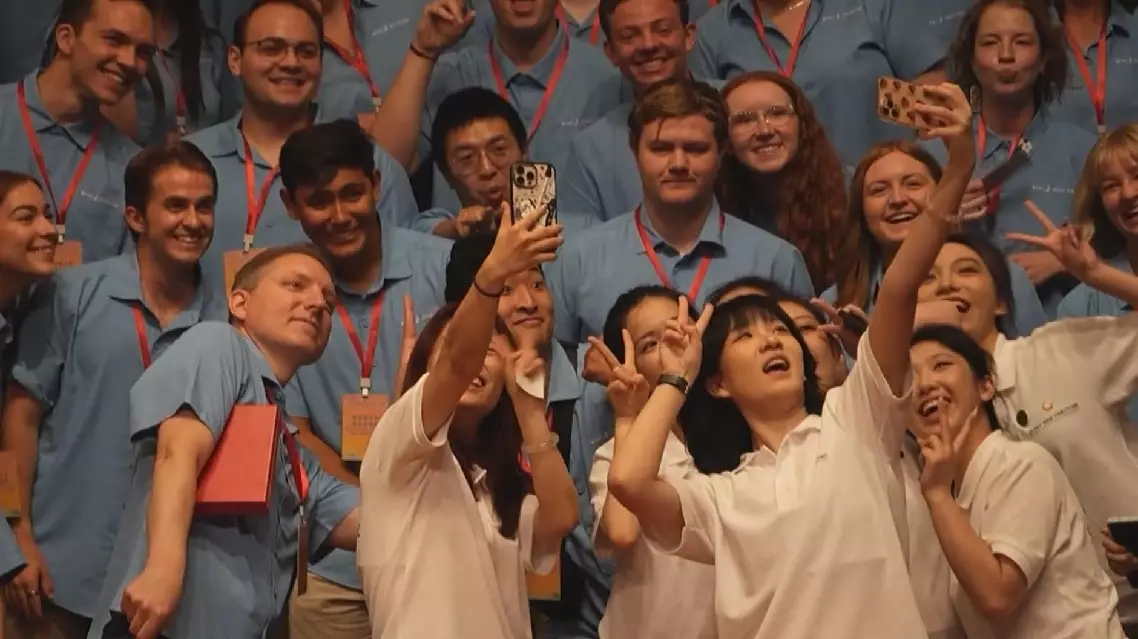
In recent years, as signature programs under the initiative proposed by Chinese President Xi Jinping in 2023 to invite 50,000 young Americans to China on exchange and study programs in the next five years, a series of events have been held -- including the China-U.S. Youth Exchange Week and the China-U.S. Youth Choir Festival, both under the theme "Bond with Kuliang."
From singing "Auld Lang Syne" together to experiencing China's innovation and vitality firsthand, young people from both countries have built friendships.
"I think, I'm just really grateful for how welcoming. Just a smile and a wave -- It's like you could make a friend. And I think it's really cool to make friends with people from other countries -- in their country. I think is a really special experience," said Bella Thurgood, member of the select choir of Brigham Young University.
"I don't think cultural differences are a barrier to communication. Both we and the American students are truly eager to learn about each other's cultures. I hope I can meet my American friends more often in the future -- and I wish for our friendship to grow stronger and stronger," said Lin Xinyi, a student at Fujian South China Women's Vocational College.
Today, among the hills of Kuliang, the "friendship grove" planted by Chinese and American youth is thriving. Not far away, the ancient cryptomeria trees that once witnessed children from both countries growing up together a century ago remain tall and lush. Carved into the stone beneath the thousand-year-old cryptomeria is a heartfelt message by Xi for both peoples: May the friendship between the Chinese and American people grow strong and last forever -- just like the ancient cryptomeria trees of Kuliang.
Fujian's Kuliang keeps alive century-old China-US friendship