BUDAPEST (AP) — Russia's ambassador to Hungary was summoned Thursday over a massive drone attack near Hungary’s border with Ukraine, in a stark example of the change brought about by the election of Prime Minister Péter Magyar after years of cozy relations between Budapest and Moscow under his predecessor, Viktor Orbán.
An Associated Press reporter saw Ambassador Evgeny Stanislavov leaving the Hungarian Foreign Ministry less than 30 minutes after arriving for an official summons to speak with Foreign Minister Anita Orbán about strikes that hit the Ukrainian region of Transcarpathia on Wednesday. The region is home to a sizable Hungarian minority.
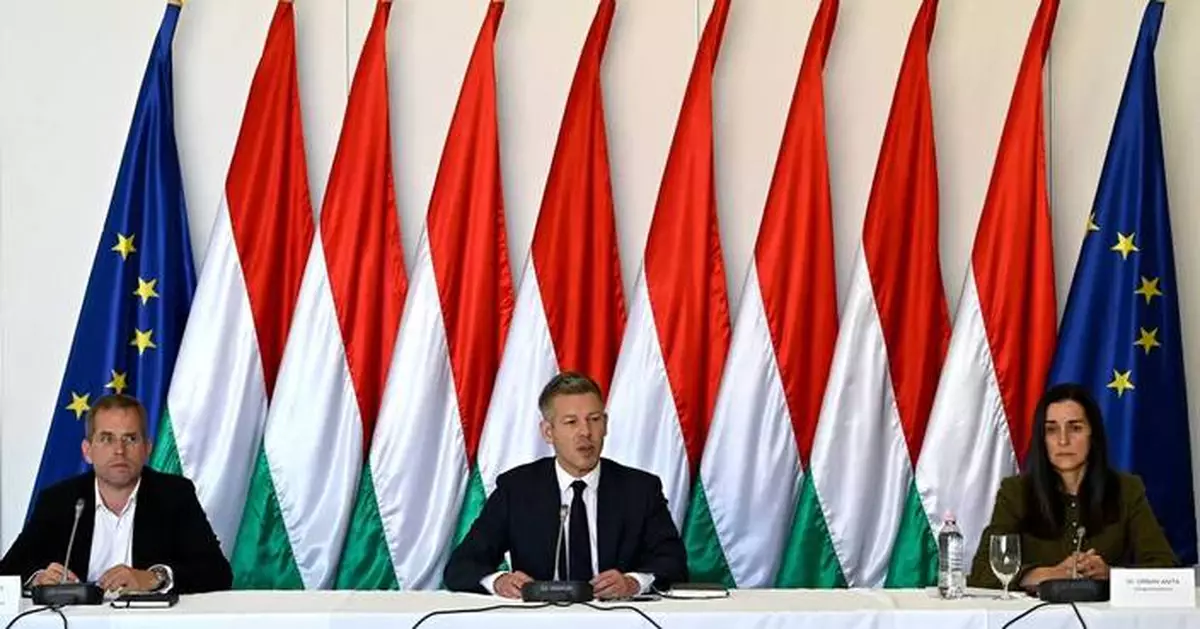
“The Hungarian government strongly condemns the Russian attack on Transcarpathia," Magyar said Wednesday during a news conference in Ópusztaszer in southern Hungary, when he announced that the ambassador would be summoned to protest the attack.
“She will tell him the same and ask for information on when Russia and Vladimir Putin plan to finally end this bloody war that began more than four years ago,” Magyar said.
The Russian government has not made any public statements on the summons.
When the ambassador left the Foreign Ministry building on the banks of the Danube, an activist yelled at him in Hungarian, “Comrade, it's over!”
Russia fired at least 800 drones in a massive daytime barrage Wednesday targeting about 20 regions of Ukraine including Transcarpathia, Ukrainian President Volodymyr Zelenskyy said. At least six people were killed and wounded dozens, including children. Lasting hours, it was one of the longest-lasting attacks by Moscow in the war now in its fifth year.
Zelenskyy called the summons in Budapest an “important message” and thanked Magyar for his comments.
“Moscow has once again shown itself to be a common threat not only to Ukraine, but also to neighbouring countries and Europe as a whole,” Zelenskyy said on social media.
After defeating Orbán in a historic vote in April, Magyar has vowed to undo much of the legacy built during Orbán’s 16 years in power, with a particular focus on alleged corruption.
The summons marks a stunning change after years of close relations between Hungary — both a member of the European Union and NATO — and Moscow, even following the 2022 full-scale invasion of Ukraine.
In March, Stanislavov, the ambassador, posted on Facebook an open letter to Magyar denying Moscow was involved in helping longtime Kremlin ally Orbán.
“It’s really not worth scaring Hungarians with imaginary Russian threats,” he wrote. “The embassy has clear objectives: to ensure the maintenance of normal bilateral relations, to develop mutually beneficial cooperation in the current situation where possible, and to protect the interests of citizens of Russia and Hungary.”
Magyar announced on Thursday that he was ending two crisis governing structures in Hungary, which were set up in response to the war in Ukraine and the COVID pandemic.
Orbán had declared a “ state of danger ” in 2022 in the wake of Russia's full-scale invasion of Ukraine, and his Fidesz party granted him extraordinary executive power during the COVID pandemic in 2020. Both enhanced his powers and led to widespread criticism over democratic backsliding. "We are returning to normality," Magyar said in a social media post. “As of today, after four years, the wartime state of emergency in Hungary is ending, and with it we are also putting an end to the decree-based emergency rule introduced by the Orbán government six years ago.”
McNeil contributed from Brussels.
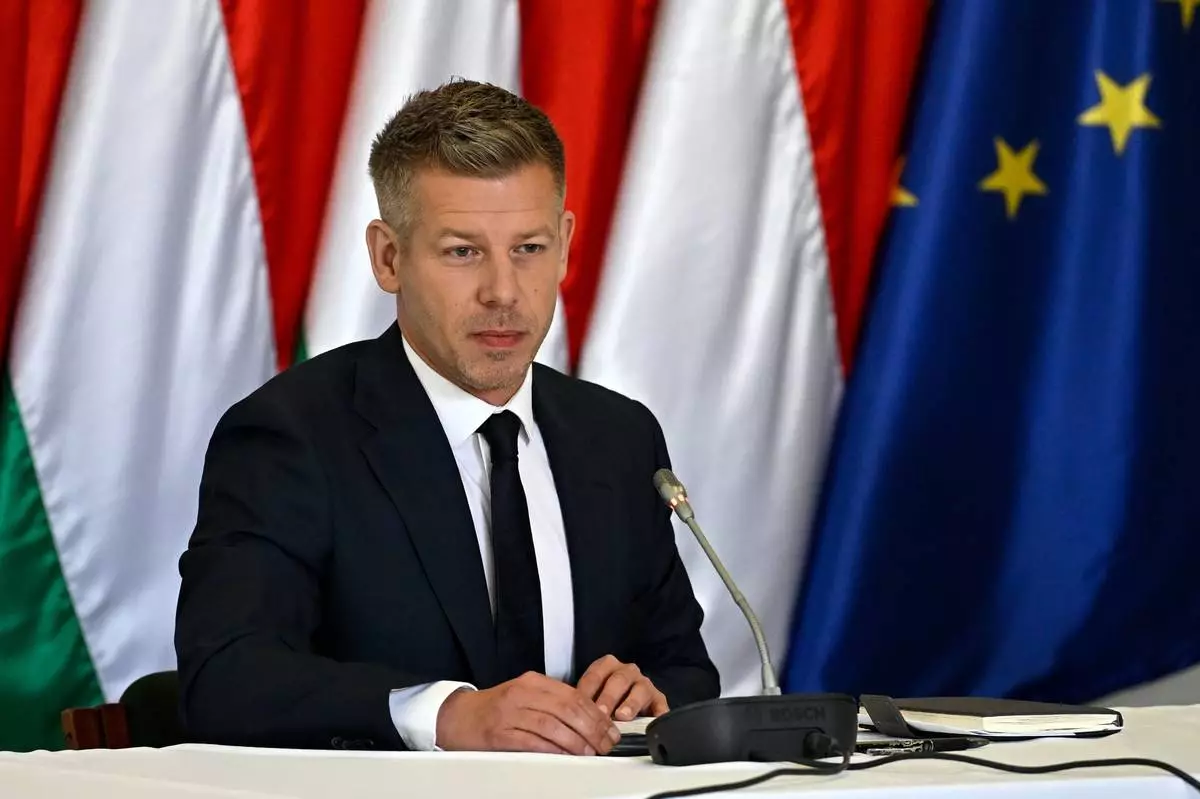
Hungarian Prime Minister Peter Magyar attends the first, out-of-town cabinet meeting of the new Tisza government in Opusztaszer, Hungary, Wednesday, May 13, 2026. (Robert Hegedus/MTI via AP)
FILE - Former Justice Minister Zbigniew Ziobro speaks to reporters alongside in Warsaw, Poland, Sept. 26, 2020. (AP Photo/Czarek Sokolowski, file)
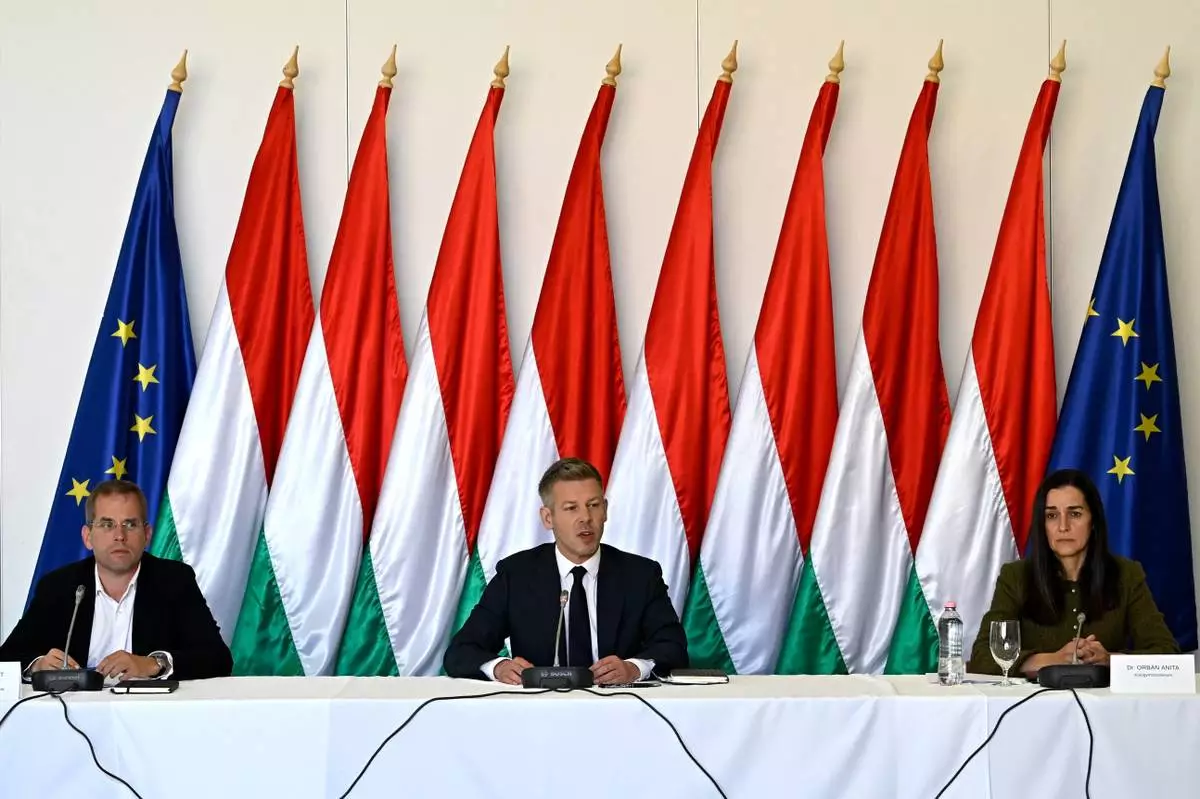
Hungarian Prime Minister Peter Magyar, centre, attends the first, out-of-town cabinet meeting of the new Tisza government flanked by Balint Ruff, Head of the Prime Minister's Office, and Foreign Minister Anita Orban, right, in the Opusztaszer National Historical Memorial Park in Opusztaszer, Hungary, Wednesday, May 13, 2026. (Robert Hegedus/MTI via AP)
DES MOINES, Iowa (AP) — Two Democrats vying to be Iowa's next U.S. senator are scheduled to debate Thursday, as each seeks to convince voters he's better positioned to flip the Republican-held seat in a contest that has seen heavy outside spending and high-profile endorsements.
State lawmakers Zach Wahls and Josh Turek are competing in a June 2 primary. It is one of a few remaining competitive Democratic Senate primaries this year, as the party looks to find the best approach to reclaim the U.S. Senate this fall.
Iowa’s Republican Sen. Joni Ernst opted out of a reelection bid, leaving the seat open for the first time since she replaced retiring Democratic Sen. Tom Harkin in 2014. Republican Senate leaders have backed Ashley Hinson, a congresswoman representing northeast Iowa, committing $29 million for her to help keep their thin majority.
Democrats see an opportunity to flip seats in the once-competitive state, despite President Donald Trump’s double-digit win in the last presidential election and an all-Republican federal delegation. But first they need to settle which federal candidate will be at the top of the ticket. Early voting began Wednesday.
While Wahls and Turek have raised and spent similar amounts, a Democratic political organization, VoteVets, has spent about $7 million to support Turek in the final stretch of the campaign. That's more than the two candidates have spent combined.
Turek, who is not a veteran, was born with spina bifida after his father’s exposure to chemicals while serving in the Vietnam War. The group has said Turek is uniquely positioned to advocate for veterans’ services, especially health care and military families.
Wahls has criticized the influx of cash as insiders in Washington trying to exert outsized influence, and it's likely to come up again Thursday, as it did at an Iowa Press debate last week.
Wahls has been vocal about who should — or should not — lead Senate Democrats, saying he would not vote for Sen. Chuck Schumer of New York to be the caucus leader.
“The leadership of Chuck Schumer has failed the Democratic Party, it has failed the state and it has failed this country,” Wahls said during last week's debate. “Dark money has an agenda, and that agenda is to protect the broken status quo and the failed leadership of Sen. Schumer.”
Schumer has tried to keep the focus on Republicans.
Wahls is endorsed by U.S. Sen. Elizabeth Warren of Massachusetts, who joined him in Iowa for campaign events over the weekend. The progressive senator told voters the Senate needs Democrats who are willing to “get in there and stand up and fight.” Wahls also often highlights the support he's seen from unions and local elected officials.
Turek responded to Wahls' criticism saying he's not a “DC insider."
“I don't know these folks," he said. Turek explained his criteria for leader candidates but stopped short of saying he wouldn’t support Schumer.
“I will go up and ask whoever is deciding to run for leadership ... ‘What are you going to do for Iowa? What are you going to do for Iowans? What are you going to do for the middle class?’” Turek said.
In the last week, Turek unveiled a rare endorsement from Harkin, who represented Iowa in Washington for three decades, as well as former Transportation Secretary Pete Buttigieg. Turek also has collected endorsements from sitting U.S. senators, including Illinois' Tammy Duckworth, New Hampshire's Maggie Hassan and Nevada's Catherine Cortez Masto.
In the first debate last week, Turek and Wahls were aligned on many issues. Both said that they would not support the Republican president’s tariffs or the war in Iran and that they do support raising the minimum wage and restoring health care access with a public insurance option. They criticized corruption in Washington and proposed higher taxes on corporations and wealthy Americans.
But they also started to draw some contrasts. More of that is likely Thursday.
Wahls referenced a law Turek supported in the Iowa legislature that makes it a state crime to be in the U.S. illegally. Turek defended his vote, saying it was Biden-era legislation and stressed the importance of a secure U.S.-Mexico border. Turek said he also supports an easier path to citizenship and reforms to immigration enforcement under the Trump administration.
Turek highlighted his working-class background and contrasted his work for a nonprofit with Wahls’ work for a super PAC focused on electing young Democrats.
Follow the AP’s coverage of the 2026 election at https://apnews.com/projects/elections-2026/.
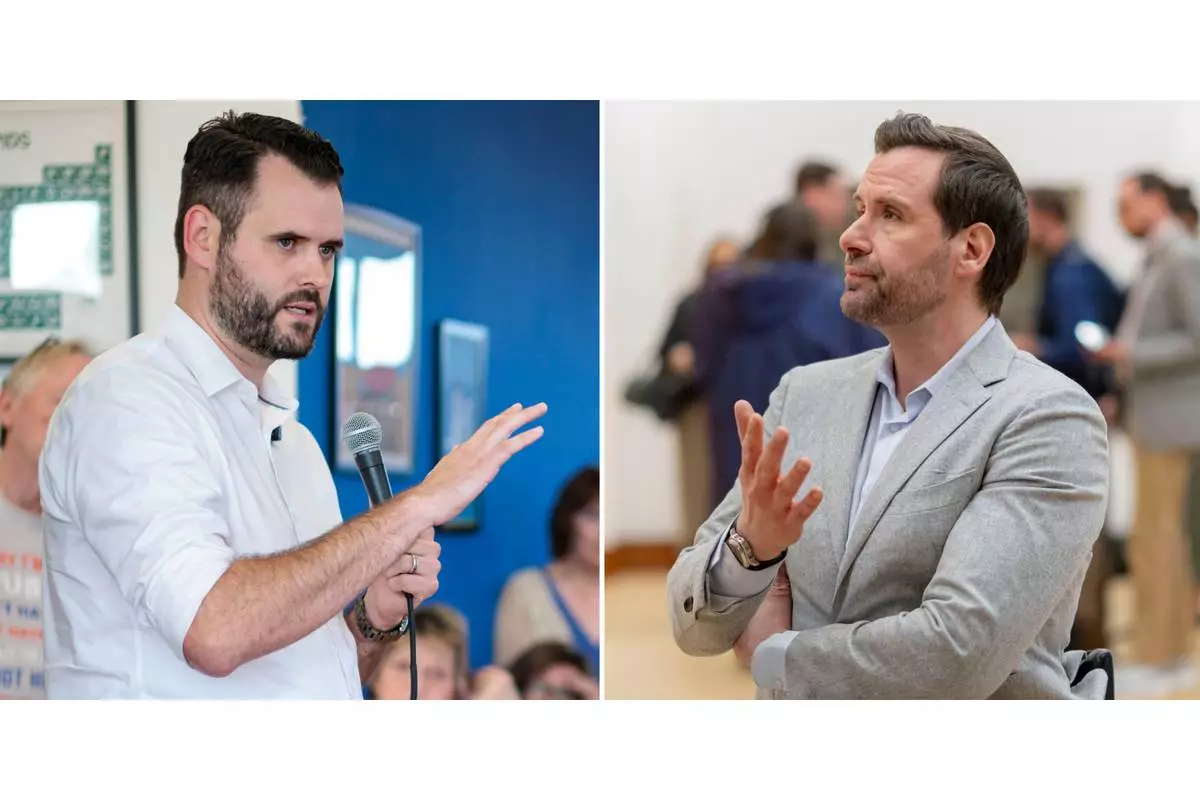
This combination of file photos shows Iowa State Sen. and candidate for the Democratic nomination for U.S. Senate Zach Wahls speaking in Cedar Rapids, Iowa, Sept, 11, 2025, left, and Iowa state Rep. Josh Turek speaking in Des Moines, Iowa, April 8, 2026, right. (Nick Rohlman/The Gazette via AP, File)