|
DUBAI, UAE, May 14, 2026 /PRNewswire/ -- Robo.ai Inc. (Nasdaq: AIIO), announced today that its wholly-owned AI data processing and compression technology subsidiary, Neurovia AI, has officially released its core technology platform, NeuroStream™. Designed for the machine economy era, the platform utilizes a bitmap vectorization algorithm to provide high-fidelity, low-bandwidth, and low-power infrastructure support for the massive visual data generated by physical artificial intelligence. Mansoor Ali Khan, Chief Technology Officer of Neurovia AI, detailed the platform's technical architecture and application cases.
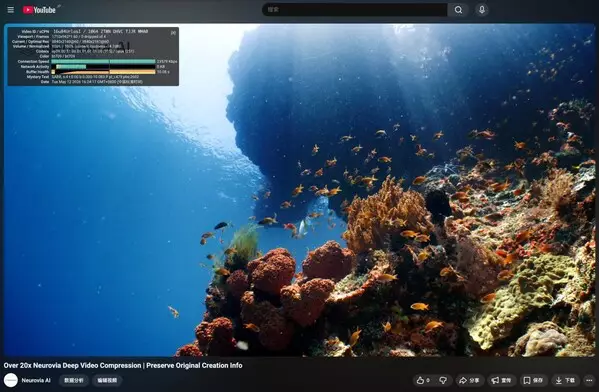
To demonstrate the practical performance of NeuroStream™, Neurovia AI has published comparative case studies on its official website (https://www.neuroviaai.ae/). According to internal testing, a 5.5GB 4K 60fps original video processed through NeuroStream™ can be compressed to a file size of 278MB, reducing storage space usage by approximately 95%.
These tests indicate that NeuroStream™ significantly reduces file size while fully retaining core visual information such as the original video's resolution and frame rate. This visually lossless characteristic ensures that the substantially compressed data continues to provide a clean and complete data source for subsequent machine vision and AI computations. This capability meets the strict data authenticity requirements of industrial, sovereign, and specific legal application scenarios, while also generating clear economic benefits for enterprises in terms of energy consumption, storage space, and processing latency.
Chief Technology Officer Mansoor Ali Khan noted that global unit data storage prices have increased approximately fourfold since 2026. According to industry estimates, every terabyte of data storage saved generates a direct economic benefit of $1,000 to $1,500 annually for an AI customer, in addition to indirect benefits related to transmission efficiency, energy consumption, data integrity, and security.
Through AI-native compression, intelligent visual optimization, and edge computing adaptation, NeuroStream™ converts traditional bitmap logic into a vectorized mathematical expression. This approach lowers transmission and storage costs while precisely preserving the critical visual information necessary for AI computation, offering an effective solution to rising storage expenses.
The platform provides native format compatibility with zero decompression usage costs, as processed images and videos maintain their original formats and can be directly accessed by systems without specific decompression software. This full compatibility with existing conventional video workflows substantially reduces system integration and friction costs for enterprises.
Furthermore, NeuroStream™ optimizes data quality and enhances machine vision recognition accuracy by intelligently improving the data signal-to-noise ratio during processing. This process aids in increasing the computational efficiency of AI algorithms and ensures that machines maintain high recognition accuracy on the compressed data.
The platform features an architecture adapted for low-computing edge deployment, enabling standard commercial computing devices to efficiently process hundreds of terabytes of data. This characteristic makes the platform suitable for deployment on edge sensors, drones, and mobile terminal nodes with limited computing resources. Additionally, the product ensures data security and privacy protection through lossless offline operation, allowing it to function independently in disconnected environments to meet the data compliance requirements of highly sensitive industries such as aerospace, medical imaging, and energy.
Moving forward, Neurovia plans to progressively introduce the NeuroStream™ platform to core application scenarios including autonomous driving, robotics, smart cities, industrial AI, and global intelligent networks. As the deployment scale of global edge computing nodes expands, NeuroStream™ is expected to effectively reduce network bandwidth pressure and overall energy consumption in data centers. This will enable global machine vision networks to become more efficient, real-time, and intelligent, providing solid infrastructure support for the large-scale commercial deployment of the machine economy.
About Neurovia AI Limited
Neurovia AI (www.neuroviaai.ae) provides AI data processing and visual infrastructure through its NeuroStream™ platform. Dedicated to transitioning visual data from human viewing to machine understanding, the company utilizes AI-native compression and edge computing to address data bottlenecks in Physical AI. Its technology serves autonomous driving, smart cities, and intelligent manufacturing, providing a foundational layer for global machine perception and collaboration.
About Robo.ai Inc.
Robo.ai Inc. (NASDAQ: AIIO) is a technology company dedicated to building an artificial intelligence machine economy platform. Its mission is to integrate smart terminals through AI software, intelligent hardware, and smart assets to construct a unified artificial intelligence operating system and a blockchain-empowered ecosystem to pioneer an intelligent future.
Safe Harbor Statement
This press release contains forward-looking statements as defined in the Private Securities Litigation Reform Act of 1995. Actual results may differ from expectations; for further details, please refer to the documents the company has filed with the U.S. Securities and Exchange Commission.
Media Contacts
Neurovia AI Corporate Communications
Email: info@neuroviaai.ae
Website: www.neuroviaai.ae
Robo.ai Inc. Corporate Communications
Email: pr@roboai.io
Website: www.roboai.io
DUBAI, UAE, May 14, 2026 /PRNewswire/ -- Robo.ai Inc. (Nasdaq: AIIO), announced today that its wholly-owned AI data processing and compression technology subsidiary, Neurovia AI, has officially released its core technology platform, NeuroStream™. Designed for the machine economy era, the platform utilizes a bitmap vectorization algorithm to provide high-fidelity, low-bandwidth, and low-power infrastructure support for the massive visual data generated by physical artificial intelligence. Mansoor Ali Khan, Chief Technology Officer of Neurovia AI, detailed the platform's technical architecture and application cases.
To demonstrate the practical performance of NeuroStream™, Neurovia AI has published comparative case studies on its official website (https://www.neuroviaai.ae/). According to internal testing, a 5.5GB 4K 60fps original video processed through NeuroStream™ can be compressed to a file size of 278MB, reducing storage space usage by approximately 95%.
These tests indicate that NeuroStream™ significantly reduces file size while fully retaining core visual information such as the original video's resolution and frame rate. This visually lossless characteristic ensures that the substantially compressed data continues to provide a clean and complete data source for subsequent machine vision and AI computations. This capability meets the strict data authenticity requirements of industrial, sovereign, and specific legal application scenarios, while also generating clear economic benefits for enterprises in terms of energy consumption, storage space, and processing latency.
Chief Technology Officer Mansoor Ali Khan noted that global unit data storage prices have increased approximately fourfold since 2026. According to industry estimates, every terabyte of data storage saved generates a direct economic benefit of $1,000 to $1,500 annually for an AI customer, in addition to indirect benefits related to transmission efficiency, energy consumption, data integrity, and security.
Through AI-native compression, intelligent visual optimization, and edge computing adaptation, NeuroStream™ converts traditional bitmap logic into a vectorized mathematical expression. This approach lowers transmission and storage costs while precisely preserving the critical visual information necessary for AI computation, offering an effective solution to rising storage expenses.
The platform provides native format compatibility with zero decompression usage costs, as processed images and videos maintain their original formats and can be directly accessed by systems without specific decompression software. This full compatibility with existing conventional video workflows substantially reduces system integration and friction costs for enterprises.
Furthermore, NeuroStream™ optimizes data quality and enhances machine vision recognition accuracy by intelligently improving the data signal-to-noise ratio during processing. This process aids in increasing the computational efficiency of AI algorithms and ensures that machines maintain high recognition accuracy on the compressed data.
The platform features an architecture adapted for low-computing edge deployment, enabling standard commercial computing devices to efficiently process hundreds of terabytes of data. This characteristic makes the platform suitable for deployment on edge sensors, drones, and mobile terminal nodes with limited computing resources. Additionally, the product ensures data security and privacy protection through lossless offline operation, allowing it to function independently in disconnected environments to meet the data compliance requirements of highly sensitive industries such as aerospace, medical imaging, and energy.
Moving forward, Neurovia plans to progressively introduce the NeuroStream™ platform to core application scenarios including autonomous driving, robotics, smart cities, industrial AI, and global intelligent networks. As the deployment scale of global edge computing nodes expands, NeuroStream™ is expected to effectively reduce network bandwidth pressure and overall energy consumption in data centers. This will enable global machine vision networks to become more efficient, real-time, and intelligent, providing solid infrastructure support for the large-scale commercial deployment of the machine economy.
About Neurovia AI Limited
Neurovia AI (www.neuroviaai.ae) provides AI data processing and visual infrastructure through its NeuroStream™ platform. Dedicated to transitioning visual data from human viewing to machine understanding, the company utilizes AI-native compression and edge computing to address data bottlenecks in Physical AI. Its technology serves autonomous driving, smart cities, and intelligent manufacturing, providing a foundational layer for global machine perception and collaboration.
About Robo.ai Inc.
Robo.ai Inc. (NASDAQ: AIIO) is a technology company dedicated to building an artificial intelligence machine economy platform. Its mission is to integrate smart terminals through AI software, intelligent hardware, and smart assets to construct a unified artificial intelligence operating system and a blockchain-empowered ecosystem to pioneer an intelligent future.
Safe Harbor Statement
This press release contains forward-looking statements as defined in the Private Securities Litigation Reform Act of 1995. Actual results may differ from expectations; for further details, please refer to the documents the company has filed with the U.S. Securities and Exchange Commission.
Media Contacts
Neurovia AI Corporate Communications
Email: info@neuroviaai.ae
Website: www.neuroviaai.ae
Robo.ai Inc. Corporate Communications
Email: pr@roboai.io
Website: www.roboai.io
** This press release is distributed by PR Newswire through automated distribution system, for which the client assumes full responsibility. **
Robo.ai Subsidiary Neurovia AI Launches NeuroStream™ Technology Platform to Build Physical AI Visual Data Infrastructure
The new radiofrequency treatment, XERF, is designed to target multiple layers of the skin while prioritizing patient comfort.
SYDNEY, May 14, 2026 /PRNewswire/ -- Cynosure Lutronic's XERF is a radiofrequency-based treatment designed to tighten and revitalise skin without the need for needles, numbing or downtime. Positioned as the world's first single-shot, multifrequency monopolar RF technology, XERF combines 6.78 MHz and 2 MHz frequencies to deliver energy at multiple tissue depths, targeting the surface, mid and structural layers of the skin.
The result is a treatment designed to support smoother, tighter and more rejuvenated-looking skin, while maintaining patient comfort through Wave Fit pulse technology and advanced integrated cryogen cooling.
The Australian launch is expected to attract strong interest across the medical aesthetic and beauty sectors, particularly as demand grows for treatments that can deliver visible results without the discomfort and recovery often associated with more intensive procedures.
Recently unveiled at Sydney's iconic Taronga Zoo, with views of the Harbour Bridge and Opera House, XERF's launch was aptly staged in a setting framed by some of the world's most celebrated structures; a nod to the device's focus on structural skin tightening. XERF's arrival also reflects a broader shift in the aesthetics market toward treatments that sit between skincare and more invasive interventions, giving patients options that are lower-disruption but still clinically driven. For clinics, that shift is also driven by demand for treatments that can be easily integrated into busy schedules while still delivering visible, clinically meaningful results.
Among the early adopters is Dr Dae Hwan Kwon, a Melbourne-trained cosmetic physician with a special interest in regenerative skin health and aesthetic harmony. After first learning about the technology in Korea and trialling it on himself, he introduced it into practice with a focus on lower-face tightening, jawline definition, neck rejuvenation and brow lifting.
Over time, Dr Kwon moved beyond the standard protocol and began customising treatments based on face shape and clinical need, a shift he says has delivered strong patient satisfaction.
"What really struck me was that it was significantly less painful than other radiofrequency machines, and that was a major advantage," Dr Kwon said.
"XERF works especially well for people who want lower-face tightening, a more sculpted jawline and tighter neck lines. It can also be highly effective for brow lifting, and when I combine it with jaw contouring treatments, it can deliver a better result with a longer-lasting effect."
A similar experience has been reported by Dr Siew Tuck Wah, a leading Singapore doctor in the field of non-invasive medical aesthetics, who has used XERF for about a year and treated around 100 patients. With a clinic already equipped with multiple energy-based technologies, Dr Siew said XERF stood out because it offered a genuinely new approach, particularly in terms of comfort and adaptability.
Rather than applying a one-size-fits-all treatment, Dr Siew said the device allows practitioners to tailor depth and mode according to facial structure, including whether a patient has a heavier face, more subcutaneous fat, or milder signs of laxity. In his experience, XERF has performed well across a broader range of patients than many practitioners might typically expect from radiofrequency, including older patients and those with heavier jowls.
"What surprised me was that even older patients and those with heavier jowls responded to XERF," Dr Siew said. "They saw lifting, improvement in skin quality, more definition of the jawline and improvement in the upper neck."
He also highlighted the device's developing versatility, including smaller treatment tips designed for delicate areas such as the skin around the eyes.
"What XERF has shown me is that it can be very comfortable to treat. Patients find it more comfortable than other radiofrequency devices, and that has translated into very high patient satisfaction," Dr Siew said.
"Patients often see lifting within two weeks of treatment, and the results are long lasting, more than three months."
The XERF system also features an innovative spider-pattern tip designed to reduce edge effects and support more controlled energy delivery, with the aim of increasing both treatment efficacy and patient safety. Its shorter treatment times may also allow clinics to treat more patients in a day compared with existing similar skin-tightening technologies.
For clinics in Australia and New Zealand, the arrival of XERF comes at a time when non-surgical aesthetic treatments continue to grow, particularly among patients seeking visible results without interrupting their daily lives.
As practitioners increasingly look for technologies that combine performance, efficiency and patient comfort, XERF is entering the market with strong momentum and a growing reputation among early adopters.
"If you're new to XERF and considering adding it to your clinical practice, my advice is please go ahead, because it has changed my practice and brought a whole new dimension to skin tightening for me," Dr Siew said.
About Cynosure Lutronic
Cynosure Lutronic was formed following the merger of Cynosure and Lutronic in 2024 which creates a global medical aesthetics organization built on more than 60 years of combined innovation in energy-based technologies.
Cynosure Lutronic develops and commercializes energy-based devices across a wide range of aesthetic indications with direct operations in North America, Europe, and Asia-Pacific, and product distribution in approximately 130 countries.
** This press release is distributed by PR Newswire through automated distribution system, for which the client assumes full responsibility. **

Breakthrough skin-tightening device XERF™ arrives in Australia

Breakthrough skin-tightening device XERF™ arrives in Australia

Breakthrough skin-tightening device XERF™ arrives in Australia

Breakthrough skin-tightening device XERF™ arrives in Australia