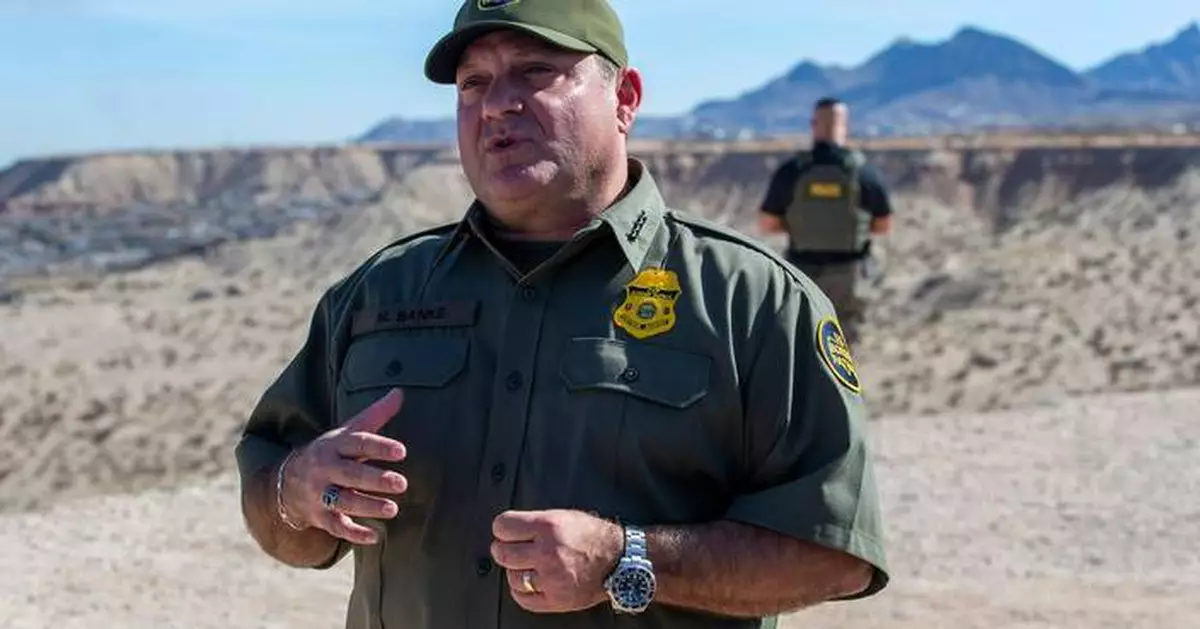
The head of U.S. Border Patrol, the agency tasked with securing the nation's frontiers and increasingly tapped by the Trump administration for immigration operations in American cities, announced his resignation Thursday.
Michael Banks' decision, announced in a Fox News interview and later confirmed by the Department of Homeland Security, is the latest leadership shake-up of officials implementing President Donald Trump's immigration crackdown and comes as the Republican administration appears to be recalibrating its approach to its centerpiece policy of mass deportations.
“It’s just time,” Banks was quoted as saying in a report on the Fox News website, which said the resignation was effective immediately. “I feel like I got the ship back on course," he said, referring to what he described as previous chaos at the southern border. Banks said it was “time to enjoy the family and life."
In a statement, the U.S. Customs and Border Protection commissioner, Rodney Scott, thanked Banks for his service “during one of the most challenging periods for border security.”
The White House did not immediately respond to a request for comment.
It was not clear who will replace Banks. He led an agency at the forefront of Trump's high-profile immigration enforcement efforts but kept a lower profile than some other officials such as Gregory Bovino, a now-retired commander who became a public face of the immigration crackdown.
CBP is one of the federal agencies that participated since last year in a series of immigration enforcement operations, carried out primarily in cities governed by Democrats — an effort that triggered a spike in arrests and led to the fatal shooting of two U.S. citizens in Minneapolis this year at the hands of federal immigration officers.
Banks' resignation takes place two months after Markwayne Mullin, a former Republican senator from Oklahoma, became homeland security secretary. DHS oversees CBP and U.S. Immigration and Customs Enforcement, commonly known as ICE.
Banks is stepping down at the same time that ICE is also going through a leadership transition. Todd Lyons, the acting ICE director, is leaving later this month and will be replaced by David Venturella, who worked for years for private contractors before returning to government service.
CBP was established in 2003 and handles customs, immigration, and agricultural regulations to secure U.S. borders. It has a workforce of over 20,000 agents assigned to patrol the more than 6,000 miles of land borders, and an operating budget of $1.4 billion, according to information from its website.
As head of CBP, Banks became a pivotal figure in the Trump administration’s hardline policy to reconfigure immigration law enforcement in the United States. He oversaw the expansion of prosecutions for illegal border crossings, intensified coordination between the Border Patrol and ICE, and supervised the implementation of broader internal enforcement operations within the country’s borders.
Banks returned to the Border Patrol last year after a long agency career that had never landed him in its senior ranks. His star had risen as border czar to Gov. Greg Abbott, R-Texas, during a period when illegal crossings reached record highs and the state launched a multibillion-dollar enforcement surge that led to turf battles with the Biden administration.
Banks kept a relatively low public profile as arrests for illegal crossings that have plunged to their lowest levels since the mid-1960s, a trend that began toward the end of that Democratic administration.
Banks did not appear publicly at the Border Security Expo this month in Phoenix, an annual conference at which government officials update contractors on the state of the border. Scott, who was Banks’ supervisor, is a close ally of Trump border czar Tom Homan and has acted more as the agency’s public face.
Banks, who grew up in a small town in Warner Robins, about 100 miles (160 kilometers) southeast of Atlanta, Georgia, has said his first job was picking peaches at an orchard when he was 14 years old. He worked with migrant farm workers and learned “compassion and humility,” he said, in an interview published last year on the CBP website.
Banks, in the interview, said he was “honored” to have returned to the agency.
“The United States Border Patrol will be unapologetic in its enforcement of our nation’s laws,” he said.
——-
Elliot Spagat in San Diego, California contributed to this report.
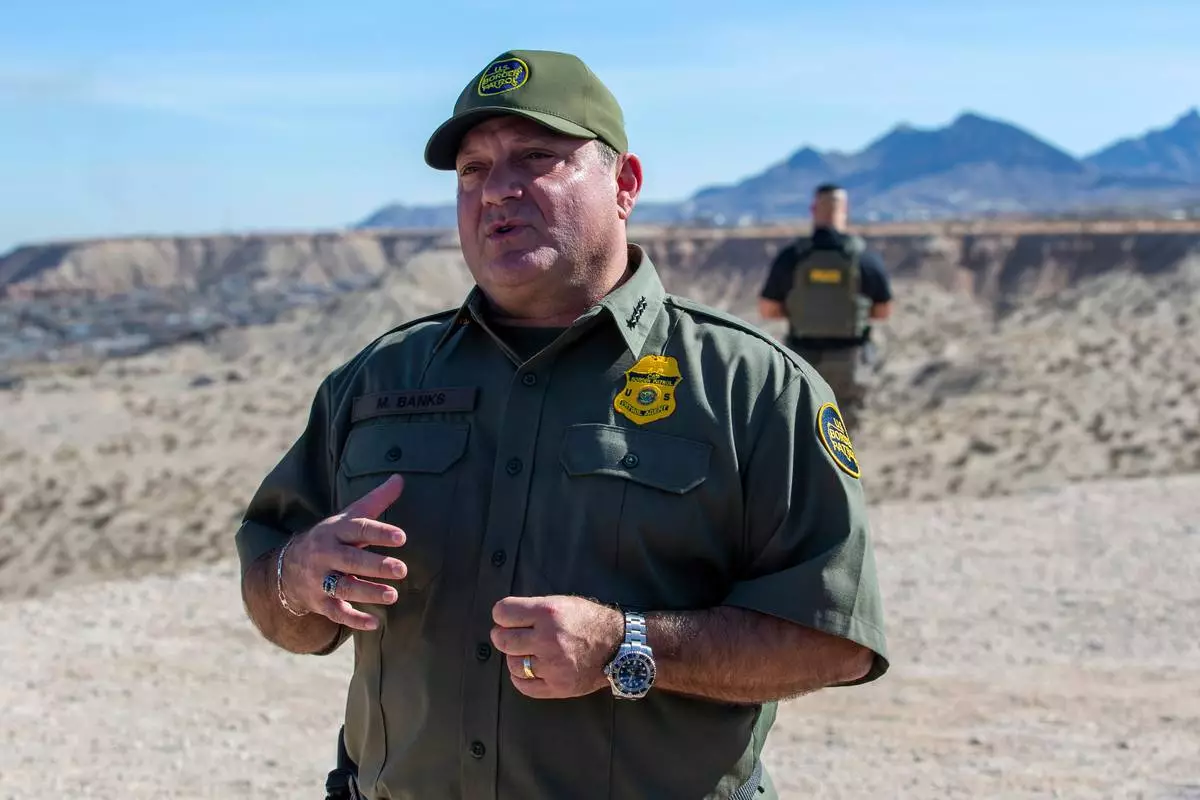
FILE - Border Patrol Chief Michael Banks speaks to reporters during the visit to the US-Mexico border by Defense Secretary Pete Hegseth in Sunland Park, N.M., Feb. 3, 2025. (AP Photo/Andres Leighton, File)
NEW YORK (AP) — The U.S. stock market rose to more records Thursday after Cisco Systems joined the parade of U.S. companies reporting fatter profits for the start of 2026 than analysts expected.
The S&P 500 climbed 0.8% to set an all-time high for a second straight day. The Dow Jones Industrial Average rose 370 points, or 0.7%, and finished above the 50,000 level for the first time since the war with Iran began, while the Nasdaq composite added 0.9% to its own record.
Cisco helped lead the market after reporting better profit and revenue for the latest quarter than analysts expected. The tech giant’s stock leaped 13.4% for its best day in nearly 15 years, and CEO Chuck Robbins said it saw “very strong, broad-based demand for our products.”
Big Tech behemoths in particular are pouring cash into artificial-intelligence technology, and Cisco gave a forecast for profit in the current quarter that easily topped analysts’ expectations.
Such voracious demand for AI, and the big profits it’s producing, have been major reasons the U.S. stock market has set records throughout this year. Cerebras Systems, an AI processor company, raised $5.55 billion after selling its stock in an initial public offering, and its shares surged 68.1% in their debut on the Nasdaq Thursday.
Corporate earnings reported so far this season have “reinforced that this is still an AI-led market, but one where the impact is broadening quickly,” according to Gargi Pal Chaudhuri, chief investment and portfolio strategist at BlackRock.
“What started with a handful of companies is now driving earnings growth across semiconductors, infrastructure, and even parts of the industrial economy,” she said.
Outside of AI, other stocks rallying after delivering better-than-expected profit reports included StubHub Holdings, up 13.7%, Viking Holdings, up 5.5% and Yeti Holdings, up 6.2%.
All three companies sell products that aren’t day-to-day essentials, such as concert tickets, river cruises and insulated water bottles. Strong results from them could be an indicator that customers are still willing to spend even though U.S. consumers have been telling surveys they’re feeling discouraged about the economy.
Whether U.S. households will keep spending and support the economy is a big question because pressure has been bearing down on them due to high oil prices and inflation created by the Iran war. A report released Thursday said that shoppers overall spent less at U.S. retailers last month than economists expected. But the deceleration after factoring out gasoline and automobile sales wasn’t quite as bad as economists thought it would be.
A separate report, meanwhile, said more U.S. workers filed for unemployment benefits last week, which could be an indication of more layoffs. The number, though, remains relatively low compared with history.
Treasury yields flitted up and down in the bond market immediately after the reports, but they largely remained steady. The yield on the 10-year ticked up to 4.47% from 4.46% late Wednesday.
On Wall Street, the S&P 500 rose 56.99 points to 7,501.24. The Dow Jones Industrial Average added 370.26 to 50,063.46, and the Nasdaq composite climbed 232.88 to 26,635.22.
In stock markets abroad, indexes rose in Europe following a mixed finish in Asia. Japan’s Nikkei 225 fell 1%, while South Korea’s Kospi jumped 1.8% to another record thanks to gains for AI-related stocks.
Stocks were virtually flat in Hong Kong and down 1.5% in Shanghai as Chinese leader Xi Jinping met with U.S. President Donald Trump in Beijing.
Some investors hope Trump could encourage Xi to use China’s close economic ties with Iran to get it to reopen the Strait of Hormuz. The strait’s closure because of the war has kept oil tankers pent up in the Persian Gulf instead of delivering crude to customers worldwide, which has driven up prices.
The price for a barrel of Brent crude oil, the international standard, rose 0.1% to settle at $105.72 Thursday, and it remains well above its price of roughly $70 from before the war.
AP Business Writers Chan Ho-him and Matt Ott contributed to this report.
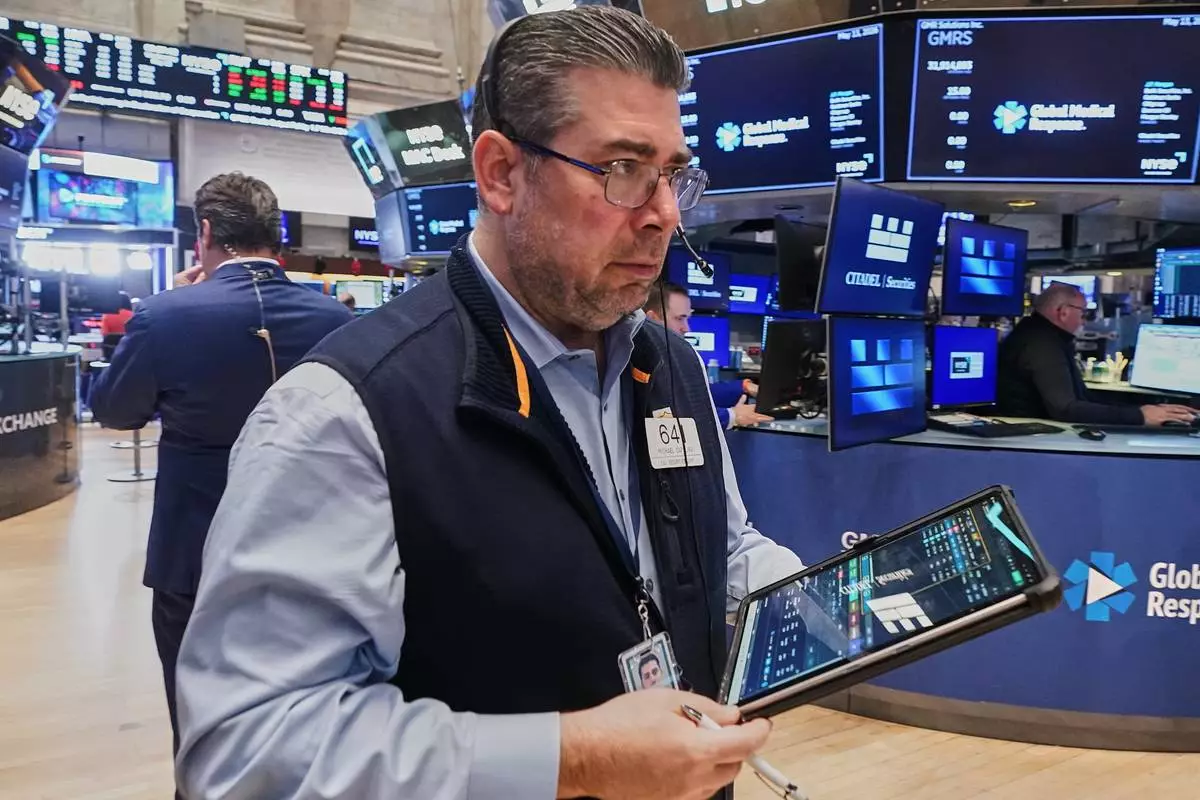
Trader Michael Capolino works on the floor of the New York Stock Exchange, Wednesday, May 13, 2026. (AP Photo/Richard Drew)
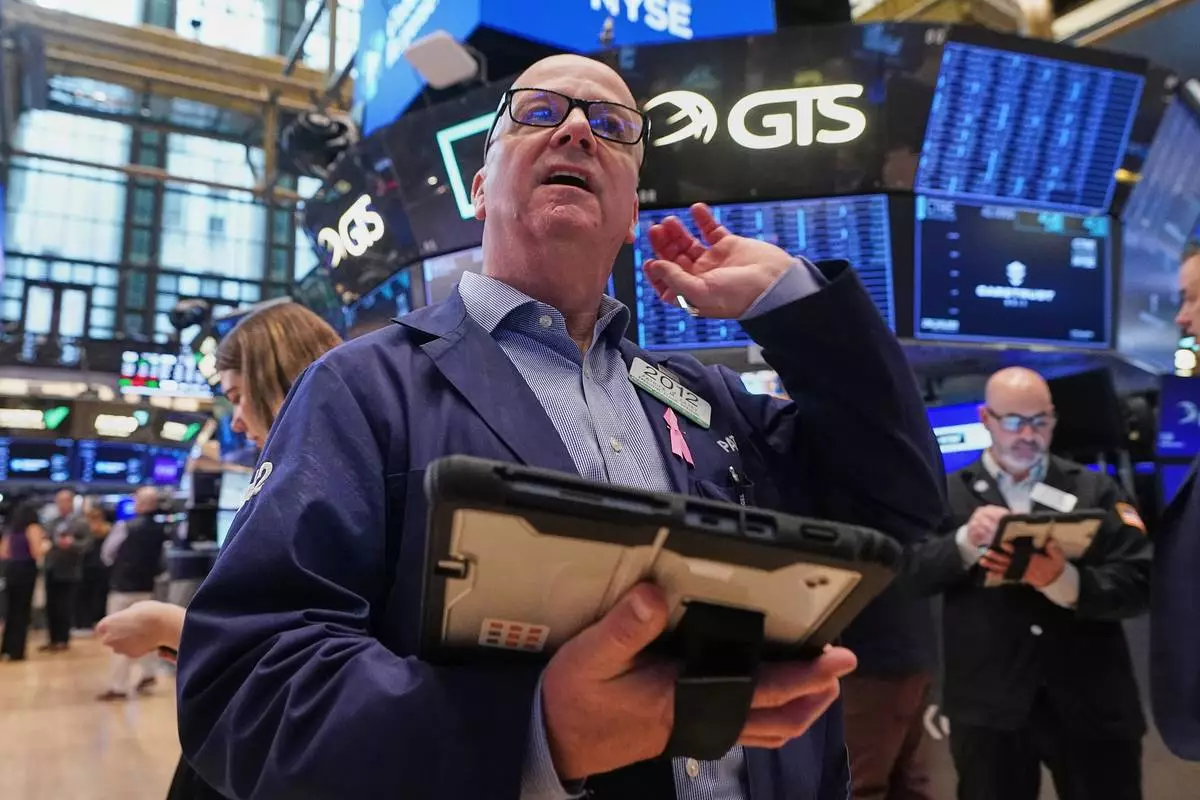
Trader Patrick Casey works on the floor of the New York Stock Exchange, Wednesday, May 13, 2026. (AP Photo/Richard Drew)
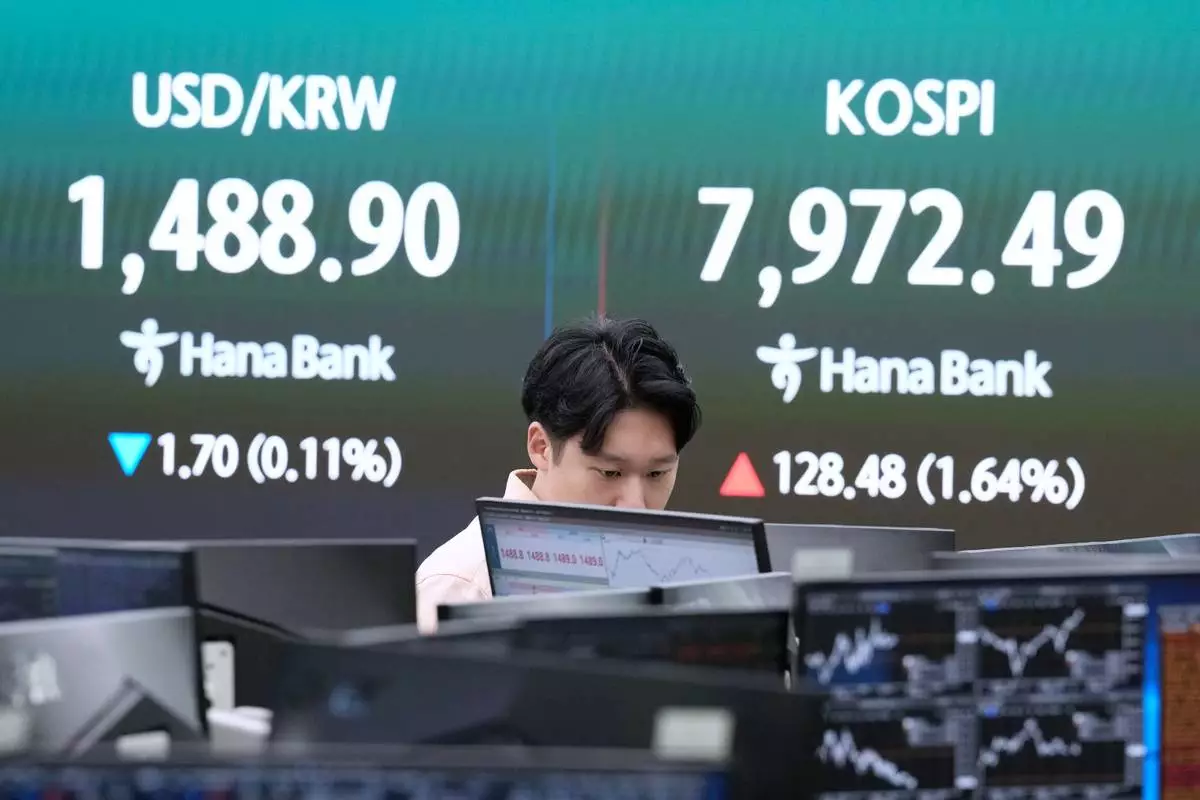
A currency trader watches monitors near a screen showing the Korea Composite Stock Price Index (KOSPI), right, and the foreign exchange rate between U.S. dollar and South Korean won at the foreign exchange dealing room of the Hana Bank headquarters in Seoul, South Korea, Thursday, May 14, 2026. (AP Photo/Ahn Young-joon)
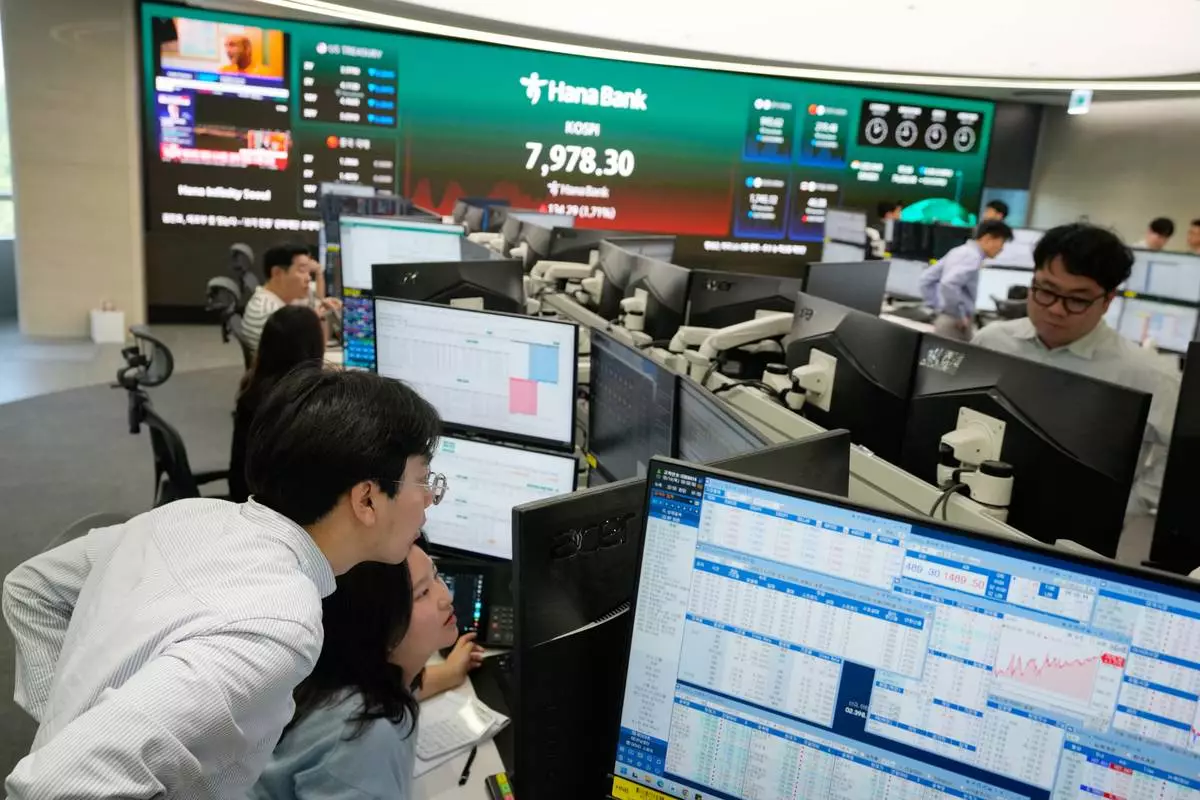
Currency traders work at the foreign exchange dealing room of the Hana Bank headquarters in Seoul, South Korea, Thursday, May 14, 2026. (AP Photo/Ahn Young-joon)
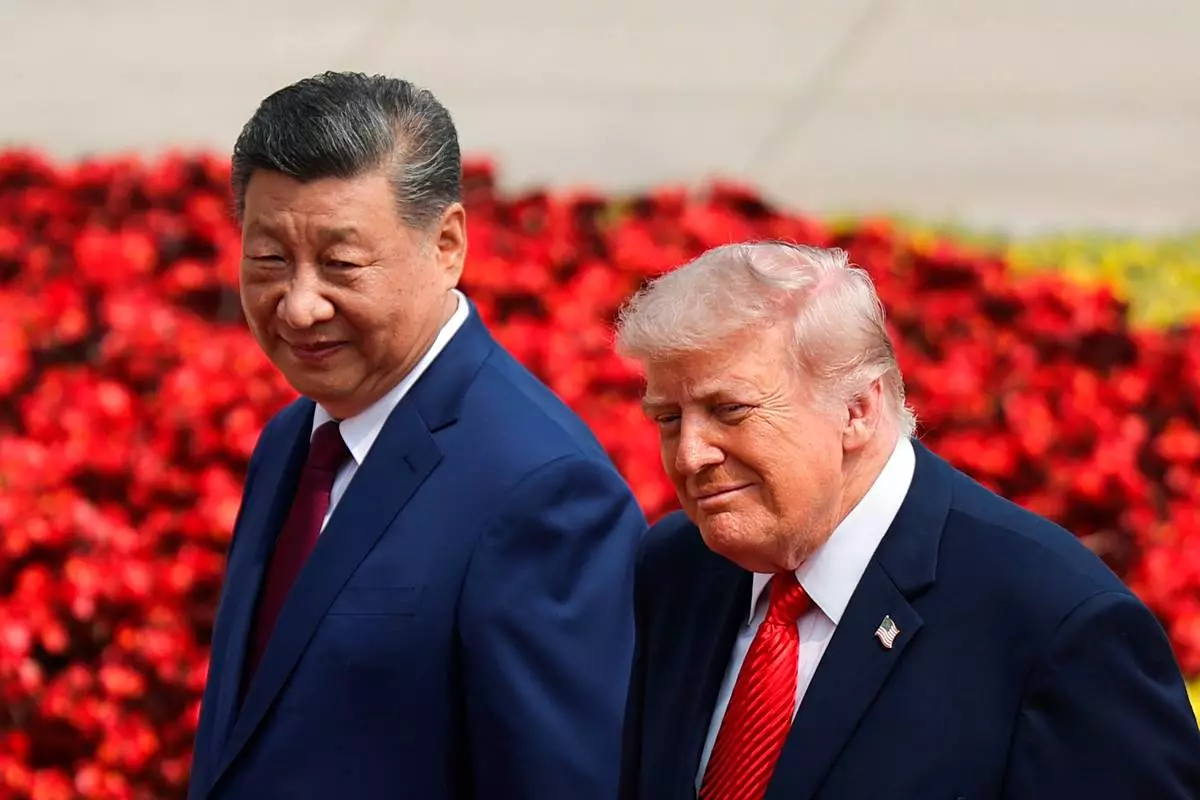
U.S. President Donald Trump, right, and Chinese President Xi Jinping attend a welcome ceremony at the Great Hall of the People in Beijing, Thursday, May 14, 2026. (Maxim Shemetov/Pool Photo via AP)
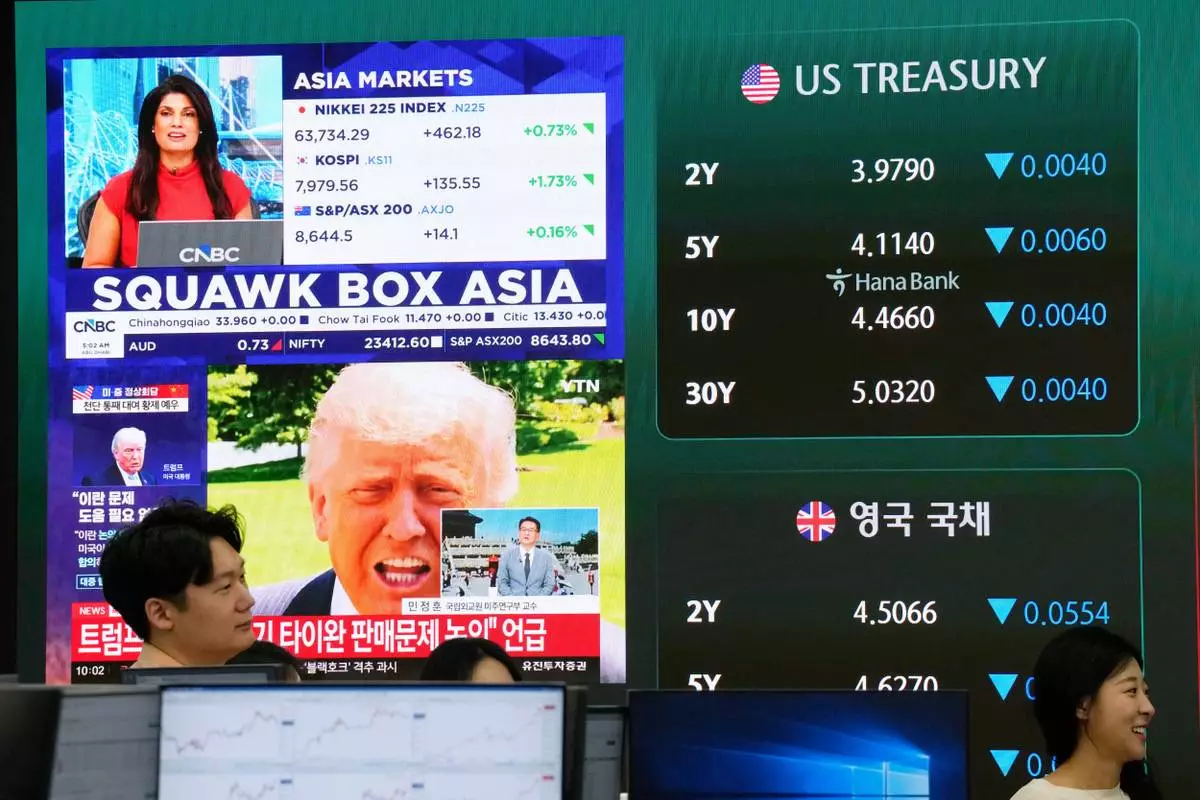
Asia markets index of Japan, South Korea and Australia is seen on a screen at the foreign exchange dealing room of the Hana Bank headquarters in Seoul, South Korea, Thursday, May 14, 2026. (AP Photo/Ahn Young-joon)