China and the United States should look to maintain regular communication and upgrade the frequency of their dialogues in order to manage competition and respect their differences while making cooperation a top priority, said a Chinese scholar.
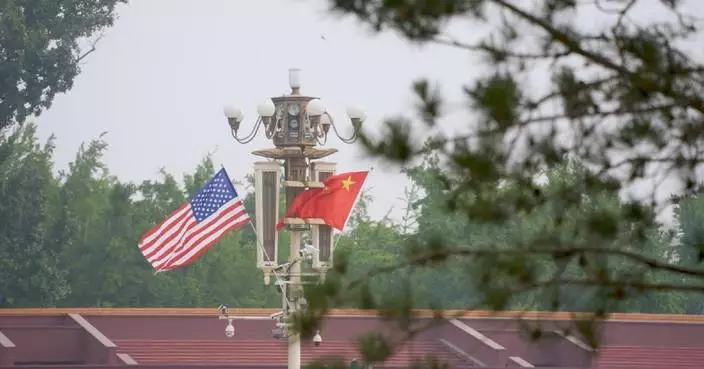
In a meeting closely watched by the world, Chinese President Xi Jinping and U.S. President Donald Trump on Thursday agreed on a new vision of building a constructive bilateral relationship of strategic stability.
It came amid Trump's three-day state visit to China at the invitation of Xi, which marked the first such U.S. presidential visit in nine years.
Yang Yue, deputy director of the Institute of Asian Studies of China Foreign Affairs University, shared her assessment of the new vision outlined by the two sides in an interview with the China Global Television Network (CGTN).
"This new positioning, I think, is a breakthrough for this summit. It normalizes managed competition, while prioritizing cooperation," Yang said.
Calling for greater bilateral cooperation in public health, climate, counter narcotics, and other fields, the professor stressed the need for China and the U.S. to establish clear guardrails for competition and carry out more frequent dialogue to reduce crisis risks.
"Not all competition is bad. But both sides need explicit red lines and no-go zones. For example, [they can] compete in technology, but never weaponize supply chains for essential medicines. Differences are permanent, that's fine. And the key is predictable crisis communication. Like, update hotlines to mandatory weekly or monthly strategic dialogues," she said.
Regarding peace, Yang called on the two countries to honor their commitments -- particularly on the one-China principle -- with concrete actions on a daily basis.
"Peace cannot be fragile. For example, on the Taiwan question, I think the maximum common denominator is stability. And durable peace requires daily discipline, and not just summit statements," Yang said.
Trump, who departed Beijing on Friday, brought along a high-level delegation of more than a dozen American business leaders from key sectors including technology, finance, aviation, and agriculture.
Cooperation should outweigh competition in China-US ties: scholar
The building of a constructive China-U.S. relationship of strategic stability will provide vast potential for cooperation in trade, technology and investment between the two countries, a Chinese scholar said on Thursday.
Wu Xinbo, executive dean of the Institute of International Studies under the Fudan University in Shanghai, said that the new vision of bilateral ties agreed on by Chinese President Xi Jinping and visiting U.S. President Donald Trump during their talks on Thursday is expected to provide strategic guidance for bilateral ties over the next three years and beyond.
Xi said the "constructive strategic stability" means positive stability with cooperation as the mainstay, sound stability with moderate competition, constant stability with manageable differences, and enduring stability with promises of peace.
"First, cooperation should be a primary aspect of China-U.S. relations, with both sides working together to expand the pie of cooperation. Second, competition between China and the U.S. is inevitable. However, this competition should be benign, not malicious. Third, differences will continue to exist between China and the U.S. in many areas. These differences cannot be resolved in the short term, but they can be well managed to prevent them from escalating into crises or even conflicts. Finally, and most importantly, China and the U.S. must maintain a peaceful relationship," said Wu. Wu also talked about on how to translate the new positioning of bilateral relations into actions, and jointly promote the stable, healthy and sustainable development of China-U.S. relations. "In the past, the U.S. addressed trade imbalances by launching unilateral tariff wars. I think tariffs will play a declining role as a bargaining chip in managing China-U.S. trade relations. The only solution to China-U.S. economic and trade problems is to expand the trade pie. Therefore, trade is the area where breakthroughs are most likely to be achieved," he said.
In the technology sector, with the advancement of Chinese technology, American companies have realized that if they ban the sales of their high-tech products to China now, they will permanently lose this market in a few years, which is detrimental to the development of the United States.
"As I said just now, insightful individuals within the United States, including business leaders, are calling on the U.S. to adjust its unreasonable and ineffective policies of suppressing and containing Chinese technology. The presence of so many tech industry leaders at this recent China-U.S. meeting demonstrates their emphasis on the Chinese market and indicates that the Trump administration values their demands," said Wu.
In the investment field, Chinese companies show willingness to invest in the United States, and American companies are also keen to expand their investment in China. Therefore, policy adjustments will unleash great potential for cooperation in major areas between them, said the expert.
Huge potential lies ahead for cooperation between China,US in trade, technology, investment: scholar