KYIV, Ukraine (AP) — Like many Ukrainians, Maryna Homeniuk fled her homeland after Russia's full-scale invasion four years ago. She managed to complete her degree in the Czech Republic, adding Vietnamese to her impressive list of languages, before returning home the following year and meeting her beloved, Yurii Orlov.
Homeniuk and Orlov, who captained the Kyiv Floorball Club after playing hockey for teams in the Ukrainian capital, were among the 24 people killed Thursday during a terrifying wave of Russian airstrikes that Ukrainian military officials described as the biggest barrage of the war. A cruise missile flattened their apartment building.
On Saturday, friends and family paid their final respects to Homeniuk, a 24-year-old English teacher. They had hoped to pay tribute to Orlov, too, but his body wasn't ready for burial yet.
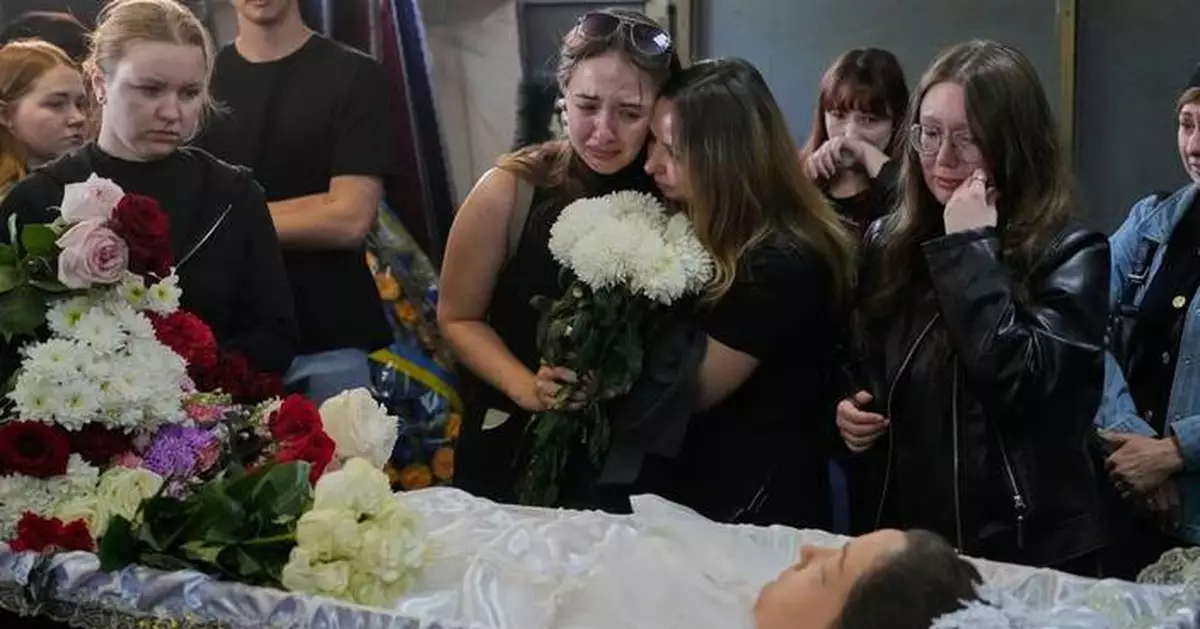
“She was a very caring person. I feel very sorry, because she had so many dreams. She worked with children and wanted to have children herself someday, when times were safer,” her friend Olesia Yukhnovych told The Associated Press.
The couple met on a dating app after Homeniuk returned to Ukraine in 2023 from the Czech Republic, where she studied Vietnamese. Friends say she spoke about 10 languages, including fluent Korean and Chinese.
A sensitive soul, she took in abandoned animals, friends said. She also loved seeing the world and would save up for adventures in new countries.
“This is a young person. This is a girl who had absolutely the whole future ahead of her,” said Anastasiia Petrushyna, a friend and colleague. “This future will no longer exist — our youth basically can’t have it. You never know what trouble awaits you.”
Friends said they were glad Homeniuk met Orlov, who was 30 years old when they died. Despite their differences — he loved sports and she loved art — it was obvious to everyone that they cared deeply for one another.
Homeniuk went to every one of his games on Sundays, it was their tradition. He taught her how to play floorball, a version of floor hockey, and she taught him how to speak English.
“It’s a shame. I should have been helping prepare for the wedding and I ended up helping prepare for the funeral,” said Yukhnovych. “It’s horrible.”
Their deaths followed a very difficult winter of relentless Russian attacks on Kyiv. Yukhnovych said they often spoke about wanting to relocate from their neighborhood, Darnytsia, in Kyiv’s left bank, where power cuts were restored later than in other parts of the city, but couldn't afford to do so.
Yukhnovych said she texted Homeniuk after Thursday's attack but got no reply.
“You never think something could happen to someone close to you, and you just message them as a precaution,” she said. “I never thought this would be one of those times when the message would remain unread.”
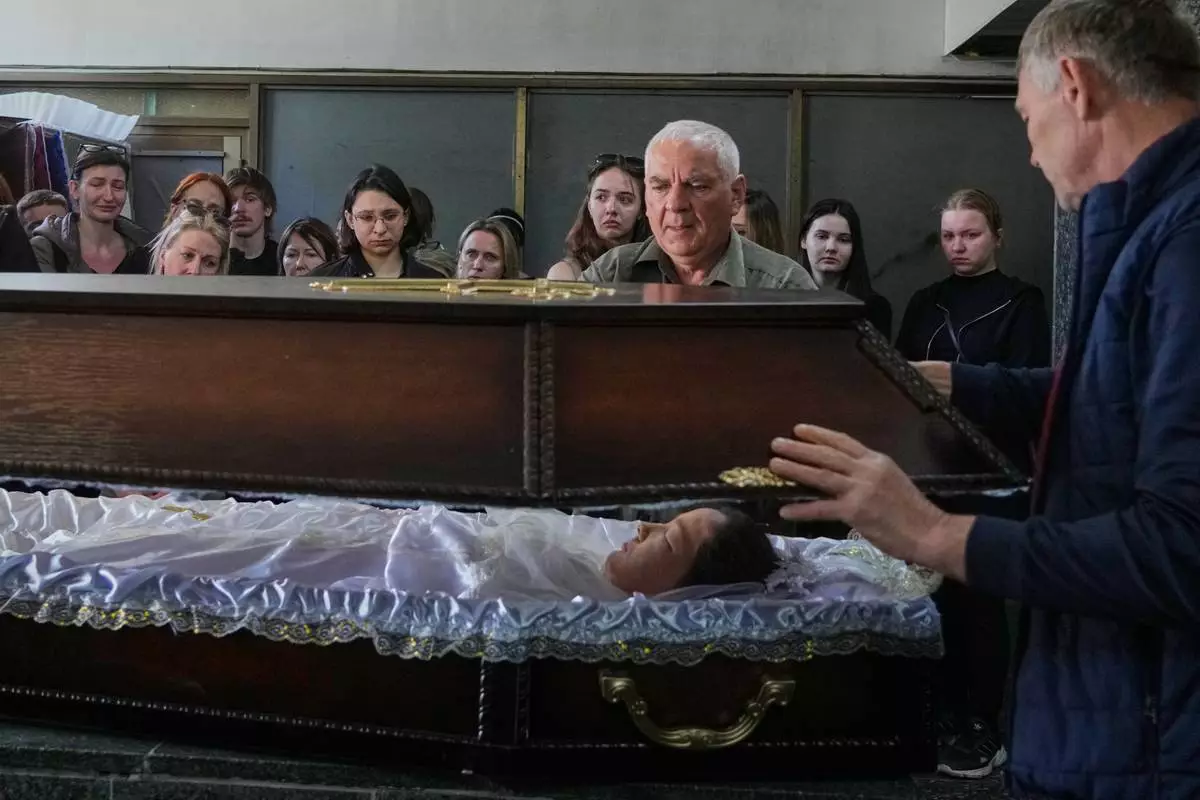
Morgue assistants close the coffin lid during the farewell ceremony for Maryna Homeniuk, a 24-year old English teacher who was killed when Russian missile hit an apartment building, killing 24 during Thursday massive missile attack, in Kyiv, Ukraine, Saturday, May 16, 2026. (AP Photo/Efrem Lukatsky)
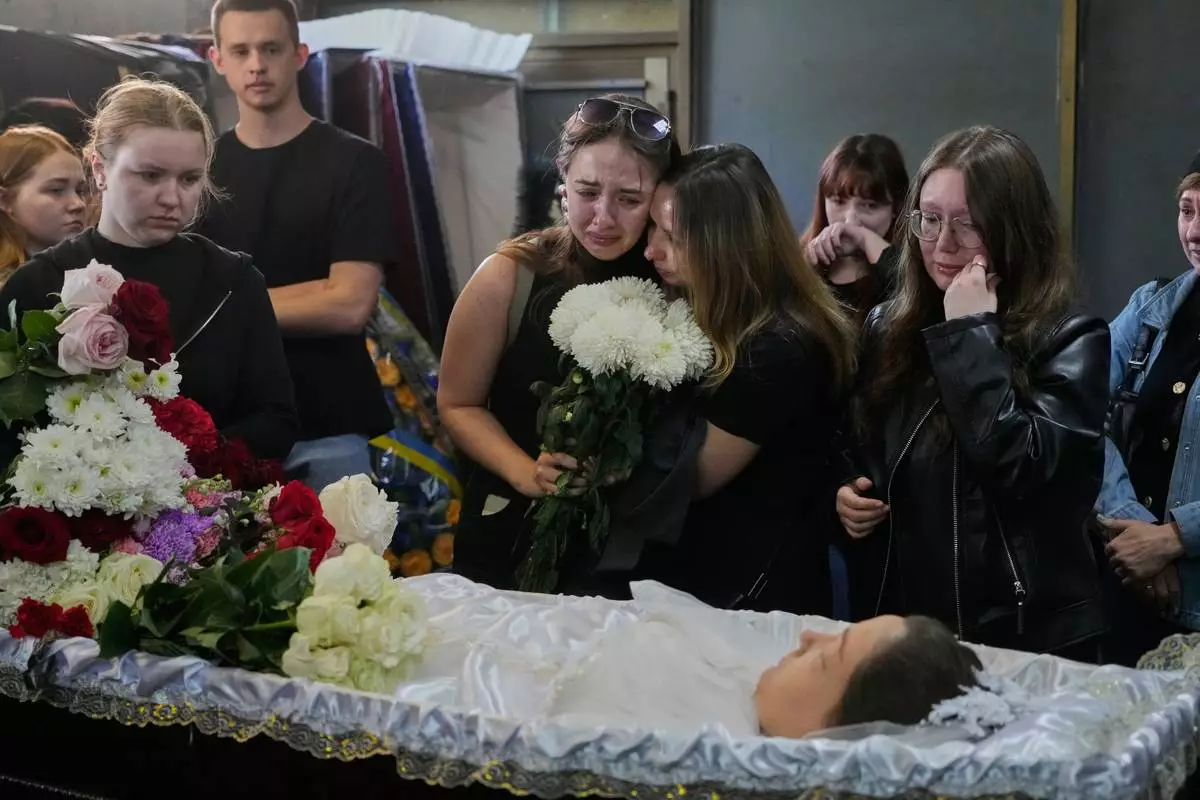
Friends mourn over the coffin of Maryna Homeniuk, a 24-year old English teacher who was killed when Russian missile hit an apartment building killing 24, in Thursday massive missile attack, during farewell ceremony in Kyiv, Ukraine, Saturday, May 16, 2026. (AP Photo/Efrem Lukatsky)
ROME (AP) — The researchers in Ireland looked at their computer screen, marveling at a medieval book tracked down in a Roman library. They flipped through its digitized pages and found their sought-after treasure: the oldest surviving English poem.
“We were extremely surprised. We were speechless. We couldn’t believe our eyes when we first saw that,” Elisabetta Magnanti, a visiting research fellow at Trinity College Dublin's school of English, told The Associated Press.
What's more, she said, the poem was within the main body of Latin text: "It was extraordinary.”
Composed in Old English by a Northumbrian agricultural worker in the 7th century, "Caedmon’s Hymn" appears within some copies of the “Ecclesiastical History of the English People,” written in Latin by a monk and saint known as the Venerable Bede. His history is one of the most widely reproduced texts from the Middle Ages, with almost 200 manuscripts, according to Magnanti's colleague Mark Faulkner, an associate professor of medieval literature at Trinity.
He considers Caedmon’s poem to be the start of English literature.
The manuscript he and Magnanti found is one of the oldest, dating from the 9th century. Two earlier copies contain the poem in Old English, but as afterthoughts — translated from Latin and scrawled into the margin by later scribes or appended but not within the text's main body, according to the researchers.
The discovery sheds light on the English language's wide diffusion, long before what was previously understood, Faulkner said in Rome, where the duo had traveled to view the text in person for the first time.
“Prior to the discovery of the Rome manuscript, the earliest one was from the early 12th century. So this is three centuries earlier than that. And so it attests to the importance that was already being attached to the English in the early 9th century,” Faulkner said.
And it's something of a miracle they uncovered it at all.
Caedmon is said to have composed the poem while working at Whitby Abbey in North Yorkshire, after guests at a feast began reciting poems, Faulkner said.
“Embarrassed that he didn’t know anything suitable, Caedmon left the feast and went to bed," he said. "A figure then appeared to him in his dreams telling him to sing about creation, which Caedmon miraculously did, producing the nine-line hymn."
Some 1,400 years later, this copy of his poem resurfaced in Rome’s main public library — but not before crossing the Atlantic Ocean at least twice and changing hands even more times.
Monks transcribed this copy of Bede's history in the scriptorium of the Benedictine abbey of Nonantola, one of the most important transcription centers during the Middle Ages, located near modern-day Modena in northern Italy, according to Valentina Longo, curator of medieval and modern manuscripts at Rome's National Central Library.
In the 17th century, as the abbey's importance declined, its vast collection of manuscripts was shifted to another abbey in Rome, then moved to the Vatican and finally on to a small church.
Along the way, some of the texts went missing, only to emerge in the early 19th century in the possession of famous international collectors, Longo said.
This copy of Bede's history went to renowned English antiquarian Thomas Phillipps. He fell on hard times, selling off bits and pieces of his collection, and Swiss bibliophile Martin Bodmer secured the book. From there, somehow, it arrived in New York City, in the trove of Austrian-born rare bookseller H.P. Kraus during the 20th century.
Italy's culture ministry was scouring the world for the Nonantola abbey's missing manuscripts, snapping them up in auctions and from collectors around the world. It bought the copy of Bede's history from Kraus in 1972, Longo said, and since then the illustrious text has remained in Rome's library — but received scant notice.
Enter Magnanti, who had spent over four years studying Bede’s history and was compiling a catalog of extant copies.
“I knew that the book was listed in the library’s catalog, so I was almost certain that the book was, in fact, still here," she said. “I realized that, because of the very complex history of this book, no big scholar had really looked at it. So it had been virtually unstudied."
She emailed the library, which confirmed the book was in its stacks. Three months later, she received digital images of the entire manuscript.
The library has digitized the entire Nonantolan collection and it is freely accessible through the website, Longo said.
It's part of a massive project by the library to make thousands of rare books and manuscripts available to researchers around the world, according to Andrea Cappa, the library's head of manuscripts and the rare books reading room.
“The discovery made by the experts of Trinity College is just one starting point, a single manuscript that might pave the way for countless other discoveries, in countless other fields, through international cooperation like this,” Cappa said.
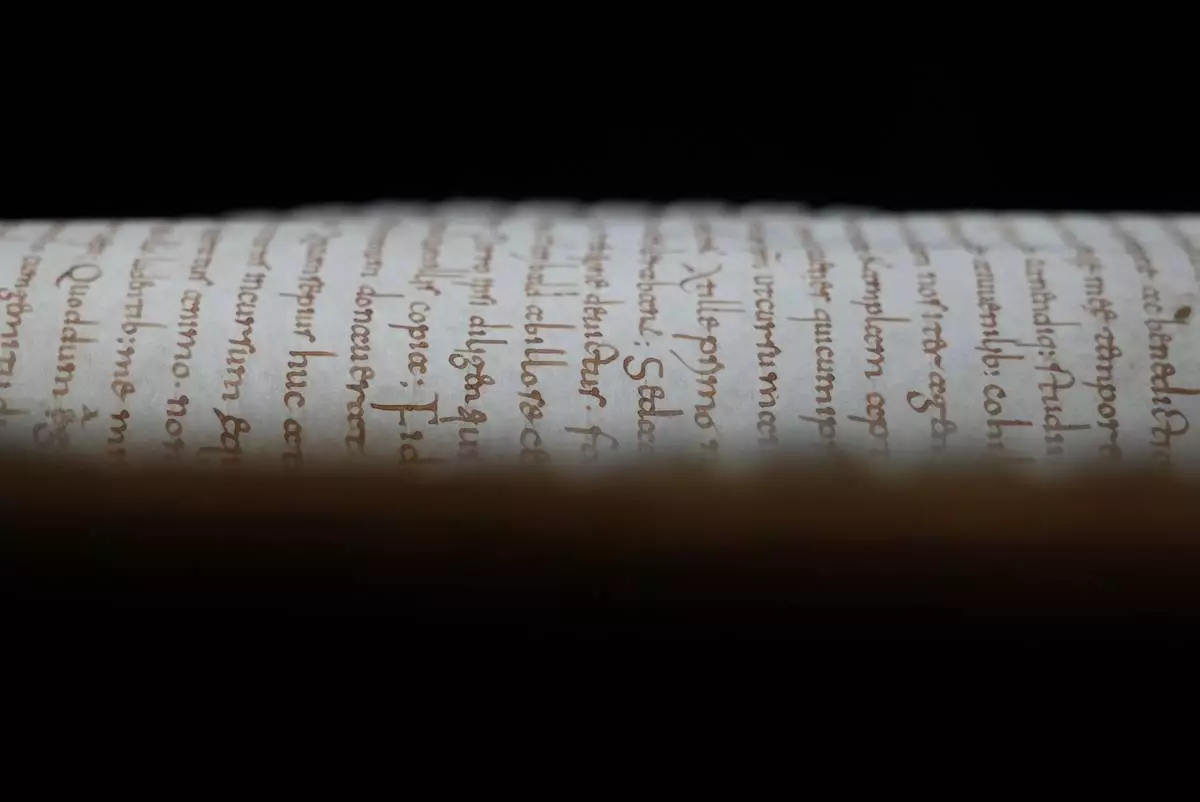
The 8th-century manuscript copy of the Venerable Bede's Ecclesiastical History of the English People, containing a rare, long-lost copy of Caedmon's Hymn — the first poem ever written down in Old English — is seen at Rome's National Library, Thursday, May 8, 2026. (AP Photo/Andrea Rosa)
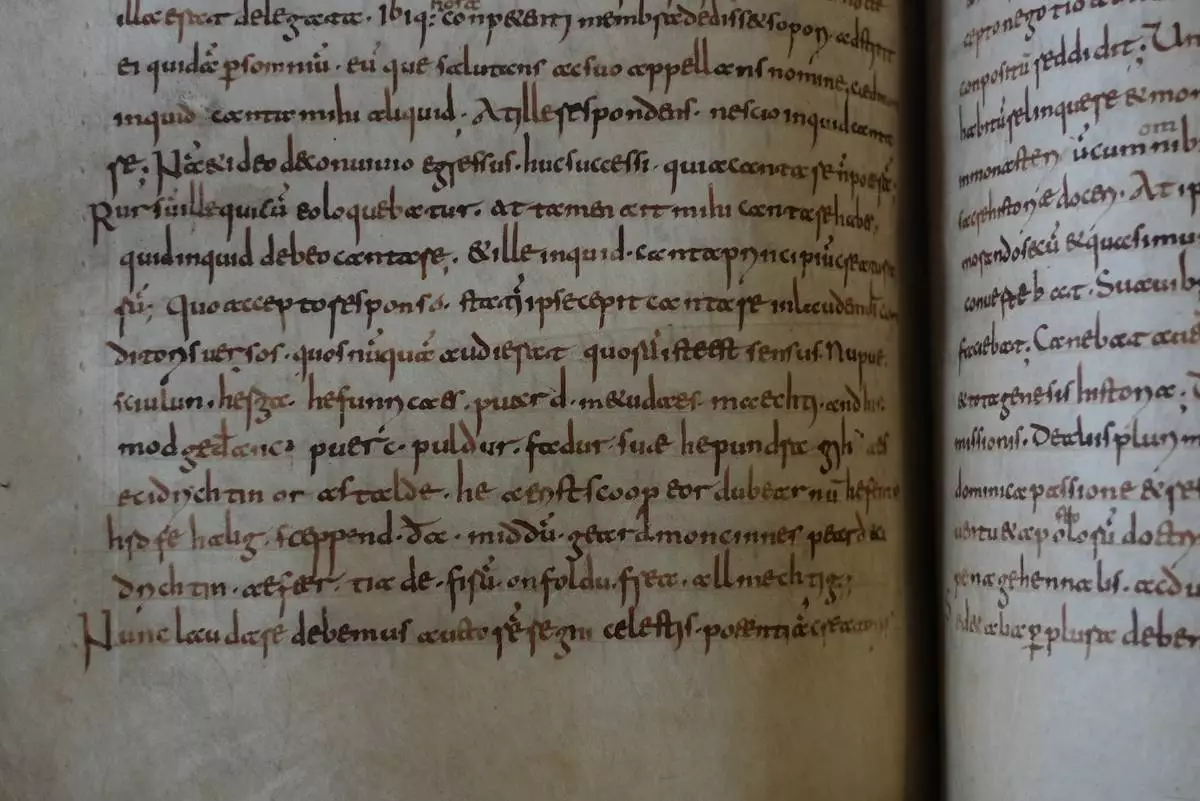
A rare, long-lost copy of Caedmon's Hymn — the first poem ever written down in Old English — is visible in the five lines above the final line of a page from an 8th-century manuscript copy of the Venerable Bede's Ecclesiastical History of the English People, at Rome's National Library, Thursday, May 8, 2026. (AP Photo/Andrea Rosa)
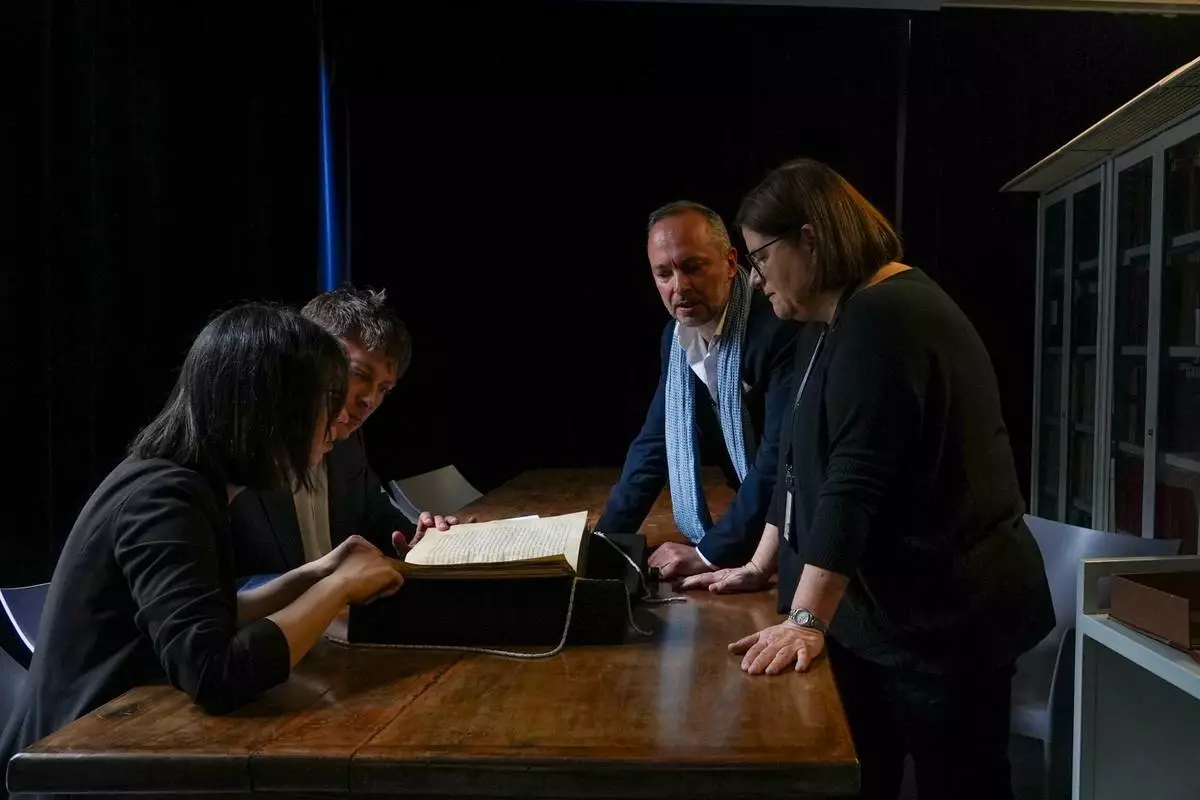
From left, Elisabetta Magnanti, Mark Faulkner of Dublin's Trinity College, Andrea Cappa and Valentina Longo of Rome's National Central Library examine a manuscript containing a rare, long-lost copy of Caedmon's Hymn — the first poem ever written down in Old English — at Rome's National Library, Thursday, May 8, 2026. (AP Photo/Andrea Rosa)
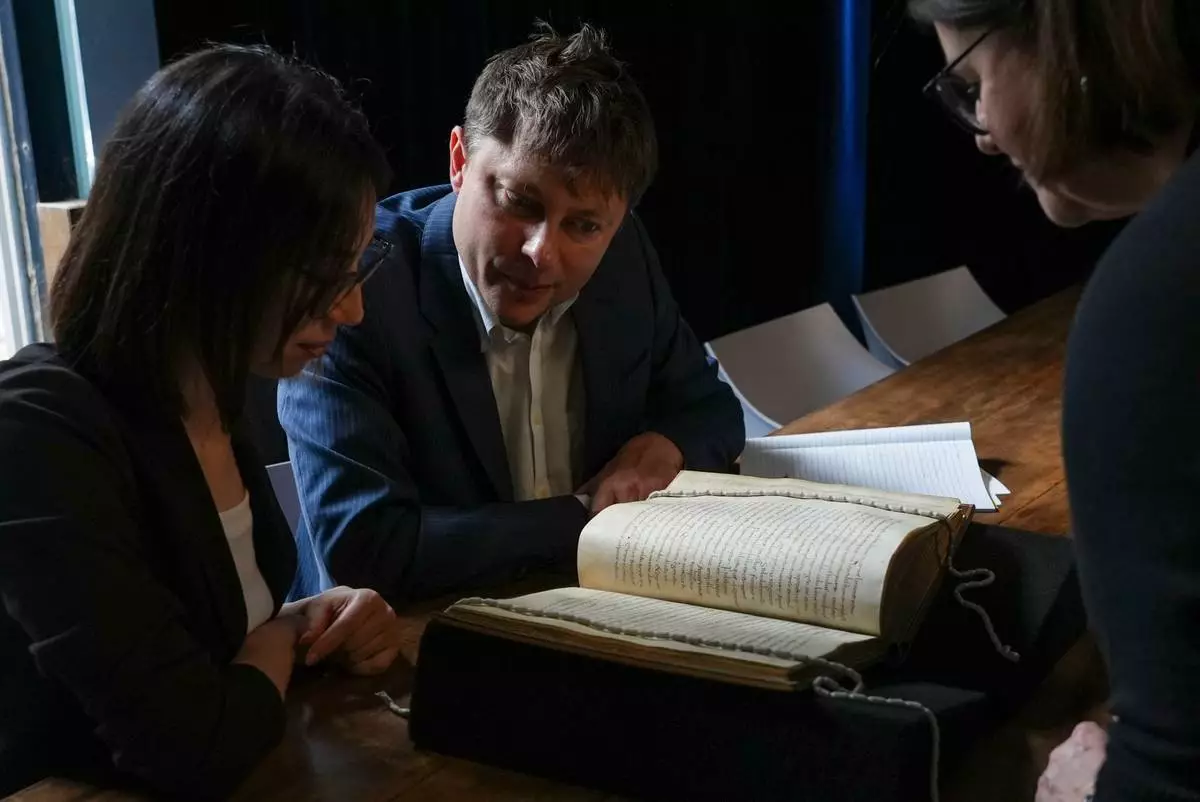
From left, Elisabetta Magnanti and Mark Faulkner from Dublin's Trinity College and Valentina Longo of Rome's National Central Library look at a manuscript containing a rare, long-lost copy of Caedmon's Hymn, the first poem ever to be written down in Old English, at Rome's National Library, Thursday, May 8, 2026. (AP Photo/Andrea Rosa)
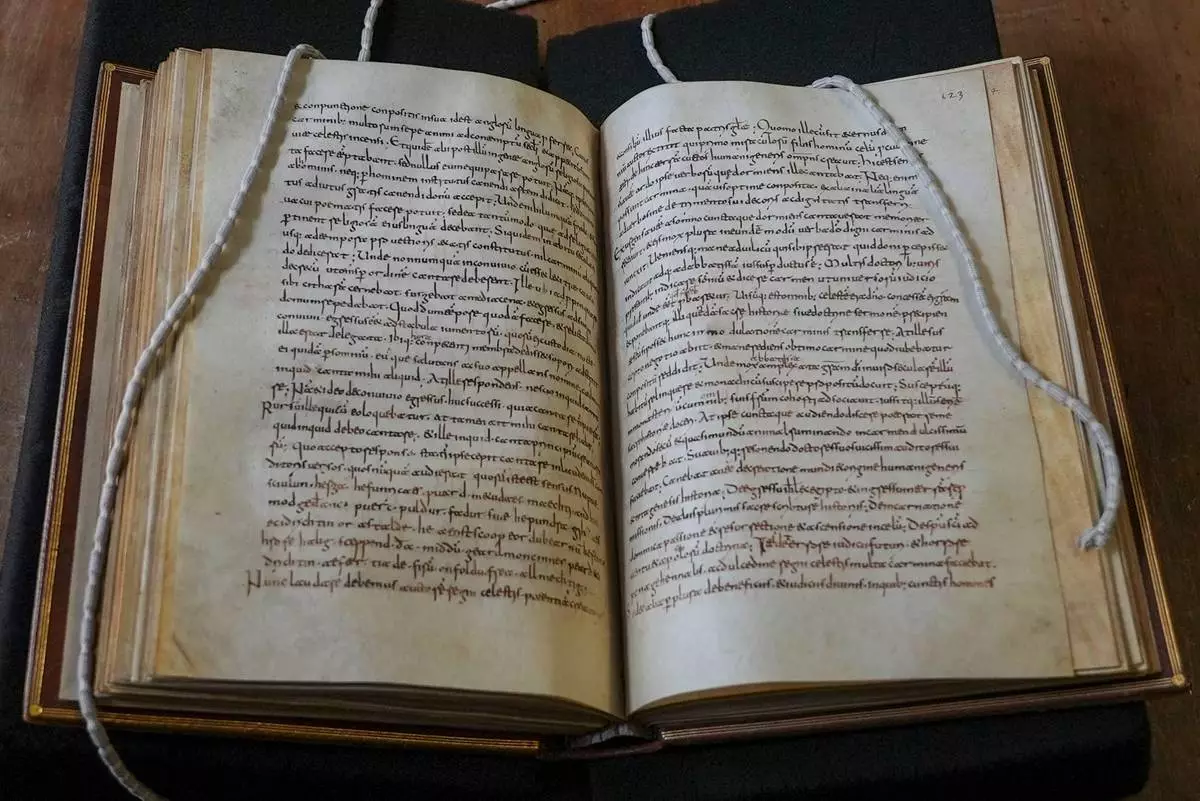
A rare, long-lost copy of Caedmon's Hymn — the first poem ever written down in Old English — is visible in the five lines above the final line of the left page from an 8th-century manuscript copy of the Venerable Bede's Ecclesiastical History of the English People, at Rome's National Library, Thursday, May 8, 2026. (AP Photo/Andrea Rosa)null