Skip to Content Facebook Feature Image

Researchers work to reverse population decline of Humboldt penguins

HotTV

HotTV

HotTV

Researchers work to reverse population decline of Humboldt penguins

2026-05-17 17:08 Last Updated At:05-18 14:44

Scientists in Peru and Chile are racing to reverse the sharp decline of Humboldt Penguins, a warm-climate species uniquely adapted to the Pacific coast, as climate change and avian influenza threaten its survival.

Peru and Chile are home to the Humboldt penguin, named after the cold water current which flows from Antarctica up the Pacific coast of both countries. It is one of the very few penguin species in the world that lives in a warm climate. Scientists call them a sentinel species -- thermometers of the overall health of the ecosystem.

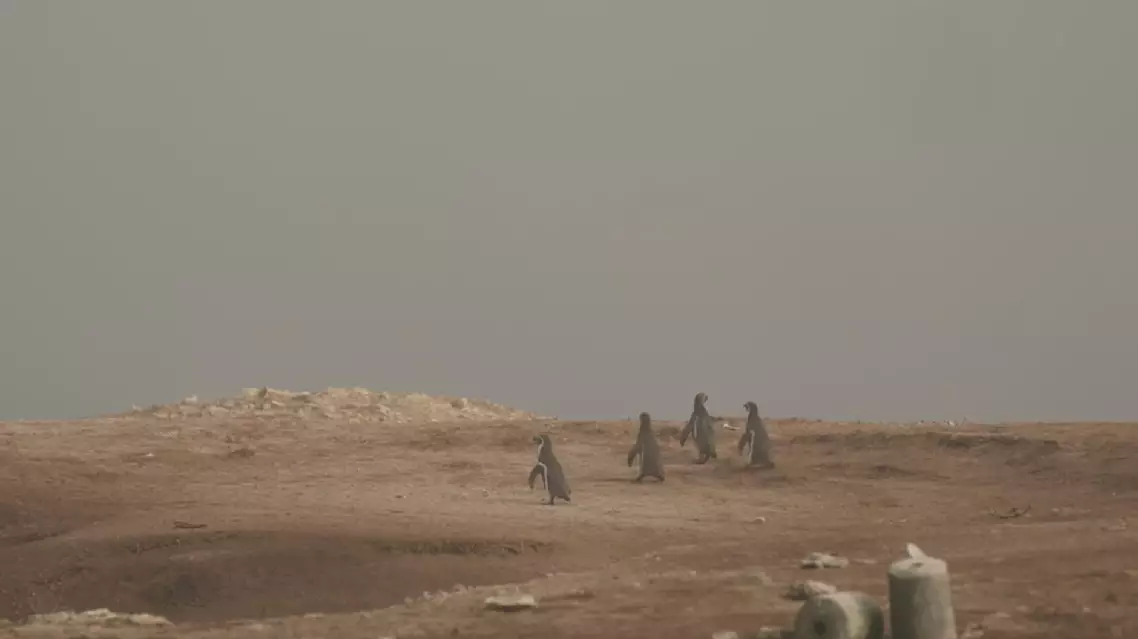
The penguins nest in Punta San Juan, a small national reserve in southern Peru. They are one species among many marine predators that rest and reproduce here in huge numbers. Biologist Susana Cardenas leads a team that is monitoring and researching these animals and birds. What the researchers have seen in recent years is a dramatic population decline in all species, but particularly penguins, and they are trying to find out why.

"In the last few years, we've seen a decline in the Humboldt penguin population. So, we can go back to 2022 in Punta San Juan, there were about 2,500 Penguins -- that was the size of our colony. And then, well, we had avian influenza that has hit wildlife really hard in Peru and in different places of the world," said Cardenas.

But the impacts didn't stop there for the penguins, which are classed as having vulnerable conservation status, Cardenas explained.

"After that, unfortunately, an El Nino in March of 2023 started and the marine conditions changed and the food availability was not the same. And the penguins, they were getting ready for their breeding season and that's when the marine conditions changed and they did not come back to breed," she said.

In Punta San Juan, penguin numbers dropped from 2,500 to 400 just as Peru's population plummeted from 15,600 to 5,000 all across the birds' range in Peru and Chile, according to Cardenas. That's why continuous data collection is key to maintain the decades of research.

Interns like Sandra Alcantara keep a daily count of the number of nesting penguins and chicks.

"I come here at 6 a.m. to conduct a penguin census. I count all the penguins in a specific age group: adults, juveniles, fledglings, and chicks. Right now, we're in the breeding season, so most of them are adults. So far, I've only seen two juveniles. As the weeks go by, I'll be able to see chicks and then, later on, fledglings," said Alcantara.

The penguins naturally make burrows in the guano, sea bird droppings which build up over decades. Field coordinator Kevin Farfan checks to see if there are any birds in the burrows.

"We are now observing in real time a gradual increase in the number of adult individuals resulting from successful reproduction -- a rise that is slow but steady -- and that gives us great cause for celebration," he said.

These animal populations, while apparently abundant in Punta San Juan, are also highly sensitive to change. Without the tireless dedication of these scientists and volunteers, Peru and the world could lose one of its iconic birds.
Researchers work to reverse population decline of Humboldt penguins


Researchers work to reverse population decline of Humboldt penguins

A number of university students in the U.S. capital have shared their views on China's initiative to invite 100,000 young Americans to visit the country for exchanges and study over the next five years.

The program was announced by Chinese President Xi Jinping when addressing a welcome ceremony at the White House during his visit to the United States from Wednesday to Friday.

Many of the students interviewed expressed their hope to visit some well-known places in China like Beijing, Shanghai and Guangdong.

"My dad's been to China for work, and he really loves it, so I'd love to go sometime. Maybe Shanghai. That's where my dad went, and he really liked it there," said a student.

"I've heard of Guangdong. I've heard of the basketball team," another student said.

Many of the students agreed that allowing more young Americans to experience Chinese culture in person would be beneficial for both countries.

"I think that's really cool to have the opportunity to connect with those cultures. And I really do like that idea. I think it's a great idea to invite us to China. It's great," said a student.

"I feel like the culture. I feel like getting the opportunity to immerse yourself in different cultures is really important," said another student.

"There's definitely value in traveling to other places and learning other cultures. So I think that it can be beneficial," said another one.

Even beyond cultural exchange, the students expressed their beliefs that American youth could learn a lot from Chinese society.

"I think, for me personally, it's the scale, with how many people live in China. I would definitely be interested in seeing how that functions, especially in those larger cities," said a student.

"I think I would like to know what their people are like. What are their thoughts on the world? On what the world should be like?" one student said.

"I think China's amazing. They're so far ahead. We're supposed to be the Western world, but I feel like they're so much more advanced than us in so many ways. I know AI and medicine are big things right now, and I think China has made huge advancements in that. So probably that," said a student.

The students also hope that the program will help strengthen China-U.S. relationship, promote educational exchanges, and broaden the horizons of those who take part.

"It's better for both countries to be connected and to build a better relationship over the coming years. And I think that's important to global peace and prosperity," said a student.

"I think it's really a great thing. I think different cultures, combining different cultures, and education is such a global thing, and having different students come all over the place and take classes here and there," said another student.

"There's a lot more to this world than what's right in front of us. And there's a lot to learn from different ways of seeing things around the world. So I think it could be valuable from that standpoint," a student said.

US students share views on China's plan to invite 100,000 young people for study, exchange

US students share views on China's plan to invite 100,000 young people for study, exchange

Recommended Articles