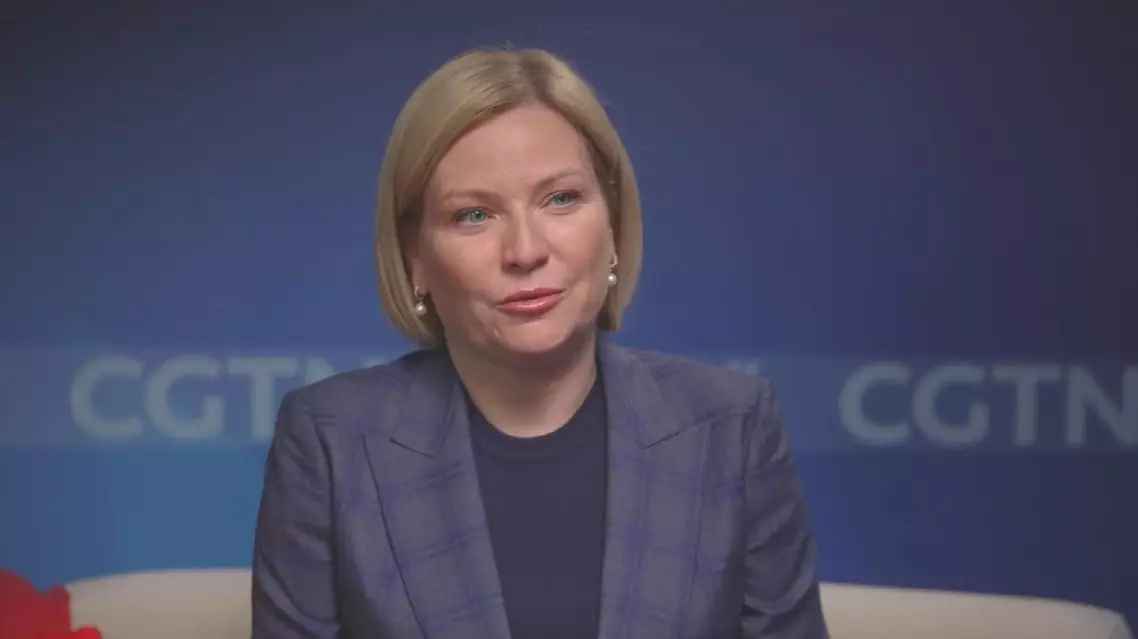
China and Russia are set to further strengthen cooperation in the film industry, with both sides believing the prospects for collaboration are broad, Russian Minister of Culture Olga Lyubimova noted.
In a recent interview with China Media Group (CMG), Lyubimova said that the two countries have signed an important strategic document on film cooperation through 2030.
"It is very important that our departments have signed a significant strategic document on joint cooperation in the field of cinematography through 2030. You know that China has the world's largest film industry, with its 120,000 screens. This is an absolutely incredible scale, and an incredible number of viewers who visit cinemas every year with great pleasure," Lyubimova said.
"In Russia, Russian producers strive for the honor of obtaining China's 'dragon seal' -- a distribution certificate and the opportunity to release Russian films in China. And we are very glad that Russian films can receive the 'dragon seal.' I think it is a mark of quality for any films, no matter which country it comes from," she added.
In order to be released in China, films must obtain a longbiao, or "dragon seal" from the China Film Administration.
China and Russia signed an action plan on film co-production through 2030 last year, under which the two sides have already carried out exchanges.
China, Russia eye expanded cooperation in film industry: Russian culture minister

U.S. stocks closed mixed on Monday as a sharp sell-off in semiconductor equities dragged down the technology sector, while investors digested new U.S. economic sanctions announced against Iran and fresh trade tariff warnings targeting Canada.
The Dow Jones Industrial Average rose 140.15 points, or 0.26 percent, to 53,417.16. The S and P 500 sank 21.51 points, or 0.28 percent, to 7,652.86. The Nasdaq Composite Index shed 200.264 points, or 0.77 percent, to 25,980.19.
Eight of the 11 primary S and P 500 sectors ended in the green, with consumer staples and financials leading the gainers by going up 1.76 percent and 1.24 percent, respectively. Meanwhile, technology and energy led the laggards by losing 1.59 percent and 0.76 percent, respectively.
The tech sector's pullback stemmed from broad weakness across chipmakers. Memory and semiconductor shares came under heavy pressure following weekend reports that graphics processor leader Nvidia plans to implement price hikes across select AI server configurations. SanDisk, Western Digital, SK Hynix, Micron Technology and Seagate Technology all finished lower.
Geopolitical developments dominated macroeconomic headlines as U.S. Treasury Secretary Scott Bessent on Monday threatened Iran with "an economic D-Day," announcing a wave of new sanctions aimed at further isolating the country.
On the trade front, U.S. President Donald Trump escalated trade frictions with Canada, announcing intentions to raise tariffs on Canadian cars, automotive parts and steel to 50 percent effective Jan. 1, 2027. The announcement weighed on domestic automotive equities, pulling shares of General Motors and Ford lower.
In corporate earnings disclosures, U.S.-listed shares of Chinese e-commerce firm PDD and electric vehicle maker XPeng declined 1.48 percent and 8.53 percent, respectively, following their latest quarterly financial reports.
Market attention is now converging on two critical catalysts later this week: Nvidia's highly anticipated second-quarter earnings release on Wednesday, expected to serve as a vital referendum on the ongoing AI investment cycle, and Federal Reserve Chair Kevin Warsh's scheduled address at the central bank's annual Jackson Hole Economic Policy Symposium.
U.S. stocks close mixed as chip stocks sink