LEHI, Utah--(BUSINESS WIRE)--May 18, 2026--
Sirion, the global leader in AI-native contract lifecycle management (CLM), in collaboration with World Commerce & Contracting (WorldCC), today released a new research report titled: Trusted Contract Data: From Repository to System of Record (SOR).
This press release features multimedia. View the full release here: https://www.businesswire.com/news/home/20260518870836/en/
As enterprises accelerate AI adoption, the findings reveal a growing divide between organizations that merely store contracts and those that can trust, operationalize and act on contract data across the enterprise. The report* comprises responses and insights from more than 170 enterprises worldwide, including legal, procurement, and IT leaders.
The research suggests that many enterprise AI initiatives may be constrained not by model capability, but by fragmented and untrusted contract data foundations.
“GenAI is exposing a hard truth across enterprises: AI is only as reliable as the underlying data foundation,” said Ajay Agrawal, Co-Founder and CEO, Sirion. “Most organizations still manage contracts as disconnected documents spread across repositories, shared drives, and siloed systems. That model breaks down in an AI-driven enterprise. Contracting now requires a trusted System of Record that can transform legal language into structured, connected, operational data. Without that foundation, AI cannot reliably drive decisions, automation, or enterprise-scale execution.”
While most organizations now have a place to store executed contracts, the report highlights a more important gap: far fewer have established a true contract SOR, capable of capturing what was agreed to, where it applies, what obligations and entitlements follow, and whether the business can confidently act on that information.
“Change management remains the most under-considered element in contracting transformation, yet it is often the determining factor between success and failure,” noted Leandro Doca, VP, Head of CCM for Americas at Capgemini, in the survey.
Key Findings from the Survey:
“This report is a warning against mistaking storage for control,” said Sally Guyer, CEO, WorldCC. “Organizations may have digitized their contract archives, but that does not mean they have trusted contract data. In today’s market, organizations need to know what was agreed, what has changed, what action is required, and whether the business can rely on that information. Trusted contract data is now the foundation for better execution. The organizations that move forward will be those that clean up their data, connect their systems, widen access, and define clear ownership. They will not rely on AI to fix weak foundations. They will use AI to amplify strong ones.”
The report also highlights the operational consequences of disconnected contract data. Without a trusted and connected SOR, enterprises remain dependent on manual interpretation, fragmented repositories, and institutional knowledge. The result is slower decision-making, weaker visibility into obligations and entitlements, higher value leakage, and lower confidence in AI-generated outputs.
Trusted contract data: From Repository to System of Record is now available from Sirion and WorldCC. Download the report here.
*The survey was conducted between 13 February and 10 April 2026 with 170 respondents.
About WorldCC
World Commerce & Contracting (WorldCC) is a global non-profit association dedicated to improving trading relationships and commercial effectiveness. With more than 80,000 members worldwide, WorldCC provides research, standards, training, and resources that enable organizations to achieve better commercial and contracting outcomes.
About Sirion
Sirion is the world’s leading AI-native CLM platform, pioneering the application of agentic AI to help enterprises transform the way they store, create, and manage contracts.
The platform’s extraction, conversational experience, and AI-enhanced negotiation capabilities have revolutionized contracting across enterprise teams–from legal and procurement to sales and finance. The world’s most valuable brands trust Sirion to manage 7M+ contracts worth nearly $800B and relationships with 1M+ suppliers and customers in 100+ languages. Leading analysts such as Gartner, IDC, and Spend Matters have consistently recognized Sirion as a leader in CLM for its focus on category-leading innovation. For more information, visit www.sirion.ai.
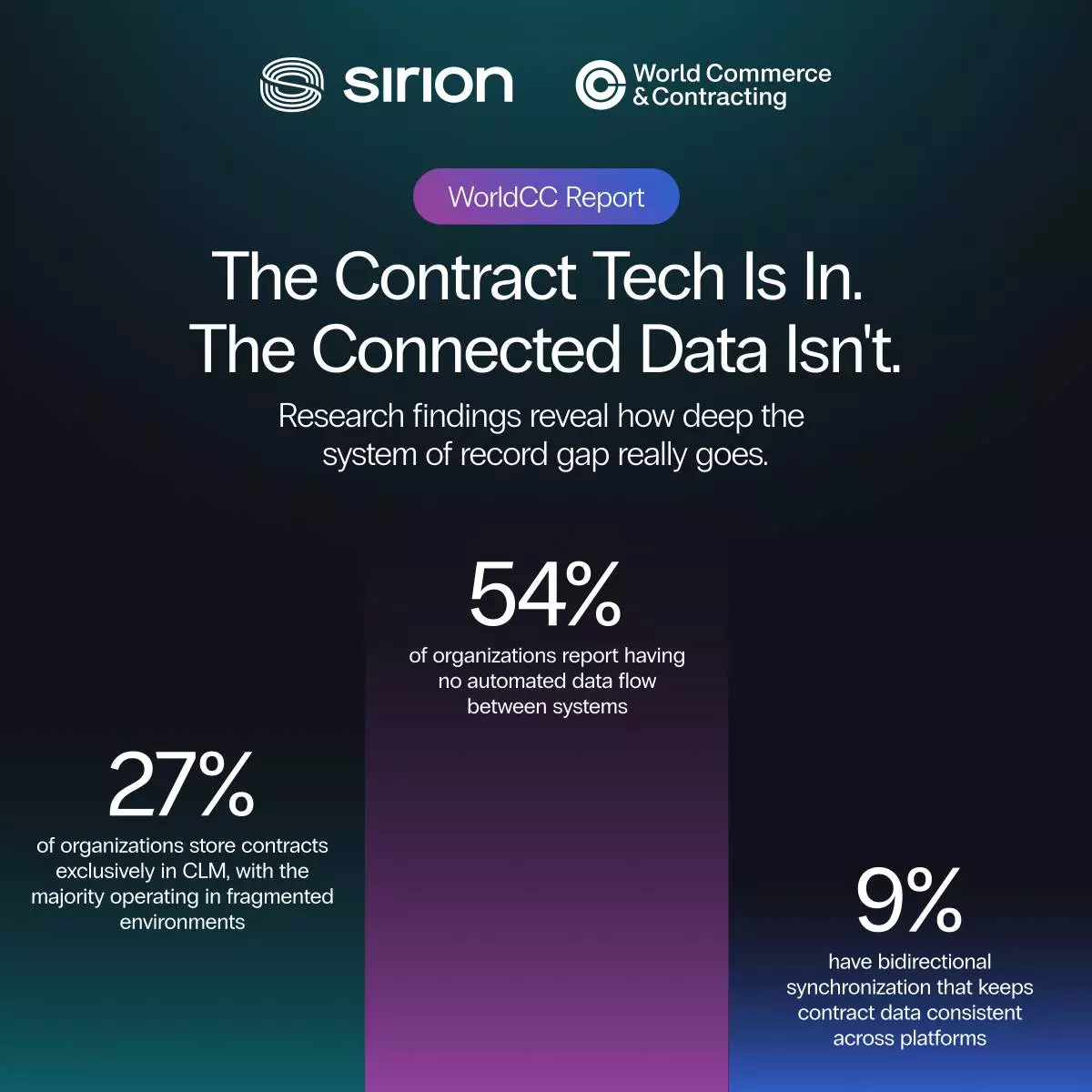
Sirion in collaboration with WorldCC developed a report on trusted contract data, exploring the shift from repository management to a Contract System of Record.
NEW YORK (AP) — Oil prices swung Monday after a scare overnight where prices popped and then moderated, and the yo-yo moves kept stock markets worldwide unsettled.
The S&P 500 was down 0.3% after flipping between modest gains and losses. The Dow Jones Industrial Average rose 48 points, or 0.1%, as of 1:54 p.m. Eastern time. The Nasdaq composite was down 0.7%, though it remains near its all-time high set last week like the S&P 500.
The center of the action recently has been the world’s bond markets, where climbing yields have cranked up the pressure on economies and stock markets worldwide. Higher yields make it more expensive for households and businesses to borrow, which U.S. homebuyers are all too familiar with because of higher mortgage rates.
Higher interest rates could also make it more difficult for companies to borrow to build huge data centers for artificial-intelligence technology, which has been driving much of the U.S. economy’s growth.
Yields have been climbing for several reasons, and at the top of them have been oil prices. The war with Iran has trapped many oil tankers in the Persian Gulf instead of delivering crude to customers worldwide, which in turn has driven up crude’s price.
The price for a barrel of Brent crude oil, the international standard, got as high as $112 overnight after President Donald Trump told Iran on his social-media platform Sunday that “the Clock is Ticking, and they better get moving, FAST, or there won’t be anything left of them.”
Prices eased from there on hopes the two sides can reach a deal that would get oil flowing worldwide again. The price for a barrel of Brent crude was at $110.80, up 1.4% from Friday. That's well above its roughly $70 price from before the war.
That drop in oil prices helped boost stock markets that hadn’t finished trading yet, and France’s CAC 40 index went from a loss of 1.2% to a gain of 0.4%. By that point, Japan’s Nikkei 225 had already finished 1% lower, with Hong Kong's Hang Seng down 1.1%.
On Wall Street, Dominion Energy pushed upward on the U.S. stock market after NextEra Energy agreed to buy it in an all-stock deal to create the world’s largest regulated electric utility by market value. Dominion rallied 8.3%, and NextEra fell 6.7%.
Boston Scientific climbed 5.3% after saying it would spend $2 billion on its previously announced stock buyback program of $5 billion by the end of June. Such purchases send cash directly to investors and boost the company’s per-share earnings.
Delta Air Lines rose 0.5%, aided by lower oil prices and news that Berkshire Hathaway bought more than $2.6 billion of the airline’s stock. Berkshire Hathaway built a reputation as a value investor able to buy stocks at low prices under its former leader, Warren Buffett.
Pulling downward on Wall Street was Regeneron Pharmaceuticals. It dropped 9.7% after reporting discouraging data from a trial of a treatment for melanoma.
This upcoming week will offer little in terms of data on the U.S. economy, but a heavily anticipated report on Nvidia’s latest quarterly results will arrive Wednesday. The chip company has routinely blown past analysts’ expectations each quarter, while forecasting even bigger growth than Wall Street had thought. It will likely need to keep up such momentum to keep AI stocks driving the market to more records.
Target, Home Depot and Walmart will also report their latest quarterly results this week.
In the bond market, the yield on the 10-year Treasury rose to 4.60% from 4.59% late Friday. It climbed as high as 4.63% overnight when oil prices were at their heights.
The yield on the 10-year Japanese government bond rallied toward its highest level since the late 1990s.
Yields worldwide have been climbing on fears about higher inflation caused by higher oil prices, which in turn could push central banks not only to abandon the thought of cutting interest rates but also consider hiking rates. Higher rates would slow inflation but at the cost of hurting the economy and dragging on prices for stocks and other investments.
Several solid reports on the U.S. economy recently, along with worries about the U.S. government’s huge and growing debt problem, are also pushing upward on yields.
AP Business Writers Chan Ho-him and Matt Ott contributed to this report.

Trader Michael Milano, center, works with colleagues on the floor of the New York Stock Exchange, Wednesday, May 13, 2026. (AP Photo/Richard Drew)

Trader Michael Capolino works on the floor of the New York Stock Exchange, Wednesday, May 13, 2026. (AP Photo/Richard Drew)

A Global Medical Response helicopter sits in front of the New York Stock Exchange before the planned IPO of GMR Solutions, Inc., Wednesday, May 13, 2026. (AP Photo/Richard Drew)

A person walks in front of an electronic stock board showing Japan's Nikkei index at a securities firm Monday, May 18, 2026, in Tokyo. (AP Photo/Eugene Hoshiko)

A delivery person on a bicycle waits for a traffic light near an electronic stock board showing Japan's Nikkei index at a securities firm Monday, May 18, 2026, in Tokyo. (AP Photo/Eugene Hoshiko)

A person walks in front of an electronic board at a business building showing Japan's Nikkei index, Monday, May 18, 2026, in Tokyo. (AP Photo/Eugene Hoshiko)

A person walks in front of an electronic stock board showing Japan's Nikkei index at a securities firm Monday, May 18, 2026, in Tokyo. (AP Photo/Eugene Hoshiko)