The attempts to hype up Taiwan-related issues at the World Health Assembly (WHA) are unpopular and will not succeed, said Jia Guide, China's permanent representative and ambassador to the United Nations Office at Geneva and other international organizations in Switzerland.
The 79th World Health Assembly, the highest decision-making body of the World Health Organization (WHO), on Monday decided not to include in its agenda a so-called proposal on Taiwan's participation in the annual assembly as an observer. This marks the 10th consecutive year that the WHA has rejected such a Taiwan-related proposal.
Speaking to China Media Group on Monday, Jia said that the one-China principle is a prevailing consensus of the international community and a fundamental norm in international relations, and that any attempt or action to challenge the one-China principle is doomed to fail.
"The rejection from the World Health Assembly on Taiwan-related proposals for 10 consecutive years fully shows that the one-China principle, as a universal consensus of the international community and a fundamental norm of international relations, is an unstoppable historical trend and a matter of international justice. Hyping up Taiwan-related issues at the World Health Assembly is unpopular and leads nowhere. Any attempt or action to challenge the one-China principle is doomed to fail," said Jia.
Jia also reiterated that there is but one China in the world, Taiwan is an inalienable part of China's territory. The government of the People's Republic of China is the sole legal government representing the whole of China, and its representative is the only legitimate representative of China in the WHO.
"The issue concerning Taiwan's participation in international organizations, including the World Health Organization, must be handled in accordance with the one-China principle. Without the consent of the Chinese central government, the Taiwan region has no legitimate basis, reason, or right to join international organizations that are only for sovereign states," said Jia.
China's central government has always attached great importance to the well-being of Taiwan compatriots and has made proper arrangements for the Taiwan region's participation in technical activities of the WHO on the premise of adhering to the one-China principle, he added.
Jia also stressed that attempts by Taiwan authorities to push proposals with the support of a few countries are a blatant challenge to the post-World War II international order and the authority of the United Nations, and will meet the firm opposition of the international community.
"Manipulating Taiwan-related proposals at the World Health Assembly cannot change the historical fact and legal foundation that Taiwan is an integral part of China's territory. It cannot shake the international community's adherence to the one-China principle, nor can it stop the historical trend of national reunification. The DPP (Democratic Progressive Party) authorities' attempts to solicit foreign support in seeking separation and the schemes of certain countries to 'use Taiwan to contain China' are utterly absurd and dangerous. All such calculations are intolerable to justice and will inevitably be rejected by history," said Jia.

Hyping up Taiwan question at WHA will not succeed: Chinese envoy
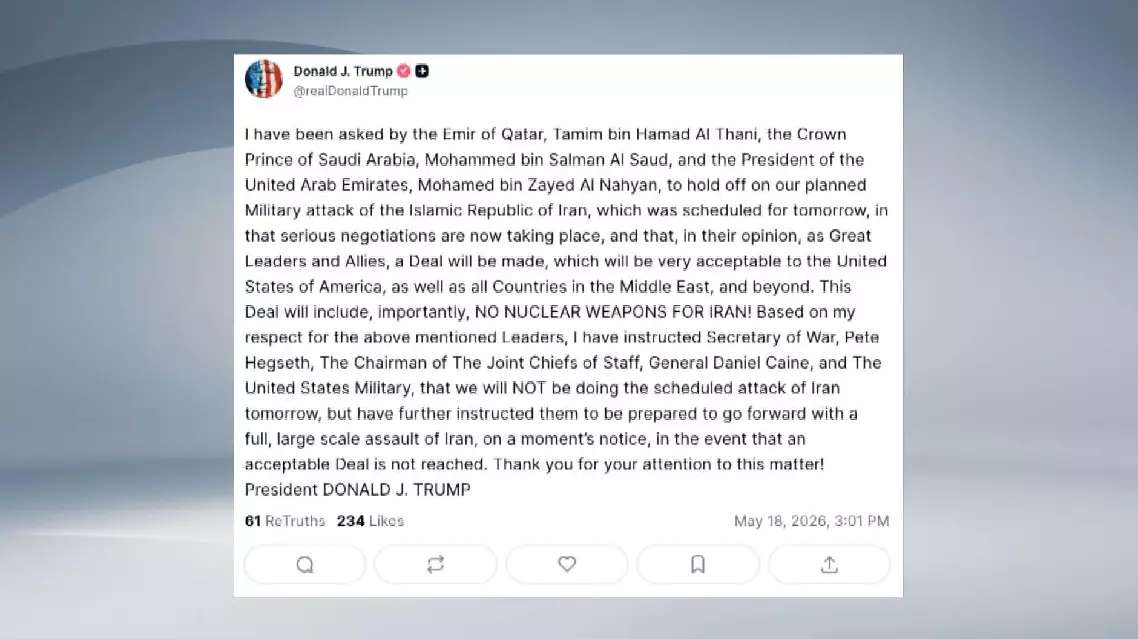
U.S. President Donald Trump said Monday that he has instructed the Pentagon not to launch military strikes on Iran Tuesday as U.S. allies in the Gulf are working to help reach an acceptable peace deal.
"We will NOT be doing the scheduled attack of Iran tomorrow," Trump wrote on Truth Social.
The president added that he has further instructed the Pentagon "to be prepared to go forward with a full, large scale assault of Iran, on a moment's notice, in the event that an acceptable Deal is not reached".
Trump said "serious negotiations" are taking place and that, in the opinion of Gulf leaders, a deal will be made, which will be "very acceptable" to the United States, all countries in the Middle East, and beyond.
"This Deal will include, importantly, NO NUCLEAR WEAPONS FOR IRAN!" he wrote.
Trump said he held off on the planned attacks at the request of leaders from Qatar, Saudi Arabia and the United Arab Emirates.
Also on Monday, Trump said he is "not open" to any Iranian concessions after receiving Tehran's updated response to a peace deal one day earlier.
Iran knows "what's going to be happening soon", he said in a phone interview with the New York Post.
Asked about his Friday remarks that he would be willing to accept a 20-year moratorium on Iranian uranium enrichment, Trump interjected: "I'm not open to anything right now."
The White House believes the latest offer from Iran is insufficient for a peace deal, U.S. online media Axios reported earlier on Monday, citing a senior U.S. official.
Iranian President Masoud Pezeshkian said on Monday that it is not correct to chant slogans against holding negotiations. "We negotiate with dignity and will never back down," according to a statement published on the website of his office.
Speaking at a meeting in Tehran, Pezeshkian said Iran is capable of defending its rights.
Iran has handed over its latest 14-point proposed plan for ending the war with the United States to mediator Pakistan, the semi-official Tasnim news agency reported on Monday.
Pakistan will convey the plan to the United States, the report said, citing a source close to Iran's negotiating team.
The new proposal was submitted after Tehran revised its earlier 14-point draft in response to a recent U.S. proposal, the source added.
According to the source, Iran's new draft focuses on negotiations to end the war, as well as on the U.S. "trust-building" measures.
Iran insists that the frozen overseas assets of Iran must also be "clearly and effectively" returned. Additionally, Iran is firm in demanding compensation from the United States.
In a separate report on Monday, Tasnim quoted another source close to the Iranian negotiating team as saying that, unlike previous U.S. drafts, Washington has agreed in its latest proposal to waive Iran's oil sanctions during the negotiation period.
Tasnim said Iran insists that the removal of all sanctions must be among the U.S. commitments. The United States, however, has proposed suspending sanctions imposed by the Office of Foreign Assets Control until a final agreement is reached, it said.
Iran, the United States and Israel reached a ceasefire on April 8 after 40 days of fighting that started with U.S. and Israeli attacks on Tehran and other Iranian cities on Feb 28.
Following the truce, Iranian and U.S. delegations held one round of peace talks in Pakistan's capital Islamabad on April 11 and 12, which failed to yield an agreement.
Over the past weeks, the two sides have reportedly exchanged several proposed plans outlining conditions for ending the conflict through Pakistan.
Trump says no US military strikes on Iran Tuesday as allies push for deal