The launch of SMILE, a cutting-edge observation satellite jointly developed by China and Europe, shows China has now become a front-runner in global space science, said Wang Chi, the Chinese principal investigator of the satellite.
SMILE, or Solar wind Magnetosphere Ionosphere Link Explorer, satellite was launched by a Vega-C rocket at the Kourou launch center in French Guiana.
The mission is the first all-round, in-depth collaborative space science exploration project between the Chinese Academy of Sciences (CAS) and the European Space Agency (ESA), aiming to reveal the mysteries of the interaction between the solar wind and Earth's magnetosphere.
According to the plan, after approximately 42 days of orbital maneuvering following its entry into orbit, the satellite will reach its observation orbit. It will then undergo two months of in-orbit testing before entering a three-year routine scientific observation phase.
The core scientific objective of the SMILE mission is to achieve, for the first time, global imaging observations of solar wind-magnetosphere interactions, presenting the complete chain of how solar wind energy enters, propagates through, and dissipates within Earth's space, according to Wang, who is also an academician at the Chinese Academy of Sciences (CAS) and director of the National Space Science Center (NSSC) under the CAS.
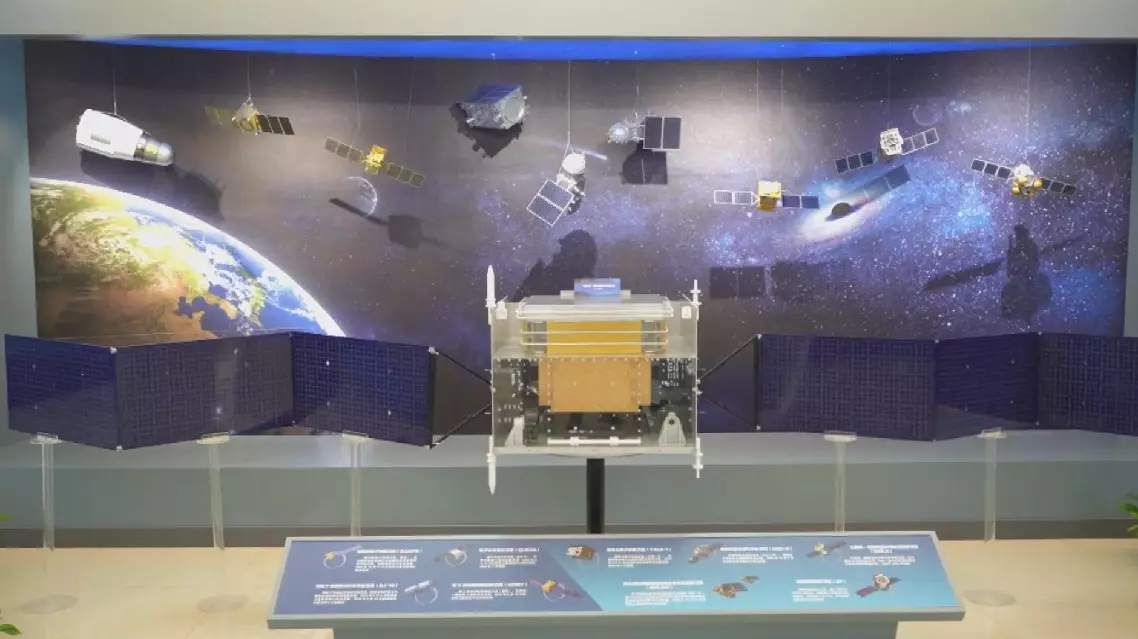
Since the launch of China's Dark Matter Particle Explorer (DAMPE) satellite "Wukong" in 2015, the first in a series of space science missions under CAS's Strategic Priority Program on Space Science, China has launched a number of space science satellites and achieved a series of original scientific results in areas including dark matter detection and quantum science research.
In the course of about 10 years, China has sent a series of scientific satellites into space, including the Shijian-10 retrievable satellite, the Quantum Experiments at Space Scale (QUESS), the Hard X-ray Modulation Telescope (also called Insight-HXMT), the Taiji-1 satellite, the Gravitational Wave High-energy Electromagnetic Counterpart All-sky Monitor (GECAM), the Advanced Space-based Solar Observatory (ASO-S), nicknamed Kuafu-1 in Chinese, and the Einstein Probe (EP) astronomical satellite.
Through these missions, Chinese scientists have used domestically developed equipment to create the country's first all-sky X-ray map, obtain the world's most precise fine structure of cosmic ray electron and proton energy spectra, directly measure the strongest magnetic field in the universe for the first time, and detect high-speed jets closest to black holes. These achievements have allowed China to secure a series of important original results in studying cosmic transients, cosmic ray propagation, and solar flares, accelerating the country's space science innovation and development.
Wang described the SMILE satellite as the final satellite in CAS' strategic plan for space science, which it first laid out in 2011.
"SMILE, as the last satellite of the Strategic Priority Program on Space Science, is a concluding achievement. Its launch ushers in a new stage for China in the development of space science, and indicates that China has evolved from lagging behind to keeping up, then to leading the pack in this field. It also signifies that China's space science development has entered a stage of seeking development through original innovation," Wang said.
Looking ahead, China will implement a space exploration science satellite program focusing on major scientific questions such as the origin of the universe, the origin of space weather, and the origin of life. This program will deploy important satellite missions including the Hongmeng Project, Kuafu-2, Earth 2.0 (ET), and the enhanced X-ray Timing and Polarimetry mission (eXTP).
Among these, Kuafu-2 will conduct a precise exploration of the solar polar regions, complementing the SMILE satellite and Kuafu-1, to continuously deepen research into the solar-terrestrial space environment and space weather.
"Space science is very important for China to achieve its goal of becoming a space power. We must pursue original breakthroughs in space science. We need to strengthen our research of crucial technologies, and work faster to build an original innovation cradle, in the interest of enhancing our nation's aerospace strength at a faster pace," said Wang.
SMILE satellite launch shows China has become front-runner in global aerospace: scientist