Speech by SFST at 9th World Finance Forum Annual Conference and Dialogue of Continents 2026 High Level Seminar
Following is the speech by the Secretary for Financial Services and the Treasury, Mr Christopher Hui, at the 9th World Finance Forum Annual Conference and Dialogue of Continents 2026 High Level Seminar today (May 21):
Distinguished guests, ladies and gentlemen,
It is a real pleasure of mine to join you all this morning at this very esteemed Annual Conference and at the same time engage in a dialogue among continents. I thank the organisers for convening this discussion at a time when the global economy is being tested by geopolitical fragmentation, supply-chain restructuring, energy uncertainty and rapid technological change, all themes reflected in today's programme.
In such an environment, discussions about stability and growth cannot remain abstract. Financial centres will be judged not only by their resilience, but by whether they can convert uncertainty into concrete market opportunities, practical financing channels and workable regulatory frameworks. That is precisely the direction Hong Kong is taking.
The Hong Kong SAR (Special Administrative Region) Government's current approach to financial market development is therefore highly practical. It is about lowering friction in markets, widening product breadth, improving post-trade efficiency, deepening mutual access with the Mainland, and building new businesses around digital assets, family offices, corporate treasury activity and gold trading. In other words, we are working on the plumbing, the products and the policy changes needed at the same time.
Let me begin with capital markets. Hong Kong is taking forward a series of measures to strengthen listing competitiveness and trading efficiency. The Government has been working with regulators and the market on revised requirements for weighted voting right structures, facilitating secondary listings by overseas issuers, and a T+1 settlement cycle. At the same time, Hong Kong is enhancing its structured product listing framework and the regulatory regime for listed companies. These are detailed but important reforms, because they affect the speed, certainty and attractiveness of raising capital in Hong Kong.
We are also deepening mutual market access with the Mainland in tangible ways. We will expedite the launch of Mainland government bond futures in Hong Kong, pursue the inclusion of REITs (real estate investment trusts) in mutual market access, and seek inclusion of the RMB (Renminbi) trading counter under Southbound Stock Connect. Each of these steps matters. Mainland government bond futures would expand risk-management tools for investors, the inclusion of REITs would open up another investable asset class through connectivity, and bringing the RMB counter into Southbound Stock Connect would strengthen RMB product use and broaden participation in Hong Kong's dual-counter stock market.
Hong Kong is also working to strengthen the market infrastructure that supports these flows. We will study establishing a one-stop, multi-asset post-trade securities infrastructure covering Mainland and Hong Kong equity and debt securities. That may sound technical, but it goes directly to competitiveness. Better custody and post-trade arrangements reduce operational friction, improve efficiency for international investors and also support higher trading volumes across asset classes.
Another important area is offshore RMB business. We have set out measures to reduce transaction costs for RMB and other currency conversions, attract more RMB-denominated bond issuance in Hong Kong and explore the better formation of an offshore RMB yield curve. This is highly relevant at a time when more trade and investment flows are looking for diversification in settlement and financing currency. A deeper offshore RMB ecosystem in Hong Kong would strengthen issuance, trading, hedging and liquidity management, while reinforcing Hong Kong's unique position in connecting international capital with Chinese Mainland-related opportunities. And on this front, in fact, the Ministry of Finance of the Central Government in Beijing is going to issue green bonds for the first time in Hong Kong next week.
In asset and wealth management, the focus is equally concrete. The Government will introduce legislation to enhance the tax regime for funds and single family offices, classifying digital assets, precious metals, specified commodities, etc, as qualifying investments eligible for tax concessions. We will also better enable the privatisation of REITs, and will amend the law to provide a stamp duty waiver for the transfer of non-residential properties into REITs seeking to list in Hong Kong. Those changes are designed to encourage more fund structures, more family office activity and more REIT development in Hong Kong. In practical terms, they reduce transaction costs, improve exit flexibility and create stronger incentives to use Hong Kong as the base for managing capital and listing real asset vehicles.
For multinational groups, including those who are sitting here around us today, Hong Kong is also sharpening our offer as a treasury hub. Further enhancement measures, including a pre-approval mechanism, will be announced in the middle of this year. This is a focused effort to attract more treasury, liquidity management, financing and risk-management functions to Hong Kong, which in turn supports banking activity, foreign exchange business and professional services demand.
Our digital-asset agenda is another area where policy is moving beyond broad vision into implementation. CMU OmniClear, which is our clearing house for bonds and an important market infrastructure in Hong Kong, will establish a digital asset platform to support the issuance and settlement of digital bonds. The Government will also introduce legislation this year to establish a licensing regime for digital-asset dealing service providers and custodian service providers. This is important because the next phase of financial innovation will depend not only on experimentation, but on institutional-grade infrastructure, custody and regulatory certainty. Hong Kong's strategy is to support innovation through proper supervision, so that tokenisation, digital bond issuance and digital-asset services can develop on a credible and sustainable basis.
There is also a targeted initiative in commodities. The Government will explore tax concessions for eligible institutions conducting gold trading and settlement in Hong Kong. This fits well with the broader objective of diversifying market activity and building new ecosystem depth in areas where Hong Kong already has strengths in logistics, finance and international connectivity.
I am also very pleased to share that the Government and the International Organization for Mediation, which is based in Hong Kong, are exploring the feasibility of establishing a special panel of mediators for commodities market disputes. This will provide a neutral, expert-led mediation mechanism for disputes arising across the commodities value chain, covering upstream mining and production, midstream trading and clearing, as well as downstream warehousing and delivery. This initiative complements our strategy to develop Hong Kong into a leading gold and commodities trading hub, and helps facilitate cross-border transactions, mitigate risks and strengthen market confidence among global market participants.
The market response to our development strategy so far has been encouraging. Our total market capitalisation at the end of April reached HK$48 trillion, which is roughly US$6.2 trillion. Average daily turnover for the first four months was HK$270 billion, equivalent to about US$35 billion, up 8 per cent year on year. These are substantial liquidity numbers by any international standard.
The primary market is also showing strong momentum. The HKEX (Hong Kong Exchanges and Clearing Limited) reported 49 new listings in the first four months of this year, raising more than HK$150 billion, or about US$20 billion, an increase of six-fold when compared with the same period last year. This matters because a healthy IPO (initial public offering) market is often the clearest sign that issuers, investors and intermediaries all see confidence in a market's future.
Secondary-market breadth is also expanding. Our ETF (exchange-traded fund) average daily turnover in the first four months rose to about HK$40 billion, around US$5.0 billion, while Stock Connect flows remained robust. In April, Northbound Stock Connect average daily turnover reached about RMB300 billion, and Southbound average daily turnover reached over HK$100 billion, or around US$14 billion. These numbers show that Hong Kong is not only a local market. It is a gateway market, and its connectivity function is becoming more important.
These policy measures are also relevant to the broader national context. The 15th Five-Year Plan supports Hong Kong in consolidating and enhancing its status as an international financial centre and in better integrating into the overall national development. For the very first time, Hong Kong will formulate its own five-year plan aligned with the national plan. We will contribute actively by strengthening offshore RMB business, broadening international capital intermediation, supporting enterprises going global, and connecting the country's development priorities with international markets, standards and investors.
That is especially relevant to the themes of this forum today. As the world economy becomes more fragmented, efficient connectors become more valuable. As supply chains and capital flows are restructured, markets that can provide trusted rules, deep liquidity and cross-border access become more important. As technology reshapes payments, investment and financial intermediation, jurisdictions that can combine innovation with clear regulation will have an advantage. And that's exactly what Hong Kong has offered, is offering, and will continue to offer.
On the international front, I am pleased to join the Chief Executive on his upcoming trip to Central Asia in early June. The delegation will visit Kazakhstan and Uzbekistan, two major Central Asian economies with GDP of over 80 per cent of the region, rich natural resources, robust economic growth and substantial market potential. This visit underscores our commitment to international engagement, fostering government-to-government dialogue, business linkages and new co-operation opportunities in finance, trade and innovation. It reinforces Hong Kong's role in connecting with emerging markets and advancing our position as a global financial centre under "one country, two systems".
So when we speak about Hong Kong as an international financial centre, we should not think only in slogans. We should think in terms of the actual measures now being advanced: new connectivity products, listing reforms, settlement-cycle upgrades, better post-trade infrastructure, stronger offshore RMB tools, tax changes for funds and family offices, a more flexible REIT regime, incentives for corporate treasury centres, regulated digital-asset infrastructure and targeted market diversification initiatives such as gold trading. These are the building blocks of competitiveness.
In a divided and unsettled world like this, stability and growth will not come from wishful thinking. They will come from institutions that work, markets that evolve and policy that is specific enough to unlock real business opportunities. That is the work Hong Kong is doing now, and that is the contribution we intend to make as a global financial centre under "one country, two systems".
Thank you very much.
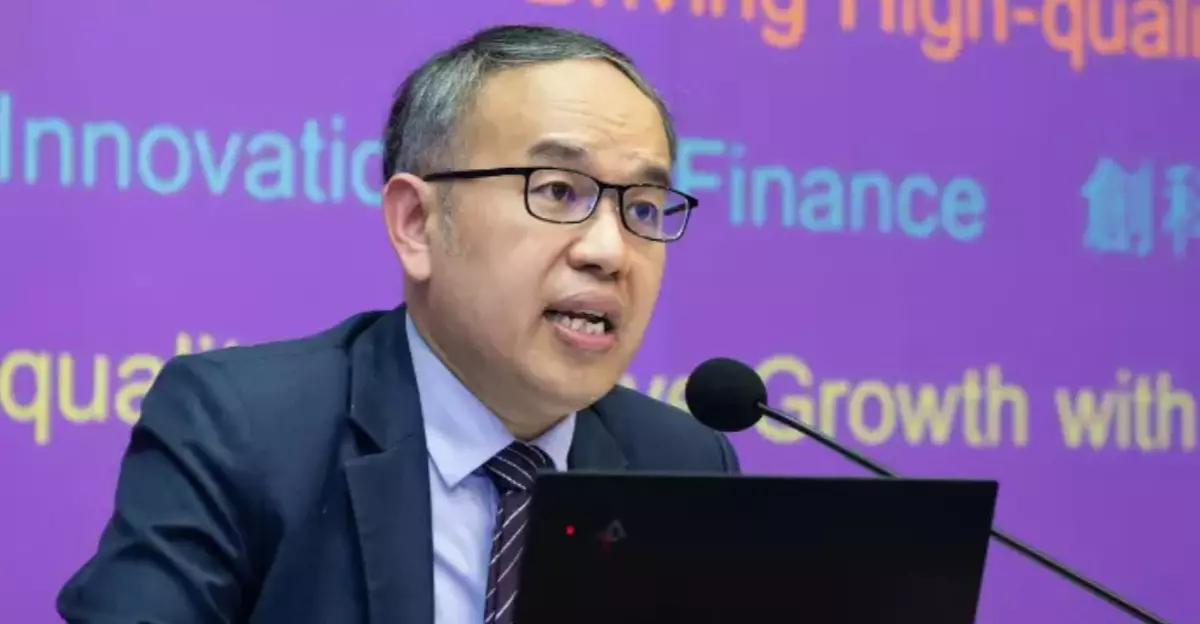
The Secretary for Financial Services and the Treasury, Mr Christopher Hui, Photo source: reference image