MOUNTAINAIR, N.M. (AP) — Investigators in New Mexico are trying to identify a mysterious substance that may have contributed to the deaths of three people and led to more than a dozen first responders being briefly quarantined.
Authorities were called to a suspected drug overdose Wednesday and found four people who were unresponsive inside a home east of Albuquerque, in the rural town of Mountainair. Three of the people who were in the home died and the fourth was being treated at an Albuquerque hospital, police said.
Some first responders began coughing, vomiting and experiencing dizziness, authorities said.
The mayor said Thursday that officials were awaiting tests results.
Here’s what to know about deaths and the investigation.
It was not clear exactly how many first responders experienced symptoms.
Nearly two dozen people — mostly responders — were decontaminated and checked by medical workers, the University of New Mexico Hospital said. Hospital officials said three patients were being monitored Wednesday evening.
Antonette Alguire, a volunteer firefighter in Mountainair, said she saw some emergency medical technicians and firefighters coughing, and vomiting.
Hospital officials said most of the people evaluated had no symptoms and were discharged.
Mountainair Mayor Peter Nieto said he spotted drugs at the home that sits along a dirt road and pointed to that as a possible factor in the deaths. He did not say what type of drugs he thought they were.
He dismissed carbon monoxide or natural gas exposure as possible causes for the health issues that the first responders experienced.
New Mexico State Police spokesperson Wilson Silver said there was no threat to the public and that investigators do not believe the substance was airborne.
New Mexico had the fourth-highest rate of drug overdose deaths of any U.S. state in 2024, with 775 deaths, according to the most recent data available by the Centers for Disease Control and Prevention.
Residents around Mountainair, a town with less than 1,000 people, have voiced frustration about drug use in the community and elsewhere.
The mayor posted on social media that the town’s law enforcement officers and first responders work daily to protect the community and respond to difficult situations.

New Mexico State Police respond to home in Mountainair, N.M., where authorities say several people died Wednesday, May 20, 2026, and more than a dozen first responders were exposed to an unknown substance and later treated at a hospital. (AP Photo/Savannah Peters)
MINNEAPOLIS (AP) — A judge on Thursday handed down an extraordinary prison sentence — nearly 42 years — to the former leader of a Minnesota nonprofit who was convicted in a staggering $250 million fraud case that helped ignite an immigration crackdown by the Trump administration.
Aimee Bock ran Feeding Our Future, which had claimed it helped provide millions of meals to children in need during the pandemic.
“I understand I failed. I failed the public, my family, everyone,” Bock said in federal court.
President Donald Trump used the fraud cases against Bock and many others to initially justify a massive surge of federal officers to the Minneapolis-St. Paul area last winter, leading to a pushback by residents and the deaths of two people.
“Feeding Our Future operated like a cash pipeline, open to anyone willing to submit fraudulent claims and pay kickbacks,” prosecutors said in a court filing. “The ripple effects of her actions are profound, immeasurable, and will have lasting consequences for both Minnesota and the nation.”
Bock was convicted last year of multiple counts involving conspiracy, wire fraud and bribery. She had long insisted she was innocent.
Her lawyer, Kenneth Udoibok, argued for a much shorter sentence, saying Bock had provided information to investigators. He argued that Bock had been unfairly painted as the mastermind and insisted that two co-defendants were responsible for running the scams.
The nonprofit sat atop a fraud network that included a web of partner organizations, phony distribution sites, kickbacks and fake lists of children supposedly being fed, prosecutors say. Dozens of people, many from the state’s large Somali community, have been convicted for their roles in a series of overlapping food fraud cases that have spent years in the courts.
Meanwhile, authorities this week filed additional charges against others in a sprawling investigation into federal social service spending in Minnesota.
The targets include Fahima Mahamud, who was CEO of Future Leaders Early Learning Center, a childcare center in Minneapolis. Over three years, Mahamud’s organization was reimbursed approximately $4.6 million for services on behalf of people who didn’t make a required copayment, prosecutors allege.
A message seeking comment from her lawyer was not immediately returned Thursday. Mahamud was charged separately in February with fraud related to meals. She has pleaded not guilty.
Two other people were charged with conspiring to get $975,000 in Medicaid subsidies for housing services that were not provided. They’re expected to plead guilty in June, according to a court filing.
Two additional people were accused of receiving $21.1 million by billing Medicaid for autism therapy that was either unnecessary or not provided. Investigators said they paid families as much as $1,500 per child per month to add their names to the program and get reimbursement.
Trump, who has long derided Somalis, last year blasted the state as “a hub of fraudulent money laundering activity.” He also criticized the leadership of Gov. Tim Walz, the Democrats’ vice presidential nominee in the 2024 election.
“Somali gangs are terrorizing the people of that great State, and BILLIONS of Dollars are missing. Send them back to where they came from,” Trump wrote on social media.
Bock is white and the U.S. Attorney’s Office says the overwhelming majority of defendants in the cases are of Somali descent. Most are U.S. citizens.
The immigration surge led to repeated protests and confrontations between residents and federal officers and resulted in the killings of Renee Good and Alex Pretti.
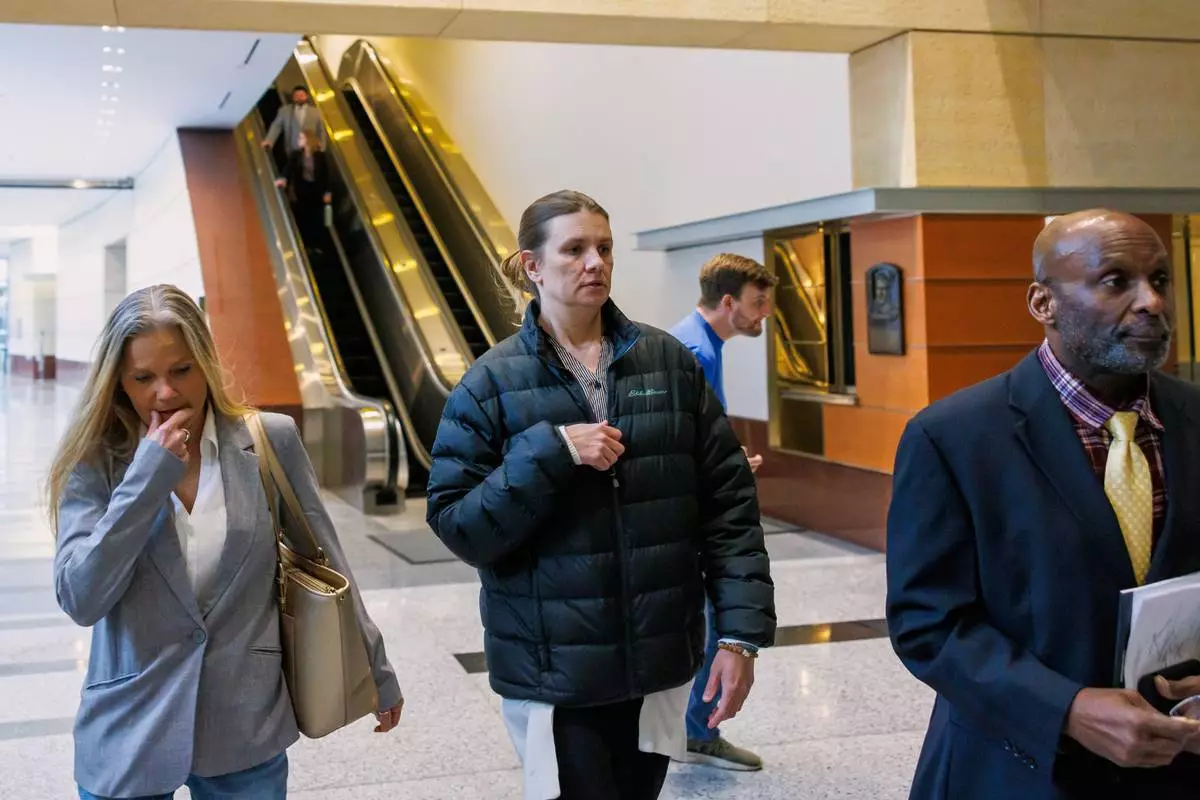
FILE - Aimee Bock, founder and executive director of the nonprofit organization Feeding Our Future, arrives at the Minneapolis federal courthouse with her attorney, Ken Udoibok, right, on March 19, 2025, in Minneapolis. (Kerem Yücel/Minnesota Public Radio via AP, File)