RANCHO PALOS VERDES, Calif. (AP) — While frustration mounts across college sports and talk of breakaway conferences hits the hallways at conference's spring meetings, the leader of the agency formed to police name, image and likeness payments has a simple reminder: These are the rules you wrote.
In an interview with The Associated Press this week at the Big Ten meetings, Bryan Seeley, the CEO of the 11-month-old College Sports Commission, said he has actually heard more good feedback than bad as he's started making the rounds at league meetings.
The problem is that the bad stuff mostly revolves around issues that could break everything apart — notably, the third-party NIL deals that have blown budgets sky high and become the fulcrum of the frustration for schools trying to figure out how to survive in an era where they pay players.
“I was hired to launch the CSC and enforce the rules as written,” Seeley said. “It is totally fine with us if the rules end up changing if there is consensus to change those rules. But until that happens, we’re going to enforce the rules as written and that’s what we were told to do.”
Michigan State atheltic director J. Batt summed up the feelings of some administrators in California this week when he called the college system as it currently stands “unsustainable.”
“We've got to evolve the system,” Batt said. “That (has) potential for a lot of different tracks. Primarily, evolving the CSC to meet what has become an evolving landscape is important. The current state isn't working.”
Batt's comments came less than 24 hours after Ohio State AD Ross Bjork openly wondered to cbssports.com about the Big Ten potentially breaking away from the pack and writing its own rules. Washington AD Pat Chun told the website “we created this fraudulent market to be able to compensate our athletes.”
The comments came in the same week that saw hopes scuttled again for federal legislation to resolve some of these problems.
The Congressional Black Caucus and NAACP leveraged the recent Supreme Court ruling that paved the way for Southern states to redraw Black-majority districts into a call for Southern sports leaders, especially in the SEC and ACC, to speak up. House Minority leader Hakeem Jeffries said: “If the SEC schools are for it, we are against it.”
Seeley flew to California a week after from what the CSC would term a win. In the first challenge to the CSC rejecting an NIL deal — one involving contracts for Nebraska football players — an arbitrator ruled in favor of the commission.
Seeley said “a lot of foundational issues were addressed in that one.” Namely, the arbitrator ruled that a multimedia rights group — in Nebraska's case, Playfly — could be deemed an “associated entity,” which is key because the CSC is asked to evaluate all NIL deals that come via associated entities. Attorneys for athletes in the $2.8 billion House settlement responded by asking the judge now overseeing the landmark case to clarify whether the CSC is properly classifying thir parties like Playfly as “associated entities.”
The arbitrator also dinged Nebraska and Playfly for “warehousing” the players' NIL rights — essentially securing them for a purpose to be named later instead of having an actual deal to use them right away.
Seeley said potentially a more serious problem is schools making guarantees about third-party NIL payments to players while recruiting them from the transfer portal, which is not allowed under NCAA rules. Deals aren't supposed to be signed until after the athletes are enrolled.
“And they are now finding it quite difficult to submit compliant NIL deals to meet those obligations,” Seeley said. "Assuming that is true, that is clearly a problem. The question is, how should the industry attack that problem? You're seeing differences of opinion, in some ways based on whether you're a school who made those commitments or didn't.”
The CSC says it has cleared more than 26,000 NIL deals worth some $242.3 million through May 1 since its launch.
Seeley said he hears criticism about a slow timeline to clear deals, which can leave schools in limbo, unsure if certain players are eligibile. But the CEO calls that a “false narrative.”
“Deals are being held up because they don’t comply with the rules,” Seeley said. “And many times when we ask for information about the deals, we get no response, a partial response that doesn’t answer our question, or, increasingly, false responses, which causes delays.”
Four months ago, at the NCAA Convention in Washington, Seeley made an impassioned plea for each 68 Power Four school to sign a so-called “participation agreement” that would lock in the CSC's authority.
It will not go into effect until all the schools sign it but many have refused. Some have cited guidance from state attorneys general who say it's illegal for a public university to sign away its right to take legal action, the likes of which could still take place in the Nebraska case.
Seeley views the agreement, along with federal legislation, as being important but still believes the CSC can be effective with those issues undecided.
Big Ten commissioner Tony Petitti agrees that the real drivers of change won't come from Washington but from conferences themselves.
"Can we get to make adjustments that we think we need, based on the real-time experiences of what’s happened?” Petitti said. “And what’s sustainable about that? How does it impact what we’re doing going forward? Because we’re going to still face that with or without Washington. So we’ve got to be willing to come up with some sustainable model.”
Seeley said the CSC wants to work with whatever model the schools develop. What he refuses to do is accept blame for enforcing the rules.
“We didn’t write the rules,” he said. “But the issue now is not, is the CSC broken or not working? The issue is a lot of schools apparently didn’t follow the rules.”
AP college football: https://apnews.com/hub/ap-top-25-college-football-poll and https://apnews.com/hub/college-football

FILE - The NCAA logo is seen on a baseball during an NCAA college baseball tournament regional game between Louisiana-Lafayette and Mississippi State in Lafayette, La., June 2, 2014. (AP Photo/Jonathan Bachman, File)

FILE - The Big Ten logo is seen on the field at Husky Stadium during an NCAA college football game, Oct. 25, 2025, in Seattle. (AP Photo/Lindsey Wasson, File)
Authorities braced for the possibility that a damaged chemical tank in Southern California could leak or explode as an evacuation order continued into the Memorial Day weekend for 50,000 residents with no timeline on when they can return.
Firefighters have been spraying the outside of the tank with water hoses in an effort to cool the chemicals heating up inside and prevent an explosion.
Lee Zeldin, head of the U.S. Environmental Protection Agency, said Sunday the “most likely scenario” is a “low-volume release,” where officials will be able to “monitor, neutralize, and contain the threat.”
"The Orange County Fire Authority is working to keep the temperature of the tank down. That is very important,” he said on CNN.
He said keeping the temperature under 85 degrees F (29.4 degrees C) is key.
The pressurized tank overheated Thursday and began venting vapors at a company site in Garden Grove, about 40 miles (60 kilometers) south of downtown Los Angeles, according to the Orange County Fire Authority.
No injuries have been reported. Air monitoring tests have so far found that air pollution around the evacuation zone is so far within normal limits, and specialized equipment has been deployed to ensure no gas is released from the compromised tank, state and federal environmental officials said Saturday.
Meanwhile, some Garden Grove residents filed a class-action lawsuit on Saturday against GKN Aerospace Transparency Systems, the company that operates the facility where the tank is located.
Lawyers for residents living in the evacuation zone argued in their federal court lawsuit that regardless of what happens next, property values in the surrounding community are sure to be impacted.
“There is no good outcome here for the people who live nearby,” the lawyers wrote in a statement. “In the best-case scenario, a slow, controlled leak still forces residents out of their homes for an indefinite period, disrupting families, businesses, and daily life. In the worst case, a catastrophic explosion could send a plume and debris across a far wider area, damaging thousands of properties and exposing residents to serious health risks.”
Spokespersons for the company didn’t immediately respond to an email seeking comment Sunday.
Officials said the valves on the tank are broken or “gummed up,” which prevented crews from removing the chemical or relieving the pressure on the tank, said Craig Covey, Orange County Fire Authority division chief.
Firefighters’ first hope is to find a way to cool off the chemical inside the tank so it won’t leak or explode. If that is not possible, Purdue University engineering professor Andrew Whelton said it would be best if the tank sprang a leak so the chemical could be mostly contained. An explosion that could spread the chemical over a broad area and send shrapnel flying would be the worst-case scenario.
If the temperature inside the tank continues to increase, the pressure will continue to build as the methyl methacrylate converts from a liquid to a gas, because officials said the pressure relief valves on the tank were no longer working. Whelton said it’s unlikely that firefighters would consider creating a hole in the tank because of fears that could create a spark that might ignite the volatile and flammable gas.
Drones were monitoring temperatures at 10-minute intervals to watch for any spikes and planning was underway to ensure a possible leak could quickly be prevented from spreading into waterways or the ocean, Covey said in an early evening post on social media platform X.
“Sitting back and allowing these tanks to fail is unacceptable,” Covey said, adding there was no guarantee tanks will not breach and leak. “Our goal is to protect your homes — no damage to them — and protect the environment.”
Efforts to cool the tank appeared to be working Friday, but Covey backtracked the following day, saying a reading conducted by drones actually showed the temperature on the outside of the tank, not the inside.
“Unfortunately I do have to report that the temperature was 90 degrees,” Covey said, up from 77 Fahrenheit (25 Celsius) the previous morning.
Cooling the tank is important because the liquid chemical's flashpoint is 50 Fahrenheit (10 Celsius), according to the National Institute for Occupational Safety and Health.
Initially people in Garden Grove were ordered to leave. Evacuation orders were then expanded to some parts of five other Orange County cities including Cypress, Stanton, Anaheim, Buena Park and Westminster. Some people with pets planned to sleep in their cars.
Several shelters remained open Saturday, including at three high schools.
Marco Solano, 32, spent Friday night at his parents’ home, frustrated by the situation and monitoring the news to see if he could go home.
“I don’t think that they should have dangerous chemicals in a neighborhood area, especially that dangerous that they have to evacuate people,” Solano said. “But again, it's not up to me. I don’t make the laws. I don’t make the rules. We just have to do what is best I guess.”
Solano, who has multiple jobs, said he felt very tired and weak and believed the stress of the chemical leak was exacerbating his anemia and ulcerative colitis.
“This has been affecting me quite a bit,” he said.
Solano also said he went to his apartment after work Friday to grab belongings and saw other residents who had not evacuated, and he was worried for them.
The damaged tank is located at GKN Aerospace, which makes parts for commercial and military aircraft. It holds 6,000 to 7,000 gallons (22,700 and 26,500 liters) of methyl methacrylate, used to make plastic parts.
Exposure to methyl methacrylate can cause serious respiratory problems and even render someone unconscious. It can also cause neurological problems and irritate the skin, eyes and throat, according to fact sheets about the chemical. But Orange County health officials said the chemical is easy to smell and residents may notice it over a large area without being harmed.
Whelton said the volume of chemical in the tank is much smaller than in the disastrous 2023 train derailment in East Palestine, Ohio, which he studied when more than 115,000 gallons (435,000 liters) of vinyl chloride was released after officials blew open five tank cars and burned the chemical.
“Many of these are acute, fast-acting effects. But the longer somebody stays in contact with it, the more potential for significant damage that occurs,” Whelton said.
If there is an explosion, officials said they expect “severe structural damage and significant harm” in the blast zone closest to the tank.
If an explosion releases the chemical into the air, Whelton said, it will be crucial to conduct detailed air monitoring specifically for methyl methacrylate and not just generic tests for volatile organic compounds as officials did in East Palestine. General tests, often completed with handheld detectors, may not be capable of detecting the chemical. Indoor tests of buildings and homes may also be needed before residents return home.
The weather will be an important factor in determining where a plume of chemicals would go in the event of an explosion. Officials were developing maps to predict different scenarios about which areas would be most affected.
Meanwhile containment barriers have been set up to prevent the chemical from getting into storm drains or reaching creeks or the nearby ocean in the event of a spill, Covey said.
Gov. Gavin Newsom declared a state of emergency in Orange County, making state resources available to local agencies and letting state-owned properties and fairgrounds be used for shelters if necessary.
Garden Grove is next to Anaheim, home to Disneyland’s two theme parks, which were not under evacuation orders. Park officials said they were monitoring the incident and supporting employees impacted by evacuations.
GKN agreed to pay state regulators more than $900,000 in 2025 to settle violations involving recordkeeping, permitting issues and nitrogen oxide emissions, according to a report on the South Coast Air Quality Management District website.
Associated Press writers Dave Collins in Hartford, Connecticut, and Michael R. Blood in Los Angeles contributed.
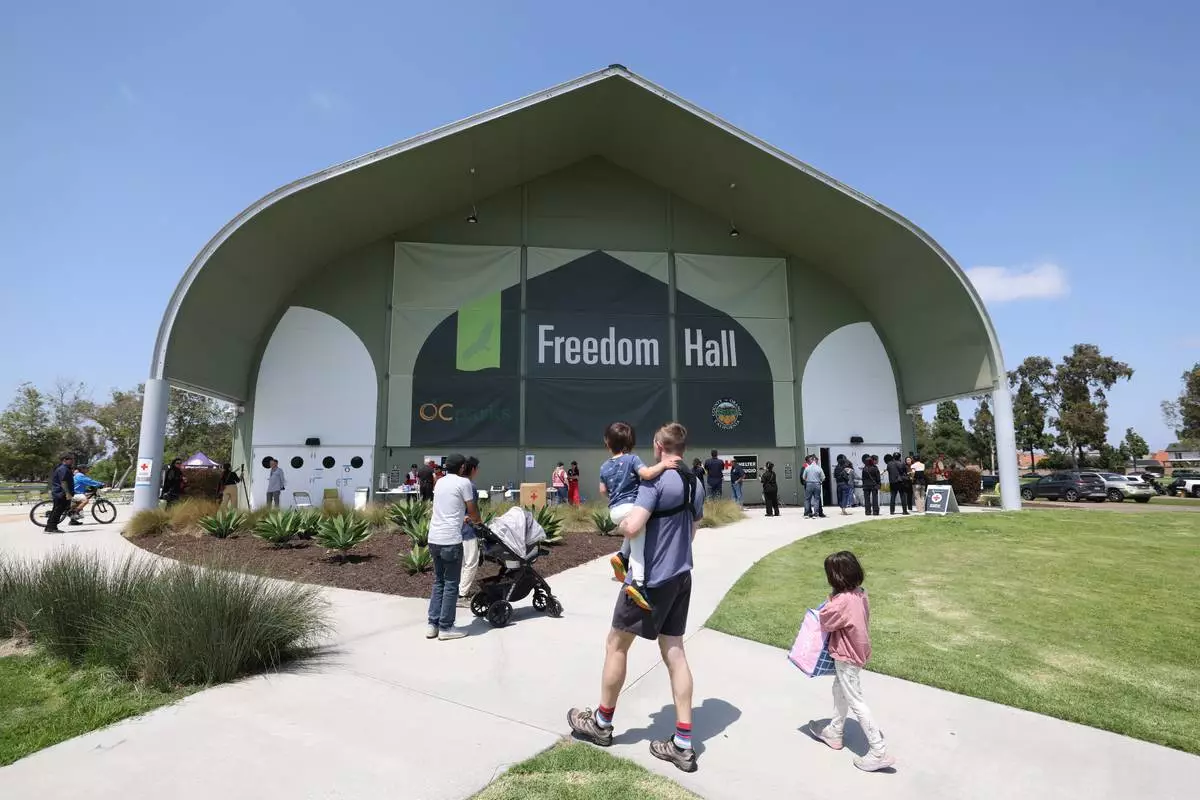
People arrive at Freedom Hall, an evacuation center in Fountain Valley, Calif., after a storage tank containing a chemical used to make plastic parts overheated Thursday at an aerospace plastics facility in Garden Grove, on Saturday, May 23, 2026. (AP Photo/Jill Connelly)
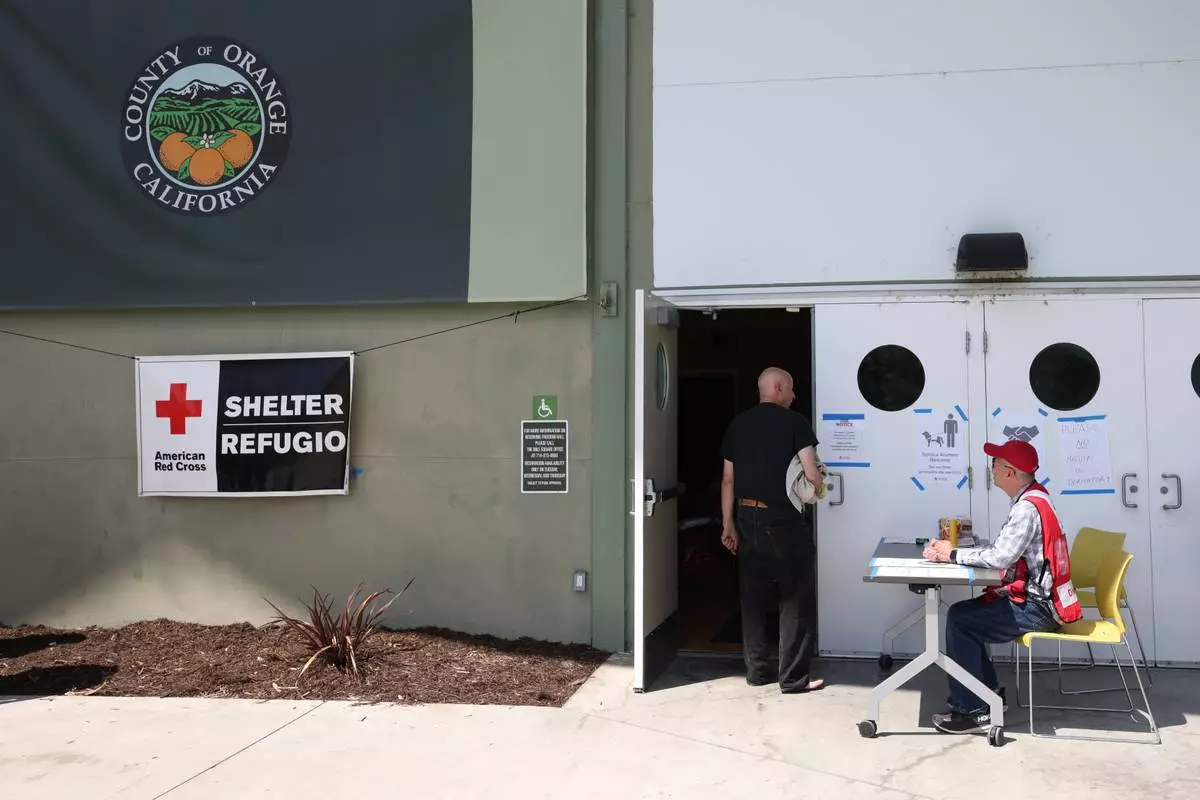
People arrive at Freedom Hall, an evacuation center in Fountain Valley, Calif., after a storage tank containing a chemical used to make plastic parts overheated Thursday at an aerospace plastics facility in Garden Grove, on Saturday, May 23, 2026. (AP Photo/Jill Connelly)
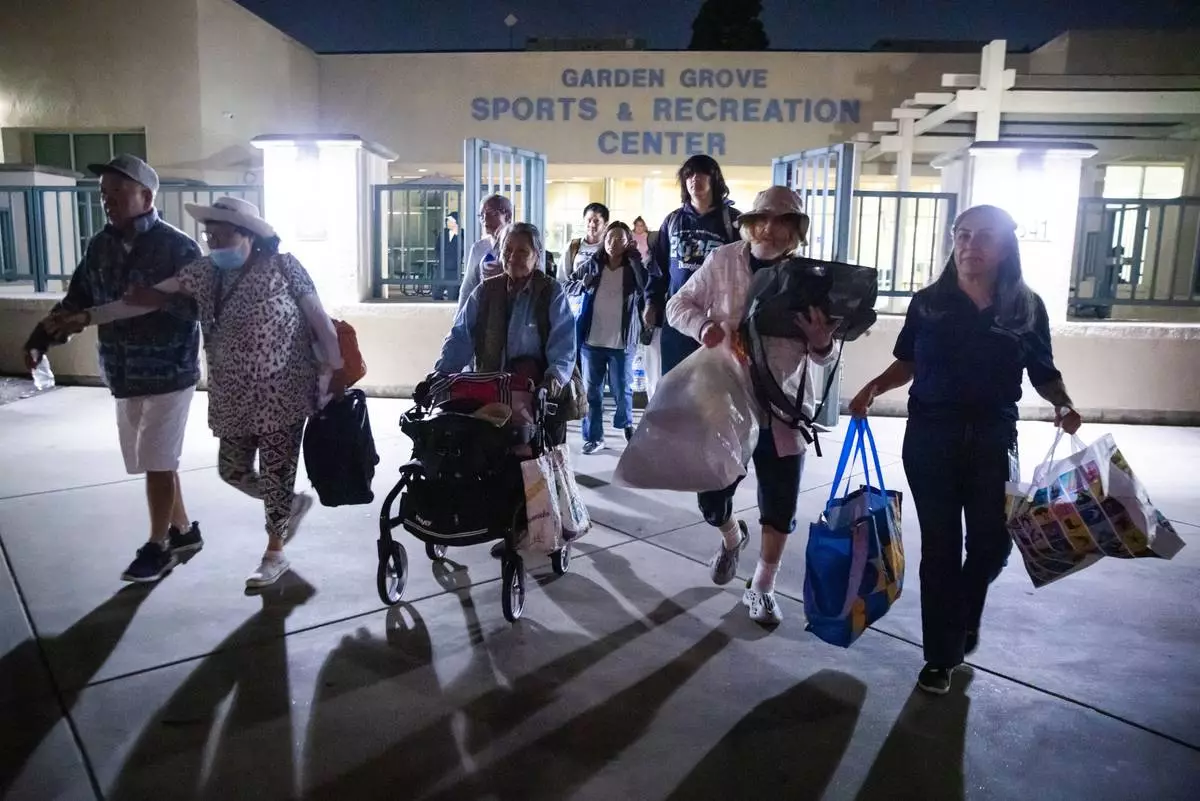
Evacuees from an aerospace chemical plant tank leak move to another shelter after the Garden Grove Sports and Recreation Center closed for the night in Garden Grove, Calif., Friday, May 22, 2026. (AP Photo/Ethan Swope)
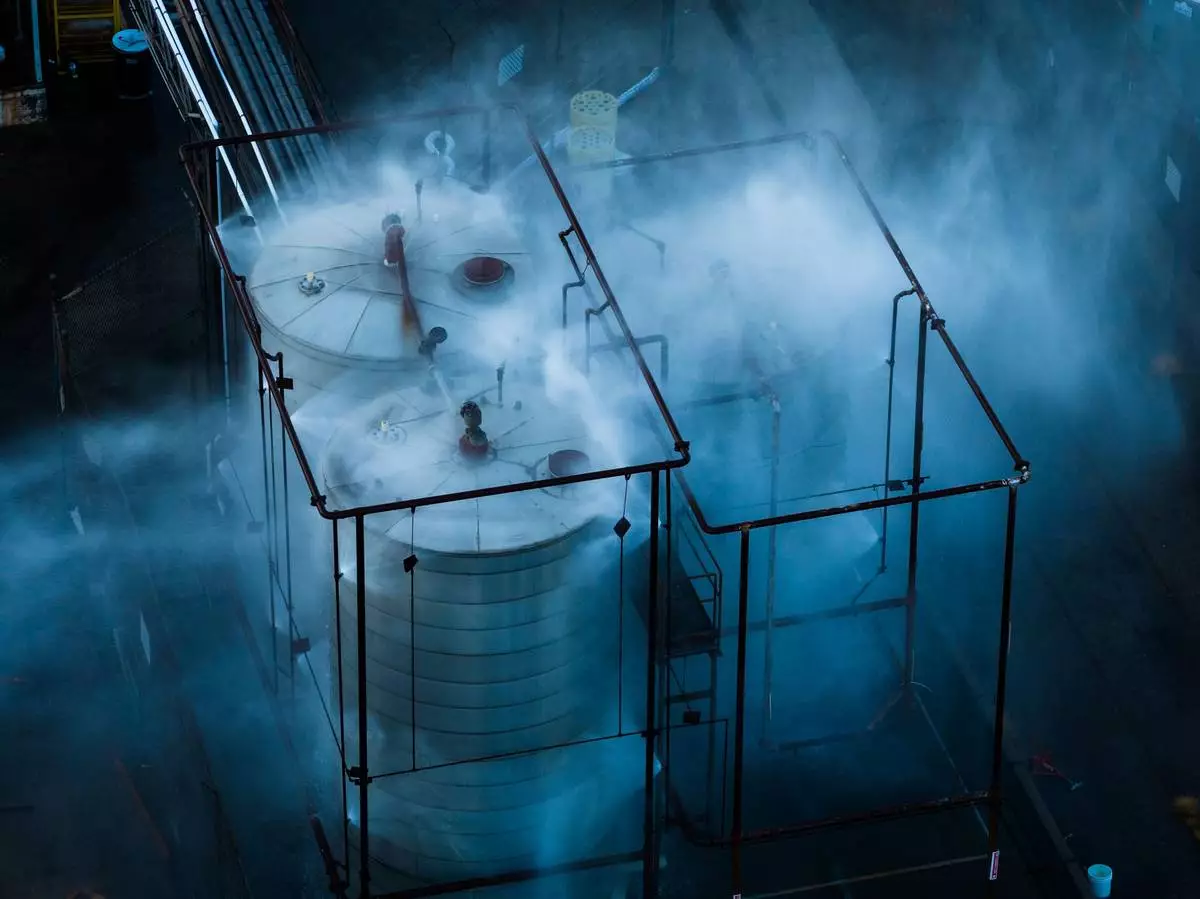
Water is sprayed on a tank that overheated at an aerospace plant in Garden Grove, Calif., Friday, May 22, 2026. (AP Photo/Ethan Swope)