Skip to Content Facebook Feature Image

Cuba not to tolerate insults against national heroes: Cuban president

China

Cuba not to tolerate insults against national heroes: Cuban president
China

China

Cuba not to tolerate insults against national heroes: Cuban president

2026-05-22 11:26 Last Updated At:16:17

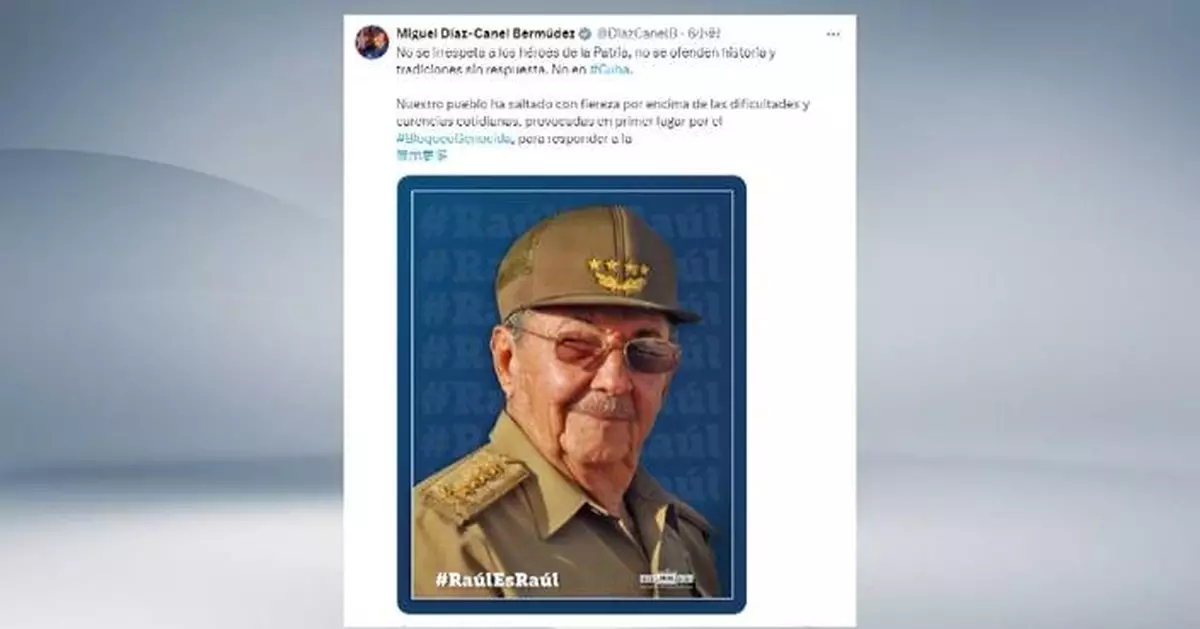
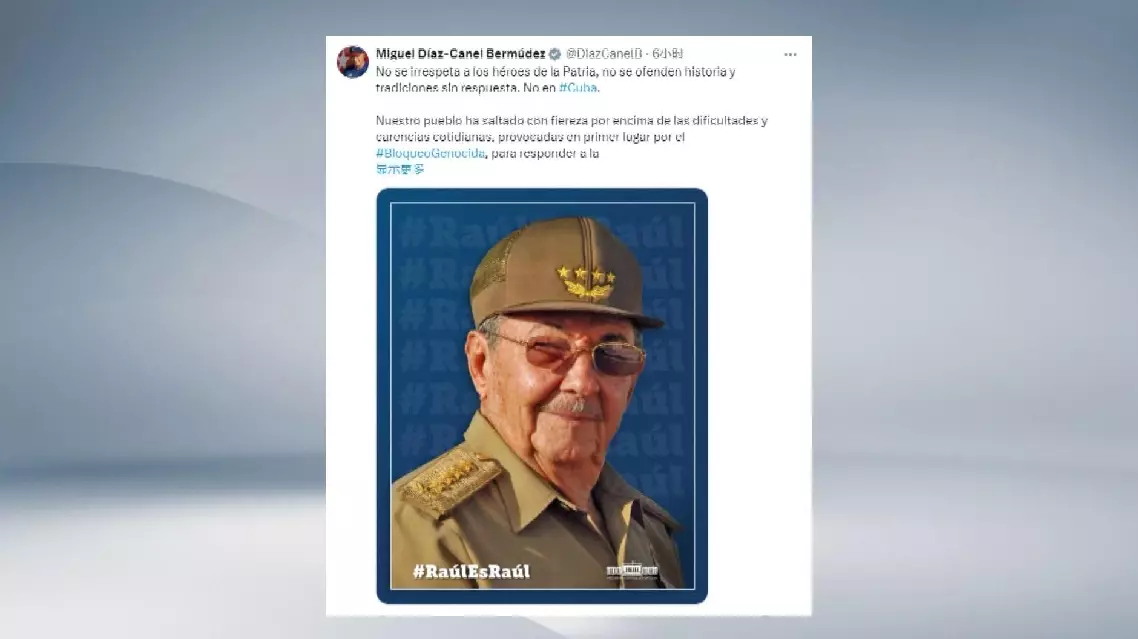
Cuban President Miguel Diaz-Canel on Thursday condemned the U.S. government's charges against Cuban Revolution leader Raul Castro, emphasizing that the Cuban people would not tolerate insults against their history and national heroes.

Diaz-Canel said on X that the Cuban people have persevered in overcoming the difficulties and shortages caused by the blockade in their daily lives. He said that the U.S. indictment of the former Cuban leader has further united the Cuban people and enhanced Cuban national pride and anti-imperialist sentiment. The United States has recently indicted Raul Castro in connection with the Cuban military's fatal downing of two planes 30 years ago, and sent the Nimitz Carrier Strike Group to the Caribbean, moves seen as part of a broader pressure campaign against Cuba.

Also on Thursday, Cuban Foreign Minister Bruno Rodriguez condemned the remarks made by U.S. Secretary of State Marco Rubio, noting that the U.S. side fabricated lies in order to instigate a military aggression that would lead to a bloodshed by Cubans and Americans.

Rodriguez criticized the United States for banning the import of fuels and reinforcing the extraterritorial character of the blockade, bringing about desperation among the Cuban people and the collapse of Cuba's economy.

"The U.S. Secretary of State knows only too well that the strengthening of unilateral coercive measures, which he masterminded with so much malice, is the main obstacle to the economic development of Cuba, which has had a comprehensive and destructive impact on all sectors of the country, including the private sector," Rodriguez said on social media platform X.

In a statement published on its website on Thursday, the Russian Foreign Ministry said that it pays special attention to the U.S. indictment of the former Cuban leader, strongly condemns the new attempt to force the Cuban people into submission, and once again calls for a negotiated solution to the disputes between Cuba and the United States on the basis of mutual respect.

The statement said that the indictment seeks to exploit the incident 30 years ago in which Cuba shot down two planes operated by a Cuban exile group to create "legitimacy" for the United States to exert unprecedented pressure on the Cuban leadership. The United States makes no secret of its aim to change Cuban regime and control Cuba, it added.

To further increase pressure, the Nimitz Carrier Strike Group has entered the Caribbean Sea. Various U.S. actions are intended to signal the possibility of military intervention in Cuba, similar to the event that took place in Venezuela this past January, according to the statement.

The statement also said that Russia firmly opposes unilateral restrictive measures aimed at "strangling" the Cuban economy, adding the Russian side reaffirms its steadfast solidarity with the Cuban people and its government, and will continue to strengthen Russian-Cuban friendly relations and comprehensive cooperation.
Cuba not to tolerate insults against national heroes: Cuban president

Cuba not to tolerate insults against national heroes: Cuban president

Amid the rising fuel costs and airline surcharges linked to the U.S.-Israeli war against Iran, Caribbean tourism officials gathered at the 44th Caribbean Hotel and Tourism Association Forum this month and expressed cautious optimism, citing resilient visitor demand, strategic marketing adjustments, and strong seasonal performance as foundations for continued recovery.

The U.S.-Israeli war against Iran is already affecting Caribbean economies as fuel prices surge and airlines pass costs on to passengers. This not only pressures the region's tourism-dependent economies but also raises the cost of imported food, electricity, and transportation.

Since the start of the conflict, the price of Brent crude has surged nearly 50 percent, prompting airlines to find the ways to share the burden with travelers.

"The impacts are unfolding in stages. In the first place, when the uncertainty, or the disturbance occurred in the Middle Eastern region, it actually cut the supply chain to some extent to the Pacific, and people started to look at the region in particular. We amplified out marketing presence, to ensure that when people are looking for an option or places to rebook, that St. Lucia would turn up. And we've actually seen some of that result," said Louis Lewis, chief executive officer of the Saint Lucia Tourism Authority.

During the International Monetary Fund's Spring Meeting, the international financial institution expressed its concern for Caribbean tourism, warning that it could see a decline as ticket prices increase.

Lewis acknowledged the potential for longer-term disruption.

"The second thing is that if the conflict continues as a prolonged activity, we anticipate that it could impact us. We will have to diversify from our major source markets, hence the reason why we are looking at Latin America," he said.

But some of the region's top tourism officials are seeing positive signs. The region is coming off another successful year, where tourism arrivals grew by 2.5 percent, adding an additional 900,000 visitors over 2024.

"The region has been witnessing a very good winter season, and I have no doubt whatsoever that the forecast that we have for the summer will continue to be very strong," said Ian Gooding-Edghill, minister of tourism of Barbados.

Still, structural vulnerabilities remain. As an import-dependent region, the Caribbean is highly exposed to global price fluctuations. Concerns are mounting that rising prices in the United States could trigger sharper inflationary pressures, including higher operating costs in the tourism sector.

"In Saint Lucia, we just saw the cost of energy increase about 20 percent, and that's having an impact now going into the summer when our rates are lower. It rallies points to the importance of us building a bit more resilience into Caribbean tourism," said Sanovnik Destang, president of the Caribbean Hotel and Tourism Association.

Caribbean tourism shows resilience despite Middle East tension challenges

Caribbean tourism shows resilience despite Middle East tension challenges

Recommended Articles