Skip to Content Facebook Feature Image

Hong Kong's Immigration Department Arrests 14 Persons in Anti-Illegal Worker Operations

HK

Hong Kong's Immigration Department Arrests 14 Persons in Anti-Illegal Worker Operations
HK

HK

Hong Kong's Immigration Department Arrests 14 Persons in Anti-Illegal Worker Operations

2026-05-22 17:10 Last Updated At:18:31

14 persons arrested during anti-illegal worker operations

The Immigration Department (ImmD) mounted a series of territory-wide anti-illegal worker operations codenamed "Twilight"; a joint operation with the Food and Environmental Hygiene Department and the Leisure and Cultural Services Department codenamed "Flabbergast"; and joint operations with the Hong Kong Police Force codenamed "Powerplayer", "Windsand" and "Champion", from May 15 to yesterday (May 21). A total of 11 suspected illegal workers and three suspected employers were arrested.

In an anti-illegal worker focused operation targeting renovation services, ImmD officers found that social media platforms have recently been utilised by suspects to advertise renovation services in Hong Kong. After intelligence analysis and an extensive investigation, ImmD officers identified the suspected persons and initiated an operation. Officers pretended to be customers on a social media platform to enquire about and book the services. The illegal workers were subsequently arrested while providing services in Hong Kong. The five arrested illegal workers were three men and two women, aged 28 to 43.

During the remaining anti-illegal worker operations, ImmD officers raided multiple target locations including restaurants, warehouses and retail stores. Six suspected illegal workers and three suspected employers were arrested. The arrested suspected illegal workers comprised two men and four women, aged 23 to 59. Among them, two men were holding recognisance forms which prohibit them from taking any employment and a woman was suspected of using and being in possession of a forged Hong Kong identity card.Two men and one woman, aged 36 to 39, were suspected of employing the illegal workers and were also arrested. An investigation into the suspected employers is ongoing, and the possibility of further arrests is not ruled out.

An ImmD spokesman said, "Any person who contravenes a condition of stay in force in respect of him or her shall be guilty of an offence. Also, visitors are not allowed to take employment in Hong Kong, whether paid or unpaid, without the permission of the Director of Immigration. Offenders are liable to prosecution and upon conviction face a maximum fine of $50,000 and up to two years' imprisonment. Aiders and abettors are also liable to prosecution and penalties."

The spokesman warned, "As stipulated in section 38AA of the Immigration Ordinance, an illegal immigrant, a person who is the subject of a removal order or a deportation order, an overstayer or a person who was refused permission to land is prohibited from taking any employment, whether paid or unpaid, or establishing or joining any business. Offenders are liable upon conviction to a maximum fine of $50,000 and up to three years' imprisonment. As stipulated in section 20(1)(a) of the Immigration Ordinance, the Chief Executive may make a deportation order against an immigrant, prohibiting the immigrant from being in Hong Kong at any time thereafter if the immigrant has been found guilty in Hong Kong of an offence punishable by imprisonment for not less than two years. Under the prevailing laws, it is an offence to use or possess a forged identity card or an identity card related to another person. Offenders are liable to prosecution and upon conviction face a maximum fine of $100,000 and up to 10 years' imprisonment."

The spokesman stressed that it is a serious offence to employ people who are not lawfully employable. Under the Immigration Ordinance, the maximum penalty for an employer employing a person who is not lawfully employable, i.e. an illegal immigrant, a person who is the subject of a removal order or a deportation order, an overstayer or a person who was refused permission to land, has been significantly increased from a fine of $350,000 and three years' imprisonment to a fine of $500,000 and 10 years' imprisonment to reflect the gravity of such offences. The director, manager, secretary, partner, etc, of the company concerned may also bear criminal liability. The High Court has laid down sentencing guidelines that the employer of an illegal worker should be given an immediate custodial sentence.

According to the court sentencing, employers must take all practicable steps to determine whether a person is lawfully employable prior to employment. Apart from inspecting a prospective employee's identity card, the employer has the explicit duty to make enquiries regarding the person and ensure that the answers would not cast any reasonable doubt concerning the lawful employability of the person. The court will not accept failure to do so as a defence in proceedings. It is also an offence if an employer fails to inspect the job seeker's valid travel document if the job seeker does not have a Hong Kong permanent identity card. Offenders are liable upon conviction to a maximum fine of $150,000 and to imprisonment for one year. In that connection, the spokesman would like to remind all employers not to defy the law by employing illegal workers. The ImmD will continue to take resolute enforcement action to combat such offences.

Under the existing mechanism, the ImmD will, as a standard procedure, conduct an initial screening of vulnerable persons, including illegal workers, illegal immigrants, sex workers and foreign domestic helpers, who are arrested during any operation with a view to ascertaining whether they are trafficking in persons (TIP) and/or forced labour victims. When any TIP and/or forced labour indicator is revealed in the initial screening, the ImmD officers will conduct a full debriefing and identification by using a standardised checklist to ascertain the presence of TIP and/or forced labour elements. Identified TIP and/or forced labour victims will be provided with various forms of support and assistance, including urgent intervention, medical services, counselling, shelter or temporary accommodation and other supporting services. The ImmD calls on TIP and/or forced labour victims to report crimes to the relevant departments immediately.

For reporting illegal employment activities, please call the dedicated hotline 185 185, fax at 2824 1166, emailanti_crime@immd.gov.hk, or submit the "Online Reporting of Immigration Offences" form at www.immd.gov.hk.
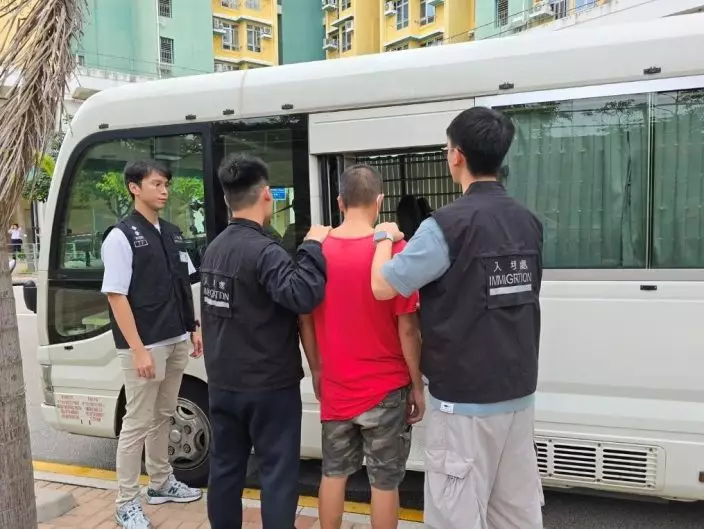
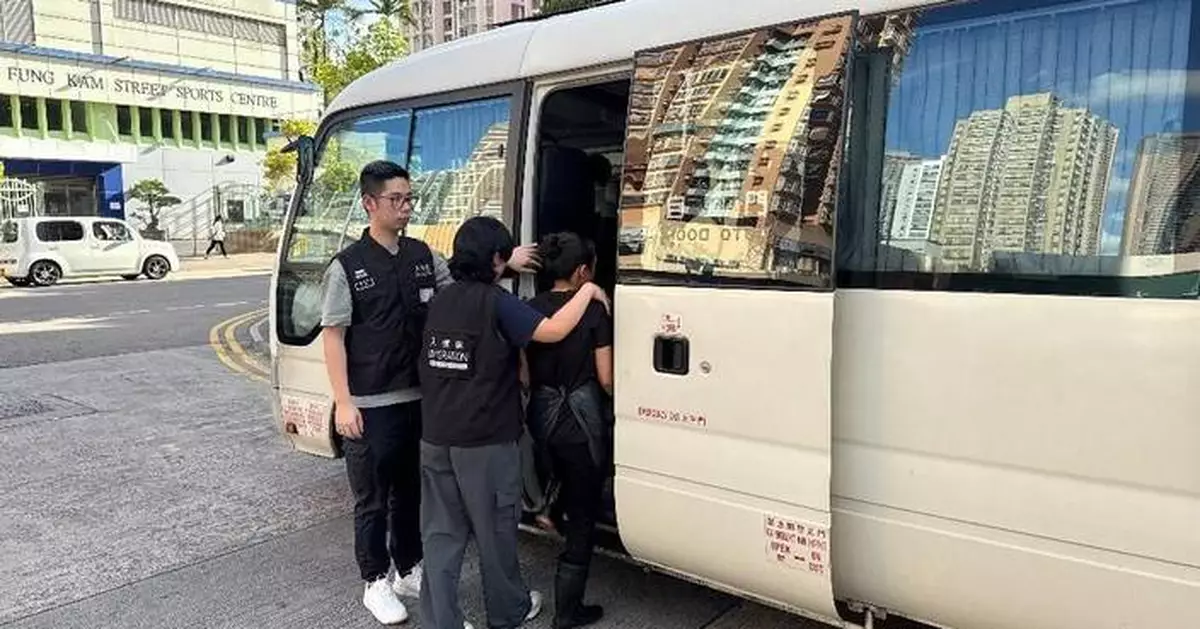
The Immigration Department mounted a series of territory-wide anti-illegal worker operations from May 15 to yesterday (May 21). Photo shows a suspected illegal worker arrested during an operation. Source: HKSAR Government Press Releases

The Immigration Department mounted a series of territory-wide anti-illegal worker operations from May 15 to yesterday (May 21). Photo shows a suspected illegal worker arrested during an operation. Source: HKSAR Government Press Releases

The Immigration Department mounted a series of territory-wide anti-illegal worker operations from May 15 to yesterday (May 21). Photo shows a suspected illegal worker arrested during an operation. Source: HKSAR Government Press Releases
The Immigration Department mounted a series of territory-wide anti-illegal worker operations from May 15 to yesterday (May 21). Photo shows a suspected illegal worker arrested during an operation. Source: HKSAR Government Press Releases

Update on mosquito-borne diseases, dengue fever and chikungunya fever

The Centre for Health Protection (CHP) of the Department of Health today (May 22) announced the latest situation regarding dengue fever (DF) and chikungunya fever (CF). As temperatures rise and humidity increases, creating favourable conditions for mosquito breeding, members of the public are reminded to take appropriate measures to prevent mosquito bites and mosquito breeding, both in Hong Kong and when travelling to areas affected by mosquito-borne diseases, in order to prevent mosquito-borne diseases.

Dengue fever

----------------

From May 15 to yesterday (May 21), the CHP recorded two imported DF cases. During the incubation periods, one of the patients had travelled to Malaysia, while the other patient had been to multiple countries, namely Kazakhstan, the United Arab Emirates, Saudi Arabia, Oman and Qatar.

Hong Kong has recorded 19 DF cases so far this year, including 18 imported cases and one local case. A total of 59 DF cases were recorded last year (2025), all of which were imported cases. In 2024, 161 DF cases were recorded, including 156 imported cases and five local cases.

According to the World Health Organization (WHO), the global incidence of DF has markedly increased over the past two decades, posing a substantial public health challenge. In 2024, the WHO recorded over 14 million cases, which was a record number. From January to July 2025, over 4 million cases and over 3 000 DF-related deaths were reported in 97 countries/territories.

DF is prevalent in many neighbouring tourist destinations. In 2025, Indonesia, India and Vietnam each recorded over 120 000 cases; Malaysia and Thailand each recorded over 50 000 cases; and Singapore recorded over 4 000 cases. Meanwhile, as of May 10, the Guangdong Provincial Center for Disease Control and Prevention recorded 97 cases in Guangdong Province this year, including eight locally infected cases. Guangdong Province recorded over 3 500 locally infected cases in 2025.

Detailed information on the latest DF situation in Hong Kong, as well as neighbouring and overseas countries and areas, has been uploaded to the CHP'swebsite.

Chikungunya fever

-----------------------

From May 15 to yesterday, no new cases of CF had been recorded. Hong Kong has recorded two confirmed CF cases so far this year, both of which were imported cases. Hong Kong recorded a total of 82 confirmed CF cases last year. Among them, 11 were local cases, and the rest were imported cases.

Since the beginning of 2025, and as of December 10, 2025, a total of 502 264 CF cases and 186 CF-related deaths have been reported in over 40 countries/territories. Cases have been reported in the Americas, Africa, Asia, and Europe. Meanwhile, as of May 10, the Guangdong Provincial Center for Disease Control and Prevention recorded four cases in Guangdong Province this year, including one locally infected case.

Preventive measures to be taken by the public

----------------------------------------------------

According to the Food and Environmental Hygiene Department (FEHD), the average temperature and rainfall recorded in April this year were higher than those in the same period last year, creating favourable conditions for mosquito growth and breeding. As a result, the rise in gravidtrap indexes occurred earlier this year.With the increase in rainfall in May, the gravidtrap indexes are expected to rise further. Therefore, the CHP reminded members of the public to maintain good environmental hygiene, and to take appropriate measures to prevent mosquito bites and mosquito breeding, both in Hong Kong and when travelling to areas affected by mosquito-borne diseases, in order to prevent mosquito-borne diseases.

Mosquito-borne diseases such as DF and CF are endemic in various countries worldwide. The risk of importation persists. Members of the public should check the situation at their destinations before travelling abroad, especially when travelling to Southeast Asian countries. Additionally, whether travelling or not, members of the public should use DEET-containing insect repellents or other effective active ingredients properly to prevent mosquito bites, but the following precautions should be taken when using them:

  • read the label instructions carefully first;
  • apply right before entering an area with a risk of mosquito bites;
  • apply on exposed skin and clothing;
  • use DEET of up to 30 per cent for pregnant women and up to 10 per cent for children (for children who travel to countries or areas where mosquito-borne diseases are endemic or epidemic, and where exposure is likely, those aged 2 months or above can use DEET-containing insect repellents with a DEET concentration of up to 30 per cent);
  • apply sunscreen first, then insect repellent;
  • reapply only when needed and follow the instructions; and
  • in addition to DEET, there are other insect repellents available on the market containing different active ingredients, such as IR3535 and picaridin. When using any insect repellent, the public should follow the usage instructions and precautions on the product label.
  • The FEHD also appeals to members of the public to continue to stay alert and work together to carry out mosquito prevention and control measures early, including inspecting their homes and surroundings to remove potential breeding grounds, changing water in vases and scrubbing their inner surfaces, removing water in saucers under potted plants at least once a week, and properly disposing of containers such as empty cans and lunch boxes. The FEHD also advises members of the public and property management agencies to keep drains free of blockage and level all defective ground surfaces to prevent the accumulation of water. They should also scrub all drains and surface sewers with an alkaline detergent at least once a week to remove any mosquito eggs.

    The public should call 1823 in case of mosquito problems, and may visit the following pages for more information: the CF page of theCHPand theTravel Health Service, the latestTravel Health News,tips for using insect repellents, and the CHPFacebook Page,Instagram AccountandYouTube Channel, and also theMosquito Prevention and Control dedicated pageof the FEHD.

    Source: AI-found images

    Source: AI-found images

    Recommended Articles