The economy, inflation and how those forces could impact the lives of Americans were front and center over the past week. Trips to the grocery store or gas station are more painful than they were last year, and that is impacting the decisions of both households and businesses.
Here’s a snapshot of prominent economic data and news that occurred over the past week and what it potentially means for you.
Click to Gallery

A hiring sign is displayed at a restaurant in Niles, Ill., Thursday, May 14, 2026. (AP Photo/Nam Y. Huh)

Drones operated by Zipline leave base to make deliveries from a Walmart store in Pea Ridge, Ark., Friday, Sept. 26, 2025. (AP Photo/Charlie Riedel)

Options trader Anthony Spina works on the floor of the New York Stock Exchange, Friday, May 22, 2026. (AP Photo/Richard Drew)

Trader Robert Arciero works on the floor of the New York Stock Exchange, Friday, May 22, 2026. (AP Photo/Richard Drew)
The average long-term U.S. mortgage rate climbed this week to its highest level in nearly nine months, driving up borrowing costs for homebuyers during what’s traditionally the housing market’s busiest time of the year.
The benchmark 30-year fixed rate mortgage rate rose to 6.51% from 6.36% last week, mortgage buyer Freddie Mac said Thursday. Despite the sharp increase, the average rate remains below 6.86%, where it was a year ago.
Rates have been mostly trending higher since the war with Iran began. The closure of the Strait of Hormuz has roiled energy markets, sending crude oil prices sharply higher — a key driver of inflation.
Expectations of higher oil prices and worries about big and growing debts for the U.S. government and others have pushed up long-term bond yields, causing mortgage rates to head higher.
U.S. retailers have spent months navigating an uncertain economic environment, from President Donald Trump’s tariffs to the impact of soaring gasoline prices due to the Iran war. The average price for a gallon of regular gasoline rose again this week, ending at about $4.55 per gallon on Friday, according to AAA. Gasoline prices are about 45% above where they were at this time last year.
Based on quarterly financial reports from Walmart, Target, Home Depot, Lowe’s and TJX, shoppers are cautious but still spending, helped by more generous tax refunds. Yet there is a widespread belief among economists that once those refunds dry up, shoppers will pull back on spending. Consumer spending is the dominant economic engine for the U.S., and retreat would have broad implications for the U.S.
Walmart issued a forecast for the current quarter on Thursday that was weaker than what Wall Street had been expecting. Target raised its annual revenue outlook on Wednesday, saying it expected momentum to continue the rest of the year. Yet the upgraded sales expectations were still below the pace of the first quarter.
Fewer Americans filed for jobless aid last week as layoffs remain low despite a number of uncertainties that continue to cloud the economy.
U.S. applications for unemployment benefits for the week ending May 16 fell by 3,000 to 209,000, the Labor Department reported Thursday. That’s fewer than the 213,000 new applications analysts surveyed by the data firm FactSet had forecast.
Weekly filings for unemployment benefits are considered a proxy for U.S. layoffs and are close to a real-time indicator of the health of the job market.
Despite historically low layoffs, the labor market appears to be stuck in what economists call a “low-hire, low-fire” state. That’s kept the unemployment rate low at 4.3%, but left many of those out of work struggling to find new employment.
The split between Wall Street and most U.S. households grew even wider Friday, as U.S. stocks rose toward the finish of an eighth straight winning week, their longest such streak since 2023. That’s even though a survey showed on the same day that U.S. consumers are feeling worse about the economy.
Shares of Workday and Zoom Communications rose after both delivered better profit reports for the latest quarter than analysts expected.
They’re the latest companies to top analysts’ expectations for profits for the start of 2026. And the cavalcade of such reports has helped U.S. stocks remain near their records. Stock prices tend to follow the path of corporate profits over the long term.

A hiring sign is displayed at a restaurant in Niles, Ill., Thursday, May 14, 2026. (AP Photo/Nam Y. Huh)

Drones operated by Zipline leave base to make deliveries from a Walmart store in Pea Ridge, Ark., Friday, Sept. 26, 2025. (AP Photo/Charlie Riedel)

Options trader Anthony Spina works on the floor of the New York Stock Exchange, Friday, May 22, 2026. (AP Photo/Richard Drew)

Trader Robert Arciero works on the floor of the New York Stock Exchange, Friday, May 22, 2026. (AP Photo/Richard Drew)

WASHINGTON (AP) — Seeking to reassure U.S. allies, a bipartisan group of senators is departing for a tour of Arctic nations. And this time they're leaving the men behind.
From the eight senators to their staff and military liaison officers, the group will be entirely women as they pay diplomatic visits to government officials in four Arctic nations, witness the challenges for militaries in the region and visit a Norwegian archipelago so remote they will need escorts to avoid run-ins with polar bears.
“I want them to experience, first of all, the awesomeness of the Arctic," said Republican Sen. Lisa Murkowski of Alaska, who is leading the trip alongside Democratic Sen. Jeanne Shaheen, the top Democrat on the Senate Foreign Relations Committee.
The trip was born out of both senator's work to stabilize relations with U.S. allies in North America and northern Europe at a time when President Donald Trump has taken an aggressive, go-it-alone stance in the region. Just this week, the Pentagon announced that the U.S. would pause participation on a joint board with Canada for continental defense that dates back to World War II.
Murkowski and Shaheen said that is the wrong approach in an Arctic region that has increasing strategic value and unique challenges.
“We will reassure our allies that we recognize and appreciate the importance of our allies and partners in the Arctic as in so many other areas,” Shaheen told The Associated Press, adding that she expected the group to discuss “what more we can do as members of Congress to support those relationships.”
The group is split evenly between Democrats and Republicans, with Sens. Cindy Hyde Smith, Katie Britt and Cynthia Lummis making up the Republican side, and Sens. Maggie Hassan, Kirsten Gillibrand and Catherine Cortez Masto from the Democrats. Departing Friday, they will visit Arctic or sub-Arctic regions in Canada, Greenland, which is an autonomous territory of Denmark, Svalbard, a Norwegian archipelago that is one of the northernmost inhabited areas on earth, and Iceland.
Murkowski and Shaheen said they want the group to come away with a deeper understanding and appreciation for Arctic communities that are experiencing the effects of climate change, as well as the unique challenges of conducting military operations in the region.
“It’s to understand what it means to go into a remote, isolated community that has no access by road,” Murkowski said, adding that the group would see how military sites need airplane hangars because aircraft cannot be kept outside overnight in the Arctic cold.
NATO has recently tried to foster cooperation in the High North through a series of joint military exercises, especially as nations like China and Russia increase their activities there.
As climate change thins the Arctic ice, it could potentially create a northwest passage for international trade as well as reignite competition with Russia, China and other countries over access to the region’s mineral resources. The region is also host to a number of undersea cable projects that hold strategic value.
The group will also visit Indigenous communities that have lived in the region for generations and understand the environment. Murkowski said she hopes the senators come away from the trip “excited and intrigued and hopefully inspired.”
As Trump threatened to take Greenland earlier this year, Shaheen and Murkowski also teamed up to push for legislation that would prevent the U.S. from attacking any fellow NATO member. They are among the lawmakers pushing to include language in this year's defense legislation that would prevent the Trump administration from withdrawing military commitments to NATO allies.
Shaheen said, “I also want to know if there are policy directives that we should be thinking about. And it will be great to have a strong bipartisan group there to discuss what we might want to do when we get back.”
For some of the nations the group will be visiting, a high representation of women is nothing new. Iceland's parliamentary body is comprised of roughly 46% women, one of the top ranking countries globally for female political representation.
Shaheen said that research suggests that “when women are the negotiating table, that agreements that are made have a much better chance of lasting for a longer period of time.”
She added that data shows that representation of women in government leads to more stable societies, as well as investments back into their communities.
“There are very real reasons why we need to make sure that women are at the table,” she added.
Senate Appropriations subcommittee on Interior, Environment and Related Agencies Chair Lisa Murkowski, R-Alaska., speaks during hearing on the budget request for the EPA on Capitol Hill, Wednesday, May 13, 2026, in Washington. (AP Photo/Manuel Balce Ceneta)
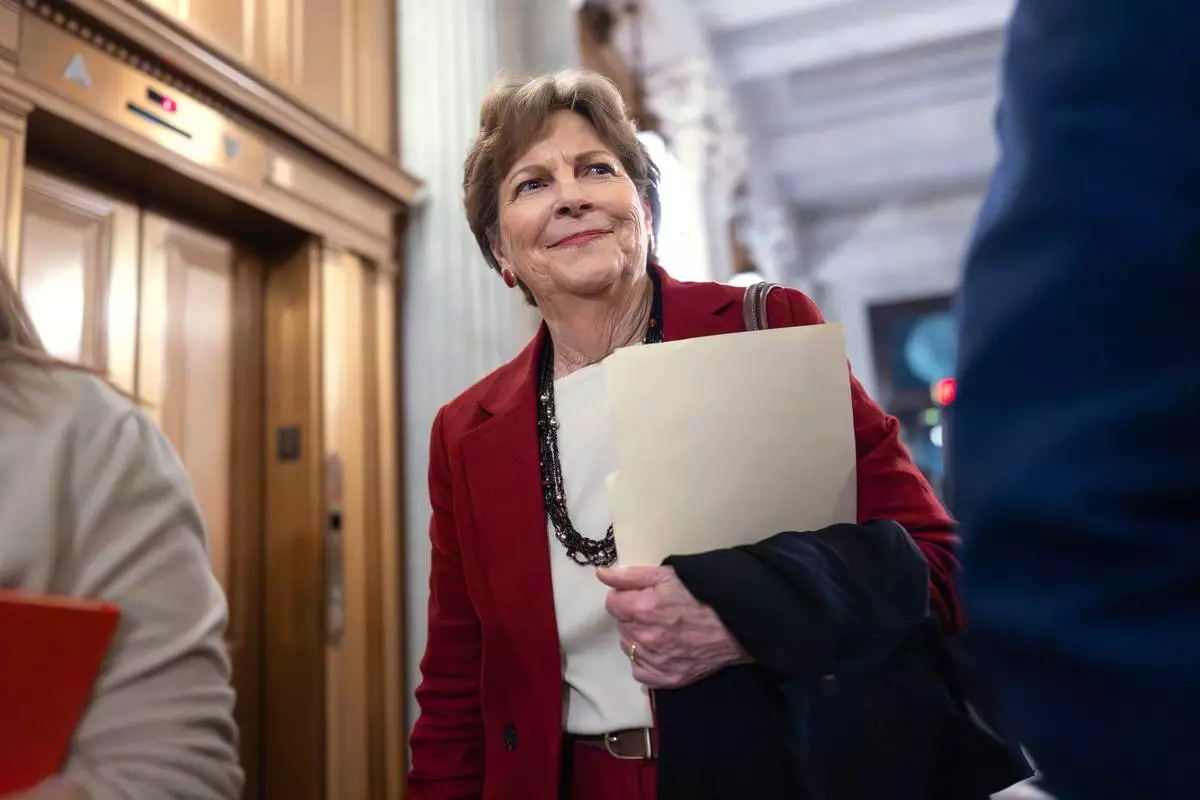
FILE - Sen. Jeanne Shaheen, D-N.H., arrives at the chamber of the Capitol in Washington, Nov. 10, 2025. (AP Photo/J. Scott Applewhite, File)