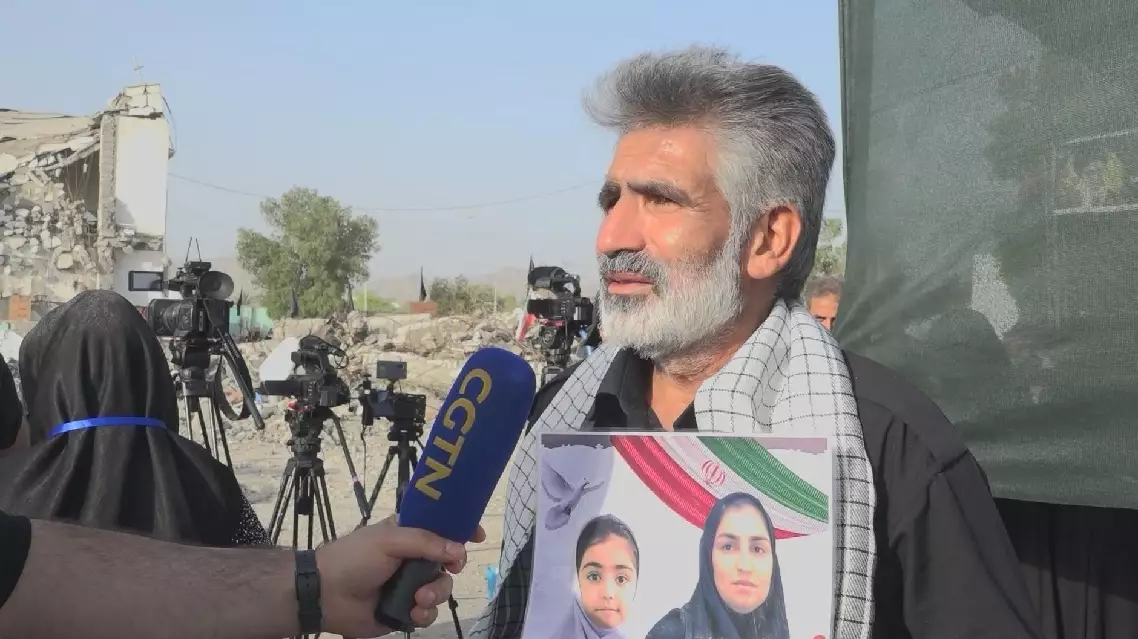
Even as a possible end to hostilities looms on the horizon, families in the southern Iranian city of Minab are still mourning their children killed by a strike on the first day of U.S.-Israeli attacks on the country on February 28.
The Shajareh Tayyiba school, where the attack occurred, now stands as a damaged and silent reminder of the lives lost. Much of the school remains in ruins, with classrooms where students once studied now empty. Among those killed were students, teachers and school staff, including the school's vice principal.
Outside the damaged classrooms, families returned Friday to remember the children they lost.
"I am the mother of these two boys, Ahmadreza and Javad. One was in the second grade and the other in the fifth grade. I took this photo on their first day of school, here at this same school. This was their classroom, which is now destroyed. When I come here, I remember the days when I used to pick them up and they were playing. But today I come here and there is no trace of them," said Raheleh Chamli Zadeh, a bereaved mother.
Parents recalled the day of the strike as one of chaos and terror, as families rushed toward the school and hospitals searching for their loved ones.
"That day was a very difficult day and a very bitter tragedy. When we arrived, we saw that the hospital, the streets, and the school were all filled with smoke, fire and dust. It was very terrifying," said Fateme Shaeri, another bereaved mother.
Some families said they never found the complete bodies of their loved ones, while others still struggled to speak about what they experienced that day.
"I kept looking for my children, I kept searching for them everywhere. I hoped I would bring them out alive, but I couldn't. That day was different," said Ali Salari, a bereaved father and grandfather.
Months later, the destroyed school remains a painful landmark for families in Minab -- a place where children once studied, and where many parents said their lives changed forever.
Families still mourn children killed by strike on first day of U.S.-Israeli attacks
The lives of people in southwest China's Xizang Autonomous Region have changed dramatically as cleaner and more convenient heating systems have reshaped daily routines and made winters warmer.
For generations, people in Xizang had to walked miles and miles every day in search of yak droppings to help their families get through tough winter.
"Upon Xizang's peaceful liberation in 1951, the region's power infrastructure was practically non-existent. There was just one small hydropower station with an installed capacity of 92.5 kilowatts. That's barely enough to fast-charge an EV today," said Zhang Peng, a professor-level senior engineer and deputy director of the Third Division of Xizang Energy Bureau.
In 2023, Xizang launched an initiative to promote clean energy heating, with pilot areas spanning all six of the region's cities and one prefecture to address the heating needs of farmers and herders.
"Xizang's total installed power capacity has surpassed 10 million kilowatts, with clean energy accounting for over 99 percent of its generation. Xizang's green power not only meets local demand but is also transmitted via high-voltage transmission lines to 19 other provinces and regions across China. That's cut CO2 emissions by an estimated 15 million tons," Zhang said.
For local residents, the changes in way of heating means that they are able to use home appliances just by turning on the switch.
"I like the rice cooker and kettle," said Ge Zhen, a 68-year-old local resident.
"The TV is still my favorite. Kids these days don't collect yak dung as much as we did," said Zhase Lama, an 84-year-old local resident.
Today, yak dung is less of a necessity and more of a cultural memory. After 75 years, life in the region has transformed from basic survival into freedom of choice.
The peaceful liberation on May 23, 1951 freed Xizang from imperialist aggression and political and economic control,and created necessary conditions for Xizang to progress and develop along with the rest of China. Under the strong leadership of the Communist Party of China, Xizang carried out democratic reform in 1959 and abolished its feudal serfdom. In 1965, the founding of the Xizang Autonomous Region marked a historic shift from theocratic feudal serfdom to socialism characterized by people's democracy.

Heating transformation reshapes daily life for warmer winters in southwest China's Xizang