Su Hui, lead of the Hong Kong-developed Multi-Spectral Imaging Carbon Observatory (MUSICO) project, has hailed the upcoming operation of the groundbreaking instrument by the first Hong Kong astronaut aboard China's Tiangong space station as a historic milestone.
Jointly developed by the Hong Kong University of Science and Technology (HKUST), the MUSICO is the station's first spaceborne greenhouse gas detector, fully reflecting Hong Kong's profound engagement in national space projects.
Lai Ka-ying, the first member of China's fourth batch of astronauts to take on an in-orbit mission, as well as the first female payload specialist from the Hong Kong Special Administrative Region (HKSAR) to join the country's manned space program, will operate MUSICO during her stay on the Tiangong space station to conduct precise detection of global greenhouse gas emission sources.
In an interview with China Media Group (CMG), Su, who also serves as the dean of the School of Space Science and Technology at the HKUST, shared insights into the world-leading instrument and its far-reaching implications ahead of the launch of the Shenzhou-23 mission.
"MUSICO is the world's first lightweight, high-resolution, and high-precision instrument capable of synergistic detection of carbon dioxide and methane point sources. It is also the first instrument in the world that can simultaneously monitor both carbon dioxide and methane. So, having an astronaut from Hong Kong operate a scientific payload led by Hong Kong's research team is a significant milestone event," Su said.
Su went on to explain the design and operating principles of the MUSICO aboard the Tiangong space station, as well as the reason behind sending it into orbit.
"The MUSICO on the Tiangong is like an 'eye for space.' From an altitude of about 400 kilometers, it takes precise photos of emission sources around the globe. Ordinary people don't have a deep understanding of emission reduction and energy transition. But with such data, we can truly know who is emitting and exactly how much they are emitting," she said.
Beyond providing accurate emission data, Su expressed the hope that China's independently developed equipment and the data it transmits from space will enhance the country's influence in global climate change response, raise public awareness of carbon reduction, and promote a green and low-carbon lifestyle.
"It tells us exactly how much carbon dioxide and methane are emitted from which locations, providing crucial data support for achieving the dual carbon goals. It also helps increase China's voice in global climate change response and governance. This is a very important project for Hong Kong to deeply participate in China's aerospace science and technology development. It demonstrates the country's recognition and support for Hong Kong's participation in the national aerospace cause. It also shows that Hong Kong's research and development teams have the ability to develop world-leading scientific instruments and contribute Hong Kong's strength and wisdom to China's aerospace industry," she added.
She was referring to the goal raised by Chinese President Xi Jinping to peak carbon dioxide emissions by 2030 and achieve carbon neutrality by 2060.
The Shenzhou-23 mission is scheduled to be launched at 23:08 Beijing time (1508 GMT) on Sunday from the Jiuquan Satellite Launch Center in northwest China.
The China Manned Space Agency announced on Saturday that astronauts Zhu Yangzhu, Zhang Zhiyuan and Lai Ka-ying will carry out the spaceflight mission.

Hong Kong astronaut to operate Hong Kong-developed space camera, marking milestone: project lead
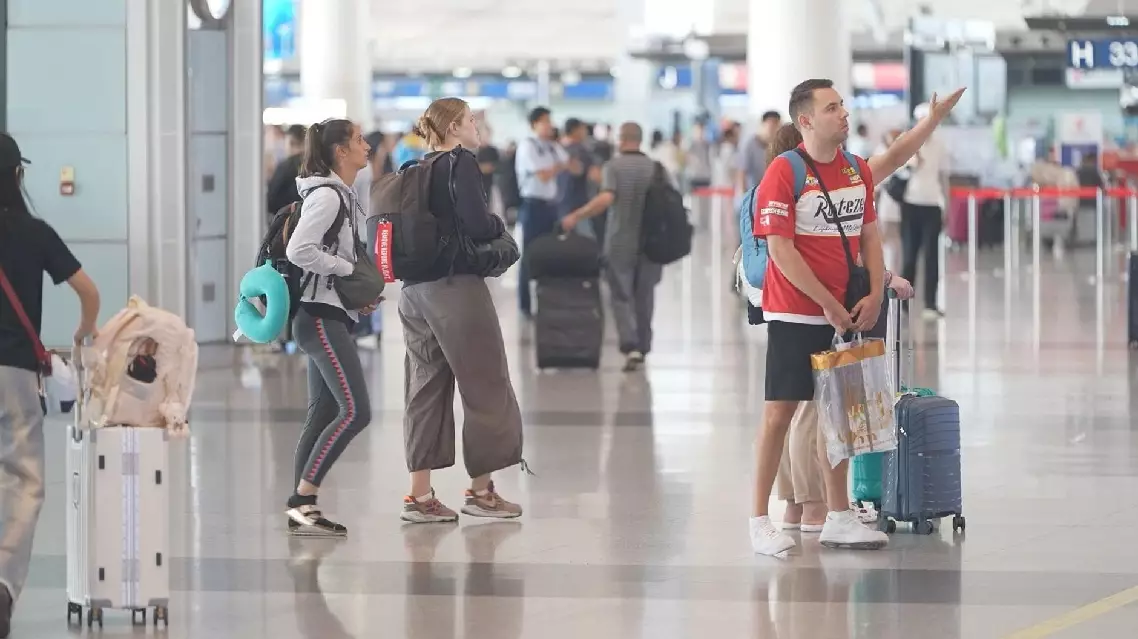
Inbound travel to China has kept growing since the start of this year, as the country's adoption of travel facilitation measures, including expanded visa-free access, has made border entry easier for international visitors.
Foreign nationals made nearly 61.29 million border crossings in the January-August period, up 19.5 percent from a year earlier, according to the latest official data released Thursday. Visa-free entries accounted for 23.72 million of the total, or 77.6 percent, up 26.8 percent from a year earlier.
In Beijing, various ports in Beijing have seen an average of 15,000 border entries by foreigners each day since the start of September, up 20 percent from August's daily average. Notably, the figure topped 17,000 on Sept 7, setting a new single-day record for the year.
During the three-day Mid-Autumn Festival which starts on Friday and the week-long National Day holiday season starting on Oct 1, the number of border entries and exits through Beijing's airports is projected to reach 727,000. The Beijing Capital International Airport is expected to handle 547,000 entries and exits, or 54,700 per day on the average, while the Beijing Daxing International Airport is expected to handle 180,000, or 18,000 per day on the average.
To ensure smooth customs clearance, the Beijing General Border Inspection Station will open additional inspection lanes during peak periods to reduce travelers' waiting time. It will also maintain permanent multilingual advisory and guidance stations staffed by on-site officers, thereby improving passenger clearance efficiency.
East China's Shandong Province, one of the Chinese provinces closest to South Korea, is expected to see more than 190,000 border entries and exits by travelers, averaging over 8,000 per day, according to the Shandong General Border Inspection Station. Notably, the Weihai Shidao Port is expected to receive more than 3,000 tourist arrivals from South Korea, a marked increase in inbound group travel compared with previous years.
"I'm very interested in Chinese traditions, so I've chosen to visit Rongcheng in Weihai during the Mid-Autumn Festival to experience the holiday here firsthand," said Kim Kyung-nam, a tourist from South Korea.
In response to the overlapping passenger flows and the concentrated arrival of large tour groups during the Mid-Autumn Festival holiday, the Shidao Border Inspection Station has worked out a specific duty plan including strategic deployment of personnel and the opening of all inspection lanes to minimize clearance times and maximize operational efficiency.
"We have set up border inspection and cultural tourism facilitation service posts, where on-duty officers will provide bilingual service for consultation and process entry formalities for tour groups, balancing efficient customs clearance with a human touch," said Li Nannan, head of a frontier inspection team at the Shidao Border Inspection Station.
East China's Jiangsu Province, with its rich cultural heritage and diverse cultural and tourism resources, attracts tourists from around the world. The Jiangsu General Border Inspection Station predicts that the ports across the province will process 110,000 border entries and exits and handle over 750 inbound and outbound flights and vessel voyages during the two holiday seasons. For outbound travel, Singapore, Thailand and other countries have emerged as popular destinations for mainland residents departing from Jiangsu's ports.
Tourist cities in south China's Guangxi Zhuang Autonomous Region are top choices for Vietnamese tourists. Thanks to its advantageous geographic location, efficient customs clearance services, and abundant border tourism resources, cross-border tourism between Guangxi and Vietnam is steadily gaining popularity.
According to the Guangxi General Border Inspection Station, the total number of border entries and exits through the four key ports -- Nanning, Guilin, Youyiguan, and Dongxing -- is expected to exceed 355,800 during this year's Mid-Autumn Festival and National Day holiday season.
The Mid-Autumn Festival, a traditional Chinese holiday, is celebrated on the 15th day of the eighth month of the Chinese lunar calendar. This year, the festival falls on Friday, and the public holiday lasts three days through Sunday.
China's National Day holiday lasts from Oct 1 to 7 this year.
Inbound travel to China continues to surge as visitors seek diverse experiences